SLIDE 1
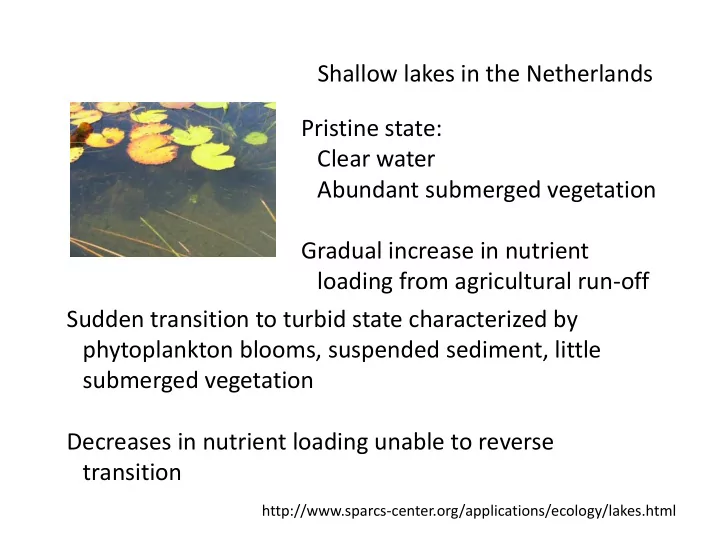
Shallow lakes in the Netherlands Pristine state: Clear water Abundant submerged vegetation G d l i i i Gradual increase in nutrient loading from agricultural run‐off S dd t iti t t bid t t h t i d b Sudden transition to turbid state characterized by phytoplankton blooms, suspended sediment, little submerged vegetation submerged vegetation Decreases in nutrient loading unable to reverse
http://www.sparcs‐center.org/applications/ecology/lakes.html
g transition
SLIDE 2 A possible explanation: Alternative stable states Alternative stable states Submerged vegetation promoted water clarity by: water clarity by:
- reducing nutrients in water
column
- providing habitat refuges for
grazing zooplankton
resuspension
http://www.sparcs‐center.org/applications/ecology/lakes.html
SLIDE 3 A possible explanation: Alternative stable states Alternative stable states Turbid state:
- Lack of penetrating sunlight
Lack of penetrating sunlight prevents re‐establishment of submerged vegetation g g
- Eutrophication, reduction in
zooplankton densities lead to h l k bl phytoplankton blooms
- Benthic feeders (fish) stir up
sediment sediment
http://www.sparcs‐center.org/applications/ecology/lakes.html
SLIDE 4
from Scheffer & Carpenter, TREE 2003
SLIDE 5
from Scheffer et al, Nature 2001
SLIDE 6 Alternative stable states
environment cause sudden, unexpected changes in ecosystems (“tipping points”)
- Changes are not easily reversed
(hysteresis) (hysteresis)
http://www.sparcs‐center.org/applications/ecology/lakes.html
SLIDE 7 Alternative stable states
- Lakes in the Netherlands: Water
clarity restored by reducing nutrient inputs and removing fish that were feeding in the benthos and on zooplankton and on zooplankton.
- Other purported examples:
Other purported examples:
- Woodlands vs grasslands in
terrestrial ecosystems
- Desertification
- Coral vs algal dominanted
t t i l f
http://www.sparcs‐center.org/applications/ecology/lakes.html
states in coral reefs
SLIDE 8
Coral (C) Macroalgae (M) Turf (T) Photo credits P. Edmunds
SLIDE 9
sea urchins, Diadema antillarum (massive die‐off in 1983) parrotfishes p grazing grazing Photo credits M. Chiappone, Wikipedia Macroalgae (M) Turf (T)