Sex and Gender in Biological Weapons-related Research Nancy - - PowerPoint PPT Presentation
Sex and Gender in Biological Weapons-related Research Nancy Connell, PhD Senior Scholar and Professor Johns Hopkins Center for Health Security Some definitions Sex differences in medical research Misconceptions about sex in research
2
- Some definitions
- Sex differences in medical research
- Misconceptions about sex in research
- Sex and the immune response
- Sex and vaccines
- Sex and susceptibility to infectious disease
- What next?
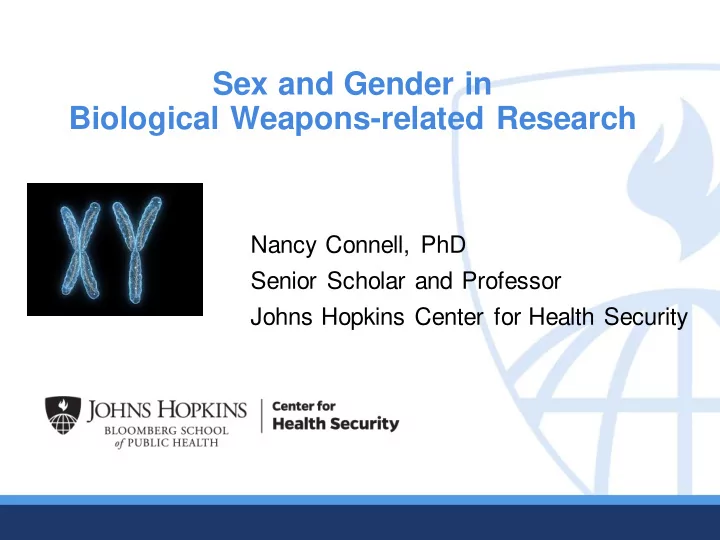
“Sex” is a biological variable referring to differences defined by sex chromosomes (XX, XY) and the presence of functional reproductive
- rgans.
“Gender” is a cultural construct referring to behaviors thought to be specified by psychosocial expectations that accrue on the basis
- f perceived or assigned sex.
As our understanding develops regarding epigenetic modification
- f the genome by the environment, age, and hormonal status, it is
evident that sex and gender are a composite.
3
Miller et al., Biology of Sex Differences 2016, 7(Suppl 1):44
Some definitions…
History of recognition of the role of sex in medical research
4
- 1977 - FDA excludes women of child-bearing age from drug trials
- 1980s – concern arise that clinical research (NIH) on conditions that affect both men and
women were being carried out only on white males but results were being applied to all men and women of all races.
- 1990s – Congresswomen, FDA and NIH return women to clinical trials (but still no
disaggregation)
- 2002- GAO determines that 8 of 10 drugs taken off the market (1997-2000) had adverse
effects on women
- 2010 -the Canadian Institutes of Health required the discussion of the inclusion of sex or
gender in both non-human animals and humans in grant applications
- 2015 – GAO determined still no differentiation
- 2016 – NIH finally links changes to funding
- 2020 - European Union Strategic Vision for Gender
Sex in medical research
- “Women do not benefit from medical research as
much as men do. This problem stems both from research design (which scientists largely control), and from scientific reporting in journals (which editors can influence)”.
5 Leopold et al., Clin Orthop Relat Res (2014) 472:391
Misconceptions about sex of animals* in research
- No real difference between males and females
- Females more variable due to estrous cycle
- Unstaged female mice, rats, and hamsters (i.e., those
not monitored for estrous cycle stage) are no more variable than males in surveys of hundreds of physiological traits and behaviors.
- Disaggregation of sex does not apply to other living
- rganisms that can be classified by sex
6
*including humans
Neurosci Biobehav Rev 2014;40:1; Biol Sex Differ 2015;6:18; Biol Sex Differ 2016;7:3; Hypertension 2016;68: 1139.
7
8
“In the area of infectious diseases of poverty, the dearth of women scientists
- ften means a lack of diverse perspectives essential to addressing gender dimensions
and the burden of infectious diseases, which often disproportionately affect women”.
Sex and immune response
- In humans, it is evident that females have increased
resistance against microbial infections, which suggests that females have a more vigorous immune de- fence against most invading pathogens.
- Females also have higher antibody responses and more
adverse re- actions in response to a number of vaccines
- Estrogen acts as an immune activator while
testosterone acts as an immune suppressor
9 Schurz et al. Human Genomics (2019) 13:2
10
Klein and Flanagan 2016
Sex and vaccines
- Variation in vaccine-induced immunity points to the critical
impact of genetics, the environment, nutrition, the microbiome, and sex in influencing vaccine responsiveness.
- Specifically, females typically develop higher antibody
responses and experience more adverse events following vaccination than males.
- This enhanced immune reactogenicity among females is
thought to render females more resistant to infectious diseases.
- Dissection of mechanisms which underlie sex differences in
vaccine-induced immunity has implicated hormonal, genetic, and microbiota differences across males and females
11
Fischinger et al.,Seminars in Immunopathology (2019) 41:239–249
12
Fischinger et al.,Seminars in Immunopathology (2019) 41:239–249
13
Sex and diseases
Key components of the immune response are carried on the sex chromosomes
- The X chromosome is known to contain the largest number
- f immune-related genes of the whole human genome.
- X chromosome, X-linked genes and X chromosome
inactivation mechanisms contribute to the clear sex bias of many diseases, including infections.
15
Conclusions – how will these early studies be applied in the BWC context?
Susceptibility
- Males and females exhibit contrasting degrees of
susceptibility to infectious and non-infectious inflammatory diseases.
- This is particularly observed in respiratory diseases
where human males are more likely to be affected by infection-induced acute inflammations compared to females.
16
Conclusions – how will these early studies be applied in the BWC context?
Vaccines:
- Sex profoundly affects the immune response and can therefor affect
- utcomes of vaccination.
- Few studies stratify data in terms of sex.
- Currently, most vaccines are tailored based on a male-dominated
participant pool and the same set of vaccines is administered to everyone.
- The effects of sex and pregnancy should be considered in all guidelines
and recommendations for vaccines and represent an opportunity for researchers and public health officials to better understand and explain individual variability in vaccine efficacy.
- Sex-specific vaccine strategies may provide enhanced protection for
females.
17
“Every cell is sexed…
18
1Institute of Gender and Health, Canadian Institutes of Health Research
…and every person is gendered.1”
quora.com mfoundation.org