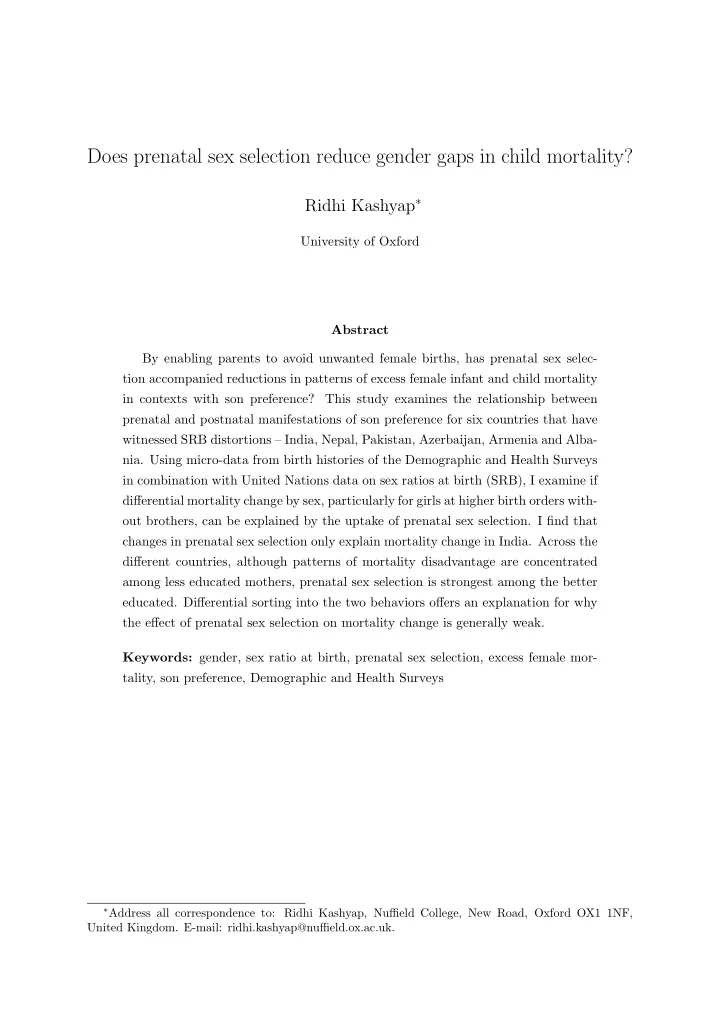
SLIDE 1 Does prenatal sex selection reduce gender gaps in child mortality?
Ridhi Kashyap∗
University of Oxford Abstract By enabling parents to avoid unwanted female births, has prenatal sex selec- tion accompanied reductions in patterns of excess female infant and child mortality in contexts with son preference? This study examines the relationship between prenatal and postnatal manifestations of son preference for six countries that have witnessed SRB distortions – India, Nepal, Pakistan, Azerbaijan, Armenia and Alba-
- nia. Using micro-data from birth histories of the Demographic and Health Surveys
in combination with United Nations data on sex ratios at birth (SRB), I examine if differential mortality change by sex, particularly for girls at higher birth orders with-
- ut brothers, can be explained by the uptake of prenatal sex selection. I find that
changes in prenatal sex selection only explain mortality change in India. Across the different countries, although patterns of mortality disadvantage are concentrated among less educated mothers, prenatal sex selection is strongest among the better
- educated. Differential sorting into the two behaviors offers an explanation for why
the effect of prenatal sex selection on mortality change is generally weak. Keywords: gender, sex ratio at birth, prenatal sex selection, excess female mor- tality, son preference, Demographic and Health Surveys
∗Address all correspondence to: Ridhi Kashyap, Nuffield College, New Road, Oxford OX1 1NF,
United Kingdom. E-mail: ridhi.kashyap@nuffield.ox.ac.uk.
SLIDE 2
1 Introduction
An extensive literature has documented the rise and spread of prenatal sex selection, as indicated by sex ratio1 at birth (SRB) distortions, across Asia, the Caucasus and parts of the Balkans (Guilmoto, 2015). Described as one of the “most notable anomalies in contemporary demography,” the growing population sex imbalance at birth is a modern manifestation of a long-standing norm guiding fertility behaviour – that of a preference for male offspring (‘son preference’) (Guilmoto, 2009, p. 519). Parental son preference can manifest itself in both prenatal or postnatal forms. The adoption of prenatal strategies for sex selection requires three preconditions: 1) parents must find it necessary to bear a son; 2) parents must have access to prenatal sex testing technology and access to abortion; 3) parents must find it necessary to keep their family size small (Guilmoto, 2009). Prior to the availability of sex detection technology, postnatal manifestations of son preference in the form of excess female mortality in infancy and childhood had been widely documented in the demographic literature, particularly for South Asia. More recent, global analyses have found that excess female mortality in infancy and childhood remain prevalent, most prominently in South Asia, the Middle East and parts of Africa (Alkema et al., 2014; Sawyer, 2012). The notion of excess implies that girls experience higher than biologically expected mortality on account of both direct or indirect forms of gender discrimination, which, as prominently described by Amartya Sen, results in them being ‘missing’ from population structures (Sen, 1990). Excess mortality for girls may result directly from infanticide or from the unequal allocation of healthcare and nutrition to girls within families (Jayachandran and Kuziemko, 2011; Borooah, 2004; Li et al., 2004; Arnold et al., 1998; Kishor, 1993; Muhuri and Preston, 1991; Gupta, 1987; Miller, 1987). Excess mortality may also indirectly emerge from the fertility effects of son preference. Sex-differential stopping behaviour practiced by parents desiring a boy cause girls to be born into larger families compared to boys (Basu and De Jong, 2010; Clark, 2000). In this indirect mechanism, within-family differences might not be apparent between girls and boys but instead aggregate-level gender gaps are likely to emerge if net resources per child are fewer in larger families than smaller ones (Jain, 2014; Carvalho et al., 2013; Rosenblum, 2013; Choe and Kim, 1998). If an important factor underlying postnatal excess mortality is child unwanted- ness, the increasing adoption of sex-selective abortion may plausibly imply better survival chances for those girls who are born as they are more likely to be wanted (Goodkind, 1996). An emerging literature has empirically tested what Goodkind called the substitution hypothesis. This literature has adopted different approaches and shown mixed results. In their global, macro-level analysis using population estimates from the United Nations, Bongaarts and Guilmoto (2015) found that the contribution of prena- tal discrimination to newly missing women in the world had increased since the
1
SLIDE 3 1980s, while the contribution of postnatal discrimination had shown small declines since the 1990s. Although at the global level excess female deaths have decreased, Kashyap (2017) found that patterns of change in excess female mortality in coun- tries that saw the onset of prenatal sex selection varied across countries and by
- period. Notably, in India and China, relative excess female mortality was remark-
ably persistent even as SRB distortions set in, increased and began to stabilise. In the 2000s, India, Nepal and Pakistan showed slight reductions in excess female mortality, even though levels of excess female mortality continued to remained high in these countries. These macro-demographic analyses highlight the relative contributions of prena- tal and postnatal manifestations of son preference to overall changes in the numbers
- f missing women Bongaarts and Guilmoto (2015) or child sex ratio distortions
Kashyap (2017). The methods used in this studies, however, do not permit an assessment of whether changes in prenatal sex selection explain variation in mor- tality changes. Reductions in excess female mortality could occur independently
- f changes in prenatal sex selection, through wider modernisation processes that
entail the weakening of son preference. In contrast, country-specific studies using micro-level data from birth records have sought to identify the impact of sex-selective abortion, either via liberalised abortion or access to ultrasound, on excess female female child mortality. Drawing
- n birth registration data in Taiwan, Lin et al. (2014) found evidence in favour of
substitution, where abortion legalisation in 1985 in a country where ultrasound was already available, led to faster improvements in female neonatal survival relative to males for higher parity births. For India, evidence has been mixed. Hu and Schlosser (2015) found that birth cohorts experiencing prenatal sex selection as in- dicated by distorted SRBs witnessed faster reductions in malnutrition rates for girls relative to boys, but found no statistically significant evidence for faster reductions in mortality for girls. In contrast Anukriti et al. (2016), found evidence for faster reductions in mortality for a subset of girls. In the period when ultrasound became widely available, the authors found the mortality gap between second- and higher-
- rder girls with first-born brothers compared with those with first-born sisters was
eliminated. This paper contributes to this literature tackling the relationship between pre- natal sex selection and postnatal excess female child mortality by expanding the analyses across different countries where SRB distortions have emerged. These in- clude contexts in South Asia (India, Nepal and Pakistan) as well as those in the Caucasus (Armenia, Azerbaijan, and Albania). Drawing on micro-level birth his- tories from the Demographic and Health Surveys (DHS), I first examine mortality
- utcomes by child gender across these different countries. Then, using the DHS
data in combination with UN data data on SRBs, I examine if girls made faster reductions in mortality for the cohorts that experienced the uptake of prenatal sex
2
SLIDE 4 selection, and if changes in prenatal sex selection explained changes in mortality patterns. My results suggest that, although excess mortality patterns generally weakened, the effect of prenatal sex selection in explaining these changes was weak. To understand why this is, I analyse variations in prenatal and postnatal manifes- tations by maternal education across these different countries.
2 Hypotheses
For prenatal sex selection to cause changes in mortality, patterns of disadvantage in female mortality should exist in the populations that experience the uptake of pre- natal sex selection. The populations, however, may not necessarily overlap. Within countries, if excess female mortality levels are generally concentrated amongst dis- advantaged households, whereas those practicing prenatal sex selection are those that are better off, changes in prenatal sex selection would not be the mechanism causing mortality change due to differential sorting into the two behaviours. Ex- isting literature has highlighted how SRB distortions, at least when SRBs have first become distorted in South Korea and India, have been concentrated amongst tertiary-educated mothers with better access to ultrasound and low fertility norms (Jha et al., 2011; Park and Cho, 1995). The pattern of disadvantage in under-five mortality in South Asia has been shown to follow the opposite pattern with the least educated mothers showing the most distorted sex ratios of mortality (Monden and Smits, 2013). If differential sorting into the two behaviours is occurring, there will be no ef- fect of prenatal sex selection on postnatal mortality change. At the aggregate level, however, mortality change could nevertheless occur. If girls are increasingly born into disadvantaged households in which son preference is strong and girls are less likely to be born into better-off households, excess female mortality may poten- tially worsen due to the negative selection of female births into these households. Conversely, if son preference is weakening faster among groups that do not practice prenatal sex selection either due to lack of ability or willingness to practice prenatal sex selection, excess mortality may decline due to changes in son preference norms and not the uptake of prenatal sex selection. If son preference remains relatively stable and widespread across different groups, as ultrasound technology and low fertility norms diffuse more widely over time, the impact of prenatal sex selection on mortality change may be greater. In countries
- f South Asia, where the mortality manifestations of son preference are significant
and suggest the presence of strong and stable son preference, the wider diffusion
- f ultrasound or the desire to reduce overall fertility facilitated by modernisation
processes may be faster than reductions in son preference. Here, it is plausible that as ultrasound diffuses beyond the initial pioneer groups of the better educated and becomes more widely available to less educated mothers where patterns of disad-
3
SLIDE 5 Table 1: Descriptive statistics on birth years, births and deaths (0 – 11 months) by Demographic and Health Survey country samples.
Country Birth Years Males Females Male/Female Births Deaths (%) Births Deaths (%) Mortality Ratio Armenia 1970-2010 15271 659 13766 494 1.22 (4.3) (3.6) (1.08, 1.38) Azerbaijan 1973-2006 6922 458 6191 371 1.12 (6.6) (6.0) (0.98, 1.28) Albania 1976-2009 6305 234 5904 163 1.35 (3.7) (2.8) (1.11, 1.65) India 1970-2006 387124 31959 357986 27932 1.07 (8.3) (7.8) (1.05, 1.08) Pakistan 1970-2013 55821 4739 52099 4005 1.11 (8.5) (7.7) (1.07, 1.16) Nepal 1970-2011 54062 5445 51633 4592 1.11 (10.1) (8.9) (1.06, 1.15)
†Male/Female mortality ratio with 95 % confidence intervals in parentheses refer to male-to-female relative risks estimated from Cox Proportional Hazards models controlling for child’s birth year and birth year squared.
vantage in female mortality are concentrated, the uptake of prenatal sex selection would contribute to reductions in female mortality disadvantage.
3 Data
This paper uses data on mortality outcomes from birth histories from the DHS for six countries that have witnessed SRB distortions – India, Nepal, Pakistan, Albania, Azerbaijan and Armenia.2 The surveys are nationally representative cross-sections
- f women aged 15-49. Different survey waves are available for each country. For
India, three survey waves (1992-93, 1998-99, 2005-06) are available. For Nepal four waves (1996, 2001, 2011), Pakistan three waves (1999-91, 2006-07, 2012-13), Alba- nia one wave (2008-09), Armenia three waves (2000, 2005, 2010), and Azerbaijan
- ne wave (2006) are available.
In the birth recode of the DHS for each country, the respondents report on all births they have had. Due to the different ages of the mothers in the survey samples, the birth histories span a number of years. In addition to the children’s characteristics, information on the parents’ characteristics, such as maternal age, maternal education and paternal education are also available in the survey. As mothers report on all births, information on sibling composition of the family can also be deduced from the birth histories. I generate a dataset that pools birth histories across different surveys waves for the six countries totalling a sample of 1,013,084 births that span the period from the 1970s to the mid- to late-2000s for each country (see Table 1 and 2 for information on the coverage of birth years by
4
SLIDE 6 Table 2: Descriptive statistics on birth years, births and child (12 – 59 months) deaths by Demographic and Health Survey country samples.
Country Birth Years Males Females Male/Female Births Deaths (%) Births Deaths (%) Mortality Ratio Armenia 1970-2010 15271 101 13766 59 1.59 (0.7) (0.4) (1.15, 2.19) Azerbaijan 1973-2006 6922 83 6191 58 1.31 (1.2) (0.9) (0.93, 1.84) Albania 1976-2009 6305 30 5904 20 1.05 (0.5) (0.3) (0.63, 1.77) India 1970-2006 387124 9427 357986 11678 0.75 (2.4) (3.3) (0.73, 0.77) Pakistan 1970-2013 55821 874 52099 976 0.82 (1.6) (1.9) (0.77, 0.93) Nepal 1970-2011 54062 1813 51633 2121 0.84 (3.4) (4.1) (0.77, 0.93)
†Male/Female mortality ratio with 95 % confidence intervals in parentheses refer to male-to-female relative risks estimated from Cox Proportional Hazards models controlling for child’s birth year and birth year squared.
country). For each birth, information on the date of birth, date of death if the child died, and child’s sex are available. Table 1 provides information on births and infant (0 – 11 months) deaths by sex for each country. Table 2 provides descriptive statistics on child (12 – 59 months) deaths by sex for each country in the dataset. The data do not allow us to observe which families practiced prenatal sex selec-
- tion. Instead, to capture changing levels of prenatal sex selection over time within
these countries I use data on the SRB across birth years as a proxy for the man- ifestation of the behaviour. This is similar to the approach adopted by Hu and Schlosser (2015) who used variation in the male-to-female child sex ratio by years across Indian states to capture changes in prenatal sex selection. The child sex ratio is a measure of both prenatal and postnatal manifestations of son preference. Hu and Schlosser (2015) merged interpolated data on the child sex ratio from the 2001 and 2011 Indian Censuses with the Indian DHS birth histories due to limited data on state-level variations in the SRB over time. They additionally smoothed SRBs computed from within the pooled Indian DHS birth histories by taking a seven-year moving average. As the study by Hu and Schlosser (2015) illustrates, the SRB can theoretically be aggregated from the DHS birth histories directly. The Indian DHS however is significantly larger than the other countries in the sample. Due to variations in birth numbers by year within surveys for each country, the SRB generated from within the DHS birth histories fluctuates significantly. Consequently, I merge in- formation on the SRB by country and birth year from the United Nations World Population Prospects (UN WPP) 2015 (United Nations, 2015a) for five of the six
5
SLIDE 7 countries except Albania, as the UN estimates of the Albanian SRB significantly underestimate it. For Albania, I use data from the Albanian statistical office on the country’s SRB time-series.3 The UN WPP SRB time-series uses information
- n vital registration obtained from national statistical offices to generate SRB es-
- timates. When these are deficient or not available, information from censuses or
surveys such as the DHS are used, or combined with vital registration estimates, to generate SRB estimates for five-year periods (United Nations, 2015b). I interpolate between consecutive five-year periods to generate yearly SRB estimates from the UN time-series. The generated yearly SRB trajectories for each of the six countries are depicted in Fig. 1. I recode the SRB variable such that a biologically normal SRB under 106 is 0 with each additional, excess male birth coded as 1, 2, 3, and so
4 Statistical Approach
How does prenatal sex selection impact mortality risks for girls who are born? The statistical approach adopted here attempts to isolate the effect of prenatal sex se- lection, as proxied by changes in the SRB, on mortality risks for girls relative to boys whilst controlling for confounders that might impact mortality change differ- entially by sex of the child. In another set of models, I examine the impact of prenatal sex selection on girls of higher birth orders (three and higher) without an
- lder brother relative to girls of higher birth orders with at least one older brother –
a subset of girls that literature on South Asia has identified as especially vulnerable to mortality disadvantage (Pande, 2003; Muhuri and Preston, 1991). The outcome of interest is death of the child reported in the survey in either infant (0–11 months) or in childhood ages (12–59 months). The dataset includes different births born in different years, with differential exposures to the event
- f interest (death). The most recent births are right censored as they have not
been fully observed until the end of the observation window (survey date). The statistical model should account for this right censoring and event history structure
- f the data. I incorporate a regression approach within an event history framework
by using a proportional hazards (PH) model (Cox, 1972). To estimate the impact
- f prenatal sex selection on girls mortality relative to boys, I estimate the following
PH model on the pooled dataset of the six countries: h(t, xibc) = hc
0(t) exp(femaleiβ1 + SRBbβ2 + (femalei × SRBb)β12
+(femalei × birthyearb)β13 + x′
ibδ)
(1) where h(t, xibc) refers to the hazard of death in the first year of life (infant mortality) or between ages 1 and 5 (child mortality) for a child i, born in year b, and in country c, x′
ib is a vector of controls including parental characteristics such
as maternal and paternal education, maternal age, maternal age squared, and child
6
SLIDE 8 1960 1970 1980 1990 2000 2010 104 108 112 116
Albania
year sex ratio at birth 1960 1970 1980 1990 2000 2010 104 108 112 116
Azerbaijan
year sex ratio at birth 1960 1970 1980 1990 2000 2010 104 108 112 116
Armenia
year sex ratio at birth 1960 1970 1980 1990 2000 2010 104 108 112 116
India
year sex ratio at birth 1960 1970 1980 1990 2000 2010 104 108 112 116
Nepal
year sex ratio at birth 1960 1970 1980 1990 2000 2010 104 108 112 116
Pakistan
year sex ratio at birth
Figure 1: Sex ratio at birth (SRB) by birth years for countries in the analysis. Data from UN WPP (2015). 7
SLIDE 9 characteristics including birth order, birth year, and birth year squared. Due to variations in the birth years covered in each country sample, I centre the birth year variable with a mean of 0 and standard deviation of 1. hc
0(t) refers to a stratified
baseline hazard for each country in the analysis, which is equivalent to including a country fixed-effect that controls for time-invariant country-specific factors such as variations in levels of overall mortality, levels of development and strength of son preference across these six different countries. The effect of interest is β12 that captures the differential impact of SRB change by birth year on the mortality
- f boys versus girls. In terms of the relative risks framework of the proportional
hazards model, the model attempts to identify the effect of prenatal sex selection, as proxied by within-country variation in the SRB by birth years, on the risk of infant and child mortality for girls relative to boys. A main effect for the SRB (β2) is also included in the model. In addition, β13 captures other sex-specific trends in mortality change unrelated to changes in prenatal sex selection. This effect attempts to capture trends in mortality change that differentially affect boys versus girls as separate from changes in the SRB. The vector of controls includes variables that may independently influence fe- male mortality relative to male mortality. Maternal education has been associated with sex ratios of infant and child mortality (Monden and Smits, 2013). Moreover, children born in later birth years in the sample are more likely to have mothers with higher levels of education than those born in earlier years. Maternal education has been linked with improved outcomes for children (Desai and Alva, 1998), but has also been shown to be associated with weaker son preference norms that result in differential treatment of girls versus boys (Pande and Astone, 2007). Although the effects of paternal education have not separately been explored in the literature, paternal education may have a separate, independent effect on the weakening of son preference norms that result in differential outcomes for boys and girls. Paternal and maternal education jointly also measure family socio-economic status. Mater- nal age, maternal age squared and the child’s birth order are included as additional control variables in the model. Multiple births by the same mother are included in the dataset. To account for the correlation of observations within families, standard errors are clustered by mother. To identify the impact of prenatal sex selection on mortality change, the model in eq. (1) assumes that changes in the SRB within each country over time is unre- lated to unobserved factors that might differentially impact the outcomes of girls compared to boys. The vector of control variables attempts to account for these
- factors. Similarly to the line of reasoning presented in Hu and Schlosser (2015, p.
1245), I also include a main effect for the SRB in all models. The main effect of the SRB should act as an indicator of the effect of unobserved time-varying factors at the country-level that are correlated with the SRB. If the main SRB effect is statistically significant, this would suggest that the vector of controls might not be
8
SLIDE 10 adequately capturing factors that might have an independent impact on changing sex-differentials in mortality. This country stratified or country fixed-effects specification in eq. (1) estimates an average within-country effect of the increases in excess male births on improve- ments in the relative risk of female versus male mortality. There could of course be country-level heterogeneity in the effect of prenatal sex selection on mortality
- change. This effect might vary by the stage of the demographic transition a country
is in, which in turn is related to the strength of son preference in that setting and the extent of female disadvantage in mortality. I also estimate models separately for each country in the dataset to explore potential heterogeneity in this effect. In this case, the models are estimated for the country dataset without the stratified baseline hazard (hc
0(t)).
5 Results
The descriptive statistics on births and infant deaths by sex presented in Table 1 and child deaths by sex are presented in Table 2. The south Asian countries of India, Nepal and Pakistan have higher levels of infant and child mortality compared to Azerbaijan, Armenia and Albania. Albania has the lowest infant and child mortality levels of the six countries analysed here. Sex ratios of infant mortality are generally higher in all countries than sex ratios of child mortality, with sex ratios of infant mortality lower in South Asia and Azerbaijan compared with Albania and Armenia. Sex ratios of child mortality are particularly skewed in the direction of lower risks of death in childhood ages for boys relative to girls for south Asia. The larger sample sizes in the south Asian (India, Nepal and Pakistan) DHS samples along with with
- verall higher levels of mortality also allow for greater precision in estimating the
sex ratios of mortality for these countries compared to the samples from Albania, Azerbaijan and Armenia. Table 3 reports results from the country-fixed effects specification from eq. (1) estimated on the pooled sample of birth histories of the six countries. For both
- utcomes, infant and child mortality, the main effect of the SRB and the interaction
effect for female x SRB are small and are not statistically significant. Averaged across the six countries, these results suggests that changes in the SRB for birth cohorts within countries were not systematically associated with differential changes in female relative to male mortality. Could between country heterogeneity in the impact of SRBs on mortality change account for this? To investigate this, I estimated eq. 1 separately for each of the six countries without the country-level fixed effects. The estimates from country-level models for Albania, Azerbaijan, Armenia, Nepal and Pakistan followed the same patterns of the model reported in Table 3 with no statistically significant effect on the female x SRB interaction or on the SRB main effect (models not shown).
9
SLIDE 11 Table 3: Hazard ratios from proportional hazards model with country fixed effects with (1) infant (0 – 11 months) mortality and (2) child (12 – 59 months) mortality as outcome variables.
Infant Mortality Child Mortality female 0.934∗∗∗ 1.281∗∗∗ (0.0121) (0.0304) SRB 0.992 1.007 (0.00593) (0.0128) female × SRB 0.993 1.012 (0.00679) (0.0139) birth year 0.982∗∗∗ 0.956∗∗∗ (0.000960) (0.00190) female × birth year 1.002∗ 1.001 (0.00103) (0.00185) birth year squared 1.000 1.000∗∗∗ (0.0000355) (0.0000693)
Exponentiated coefficients; Standard errors in parentheses
∗ p < 0.05, ∗∗ p < 0.01, ∗∗∗ p < 0.001
†Models control for maternal age, maternal age squared, ma- ternal education, paternal education and birth order.
India, however, was an exception. Table 4 shows results from the PH model estimated on the Indian sample of births. For infant mortality, the SRB main effect is not statistically significant but the female x SRB interaction term is. The hazard ratio for the interaction term for infant mortality is 0.96, which indicates that each additional excess male birth in a given year beyond biologically normal levels of 106 was associated with a 4% reduction in the risk of infant death for girls. The effect size for the female x SRB interaction is similar for child mortality but is not statistically significant at the 5% level (p = 0.054).4 This result for India contrasts with the results of Hu and Schlosser (2015) who found that changes in state-year male-to-female child sex ratios were not statisti- cally significantly associated with a faster reduction in girls’ mortality relative to that of boys in India. The finding reported in Table 4 exploits variation in the SRB by birth year whereas Hu and Schlosser (2015) relied on variation in the child sex ratio by state and birth year. Additionally, Hu and Schlosser (2015) did not account for right censoring for recent births in their dataset as they estimate a lin- ear probability model instead of a hazard model. Changes in the child sex ratio are affected by both prenatal and postnatal mechanisms of sex selection. To capture the effects of prenatal sex selection solely, the SRB is a better measure. Never- theless, by relying on national, aggregate variations in SRB by year in a context where considerable heterogeneity in the onset and levels of SRB distortions exists between states, the estimates may mask the true effect of increases in prenatal sex
10
SLIDE 12 Table 4: Hazard ratios from proportional hazards model for the Indian sample with (1) infant (0 – 11 months) mortality and (2) child (12 – 59 months) mortality as outcome variables.
Infant Mortality Child Mortality female 1.008 1.478∗∗∗ (0.0275) (0.0656) SRB 0.996 0.958 (0.0139) (0.0248) female × SRB 0.961∗∗ 0.957 (0.0133) (0.0222) birth year 0.981∗∗∗ 0.965∗∗∗ (0.00243) (0.00459) female x birth year 1.007∗∗∗ 1.010∗∗ (0.00209) (0.00332) birth year squared 1.000 1.000 (0.0000691) (0.000138)
Exponentiated coefficients; Standard errors in parentheses
∗ p < 0.05, ∗∗ p < 0.01, ∗∗∗ p < 0.001
†Models control for maternal age, maternal age squared, ma- ternal education, paternal education, birth order and state fixed-effects.
selection on sex-differentials in mortality. It is plausible, for instance, that patterns
- f mortality change may be concentrated in regions of the country where SRBs may
not have increased. There is a strong regional patterning of son preference in India (Dyson and Moore, 1983). Distorted sex ratios of mortality have been concentrated in areas where subsequent SRB distortions have been noted (Guilmoto, 2009; Bhat and Zavier, 2003). To further investigate if patterns of change in female mortality relative to male mortality in birth cohorts experiencing prenatal sex selection occurred in son- preferring families, I examined mortality change for girls based on their sibling
- composition. The existing literature on South Asia has reported that higher birth
- rder girls, usually at birth orders three and higher, without an older brother fare
the worst in terms of survival (Pande, 2003; Muhuri and Preston, 1991). Table 5 reports estimates from a proportional hazards model estimated on the sample of female births at birth order three and higher in India. I examined the risks of infant and child mortality for girls without older brothers relative to those with at least one older brother comparing cohorts that experienced prenatal sex selection with those that did not (Girls without older brothers × SRB coefficient). These models show that girls without older brothers do significantly worse than those with at least one older brother. Their risks of infant mortality are 47% higher than those with at least one brother, and risks of child mortality are 14.8% higher. The hazard ratio of under 1 (0.966) for the interaction term involving girls without
11
SLIDE 13
- lder brothers × SRB indicates that the mortality gap between higher birth order
girls without older brothers and those with at least one older brother narrowed for cohorts that experienced prenatal sex selection. Although mortality patterns by sibling composition showed similar disadvantage for girls without older brothers in Nepal, Pakistan, Azerbaijan, Albania and Armenia (see discussion of these pat- terns later in the paper), the interaction of sibling composition with SRB was not statistically significant in these five countries.
Table 5: Hazard ratios from proportional hazards models estimated on sample of female births of birth orders three and higher in India with (1) infant (0 – 11 months) mortality and (2) child (12 – 59 months) mortality as outcome variables.
Infant Mortality Child Mortality Girls without older brothers 1.471∗∗∗ 1.148∗∗∗ (0.0438) (0.0480) SRB 0.975 0.909∗ (0.0255) (0.0353) Girls without older brothers × SRB 0.966∗ 0.973 (0.0144) (0.0228)
Exponentiated coefficients; Standard errors in parentheses
∗ p < 0.05, ∗∗ p < 0.01, ∗∗∗ p < 0.001
†Models control for birth year, birth year squared, maternal age, maternal age squared, maternal education, paternal education, birth order and state fixed- effects.
5.1 Differential Sorting
These results suggest that changing SRB trends indicative of prenatal sex selection were not systematically associated with changes in patterns of girls’ mortality, either relative to boys’ mortality or for the subset of girls without an older brother relative to those with an older brother, for five of the six countries analysed here with the exception of India. One plausible explanation for the lack of a statistically significant result may lie in limited statistical power of the small samples sizes of the survey data to capture trends in sex-differentials in mortality, particularly in the samples of Albania, Armenia and Azerbaijan where mortality levels are lower than in South Asia and sample sizes are smaller. However, another plausible explanation may lie in patterns of differential sorting into prenatal and postnatal sex selection. If those populations that practice pre- natal sex selection are separate from those where postnatal manifestations of son preference in the form of female mortality disadvantage are concentrated, patterns
- f mortality disadvantage may remain unchanged or be driven by other factors un-
related to the uptake prenatal sex selection. To examine the potential contribution
- f differential sorting into prenatal and postnatal mechanisms of sex selection, in
this section I study variations in the sex ratios at birth and of mortality based on
12
SLIDE 14 existing family composition and by maternal education. SRB estimates calculated from survey-based birth histories are highly sensitive the number of births recorded in the sample (Arnold et al., 2002). For example, an SRB of 110 calculated using survey data with a sample of 5000 births has a 95% confidence interval of 105 to
- 117. Even though the point estimate is higher than normal SRB levels, the confi-
dence interval does not allow for the rejection of the null hypothesis that the SRB is different from 105. In order to capture variations in the SRB more precisely, I focus on groups of women who are most likely to practice sex-selective abortion due to their family composition by examining births at higher birth order in those families without existing sons. Similarly, patterns of change in mortality may be masked when examining boys versus girls rather than specific subsets of girls who may be more at risk than others for excess mortality risks.
INDIA 1970−1984 1985−1994 1995−2005 20 40 60 80 100 120 140 160
Conditional sex ratio at birth Level of education
No education Primary Secondary Tertiary
Figure 2: Conditional sex ratio at birth (SRB) for second and higher-order births for mothers without a son by level of maternal education and birth years, India. Bars indicate 95% confidence intervals of the conditional SRB estimate.
- Fig. 2 shows the conditional SRB for second and higher order births for mothers
who did not have a son by maternal education and the child’s birth year for India. The large sample sizes of the Indian data enable disaggregation into three periods – 1970 – 1984, 1985 – 1994, and 1995-2005. The first period comprises birth years before the onset of prenatal sex selection in India due to the lack of ultrasound tech-
13
SLIDE 15
- nology. The second period, 1985–1994, comprises birth years when SRB distortions
were first noted and ultrasound is assumed to have become available. The third period starting the mid-1990s to the most recent birth years available in the survey corresponds to the period when SRBs gradually showed stabilisation, suggesting a wider diffusion of ultrasound in the population. The dotted horizontal line in figure notes a biologically normal SRB level of 105, corresponding to a probability of male birth of 0.512.
NEPAL 1970−1984 1985−1994 1995−2005 20 40 60 80 100 120 140
Conditional sex ratio at birth Level of education
Primary or less Secondary or more
Figure 3: Conditional sex ratio at birth (SRB) for second and higher-order births for mothers without a son by level of maternal education and birth years, Nepal. Bars indicate 95% confidence intervals of the conditional SRB estimate.
The same conditional SRB indicator is shown for the Nepalese data in Fig. 3. The conditional SRBs followed a common pattern in both South Asian countries. Probabilities of male births at higher birth orders were the highest for better- educated mothers, especially those with tertiary-education. In 1970-1984, SRBs were within biologically normal ranges for all mothers. SRB distortions emerged, first in India in the 1985-1994 period and later in Nepal, in the third, post-1995 period, which also corresponds with the general country-level SRB trajectories high- lighted in Fig. 1. In the early diffusion period in India (1985-1994) SRB distortions appeared among the tertiary- and secondary-educated and then by the second pe- riod, showed a gradual diffusion to primary-educated mothers as well, alongside increases among the tertiary- and the secondary-educated. This pattern suggests a
14
SLIDE 16
gradual diffusion of prenatal sex selection to a wider population as ultrasound access diffused and low fertility norms became more widespread intensifying the readiness to abort in the absence of a son. The most significant distortions were concentrated amongst tertiary-educated mothers who had conditional SRB values approaching 140 male births per 100 female births in families without a son, suggesting that these mothers were the ones were the most able and ready to abort. In Nepal, compared with mothers with primary-level or less education, tertiary- educated mothers showed higher probabilities of male births conditional on not already having a son that exceeded biologically normal levels. The group of tertiary- educated mothers in Nepal was considerably smaller than India and estimates for the tertiary-educated group are less precise. Due to smaller sample sizes in the Nepalese surveys, I present variations across two groups – mothers with primary education or less, and those with secondary education or more. Interestingly, the DHS birth histories for Pakistan did not indicate the same patterns of SRB dis- tortions at higher order births as indicated in the Indian and Nepalese data. This finding concurs with recent work by Zaidi and Morgan (2016) who also used three waves of the DHS for Pakistan. The authors did not find systematically elevated SRBs in the five-years preceding the survey across all three survey waves. Although SRB estimates from the survey data were slightly elevated in the five-year period preceding the 2007 survey, the null hypothesis that the SRB is within biologically normal levels could not be rejected. In Albania, Armenia and Azerbaijan, patterns in SRB distortion by maternal education were similar with tertiary-educated mothers showing the most distorted SRBs in the absence of a son. Due to smaller sample sizes of births in these countries compared with the South Asian ones, I pooled data for all three countries into two periods – 1970-1994, and the period post mid-1990s, when SRB distortions appeared at the aggregate national-level in these countries as shown in Fig. 1, to the most recently available birth years in the data. The educational distribution in these three countries has more highly educated mothers than those in South Asia. In the Armenian sample less than 2% of mothers have primary or lower level of education, and 24.5% have a tertiary degree. In Azerbaijan, less than 3% have primary or lower level of education and 8.6% have tertiary education. In contrast, mothers in the Albanian sample have on average lower levels of education with 58.2% of mothers with primary or lower level of education, and 7% with tertiary education. For the least-educated mothers, probabilities of male births conditional on not having a son did not change across the two periods and were within biologically normal levels. These findings suggest that prenatal sex selection over the period under consid- eration has been largely practiced by highly-educated mothers. This has previously been reported in the literature on India and South Korea, but is noted here also for Nepal, Albania, Armenia and Azerbaijan. Over time in India, a pattern of diffusion
15
SLIDE 17 Albania, Armenia, Azerbaijan 1970−1994 1995−2010 20 40 60 80 100 120 140 160 180
Conditional sex ratio at birth Level of education
Primary Secondary Tertiary
Figure 4: Conditional sex ratio at birth (SRB) for second and higher-order births for mothers without a son by level of maternal education and birth years, Albania, Azerbaijan and Armenia. Bars indicate 95% confidence intervals of the conditional SRB estimate. 16
SLIDE 18
- f prenatal sex selection to secondary- and primary-educated mothers also emerged
in the period after the mid-1990s.
Table 6: Relative risks of under-five mortality for higher birth order girls without brothers compared with higher birth order girls with at least one brother, 1970-1994 and 1995-mid 2000s.
1970–1994 1995–mid 2000s India 1.32∗∗∗ 1.17∗∗∗ (1.28, 1.36) (1.07, 1.27) Nepal 1.17∗∗∗ 1.06 (1.07, 1.28) (0.88, 1.29) Pakistan 1.43∗∗∗ 1.31∗∗ (1.26, 1.64) (1.14, 1.51) Albania, Armenia, Azerbaijan 1.15 0.98 (0.89, 1.48) (0.67, 1.84)
∗ p < 0.05, ∗∗ p < 0.01, ∗∗∗ p < 0.001
†Relative risks are estimated from proportional hazards model with controls for birth year, birth year squared, birth order, maternal age, maternal age squared and paternal education.
How do patterns of female disadvantage in mortality vary by country and among which groups are patterns of mortality disadvantage concentrated? To capture patterns of mortality disadvantage for girls, I examined risks of under-five mortality for higher birth order girls (three and higher) without an older brother relative to higher birth order girls with at least one older brother.5 These relative risks are estimated from four PH models, one each for India, Nepal, Pakistan, and a pooled model for Albania, Azerbaijan and Armenia, on a sample of higher order female
- births. In addition to the main effects of interest for sibling composition, period and
their interactions, the estimated model included controls for birth year, birth year squared, birth order, maternal age, maternal age squared, maternal and paternal
- education. To capture trends in mortality disadvantage broadly coinciding with
a pre- and post-SRB distortion period, I disaggregated births into two periods – 1970–1994 and the second corresponding to births from 1995 to the mid-2000s. These results are reported in Table 6. In all three South Asian countries in the first period, girls without brothers had a higher risk of under-five mortality than those with at least one older brother. In India, girls had a 32% higher risk than girls with brothers, in Pakistan this effect was 43%, and in Nepal this was 17%. In the second period after the mid-1990s, this disadvantage diminished for India to 17%, and interaction term for period x sibling composition is also statistically significant (p = 0.02). In Nepal, the disadvantage for higher birth order girls without brothers is not statistically significant in the period after the mid-1990s. The interaction term of sibling composition with period is also not statistically significant, however, indicating the null hypothesis that no change occurred across the two periods cannot be rejected. In Pakistan, the effect
17
SLIDE 19 Table 7: Relative risks of under-five mortality for for higher birth order girls without brothers compared with higher birth order girls with at least one brother by maternal education, 1970–1994.
Less than primary Primary Secondary Tertiary India 1.30∗∗∗ 1.32∗∗∗ 1.20∗∗∗ 1.04 (1.27, 1.35) (1.22, 1.41) (1.10, 1.33) (0.74, 1.45) Primary or less Secondary and more Nepal 1.15∗∗∗ 1.50 (1.07, 1.24) (0.86, 2.61) Pakistan 1.43∗∗∗ 1.14 (1.28, 1.61) (0.71, 1.78) Albania, Armenia 1.82∗ 1.00 and Azerbaijan (1.11, 3.03) (0.83, 1.21)
∗ p < 0.05, ∗∗ p < 0.01, ∗∗∗ p < 0.001
†Relative risks are estimated from proportional hazards model with controls for birth year, birth year squared, birth order, maternal age, maternal age squared and paternal education.
size of the disadvantage for girls without brothers appears to diminish after the mid- 1990s from 1.43 to 1.40, but the effect is not statistically significant. In Albania, Azerbaijan and Armenia, the effect for disadvantage for girls without brothers is not statistically significant in either period. To examine in which groups patterns of mortality disadvantage are concen- trated, I further disaggregated patterns of disadvantage for higher birth order girls without older brothers relative to those with at least one brother by maternal ed-
- ucation. Results are disaggregated across four categories of maternal education in
India due to larger sample sizes for each group. For the other countries, due to smaller sample sizes, results are reported across two categories of maternal educa- tion – those with primary or less and those with completed secondary or higher. Table 7 highlights under-five mortality risks for girls without an older brother com- pared to girls with at least one older brother born in the period broadly preceding SRB distortions in the countries, 1970–1994. In contrast to patterns of prenatal sex selection that were concentrated among the more educated, patterns of mortality disadvantage in the pre-SRB distortion period were concentrated amongst less ed- ucated mothers. In India over this period, excess mortality for girls without older brothers existed in all three educational groups except among tertiary-educated mothers, for whom the relative risk of girls without older brothers was not statisti- cally significantly higher than those with at least one older brother. Girls without an
- lder brother born to less than primary and primary educated mothers had around
30% excess risk of death compared to those with at least one brother. Similarly, in the other five countries, mothers with a secondary or higher-level of education did not indicate excess mortality risks for girls without a brother.
18
SLIDE 20 Table 8: Relative risks of under-five mortality for for higher birth order girls without brothers compared with higher birth order girls with at least one brother by maternal education, 1995–mid 2000s.
Less than primary Primary Secondary Tertiary India 1.20∗∗∗ 1.19 1.12 1.48 (1.09, 1.34) (0.94, 1.53) (0.86, 1.44) (0.47, 4.67) Primary or less Secondary and more Nepal 1.05 1.41 (0.86, 1.28) (0.51, 3.89) Pakistan 1.40∗∗∗ 1.27 (1.21, 1.63) (0.82, 2.28) Albania, Armenia 1.81∗ 1.06 and Azerbaijan (1.01, 3.25) (0.78, 1.45)
∗ p < 0.05, ∗∗ p < 0.01, ∗∗∗ p < 0.001
†Relative risks are estimated from proportional hazards model with controls for birth year, birth year squared, birth order, maternal age, maternal age squared and paternal education.
Across the different countries witnessing SRB distortions studied here, with the exception of India, these results suggest that the groups that experienced mortal- ity disadvantage for girls were different from those that experienced distorted sex ratios at birth indicative of prenatal sex selection. In Nepal, Albania, Azerbaijan and Armenia, SRB distortions were concentrated among highly educated mothers whereas mortality disadvantages for girls were concentrated amongst least educated
- mothers. In India, excess mortality was more widespread and evident even among
mothers with secondary-level education. SRB patterns shown in Fig. 2 showed a diffusion of prenatal sex selection across different social groups in the 1995-2005 period, including among those where patterns of excess mortality was evident in the period before SRB distortions emerged (see Table 7). Table 8 reports results on patterns of mortality by sibling compositions for girls born after the mid-1990s. Excess mortality for girls without brothers persisted amongst the least educated in India and Pakistan, but excess mortality risks for girls without an older brother were not statistically significant in the period after the mid-1990s in Nepal. The excess mortality for girls without an older brother amongst primary- and secondary-educated mother in the 1970–1994 period became weaker and lost statistical significance in the period after the mid-1990s indicating
- verall improvements in their survival. In India, excess mortality risks for girls
without an older brother were also no longer statistically significant in the period after the mid-1990s for primary and secondary-educated mothers. Excess mortality persisted in the group of less educated mothers in Albania, Azerbaijan and Armenia, although the effect size was imprecise as indicated by the wide confidence intervals due to the smaller death counts in these three countries.
19
SLIDE 21 6 Conclusion
This paper examined the relationship between prenatal sex selection and postnatal excess mortality by using data from the birth histories from the Demographic and Health Surveys of six countries – India, Nepal, Pakistan, Albania, Armenia and Azerbaijan to assess if changes in SRBs by birth years within countries explained changes in sex-differentials in mortality. In addition to studying sex-differentials in mortality across countries, these data permitted an analysis of patterns of female mortality disadvantage by sibling composition, such as the excess risks faced by girls with or without brothers. In India, increases in prenatal sex selection as proxied by increases in the SRB were associated with faster reductions in girls infant mor- tality relative to boys. In particular, girls without an older brother at higher birth
- rders witnessed faster improvements in their survival chances. In other countries,
prenatal sex selection was not associated with sex-differential mortality change. I then examined potential reasons for the lack of a relationship between prenatal and postnatal mechanisms and explored the role of differential sorting into prenatal and postnatal mechanisms of sex selection. These data revealed that prenatal sex selection across these different countries was largely practiced by highly-educated mothers, whereas patterns of mortality disadvantage existed among the less edu- cated. Overall, levels of excess female mortality in the Albania, Armenia and Azerbai- jan were lower than those in South Asia and this was also evident in patterns of mortality disadvantage by sibling composition in each of these countries. Mortality disadvantage for higher birth order girls without an older brother was significant in India, but also in Pakistan and Nepal. Why then was the effect of prenatal sex selection different in India compared with its neighbours, Nepal and Pakistan? The evidence for prenatal sex selection in Pakistan based on the DHS birth histories was
- weak. Although UN estimates report slightly elevated SRB levels of 107, uptake
- f prenatal sex selection was likely relatively low in Pakistan. In Nepal, on the
- ther hand, evidence for prenatal sex selection was clearer. Nevertheless, prenatal
sex selection was confined to the most-educated mothers and does not appear to have diffused to other groups to the extent that it has in India. Patterns of female mortality disadvantage were also weaker in Nepal compared with India. In India, even girls born to secondary-educated mothers without an existing son had higher risks of death than those with a son in the period preceding the mid-1990s. In con- trast, patterns of mortality disadvantage were confined to less educated mothers. In terms of the intensity of son preference, India is likely to have the strongest lev- els of all countries analysed here. Perhaps the closest analogue to the Indian case, where similar patterns of change between prenatal and postnatal mechanisms may be expected is in China. DHS data for China are unfortunately not available and similar analyses in the future should seek to investigate the relationship between prenatal and postnatal mechanisms in the country with other data sources.
20
SLIDE 22 This analysis itself cannot reveal why less educated mothers did not witness SRB
- distortions. If it is driven by a limited availability of ultrasound, then it is plausible
that increasing access to ultrasound amongst those without access to it may result in reductions in female mortality disadvantage as results from India suggest. However, the limited uptake of prenatal sex selection among this group may reflect lower levels
- f readiness due to the acceptance of larger family norms as the alternative path
to achieving son preference. In this case, excess mortality is likely to come about as a consequence of these higher fertility behaviours. The erosion of son preference norms that accompany the fertility transition in the population is likely to drive changes in excess mortality instead of the substitution of postnatal excess mortality by prenatal sex selection.
References
Alkema, L., F. Chao, D. You, J. Pedersen, and C. C. Sawyer (2014). National, regional, and global sex ratios of infant, child, and under-5 mortality and iden- tification of countries with outlying ratios: a systematic assessment. The Lancet Global Health 2(9), e521–e530. Anukriti, S., S. R. Bhalotra, and H. Tam (2016). On the quantity and quality of girls: New evidence on abortion, fertility, and parental investments. Institute for the Study of Labor (IZA) Discussion Paper No. 10271. Arnold, F., M. K. Choe, and T. K. Roy (1998). Son preference, the family-building process and child mortality in India. Population Studies 52(3), 301–315. Arnold, F., S. Kishor, and T. K. Roy (2002). Sex-selective abortions in India. Population and Development Review 28(4), 759–785. Basu, D. and R. De Jong (2010). Son targeting fertility behavior: Some conse- quences and determinants. Demography 47(2), 521–536. Bhat, P. M. and A. F. Zavier (2003). Fertility decline and gender bias in northern
- India. Demography 40(4), 637–657.
Bongaarts, J. and C. Z. Guilmoto (2015). How many more missing women? Ex- cess female mortality and prenatal sex selection, 1970–2050. Population and Development Review 41(2), 241–269. Borooah, V. K. (2004). Gender bias among children in India in their diet and immunisation against disease. Social Science & Medicine 58(9), 1719–1731. Carvalho, L. S., S. H. Barcellos, and A. Lleras-Muney (2013). Child gender and parental investments in India: Are boys and girls treated differently? American Economic Journal: Applied Economics.
21
SLIDE 23 Choe, M. K. and S.-K. Kim (1998). Son preference and family building during fertility transition implications on child survival. Korean Journal of Population Studies 21(1), 184–228. Clark, S. (2000). Son preference and sex composition of children: Evidence from
- India. Demography 37(1), 95–108.
Cox, D. (1972). Regression models and life-tables. Journal of the Royal Statistical
- Society. Series B (Methodological) 34(2), 187–220.
Desai, S. and S. Alva (1998). Maternal education and child health: Is there a strong causal relationship? Demography 35(1), 71–81. Dyson, T. and M. Moore (1983). On kinship structure, female autonomy, and demographic behavior in India. Population and Development Review, 35–60. Goodkind, D. (1996). On substituting sex preference strategies in East Asia: Does prenatal sex selection reduce postnatal discrimination? Population and Devel-
- pment Review 22(1), 111–125.
Guilmoto, C. Z. (2009). The sex ratio transition in Asia. Population and Develop- ment Review 35(3), 519–549. Guilmoto, C. Z. (2015). The masculinization of births: Overview and current
- knowledge. Population 70(2), 201–264.
Gupta, M. D. (1987). Selective discrimination against female children in rural Punjab, India. Population and Development Review, 77–100. Hu, L. and A. Schlosser (2015). Prenatal sex selection and girls’ well-being: Evi- dence from India. The Economic Journal 125(587), 1227–1261. Jain, T. (2014). Where there is a will: Fertility behavior and sex bias in large
- families. Journal of Human Resources 49(2), 393–423.
Jayachandran, S. and I. Kuziemko (2011). Why do mothers breastfeed girls less than boys? Evidence and implications for child health in India. The Quarterly Journal of Economics 126(3), 1485–1538. Jha, P., M. A. Kesler, R. Kumar, F. Ram, U. Ram, L. Aleksandrowicz, D. G. Bassani, S. Chandra, and J. K. Banthia (2011). Trends in selective abortions of girls in India: analysis of nationally representative birth histories from 1990 to 2005 and census data from 1991 to 2011. The Lancet 377(9781), 1921–1928. Kashyap, R. (2017). Does prenatal sex selection substitute excess female child mortality? Population Studies, forthcoming.
22
SLIDE 24 Kishor, S. (1993). “may god give sons to all”: Gender and child mortality in india. American Sociological Review, 247–265. Li, S., C. Zhu, and M. W. Feldman (2004). Gender differences in child survival in contemporary rural China: a county study. Journal of Biosocial Science 36(01), 83–109. Lin, M.-J., J.-T. Liu, and N. Qian (2014). More missing women, fewer dying girls: The impact of sex-selective abortion on sex at birth and relative female mortality in Taiwan. Journal of the European Economic Association 12(4), 899–926. Miller, B. D. (1987). Female infanticide and child neglect in rural north India. In N. Scheper-Hughes (Ed.), Child survival: Anthropological perspectives on the treatment and maltreatment of children, pp. 95–112. Springer. Monden, C. W. and J. Smits (2013). Maternal education is associated with reduced female disadvantages in under-five mortality in sub-saharan Africa and southern
- Asia. International Journal of Epidemiology 42(1), 211–218.
Muhuri, P. K. and S. H. Preston (1991). Effects of family composition on mortal- ity differentials by sex among children in Matlab, Bangladesh. Population and Development Review, 415–434. Pande, R. P. (2003). Selective gender differences in childhood nutrition and immu- nization in rural India: the role of siblings. Demography 40(3), 395–418. Pande, R. P. and N. M. Astone (2007). Explaining son preference in rural india: The independent role of structural versus individual factors. Population Research and Policy Review 26(1), 1–29. Park, C. B. and N.-H. Cho (1995). Consequences of son preference in a low-fertility society: Imbalance of the sex ratio at birth in Korea. Population and Development Review, 59–84. Rosenblum, D. (2013). The effect of fertility decisions on excess female mortality in India. Journal of Population Economics 26(1), 147–180. Sawyer, C. C. (2012). Child mortality estimation: Estimating sex differences in childhood mortality since the 1970s. PLoS Med 9(8), e1001287. Sen, A. (1990). More than 100 million women are missing. The New York Review
United Nations (2015a). World Population Prospects: The 2015 Revision. United Nations, Department of Economic and Social Affairs, Population Division. DVD Edition.
23
SLIDE 25 United Nations (2015b). World Population Prospects: The 2015 Revision, Method-
- logy of the United Nations Population Estimates and Projections (Working Pa-
per No. ESA/P/WP.242. ed.). Department of Economic and Social Affairs, Pop- ulation Division. Zaidi, B. and S. P. Morgan (2016). In the pursuit of sons: Additional births or sex-selective abortion in Pakistan? Population and Development Review 42(4), 693–710.
24