
SLIDE 1
Seves Glass blocks
Imported from Europe
Façade – exterior feature Walkways / skylights Room dividers - interior
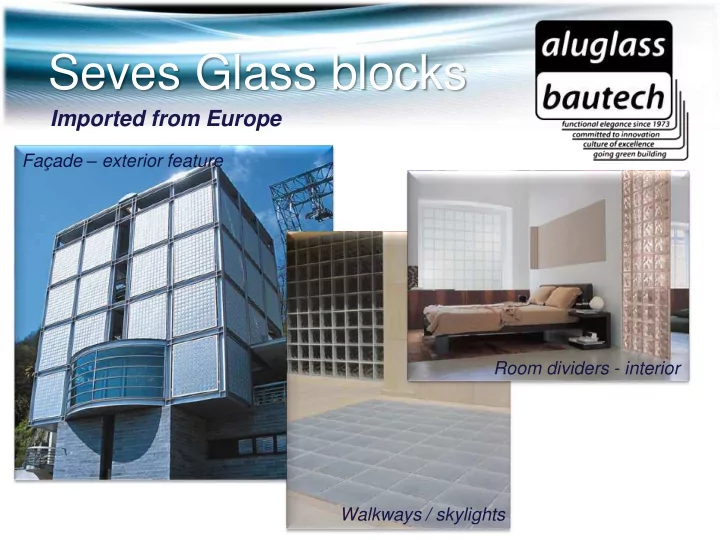
Seves Glass blocks Imported from Europe Faade exterior feature - - PowerPoint PPT Presentation
Seves Glass blocks Imported from Europe Faade exterior feature Room dividers - interior Walkways / skylights Index Introduction The GREEN glass block Technical information Installation methods Traditional installation with cement
Imported from Europe
Façade – exterior feature Walkways / skylights Room dividers - interior
Introduction The GREEN glass block Technical information Installation methods
Traditional installation with cement mortar Quicktech system Vetroquick system
Notes regarding installation
Expansion joints Galvanised steel rods Calculating the number of glass blocks and spaces
Glass block range
promote the conservation of energy and safeguards the environment
argon gas
– Resistance to compression along the side of the block according to the EN 1051/1 2005 standards; – Resistance to thermal shock according to the EN 1051/2 2008 standards; – Evaluation of the solar characteristics, according to the EN 410 2000 standards; – Calculation of the U-value according to the EN 673 2005 standards; – Sound insulation according to the EN 7117/1 2007 standards.
reduced
that dedicates special attention to sealing and annealing can guarantee high compressive strength in glass blocks
must undergo to verify their strength and resistance
creates different effects in relation to the many possible combinations that can be made using different patterns, shapes, finishes and colours
bricks offer a high level of sound insulation, even superior to that of brick walls of identical thickness
to thermal shock, glass brick structures offer a good level of safety - they constitute an effective fire barrier
pressure - in the event of breakage, the glass fragments tend to converge towards the inside (implosion) of the glass blocks instead of being projected outwards (explosion)
Arrange the vertical guides, they must be plumb, and 100/120 cm apart to assure that the wall itself will be perfectly plumb. The wall must be perfectly vertical both lengthwise and upwards in order to avoid eccentric loads Place a slip joint into the horizontal strips to prevent expansion/friction between the base of the panel and the supporting surface. Place the expansion/settling joints on the side and at the panel support points Use a trowel long enough to allow you to work easily between the vertical reinforcement
mortar between the base strips. Position the first row of Seves glass blocks.
Traditional installation with cement mortar
Build the first course perfectly plumb. Use the plastic spacers to make even joints. Apply mortar to the vertical spaces between the glass blocks you have just laid, temporarily remove the spacers as you work and then replace them Place the reinforcing rod on the central wing
prevent it to touch the glass block side. Insert the reinforcement bars, vertically and horizontally; the bars should not be more than 50 cm apart. To guarantee stability for large walls it is better to use U-sections, which are plugged or cramped to the adjacent supporting structures Finish the joints only when the mortar is completely hardened. Remove the outer plates of the spacer using a tool that will not scratch the glass Apply the finishing, fill the joints well; use soft brushes and plastering trowels. Make a perimeter cordon, or part of the
to prevent cracking along the expansion/settling joints.
Quicktech system
Vetroquick system
Expansion joints
The expansion joint is necessary for correctly installing glass blocks and it must be placed on lateral (sides) and upper edge in order to prevent possible settling
Galvanised steel rods
higher stability and safety.
and damage the glass part.
Dimension (cm) Ave unit weight (kg) Approx weight of structure (kg/sq.m) Number of pieces per sq.m
2mm joint (Pegasu s) 5mm joint (Pegasu s) 10mm joints 16m m joints 2mm joint (Pegas us) 5mm joint (Pegas us) 10mm joints 16mm joints
19x19x8 2.3 ≈78 ≈80 ≈78 ≈82 ≈27 ≈26 25 ≈23 19x9.4x8 1.3 ≈92 ≈94 ≈92 ≈96 ≈54 ≈51 50 ≈46 24x24x8 4.1 ≈81 ≈84 16 ≈16
Calculating the number of glass blocks and spaces
D = No. of spacers n = No. o f horizontal glass elements M = No. of vertical glass elements
198 Wave 198 Clearview 198 Savona 1908 ½ Wave Please view our website for the extensive range
248 Wave 248 Clearview Please view our website for the extensive range
Patented by Seves, ENERGY SAVING effectively reduces the thermal transmittance
and pressure controlled argon gas. The glass plate is inserted between the glass block halves to interrupt the thermal bridge, while the argon gas is added to reduce the thermal transmission caused by convective motion. This makes it possible to create architectural façades made entirely of glass blocks that promote the conservation of energy and safeguard the environment.
198 Pegasus Wave 198 Pegasus Wave metallised