MFLC Presentation List with Descriptions Presentation Name Category - - PowerPoint PPT Presentation

mflc presentation list with descriptions
SMART_READER_LITE
LIVE PREVIEW

MFLC Presentation List with Descriptions Presentation Name Category - - PowerPoint PPT Presentation

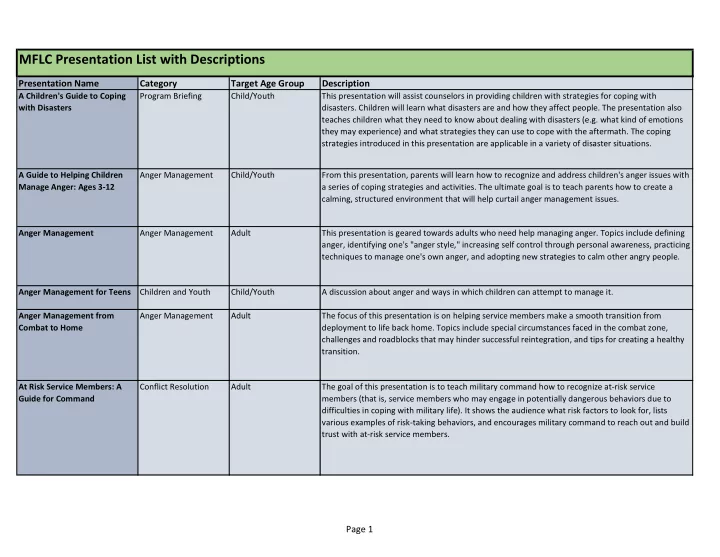
MFLC Presentation List with Descriptions Presentation Name Category Target Age Group Description A Children's Guide to Coping Program Briefing Child/Youth This presentation will assist counselors in providing children with strategies for


slide-1
SLIDE 1

Presentation Name Category Target Age Group Description

A Children's Guide to Coping with Disasters Program Briefing Child/Youth This presentation will assist counselors in providing children with strategies for coping with

  • disasters. Children will learn what disasters are and how they affect people. The presentation also

teaches children what they need to know about dealing with disasters (e.g. what kind of emotions they may experience) and what strategies they can use to cope with the aftermath. The coping strategies introduced in this presentation are applicable in a variety of disaster situations. A Guide to Helping Children Manage Anger: Ages 3-12 Anger Management Child/Youth From this presentation, parents will learn how to recognize and address children's anger issues with a series of coping strategies and activities. The ultimate goal is to teach parents how to create a calming, structured environment that will help curtail anger management issues. Anger Management Anger Management Adult This presentation is geared towards adults who need help managing anger. Topics include defining anger, identifying one's "anger style," increasing self control through personal awareness, practicing techniques to manage one's own anger, and adopting new strategies to calm other angry people. Anger Management for Teens Children and Youth Child/Youth A discussion about anger and ways in which children can attempt to manage it. Anger Management from Combat to Home Anger Management Adult The focus of this presentation is on helping service members make a smooth transition from deployment to life back home. Topics include special circumstances faced in the combat zone, challenges and roadblocks that may hinder successful reintegration, and tips for creating a healthy transition. At Risk Service Members: A Guide for Command Conflict Resolution Adult The goal of this presentation is to teach military command how to recognize at-risk service members (that is, service members who may engage in potentially dangerous behaviors due to difficulties in coping with military life). It shows the audience what risk factors to look for, lists various examples of risk-taking behaviors, and encourages military command to reach out and build trust with at-risk service members.

MFLC Presentation List with Descriptions

Page 1

slide-2
SLIDE 2

Balancing Work, Life and Command Stress Management Adult Participants will discuss their unique stressors as they attempt to manage their work-life balance and how to manage various stressors. Healthy versus unhealthy stress is reviewed as well as sleep cycles and the importance of having fun in order to be a more productive and well rounded person. Building Healthy Marriage Marriage and Couples Adult Participants in this presentation will learn to create and maintain a healthy marriage through the development of communication skills, conflict resolution strategies and personal boundaries. Building Resiliency in Children: A Parent's Guide Parenting Child/Youth This presentation aims to teach parents how to instill in their children the ability to cope with challenging circumstances, such as the deployment of a parent. Participants will learn how to recognize the characteristics of resilient children; how to form and strengthen bonds with their children; how to build their children's character; and how to teach their children optimism, coping skills, etc. Building Stress Resiliency: Making Stress Work for You Children and Youth Child/Youth A discussion about different kinds of stress and how to increase one's stress resiliency. Challenges Faced by Dual Military Couples Program Briefing Child/Youth When both halves of a couple are in the military, the relationship will have to weather many difficult situations. This presentation highlights the positive aspects of being a dual military couple, the challenges that the couple may face, and the various ways in which they can cope with those challenges. Challenges of Changing Schools Stress Management Adult This presentation focuses on helping students make the transition to a new school. Topics covered include the positive aspects of changing schools, tips on making the transition easier on all parties, strategies for forming new friendships, and ways to prevent declines in academic performance. Children and Moving Program Briefing Child/Youth The goal of this presentation is to teach parents how to assist their children during the process of moving to a new home. Highlights of the presentation include the different responses children may have to a move, the unique issues that military children face when relocating, the positive aspects

  • f moving, the "emotional rollercoaster" that children may experience during the transition, typical

concerns that children might experience when moving, tips for approaching children about a relocation and assisting them in the transition, and how to know when to seek help for a child from an outside source.

Page 2

slide-3
SLIDE 3

Children and Separation Issues

  • f Deployment

Deployment Child/Youth The focus of this presentation is on helping service members understand the difficulties children can experience when it comes to separation from a deployed parent. Topics include the emotional cycle

  • f deployment, developmental issues that may result from a parent's deployment, common stress

reactions in children and adolescents, coping strategies that parents can use when approaching their children about their deployment, tips for long-distance parenting, and how to know when to seek help for a child from an outside source. Combat Related Stress Reactions: What Service Members & Family Members Need to Know Deployment and Reintegration Adult This presentation aims to prepare service members for the various ways in which stress may present itself during deployment, particularly in relation to combat. Topics include possible ongoing stress reactions, how such reactions can affect family members, coping and communication skills, ways family members can show their support, and signs that a service member should seek help from an outside source. Communication and Assertiveness Training Stress Management Adult This presentation focuses on providing participants with communication strategies and guidelines. Topics include the components of communication, verbal and nonverbal communication, the characteristics of an active listener, tips for communicating over long distances, typical roadblocks to effective communication, and the importance of being assertive. Communication for Teens Communication Child/Youth Participants in this presentation will provide participants with communication strategies and

  • guidelines. Topics include understanding emotions, nonverbal communication, communication

guidelines, listening skills, roadblocks to good communication, and the characteristics of a good communicator. Communication Training Communication Adult This presentation focuses on providing participants with communication strategies and guidelines. Topics include the components of communication, verbal and nonverbal communication, the characteristics of an active listener, tips for communicating over long distances, typical roadblocks to effective communication, and the importance of being assertive. Conflict Resolution Conflict Resolution Adult This presentation seeks to teach participants how to deal with and resolve conflict, particularly in the workplace. Conflict Resolution Ages 13-16 Conflict Resolution Child/Youth The purpose of this presentation is to teach parents how to resolve conflicts with teenagers. Topics include tips/ground rules for understanding and addressing conflict, communication guidelines, and problem solving strategies.

Page 3

slide-4
SLIDE 4

Conflict Resolution Ages 4-12 Conflict Resolution Child/Youth The purpose of this presentation is to teach parents how to resolve conflicts with children. Topics include tips/ground rules for understanding and addressing conflict, communication guidelines, and problem solving strategies. Conflict Resolution for Middle School Conflict Resolution Child/Youth The purpose of this presentation is to teach adolescents how to resolve conflict. Topics include the characteristics of conflict, the various ways people typically handle conflict, tips/ground rules for understanding and addressing conflict, communication guidelines, and problem solving strategies. The presentation concludes with a series of questions to encourage discussion from participants. Controlling Anger Anger Management Adult This presentation is geared towards adults who need help managing anger, particularly within the context of relationships. Topics include defining anger and its warning signs, learning to recognize when anger is creating problems, utilizing strategies to help manage anger before it gets out of control, and knowing when to seek help from an outside source. Coping Skills for the Recruiter Lifestyle Stress Management Adult This presentation teaches service members and their families how to deal with the problems that may be caused by a family member's career in military recruiting. The goal is to provide families with coping strategies that will help them navigate the unique challenges of the recruiter lifestyle. Coping Strategies for the Uncertainties of Life Stress Management Adult This presentation offers a series of strategies to help adults cope with unexpected developments, disappointments, and other situations in which expectations fall short of reality. Coping with Challenges While

  • n R&R

Communication Adult While R&R (rest and recuperation) is meant to be a joyful time, it can also be stressful. The purpose

  • f this presentation is to teach participants how to identify common concerns/possible roadblocks

to a positive R&R experience. Subtopics include coping skills, communication guidelines, and tips for successful long-distance communication. Coping with Transitions Program Briefing Adult The purpose of this presentation is to teach participants how to deal effectively with change. Highlights include coping strategies and guidelines for a smoother transition, tips for adapting to change, and a group discussion regarding personal responses during periods of transition.

Page 4

slide-5
SLIDE 5

Creating Healthy Relationships Marriage and Couples Adult This presentation focuses on topics such as the origins of personal attitudes towards relationships, the characteristics of a healthy relationship, the importance of positive self-esteem, the stages of marriage, tips for writing love letters, and tools for building a healthy relationship. Deployment Survival Deployment Adult This presentation's focus is on helping service members prepare for and cope with deployment. Topics include things to consider when preparing for deployment and tips for managing separation. The presentation also discusses the importance of creating a plan that will help family members deal with day-to-day issues (finances, legal questions, personal matters, etc.) without the service member's presence. Developmental Stages 13-18 Parenting Child/Youth The purpose of this presentation is to provide parents with the tools to effectively deal with

  • teenagers. Highlights include characteristic behaviors of teenagers, the stages of adolescent

development, parenting tips and strategies, and guidelines for establishing rules and consequences. Effective Communication Skills for Couples Marriage and Couples Adult This presentation discusses the fundamental communications skills all couples need for a successful

  • relationship. The presentation reviews common barriers to couples' communication and alternative

skills to overcome those barriers: active listening, assertive communication, and negotiation. Effective Discipline Ages 13-17 Parenting Adult This presentation addresses the importance of effectively disciplining teenagers. Objectives include recognizing the characteristics of teenage development, maintaining good communication, practicing effective methods of discipline, establishing rules and consequences, working with other caregivers, taking special circumstances (e.g. the deployment of a parent) into account, and knowing when to seek help. Effective Discipline Ages 2-5 Parenting Adult The purpose of this presentation is to help parents discipline young children effectively. Objectives include learning the stages of child development, understanding how children think and feel, practicing effective methods of discipline, and knowing when to seek help.

Page 5

slide-6
SLIDE 6

Effective Discipline for Preteens Ages 10-12 Parenting Adult The purpose of this presentation is to help parents discipline older children effectively. Topics include recognizing the characteristics of preteen development, maintaining good communication, practicing effective methods of discipline, establishing rules and consequences, working with other caregivers, taking special circumstances (e.g. the deployment of a parent) into account, and knowing when to seek help. NOTE: This presentation is also listed at MagellanMFLC.org under the title "Effective Discipline Ages 10-12." Effective Discipline for School Age Children Ages 6-9 Parenting Adult The purpose of this presentation is to help parents discipline school-age children effectively. Topics include recognizing the characteristics of child development, maintaining good communication, practicing effective methods of discipline, establishing rules and consequences, dealing with aggressive behavior, working with other caregivers, taking care of oneself in order to better care for

  • ne's children, and knowing when to seek help.

Effects of Extended Daylight and Darkness Program Briefing Adult Deployment requires service members to adapt to new environments, including changes in the length of days and nights. This presentation aims to prepare service members for these changes. Topics include coping strategies, the possible effects of extended periods of sunlight and darkness, and the reasons these effects may occur. Emotional Eating Parenting Adult The focus of this presentation is to aid participants in developing and maintaining healthy eating

  • habits. Objectives include defining mindful eating, practicing steps to maintain mindful eating

habits, learning how to identify hunger, and incorporating mindful eating into one's daily routine. Facing the Challenges of Divorce Marriage and Couples Adult Topics covered in this presentation include the causes and realities of divorce, ways to cope, as well as responsibilities and forgiveness. The presentation also touches on children and divorce, with tips

  • n the topic.

Family Reunion Return & Reunion Adult This presentation aims to prepare service members and their families for the reunion that will occur when the service member returns home. Topics include the difference between a homecoming and a reunion, objectives and expectations, the importance of communicating reunion expectations during deployment, the changes that may occur in intimate relationships, strategies for dealing with change, and tips for communication and readjustment.

Page 6

slide-7
SLIDE 7

From Combat to Home Return & Reunion Adult This presentation's goal is to prepare service members for the challenges they will face as they transition from deployment. Topics include the benefits and difficulties of military life, the possible challenges that service members and their families may face during the reintegration process, and strategies for overcoming such challenges. From Couplehood to Parenthood Parenting Adult This presentation aims to prepare parents for the transition into parenthood. Topics include ways parents can expect their lives to change after the arrival of a child, possible causes of conflict between new parents, techniques for avoiding conflict before it escalates, tips for making a smooth transition, and strategies for dealing with the deployment of a new father. Healthy Relationship Skills for Singles Marriage and Couples Adult This presentation teaches single people how to prepare for a relationship. Objectives include clarifying one's expectations and priorities in a relationship, choosing the right person to enter a relationship with, understanding the right reasons for entering a long-term relationship, and practicing strategies for choosing and developing a healthy relationship. Helping Children Cope with Post Deployment Issues Return & Reunion Child/Youth The goal of this presentation is to teach parents how to help children through the reintegration process after a parent returns from deployment. Topics include the concerns children may have concerning a parent's return, guidelines for good parent/child communication, what parents can expect from children of different ages, what parents can do to enhance child resiliency/help children through the reintegration process, and how to recognize when it is time to seek help from an outside source. Helping the Service Member Reconnect with Their Child Return & Reunion Child/Youth This presentation focuses on teaching spouses/partners how to support returning service members in reconnecting with their children. Topics include possible reactions children may have to a parent's return from deployment, strategies for helping parents and children reestablish a relationship upon the service member's return, and tips for establishing (or reestablishing) a parental partnership. Homecoming and Reunion Return & Reunion Adult This presentation aims to help military families understand how to navigate a service member's

  • homecoming. Topics include the adjustments family members may experience during the service

member's deployment, the changes that may have resulted, things to consider when planning for a reunion, things to expect during the reunion process, potential roadblocks to a successful reunion, goals for the relationship/family, and homecoming tips.

Page 7

slide-8
SLIDE 8

How Children Grieve Grief and Loss Adult The goal of this presentation is to help parents navigate the grieving process with their children. Topics include the stages of child grief; children's concepts, perceptions, and beliefs; common emotional and behavioral responses in children and adolescents of varying ages; and how parents can help children through their grief. Introducing a New Baby Parenting Child/Youth The focus of this presentation is on helping parents introduce a new baby to their other children. Objectives include accommodating developmental considerations when introducing a new baby to his/her siblings, understanding a child's reaction to a new sibling, and preparing a child for his/her new sibling, Issues Families Face When the Military Deploys Deployment Adult This presentation addresses deployment-related stress for service members, spouses, children, and

  • parents. Topics include stressors for each group, symptoms of deployment stress, and coping

strategies. Life in Balance: Relaxation and Stress Relief Stress Management Adult Objectives for this presentation include maintaining a good work/life balance, identifying stressors, recognizing the signs and symptoms of stress, practicing stress management strategies, reducing

  • verall stress, and developing relaxation skills.

Maintaining a Healthy Marriage During Deployment Deployment Adult This presentation addresses the challenges a marriage may face during deployment-related separation, ways to protect and strengthen the marriage during deployment, ways to practice effective communication and conflict resolution, and things the spouses of deployed service members can do to promote their personal growth during deployment. Making Marriage Work after Deployment Deployment Adult This presentation focuses on marital issues that may result from deployment. Topics include typical pre-deployment marital issues, changes that may occur in each person as a result of deployment, the challenges of reuniting and adjusting to life post-combat, and tips for maintaining a stable relationship throughout the deployment/reintegration process. Matri-Money: Money and Marriage Marriage and Couples Adult The purpose of this presentation is to address financial concerns that may present challenges to married couples. Objectives include exploring emotional connections to financial matters, utilizing goal setting strategies, and practicing effective communication.

Page 8

slide-9
SLIDE 9

Mission Based Marriages Marriage and Couples Adult This presentation is driven by the idea that a marriage should be focused on a specific vision of the

  • future. Objectives include defining the beliefs and values that give meaning and direction to

marriage, understanding what the family does and where it's going, knowing the steps required to achieving goals for the family, utilizing strategies for strengthening and protecting the marriage, and practicing effective problem-solving techniques as a couple. Mortuary Affairs and Grief Issues Grief and Loss Adult The families of service members aren't the only ones who might have problems coping with the death of a service member. This presentation is aimed at those who work in Mortuary Affairs for the military. Topics include positive aspects and challenges of the job, effects on personal stress, symptoms of grief, the "compassion fatigue" phenomenon, and coping strategies. Motivational Interviewing Program Briefing Adult Motivational Interviewing helps to build motivation and mobilize commitment and believes in the concept that people are more often reluctant versus resistant to change. Using the concepts taught in this course allows the MFLC to empower the individual to make steps toward positive change. Nature and Prevention of Bullying - Bully Busting Activity Instructor's Guide Program Briefing Child/Youth This guide summarizes an activity that has been modified from Bully Busters, a programmed published curriculum to address bullying. The activity is designed for children in grades 1-8. Lessons include how to define a bully, how to recognize bullying behavior, how to reduce the likelihood of being a target, and how to judge whether they should handle bullying on their own or ask for help from a caregiver. Parent/Child Communication Communication Child/Youth This presentation focuses on helping parents communicate effectively with their children. Topics include the benefits of effective communication, typical developmental issues for various age groups, ways to help children process their feelings, basic principles of effective parent/child communication, how to communicate during conflict, and tips for discussing deployment with children. Parenting Skills for the Single Service Member Parenting Adult This presentation's goal is to help single military parents develop effective parenting skills. Topics include how to resolve the guilt that single parents often experience, the positive aspects of being single in the military, guidelines for disciplining children and establishing rules/consequences, tips for communicating during conflict, how to address various deployment-related issues, techniques for effective long-distance parenting, positive aspects of separation, and strategies for building a support network.

Page 9

slide-10
SLIDE 10

Parenting Teens Parenting Child/Youth This presentation aims to teach parents how to deal with teenagers. Topics include the characteristics of teenage development, components of the parent's role in a teenager's life, communication challenges and tips, strategies for effective discipline, and ways to address deployment-related issues. Post-Combat Risk-Taking Behaviors Deployment Adult This presentation seeks to help service members prepare for the risk-taking behaviors that may present themselves during the reintegration process. Objectives include defining, recognizing, and understanding risk-taking behaviors; understanding the phenomenon of "post-combat invincibility"; and strategies for a successful transition from combat to civilian life. Pre-Deployment and the Single Service Member Deployment Adult This presentation focuses on helping single service members prepare for the deployment process. Objectives include developing and maintaining support networks, creating a deployment plan, staying connected with friends and family, educating friends and family on various aspects of deployment, ensuring that important items are left in safe hands during deployment, preparing emotionally for deployment, finding mentors who can provide experience and wisdom, recognizing the differences between independence and isolation, and strategies for making good decisions. Preparing for Your Parents' Deployment Deployment and Reintegration Child/Youth This presentation focuses on helping children and adolescents prepare for a parent's deployment. Topics include things to expect during deployment, positive aspects of deployment, characteristics

  • f deployment-related stress, coping strategies and resources, tips for staying connected with the

deployed parent, and the positive aspects associated with a parent's deployment. Principles for Healthy Relationships and Marriages Marriage and Couples Adult Discusses the core components of a healthy relationship or marriage. Reviews the stages of marriage and specific actions that cultivate a relationship. Recovering from Divorce Marriage and Couples Adult Topics covered in this presentation include the definition of divorce, the stages of grief/loss, possible physical and emotional reactions to divorce, coping strategies, tips for discussing a divorce with outside parties, techniques for discussing divorce with children, and recommendations for navigating divorce in a healthy way.

Page 10

slide-11
SLIDE 11

Redeployment Issues for Children Return & Reunion Child/Youth This presentation seeks to aid parents in helping their children through the redeployment of a family member. Topics include the emotional cycle of deployment; the stages of deployment; what to expect during the deployment process; typical physical, emotional, and behavioral responses in children; the stages of child development; and strategies for a successful transition. Reigniting the Passion After Deployment Marriage and Couples Adult This presentation focuses on strategies for rebuilding and maintaining an intimate connection after a spouse/significant other returns from deployment. Reintegration Return & Reunion Adult Topics covered in this presentation include the importance of the reintegration process, reintegration checklists for soldiers in various family/living situations, the various challenges involved in adjusting to role changes after deployment, common post-deployment reactions, and positive and negative coping mechanisms. Reintegration Challenges for the Single Service Member Return & Reunion Adult The goal of this presentation is to prepare the families of service members for the reintegration

  • process. Topics include common problems associated with return from deployment, issues that may
  • ccur if a divorce was initiated during deployment, the phases of reintegration, myths and

misconceptions surrounding reintegration, and guidelines for supporting a service member during the reintegration period. Relationship Tips for Teens Communication Child/Youth This presentations aids teenagers in developing healthy relationships. Focuses include tips for making dating a positive experience, ways to recognize possible abuse, and the varying degrees of lust and love. Responding to Toddlers Who Bite and Hit Program Briefing Child/Youth Topics covered in this presentation include reasons children might bite and hit, the normalcy of biting and hitting, and strategies for curing a child of such behaviors. Return Reunion Workshop for Spouses Return & Reunion Adult The purpose of this workshop is to help military spouses through the process of reuniting with a service member. Objectives include understanding what each party has experienced during the service member's deployment, planning for the reunion and its aftermath, recognizing potential roadblocks to a successful reunion, establishing goals for the post-deployment relationship, and practicing techniques for a successful homecoming.

Page 11

slide-12
SLIDE 12

Reunion Briefing Return & Reunion Adult The goal of this presentation is to help service members understand the reintegration/reunion

  • process. Topics include the importance of reunions, common reactions to reintegration, changes

that may result from deployment, positive coping strategies, potential roadblocks, and tips for a successful reunion. Reunion: It's a Process, Not an Event Return & Reunion Adult Topics covered in this presentation include expectations for reunion/reintegration, the phases of a typical reunion, effective communication strategies, tips for a successful reunion, and techniques that can aid in a smooth transition. Sibling/Parent Relationships: Building Healthy Relations Communication Child/Youth This presentation addresses family relationships. Topics include different types of relationships, unique characteristics of sibling relationships, ways a marital relationship can affect the children of the marriage, and strategies for managing conflict between siblings. Stages of Deployment Deployment Adult This presentation covers the emotional cycle of deployment, the phases of deployment, and tips for successful reunion/re-entry. Strengthening Parenting Practices Parenting Child/Youth The goal of this presentation is to provide parents with the tools to build strong and resilient family relationships, particularly during deployment, reintegration, and similarly stressful situations. Stress During the Holidays: Maintaining Balance and Stress Resilience Stress Management Adult This presentation aims to guide service members and their families manage the unique stressors that are often associated with holidays. Objectives include recognizing the signs and symptoms of stress, defining holiday expectations, avoiding the "holiday blues," practicing stress management techniques, and utilizing strategies to guide children through the holidays with minimal stress to all parties. Stress Management Stress Management Adult Topics covered in this presentation include the signs, symptoms, and effects of a stress response; possible sources of stress; the types, levels, and stages of stress; and coping strategies for managing stress. Stress Management for Teens Stress Management Child/Youth This presentation focuses on helping teenagers manage their stress. Topics include the signs and symptoms of stress, possible sources of stress, and coping strategies. Stress Reactions and Coping Mechanisms: Honor Guard Stress Management Adult This presentation focuses on helping Honor Guard members cope with the unique stressors that are

  • ften associated with the job. Objectives include knowing possible sources of stress, understanding

the ways that stress can affect families and relationships, and recognizing stress reactions.

Page 12

slide-13
SLIDE 13

Supporting the Bereaved at Home and Down Range Grief and Loss Adult The goal of this presentation is to teach people how to comfort the bereaved. Topics include the stages of grief, physical and emotional reactions to grief, the characteristics and effects of survivor's guilt, tips for helping grieving people, and special considerations for when the bereaved is a long distance away. Supporting your children through Deployment Deployment Child/Youth This topic reviews emotions, concerns and topics surrounding issues occurring during a parent's

  • deployment. Possible child reactions at different ages and possible techniques to be used by

parents are addressed. Survivor's Guilt Grief and Loss Adult Objectives for this presentation include understanding the symptoms and effects of survivor's guilt, developing coping strategies, and utilizing tips for helping children and adolescents recover. Talking to Parents: Effective Parent/Caregiver Communications Communication Adult This presentation focuses on helping caregivers establish a healthy relationship with parents. Topics include the components of a healthy parent/caregiver relationship, tips for discussing difficult issues, and strategies for effective communication. Teaching Children How to Get Along: A Teacher Guide Program Briefing Adult The goal of this presentation is to equip teachers with the tools for handling conflicts between

  • children. Objectives include recognizing the importance of friends in a child's life, understanding the

caregiver's role, knowing the various types of uncooperative behaviors, utilizing tips for teaching children how to get along, developing problem solving skills, setting rules and consequences, and effectively disciplining aggressive behaviors. Teens and the Power of Peer Pressure Program Briefing Child/Youth This presentation focuses on helping teenagers understand and cope with peer pressure. Objectives include understanding peer pressure and why adolescents often give into it, knowing the differences between spoken and unspoken peer pressure, recognizing peer pressure tactics, utilizing strategies for standing up to negative peer pressure, and realizing that peer pressure can sometimes be a positive thing. The Emotional Cycle of Deployment Deployment Adult This presentation covers the various stages involved in pre-deployment, deployment, and

  • reintegration. Focuses include the emotional impacts of deployment, possible effects of the

deployment phases, and coping tips. The Military Spouse: Commander and Chief on the Home Front Marriage and Couples Adult This presentation focuses on the accomplishments, challenges, and sacrifices involved in the life of a military spouse.

Page 13

slide-14
SLIDE 14

Three C's of Communication Communication Adult This presentation seeks to help participants improve verbal and nonverbal communication through the use of the "Three C's" (communication, collaboration, and commitment). Tips for Teachers: Working with Children During Deployment Deployment Child/Youth This presentation is focused on providing teachers with the tools to help children through a parent's

  • deployment. Topics include signs of difficulty coping in both children and parents, as well as tips

that will help teachers minimize children's stress. Transitioning to Civilian Life Return & Reunion Adult Focuses of this presentation include common struggles involved in transitioning from military to civilian life, stress management techniques, and tips to help attain a smoother transition. Trauma and Children: A Guide for Helping Children Manage Traumatic Events Program Briefing Child/Youth Topics covered in this presentation include fears children may experience, typical reactions to trauma, strategies for helping children cope, tips for talking to children, and trauma reactions that may require professional help. Understanding Grief Education for Caretakers Grief and Loss Child/Youth This presentation focuses on teaching caregivers how to help others deal with grief. Topics include the components of grief; common physical, emotional, psychological, social, and spiritual reactions to loss; tips for comforting the bereaved; characteristic grief responses of various age groups; and the importance of self-care in minimizing caregiver stress. Welcome Home: Reconnecting with Your Child Return & Reunion Child/Youth This presentation's purpose is to teach service members how to reconnect with their children upon returning from deployment. Objectives include knowing what to expect from children of various ages and tips for reestablishing the parent/child connection. What to Say When Someone is Grieving Grief and Loss Adult Learing about the stages of grief, ways to assist the bereaved, and things you are able to say and tips you can provide to person in an attempt to comfort them. When a Parent Deploys (Ages 2- 5) Deployment Child/Youth Topics covered in this presentation include relevant developmental issues, common stress reactions to deployment, techniques for preparing children for deployment and separation, tips for talking to children about deployment, ways to help children cope, and coping strategies for caregivers.

Page 14

slide-15
SLIDE 15

When a Sibling Deploys Deployment Adult This presentation's goal is to help the siblings of service members cope with their deployment. Topics include the characteristics of sibling relationships, what to expect when a sibling deploys, the effects of stress, coping strategies, ways to stay connected to the deployed sibling, self-care tips, and the positive aspects of a sibling's deployment.

Page 15