Announcements Composition Linked List Structure A linked list is - - PDF document

announcements composition
SMART_READER_LITE
LIVE PREVIEW

Announcements Composition Linked List Structure A linked list is - - PDF document

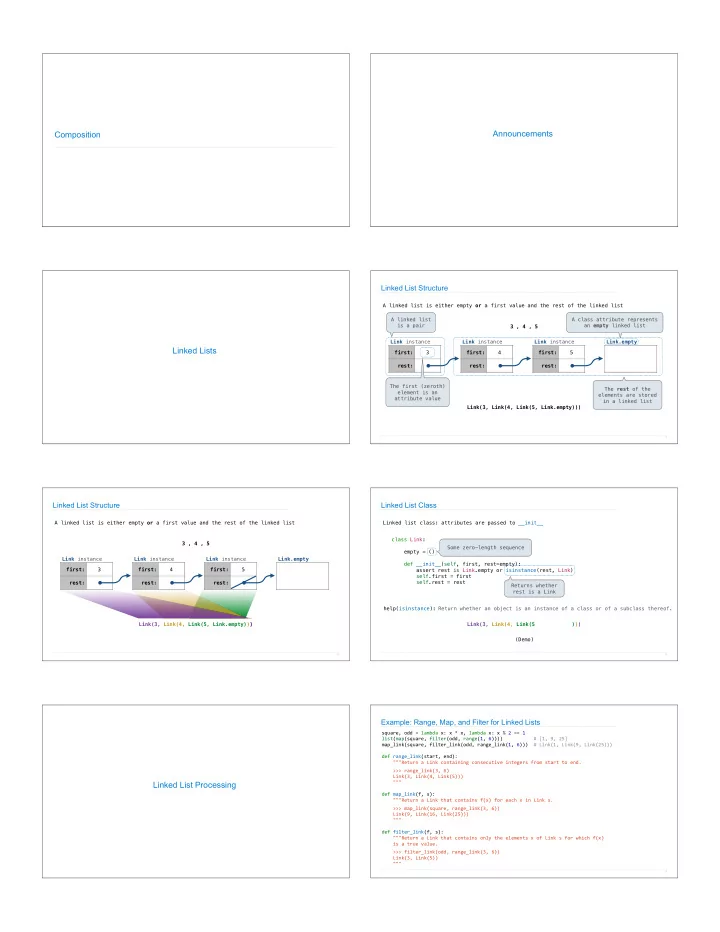
Announcements Composition Linked List Structure A linked list is either empty or a first value and the rest of the linked list A linked list A class attribute represents is a pair 3 , 4 , 5 an empty linked list Link instance Link instance Link


slide-1
SLIDE 1

Composition Announcements Linked Lists

Linked List Structure

A linked list is either empty or a first value and the rest of the linked list

4

3 , 4 , 5 Link.empty first: 3 rest: Link instance first: 4 rest: Link instance first: 5 rest: Link instance Link(3, Link(4, Link(5, Link.empty))) A linked list is a pair The first (zeroth) element is an attribute value The rest of the elements are stored in a linked list A class attribute represents an empty linked list

Linked List Structure

A linked list is either empty or a first value and the rest of the linked list

5

3 , 4 , 5 first: 3 rest: Link instance first: 4 rest: Link instance first: 5 rest: Link instance Link.empty , Link.empty ) Link(3, Link(4, Link(5 )))

Linked List Class

class Link: empty = ()

6

Some zero-length sequence Linked list class: attributes are passed to __init__ def __init__(self, first, rest=empty): assert rest is Link.empty or isinstance(rest, Link) self.first = first self.rest = rest (Demo) Link(3, Link(4, Link(5 ))) Returns whether rest is a Link help(isinstance): Return whether an object is an instance of a class or of a subclass thereof.

Linked List Processing

Example: Range, Map, and Filter for Linked Lists

square, odd = lambda x: x * x, lambda x: x % 2 == 1 list(map(square, filter(odd, range(1, 6)))) # [1, 9, 25] map_link(square, filter_link(odd, range_link(1, 6))) # Link(1, Link(9, Link(25))) def range_link(start, end): """Return a Link containing consecutive integers from start to end. >>> range_link(3, 6) Link(3, Link(4, Link(5))) """ def map_link(f, s): """Return a Link that contains f(x) for each x in Link s. >>> map_link(square, range_link(3, 6)) Link(9, Link(16, Link(25))) """ def filter_link(f, s): """Return a Link that contains only the elements x of Link s for which f(x) is a true value. >>> filter_link(odd, range_link(3, 6)) Link(3, Link(5)) """

8
slide-2
SLIDE 2

Linked Lists Mutation

>>> s = Link(1, Link(2, Link(3))) >>> s.first = 5 >>> t = s.rest >>> t.rest = s >>> s.first 5 >>> s.rest.rest.rest.rest.rest.first 2

Linked Lists Can Change

Attribute assignment statements can change first and rest attributes of a Link

10 Rest First

5

s Rest First

2

t Global frame

The rest of a linked list can contain the linked list as a sub-list Note: The actual environment diagram is much more complicated.

Rest First

1

s Rest First

2

Global frame Rest First

3

Linked List Mutation Example

Adding to an Ordered List

12

first: 1 rest: Link instance first: 3 rest: Link instance first: 5 rest: Link instance add(s, 0) s: def add(s, v): """Add v to an ordered list s with no repeats, returning modified s.””” (Note: If v is already in s, then don't modify s, but still return it.)

Adding to an Ordered List

13

first: 1 0 rest: Link instance first: 3 rest: Link instance first: 1 rest: Link instance first: 5 rest: Link instance s: add(s, 4) add(s, 3) def add(s, v): """Add v to an ordered list s with no repeats, returning modified s.””” (Note: If v is already in s, then don't modify s, but still return it.) add(s, 0)

Adding to an Ordered List

14

first: 1 0 rest: Link instance first: 3 rest: Link instance first: 5 4 rest: Link instance first: 1 rest: Link instance first: 5 rest: Link instance add(s, 6) s: add(s, 4) add(s, 3) add(s, 0) def add(s, v): """Add v to an ordered list s with no repeats...”””

Adding to an Ordered List

15

first: 1 0 rest: Link instance first: 3 rest: Link instance first: 5 4 rest: Link instance first: 1 rest: Link instance first: 5 rest: Link instance first: 6 rest: Link instance s: add(s, 6) add(s, 4) add(s, 3) add(s, 0) def add(s, v): """Add v to an ordered list s with no repeats..."""

Adding to a Set Represented as an Ordered List

16

def add(s, v): """Add v to s, returning modified s.””” >>> s = Link(1, Link(3, Link(5))) >>> add(s, 0) Link(0, Link(1, Link(3, Link(5)))) >>> add(s, 3) Link(0, Link(1, Link(3, Link(5)))) >>> add(s, 4) Link(0, Link(1, Link(3, Link(4, Link(5))))) >>> add(s, 6) Link(0, Link(1, Link(3, Link(4, Link(5, Link(6)))))) """ assert s is not List.empty if s.first > v: s.first, s.rest = __________________________ , _____________________________ elif s.first < v and empty(s.rest): s.rest = ___________________________________________________________________ elif s.first < v: ____________________________________________________________________________ return s v Link(s.first, s.rest) add(s.rest, v) Link(v) s: .

slide-3
SLIDE 3

Tree Class

Tree Abstraction (Review)

18

Recursive description (wooden trees): A tree has a root label and a list of branches Each branch is a tree A tree with zero branches is called a leaf A tree starts at the root

2 3 1 1

Relative description (family trees): Each location in a tree is called a node Each node has a label that can be any value One node can be the parent/child of another The top node is the root node

1 1 1

Root label Branch (also a tree) Leaf (also a tree) Labels Nodes People often refer to labels by their locations: "each parent is the sum of its children" Root of the whole tree Root of a branch Path

  • r Root Node

Tree Class

class Tree: def __init__(self, label, branches=[]): self.label = label for branch in branches: assert isinstance(branch, Tree) self.branches = list(branches) def fib_tree(n): if n == 0 or n == 1: return Tree(n) else: left = fib_tree(n-2) right = fib_tree(n-1) fib_n = left.label + right.label return Tree(fib_n, [left, right]) (Demo)

19

A Tree has a label and a list of branches; each branch is a Tree for branch in branches: assert is_tree(branch) return [label] + list(branches) def label(tree): return tree[0] def branches(tree): return tree[1:] def tree(label, branches=[]): def fib_tree(n): if n == 0 or n == 1: return tree(n) else: left = fib_tree(n-2) right = fib_tree(n-1) fib_n = label(left) + label(right) return tree(fib_n, [left, right])

Tree Mutation

Example: Pruning Trees

Removing subtrees from a tree is called pruning Prune branches before recursive processing

21

def prune(t, n): """Prune all sub-trees whose label is n.""" t.branches = [______________ for b in t.branches if _____________________] for b in t.branches: prune(_______________________________, _______________________________)

2 3 1 1 1 1 1

b b.label != n b n