Session Outline Conservation Collection Capacity Components - - PDF document

session outline
SMART_READER_LITE
LIVE PREVIEW

Session Outline Conservation Collection Capacity Components - - PDF document

10/22/2020 October 23, 2020 Milano, TX 1 Session Outline Conservation Collection Capacity Components Gutters and Filters Aesthetics 2 Conserving a Precious Resource Rainwater harvesting is the capture, diversion, and


slide-1
SLIDE 1

10/22/2020 1

October 23, 2020 Milano, TX

Session Outline

  • Conservation
  • Collection Capacity
  • Components
  • Gutters and Filters
  • Aesthetics

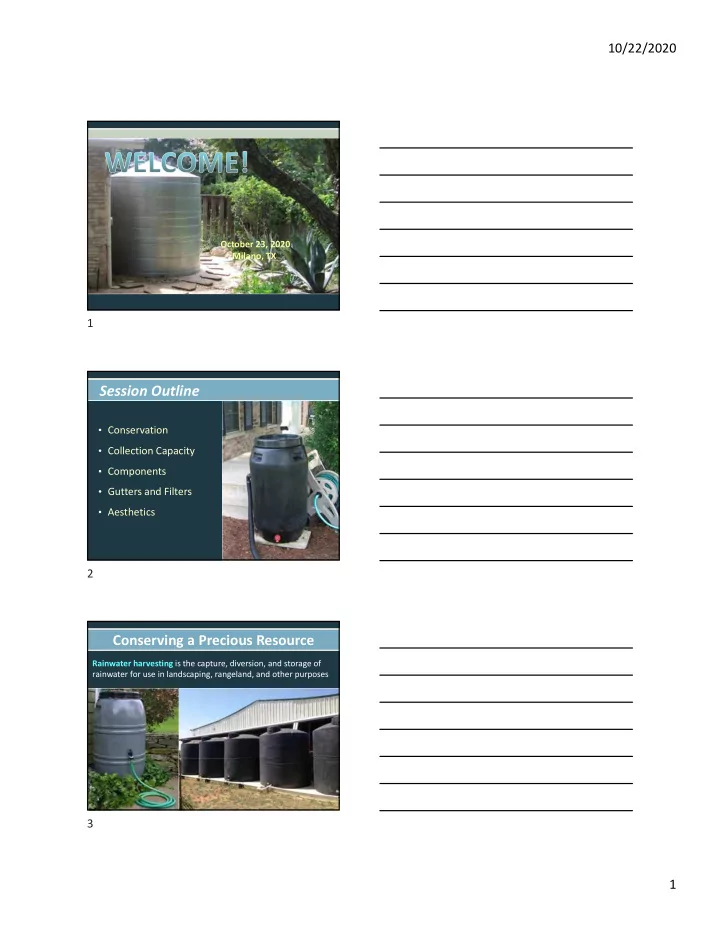
Rainwater harvesting is the capture, diversion, and storage of rainwater for use in landscaping, rangeland, and other purposes

Conserving a Precious Resource

1 2 3

slide-2
SLIDE 2

10/22/2020 2

http://www.cfpua.org/299/Water-Saving-Tips-Tools

How Do We Use Water?

Outdoor use is about 60 – 70% (estimates vary slightly)!

Not a New Idea!

Source: www.monticello.org

  • Is a conservation practice
  • Can reduce storm water runoff, and so reduces pollutants

entering water bodies

  • Rainwater is of superior quality: zero hardness, sodium-

free, and nearly neutral pH (neither acidic nor basic)

  • When properly managed, rainwater harvesting eliminates

the need for costly treatment and distribution systems

  • Apart from costs to collect, store, treat, and convey the

water into the facility, rainwater harvesting is free

Advantages of Rainwater Harvesting

4 5 6

slide-3
SLIDE 3

10/22/2020 3

  • Rainwater harvesting may need to be

supplemented with water from other sources, especially during extended dry periods or droughts

  • Systems require regular maintenance after

installation

  • Storage systems can take up space around the

house

  • Standardized construction guidelines for systems

are lacking

Disadvantages of Rainwater Harvesting

Senate Bill 198: Illegal for a homeowners association to prohibit:

  • Installing rain barrels or a rainwater harvesting

system

  • Can require screening or shielding to obscure view
  • f tanks
  • Using drought-resistant landscaping or water-

conserving natural turf

  • Composting of vegetation
  • Installing underground drip irrigation

Texas Senate Bill 198, 2013-2014 Texas Senate Bill 198, 2013-2014

Impervious Surface Causes Increased Runoff

7 8 9

slide-4
SLIDE 4

10/22/2020 4

For every 1” of rain: – Each square footof a collection surface footprint generates about 0.6 gallons of water: Total Gallons H2O = Square Feet of Footprint X 0.6 Gallons/ft2 ~In other words~ – Each 2,000 square feet of collection surface generates 1,200 gallons of water

Potential Rainfall Collection Volume

  • Ave. Monthly Rainfall (in)

January 2.8 February 2.9 March 2.9 April 3.3 May 4.1 June 3.5 July 2.3 August 2.5 September 3.5 October 3.5 November 3.2 December 3.2

77 Year Average of Monthly Rainfall in Milano

Average annual total rainfall in Milano is 39.8 inches

  • Ave. Monthly Catchment

Collection

Amount Rainfall (in) (ft2) Gal/ft2 (gal/month) in tank (gal)

January 2.8 2,000 0.6 3,360 February 2.9 2,000 0.6 3,480 March 3.3 2,000 0.6 3,960 18,840 April 4.1 2,000 0.6 4,920 May 4.1 2,000 0.6 4,920 June 3.5 2,000 0.6 4,200 July 2.3 2,000 0.6 2,760 August 2.5 2,000 0.6 3,000 September 3.5 2,000 0.6 4,200 October 3.5 2,000 0.6 4,200 November 3.5 2,000 0.6 4,200 December 3.2 2,000 0.6 3,840

Monthly Rainfall Collected/2,000 ft2 in Milano (39.8 in)

10 11 12
slide-5
SLIDE 5

10/22/2020 5

77 Year Average of Monthly Rainfall in Milano (gal/ft2)

  • Ave. Monthly Rainfall (gal/ ft2)

January 1.7 February 1.8 March 1.7 April 2.0 May 2.5 June 2.1 July 1.4 August 1.5 September 2.1 October 2.1 November 2.1 December 1.9

Average annual total rainfall in Milano in gal/ft2 is 22.8gallons

Rainfall Catchment Collection Amount (gal/month) (ft2) (gal/month) in Tank (gal)

January 1.7 1,500 2,550 February 1.8 1,500 2,700 March 1.7 1,500 2,550 13,800 April 2.0 1,500 3,000 May 2.5 1,500 3,750 June 2.1 1,500 3,150 July 1.4 1,500 2,100 August 1.5 1,500 2,250 September 2.1 1,500 3,150 October 2.1 1,500 3,150 November 2.1 1,500 3,150 December 1.9 1,500 2,850

Monthly Rainfall Collected/1,500 ft2 in Milano

Rainwater Harvesting Calculators

Texas Water Development Board Rainwater Harvesting System Sizing Calculator available through the American Rainwater Catchment Association https://arcsa.site-ym.com/?page=268 Texas A&M AgriLife Extension Rainwater Harvesting Calculator: http://rainwaterharvesting.tamu.edu/2011/05/31/calculator/

13 14 15

slide-6
SLIDE 6

10/22/2020 6

Protect water quality from the beginning to avoid clean-up later Protect water quality from the beginning to avoid clean-up later

What Can Fall on Your Roof?

  • Subdivision restrictions?
  • How much water can I catch from my roof?
  • Estimated cost of tank/s?
  • Can I afford a tank I will be proud of, or do I

need to hide a less expensive tank?

  • Is storage available under a porch, patio or in a

basement?

RWH Questions to Consider

Components

Components

Functional considerations only, or are aesthetics also important?

16 17 18

slide-7
SLIDE 7

10/22/2020 7

Site Selection

Roof and Collection Surface

Conveyance

Primary Filtration

Foundation for Tank

Components

Tanks Tank Parts Secondary Filtration Pumps and Pressure Tanks In Home Use

  • Soil type – trenching, leveling, digging
  • Elevation – gravity flow or use pump to storage tank
  • Distance tanks will be from the house
  • Distance to electricity, filters, freeze protection
  • Smaller size tanks I could install myself
  • Type of foundation under the tank (consider size)
  • Underground or larger, specially designed tanks may

require excavation or a professional

Site Selection For Tanks Roofs and Collection Surfaces

19 20 21

slide-8
SLIDE 8

10/22/2020 8

  • Not recommended:

– Chemically treated wood – Composite asphalt shingles – Asbestos – Some paints

  • If painted, paints meeting

NSF 61 should be used

  • Particle filters should be

installed if asphalt shingles are used

Some Roof Materials Are Not Recommended

Unique Catchment Surfaces Footprint of the Collection Surface

22 23 24

slide-9
SLIDE 9

10/22/2020 9

Conveyance

Gutters And Downspouts

27

Gutter sloping wrong direction. Downspout on the other end.

Problems Do Occur!

25 26 27

slide-10
SLIDE 10

10/22/2020 10 Non-traditional Downspouts

Government Canyon State Natural Area, San Antonio

Non-traditional Downspouts

28 29 30

slide-11
SLIDE 11

10/22/2020 11

Downspouts

  • Provide one square inch of downspout area for every 100

square feet of roof area

  • For example, a 2″ x 3″ downspout (6 square inches)

can accommodate runoff from a 600 square foot roof

  • A 3″ x 4″ downspout (12 square inches) can

accommodate runoff from a 1,200 square foot roof

  • The same rule can be used for circular PVC piping

Sizing Gutters

  • Should be sized to adequately move rainwater runoff

from a 100-year storm

  • Generally, should be at least 5 inches wide

32

Gutters

 Materials: vinyl, seamless aluminum, galvanized steel,

stainless steel, copper

 Slope toward the downspout 1/16”per 1’ to 1/16” per 10’  Tilt out ½” to prevent water seeping into the walls  Expansion joints for runs over 40’  Hangers every 3’  Use splash guards in valleys  Number of downspouts varies with size and surface area –

1 per 1,000 square feet surface

 1 square inch of outlet per 100 square foot of roof surface

Different Gutters and Downspouts

31 32 33

slide-12
SLIDE 12

10/22/2020 12

34 35 36

slide-13
SLIDE 13

10/22/2020 13

Water weighs 8.33 lbs/gallon

  • r 62.5 lbs/cubic foot

Secure the Gutters

Gutters with a slope of ½” per foot can serve an area almost 2 times as large as a gutter with a slope of 1/8” per foot.

Slope on Gutters

Catchment Surface

37 38 39

slide-14
SLIDE 14

10/22/2020 14

Imagination Never Hurts!

PVC Schedule 40 is for Socket Fittings Only

  • Aluminum-plastic composite

water piping

  • Multipurpose pressure piping

used for hot and cold water distribution indoors and outside

  • Composite piping is approved by

all national code authorities

  • Copper is more likely to corrode

with lower pH

Piping for RWH

  • PVC to metal threaded – often leak

– PVC – external threads - male – Metal – internal – female = best – Brass—preferred over steel

  • Teflon tape – same direction as

external threads (joint compounds not recommended)

  • Never use gray pipe to carry water
  • Never use white to carry electricity
  • Always use purple pipe for

nonpotable water

40 41 42

slide-15
SLIDE 15

10/22/2020 15 Pipe Inner Diameter

Nominal Diameter (in.)

  • Sch. 40
  • Sch. 80

(API) Flexible PVC ½ 0.622 0.546 0.546 ¾ 0.824 0.742 0.740 1 1.049 0.957 0.960 2 2.067 1.939

  • Schedule 80 has same outside diameter as Schedule 40

‒ Thicker wall for above ground use ‒ Recommended to be used with centrifugal pumps and pressure tanks

  • Standard Diameter Ratio (SDR)

‒ The ratio of pipe diameter to wall thickness

Bevel Edges And Prime Pipe Connecting Slip Socket PVC

  • Cut square – de-bur/remove debris
  • Clean – no oil and dry
  • Dry fit
  • Primer penetrates and softens

– Vary in color and viscosity

  • Apply cement to both inside and outside
  • Assemble quickly while cement is still wet
  • Push together until fully seated
  • Turn ¼ turn
  • Hold tightly to prevent joint pushing apart
  • Wipe off excess – prevent from continuing to dissolve pipe

43 44 45

slide-16
SLIDE 16

10/22/2020 16

Connecting PVC Pipe

Apply more cement to the male end reducing excess from running into pipe

A suitable primer penetrates and softens PVC surfaces more quickly than cement alone

Connecting PVC

  • Slip the pipe into the fitting while rotating ¼ turn to

distribute cement evenly

  • Keep pressure on connection or it may back out.
  • Wipe off excess

PVC Expands/Contracts 3.36” per 100 Feet at 100oF

  • Snake the pipe in the

trench

  • Backfill in cool part
  • f the day
  • Trench should be

twice the width of the pipe

  • Pipe should be below the freeze line
  • Do not have rocks or debris in backfill or exposed in

bottom of trench – use sand if possible

46 47 48

slide-17
SLIDE 17

10/22/2020 17

Curves Strengthen Conveyance in Soil

Preferred Not recommended

 Leaf screens  Downspout filters  Strainer baskets  Self cleaning filters  First flush diverters

Primary Filtration Screens and Gutter Guards

49 50 51

slide-18
SLIDE 18

10/22/2020 18

First Flush Diverters

1-2-3+ gallons per 100 square foot of roof ARCSA Design Standard:

 High Contamination - .20”  Medium Contamination - .08”  Low Contamination - .02”

1-2-3+ gallons per 100 square foot of roof ARCSA Design Standard:

 High Contamination - .20”  Medium Contamination - .08”  Low Contamination - .02”

How Much Rainfall to Divert in First Flush Diverter

Standing pipes from 4”– 8” in diameter Capacity at various SCH 40 PVC standpipe diverters Standing pipes from 4”– 8” in diameter Capacity at various SCH 40 PVC standpipe diverters

Length pipe (ft) 4” Capacity 6” Capacity 8” Capacity 1 0.7 1.5 2.6 3 2.0 4.5 7.8 5 3.3 7.5 13.0 10 6.7 15.0 26.0 15 10.0 22.5 39.0

How Much Rainfall to Divert in First Flush Diverter

52 53 54

slide-19
SLIDE 19

10/22/2020 19

More Filters

Foundation For Tank Pad Preparation

 Tank pads – level, no rocks or roots  Sand, fine gravel, soil  Do not let the base underneath the tank wash or

erode away due to overflow

 Gravity feed from the gutters, or  Collect into smaller storage and pump into larger storage  Longer distances – more resistance/friction; larger pipe

needed

 Larger tanks may require cement foundation  Jurisdiction of local ordinances

55 56 57

slide-20
SLIDE 20

10/22/2020 20

Tank Support

Foundation needs to be strong and safe Water weighs 8.3 pounds/gal 3000 gallons = 24,900 pounds Water Pressure= .4 pounds/column foot

Soil Type Load Bearing Rock w/ Gravel 6,000 psf + Gravel 5000 psf Sandy Gravel 5000 psf Sand 3000 psf Silt Sand 3000 psf Silt Gravel 3000 psf Gravel w/ Clay Clay 3000 psf 2000 psf Sandy Clay 2000 psf Silt Clay 2000 psf

Soil Bearing Capacity (lbs/ft2)

  • Ability of soil to support load

applied to the ground

  • Has a safety factor built in to

prevent failure.

  • The ultimate load bearing

capacity is the point of failure with no safety factor.

Tanks

58 59 60

slide-21
SLIDE 21

10/22/2020 21

Tanks

  • Well constructed and water tight
  • Food grade plastic liner for potable water
  • Size: how much do I need and how much can I collect?
  • Cost: $ .35 (maybe)

$2.25+ per gallon collected

Non-conventional Tanks

61 62 63

slide-22
SLIDE 22

10/22/2020 22

Where to Hide That Ugly Tank?

Two 1,440 gallon tanks under master bedroom deck

Tank Storage Options

64 65 66

slide-23
SLIDE 23

10/22/2020 23

BUILT IN ANGLETON IN 2006, THIS SYSTEM SURVIVED HURRICANE IKE THAT HIT GALVESTON IN 2008. THE 3,000 GALLON BLACK POLYETHYLENE TANK IS HIDDEN BEHIND THE CEDAR PICKET FENCE The 3,000 gal black polyethylene tank is hidden behind the cedar picket fence. A pressure tank and pump are inside the building. Built in Angleton in 2006, this system survived when Hurricane Ike hit Galveston in 2008.

Above Ground Cable Prevented Movement by Hurricane Ike

Water storage in concrete while the top serves as a patio

Concrete Tank

67 68 69

slide-24
SLIDE 24

10/22/2020 24

Hiding the Tank

Water enters this tank first

ALL IN! Red arrow indicates water intake from roof through

pre-filter. Yellow arrow is conveyance line from roof. Green arrows are ½” vent line from all tanks to corner of excavation pit.

Supply pump locaated in this tank

Hiding Those Tanks

Finished installation under grass and patio is 14,400 gallons

Hiding Tanks - Same Location as Previous Slide 70 71 72

slide-25
SLIDE 25

10/22/2020 25

Installation of Below Ground System

Hiding the Tanks

  • Two 2,500 gallon Norwesco tanks
  • WISY filter and Grunfos pump

Hiding Those Tanks

73 74 75

slide-26
SLIDE 26

10/22/2020 26 “Gateway Drug to Rainwater Harvesting”

Rain Barrels

76 77 78

slide-27
SLIDE 27

10/22/2020 27 Makinga Rain Barrel

  • Recycled food grade plastic containers, wine barrels, etc.
  • Clean
  • Supplies needed:

– ¾” brass faucet with male threads – 1” paddle bit to drill hole – Silicone or Teflon tape to seal threads – If thin-walled barrel, add electric conduit nut on inside and tighten

  • Drill hole about 4” from bottom, cover threads and

screw in faucet and attach nut on inside if needed Nicely painted barrel with small

  • verflow but directed towards

plants. Other shapes and materials

Non-Traditional Tank Options

Watering trough substitute for rain barrel

  • Lower profile,

yet more water

79 80 81

slide-28
SLIDE 28

10/22/2020 28

More Imagination!

Color of the tank affects the temperature of the water and the amount of algal growth

Making the Most of Your Tank

Precautions

Confined Space Warning Non-Potable Water Warning

82 83 84

slide-29
SLIDE 29

10/22/2020 29 Underground Tanks are Upwardly Buoyant

Buoyant force (lbs) = Volume of underground tank (cubic feet) X 62.4 pounds per cubic foot –200 gallon tank divided by 7.5 gallons per cubic foot = 26.7 cubic feet –26.7 x 62.4 pounds/cubic feet = 1664.2 pounds

  • f buoyant force

–Reinforced concrete weighs about 150 lbs/ft3

Additional Water Pressure

Water pressure = .434 pounds/column foot

  • Inlet – side or

top or bottom

  • Outlet - 4 inches

from bottom

  • Overflow - side

near top

  • Inspection port
  • Vent

Water Going In and Out of Tank

85 86 87

slide-30
SLIDE 30

10/22/2020 30

Types of Calming Inlets

  • Allows water out of the tank when full

instead of backing up into the gutter

  • Should be same size or larger coming
  • ut of tank than the inflow pipe
  • Should be covered to prevent animals

seeking water

Overflow Pipe Tank Water Level Gauges

88 89 90

slide-31
SLIDE 31

10/22/2020 31

Recommended Secondary Filtration, if Needed

  • 1. Pass water through a 50

micron filter, and then through

  • 2. Two 5 micron filters, and

finally through a

  • 3. UV (ultraviolet lamp)

filter

  • Use window screening or other fine mesh to screen water

– If open top, screen whole top – If with lid:

  • Cut hole in the lid and screw down screen
  • Cut 6” round hole in top, insert 1 gal planting pot with:

– Screen glued into bottom – Rocks filling pot half way up – Insert thicker vent screen or something similar – Make sure overflow does no provide open water for mosquitoes

  • Add mosquito dunks

Screen Out Mosquitoes and Trash

91 92 93

slide-32
SLIDE 32

10/22/2020 32

Pumps and Pressure Tanks Pumps

  • May need intake screen
  • May need to divert some water back to reservoir to cool

pump (prevent deadhead)

  • Consider pressure
  • Loose 1 psi for every 2.3 feet of head
  • Drip irrigation may require certain pressure (25 psi)

Centrifugal 230VAC Piston Pump 115 VAC Submergible

94 95 96

slide-33
SLIDE 33

10/22/2020 33

Resources

Healthy Lawns and Healthy Waters website: hlhw.tamu.edu Texas A&M University website: http://rainwaterharvesting.tamu.edu Texas Water Development Board website:

https://www.twdb.texas.gov/innovativewater/rainwater

American Rainwater Catchment Systems Association website: www.arcsa.org

For additional information: http://rainwaterharvesting.tamu.edu/

Be Sure To Use The Right Tools!

97 98