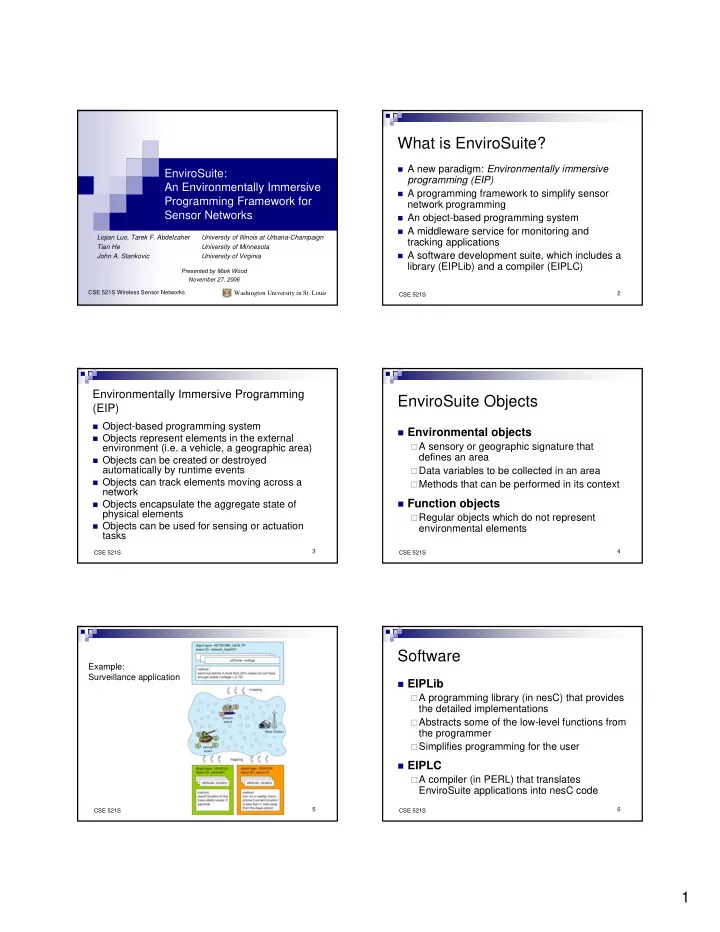
What is EnviroSuite? A new paradigm: Environmentally immersive - - PDF document

what is envirosuite
SMART_READER_LITE
LIVE PREVIEW

What is EnviroSuite? A new paradigm: Environmentally immersive - - PDF document

What is EnviroSuite? A new paradigm: Environmentally immersive EnviroSuite: programming (EIP) An Environmentally Immersive A programming framework to simplify sensor Programming Framework for network programming Sensor Networks An


slide-1
SLIDE 1

1

CSE 521S Wireless Sensor Networks

Washington University in St. Louis

EnviroSuite: An Environmentally Immersive Programming Framework for Sensor Networks

Liqian Luo, Tarek F. Abdelzaher University of Illinois at Urbana-Champaign Tian He University of Minnesota John A. Stankovic University of Virginia

Presented by Mark Wood November 27, 2006 CSE 521S 2

What is EnviroSuite?

A new paradigm: Environmentally immersive

programming (EIP)

A programming framework to simplify sensor

network programming

An object-based programming system A middleware service for monitoring and

tracking applications

A software development suite, which includes a

library (EIPLib) and a compiler (EIPLC)

CSE 521S 3

Environmentally Immersive Programming (EIP)

Object-based programming system Objects represent elements in the external

environment (i.e. a vehicle, a geographic area)

Objects can be created or destroyed

automatically by runtime events

Objects can track elements moving across a

network

Objects encapsulate the aggregate state of

physical elements

Objects can be used for sensing or actuation

tasks

CSE 521S 4

EnviroSuite Objects

Environmental objects

A sensory or geographic signature that

defines an area

Data variables to be collected in an area Methods that can be performed in its context

Function objects

Regular objects which do not represent

environmental elements

CSE 521S 5

Example: Surveillance application

CSE 521S 6

Software

EIPLib

A programming library (in nesC) that provides

the detailed implementations

Abstracts some of the low-level functions from

the programmer

Simplifies programming for the user

EIPLC

A compiler (in PERL) that translates

EnviroSuite applications into nesC code

slide-2
SLIDE 2

2

CSE 521S 7

Relation to nesC

CSE 521S 8

Object IDs

Label a contiguous group of nodes that

match a sensory signature

Data operations can be performed on

different locales based on their object ID

Group state is stored in variables

encapsulated within named objects

CSE 521S 9

Object Declarations

Object type - programmer-defined label Object context – mapping of the object to an

environmental element

Object attribute – measurements collected and

aggregated in the object context

Object method – encapsulated methods that

perform computation, communication or actuation

CSE 521S 10

Object Declaration - Example

CSE 521S 11

Object Context

EIPLib contains sensor data processing

algorithms that can return:

sensor output, i.e. temperature() environmental conditions, i.e. vehicle_sound() node attributes, i.e. voltage()

Example:

  • bject_condition = ferrous_object() && vehicle_sound();

CSE 521S 12

Object Context

Object conditions can also be parameterized. Example:

  • bject_condition = altitude()>500 && temperature()<32;
slide-3
SLIDE 3

3

CSE 521S 13

Object Attributes

Sensor measurements and aggregation

method

Degree of confidence in received

aggregation

Freshness of attribute

  • bject_attribute location

attribute_value = AVERAGE(position()) attribute_degree = 2 attriute_freshness = 500ms

CSE 521S 14

Object Methods

Methods in object_main_function statements get

called during object creation

  • bject_main_function = vehicle.getLocation;

Methods in object_function statements get called

  • nly by other objects
  • bject_function = monitor.reportLocation;

CSE 521S 15

Inter Object Call (IOC)

Methods can use EnviroSuite communications primitives

To execute an IOC and declare its handler: ES_IOC report = call monitorInstance. monitor.reportLocation(currentLocation); To receive IOC result interrupts: ES_IOCRESULT report(bool result) { // deal with remote call results here return; }

CSE 521S 16

Global Variables

Globally shared static variables can be defined with ES_READ

and ES_WRITE command result_t vehicle.getLocation(){ call ES_WRITE(monitorInstance.vehicleNumber, monitorInstance.vehicleNumber + 1); return call Timer.start(TIMER_REPEAT,500);}

CSE 521S 17

EnviroSuite supports 3 types of objects:

Event objects – created for mobile events that

dynamically change their geographic location

Region objects – mapped to static or slowly

moving regions

Function objects – not mapped to an

environmental element

CSE 521S 18

Event Object Maintenance

Event objects are created dynamically Multi-target group management protocol

(MGMP) gives the object a unique object ID

Movement of the contiguous region changes

group membership

MGMP maintains the object ID for the event

  • bject despite mobility

This is transparent to the programmer

slide-4
SLIDE 4

4

CSE 521S 19

State of Nodes Around an Environmental Event

CSE 521S 20

Maintaining Object Uniqueness

Internally, MGMP elects a leader to maintain a unique

  • bject ID

The leader sends periodic heartbeats to nodes within

the object_resolution

The heartbeat period can affect the object creation

latency

Nodes can have only one object ID MGMP maintains a state machine for node state

transitions

A delayed object creation mechanism is used to

ensure that the group has elected a single leader

CSE 521S 21

Tracking Moving Events

Object migration - Leadership handover, used

in tracking moving events

Follower nodes hear heartbeats from leaders

and know in advance the incoming event

When the event is sensed, the node joins

existing objects as a member, instead of creating spurious objects

The trajectory of the leader is stored in its

representing object

When 2 events cross, the leaders use a

temporary object ID which is a concatenation of both, and track each other’s trajectory until a disambiguation algorithm can be used

CSE 521S 22

Region Object Maintenance

Region objects are associated with a relatively fixed set

  • f nodes

A default leader sends out tree requests Spanning tree algorithm is used to construct a multi-

parent diffusion tree with the leader as root

The tree’s outer boundary is defined by outer nodes Adding and pruning of tree leaves is done to satisfy the

  • bject condition

Object attributes get aggregated along intermediate hops The root of the aggregate tree is migrated to the

location that minimizes communication and aggregation overhead, and to a higher energy node

CSE 521S 23

Evaluation: Object Creation Delay

CSE 521S 24

Evaluation: Object Migration

slide-5
SLIDE 5

5

CSE 521S 25

Evaluation: Object Crossing

CSE 521S 26

Evaluation: Inter-Object Communication

CSE 521S 27

Evaluation: Code Length

CSE 521S 28

Critiques

Hard-coded content (fixed number and type of

  • bjects you can track)

The mote cannot access the object ID The object ID is an abstraction on the base

station (not simplifying the code in the network itself)

Requires a leader (electing a leader and

changing the leader)

CSE 521S 29

Summary

Environmentally immersive programming can

be used to abstract environmental elements

EnviroSuite provides a library of algorithms for

tracking and environmental monitoring

Programming is simplified and code length is

reduced

Evaluation shows EnviroSuite performs well in

maintaining object uniqueness and identity, and inter-object communication

CSE 521S 30

EnviroSuite & Semantic Streams [Whitehouse, et al. 2005]

Both have similar goals:

Programming framework to simplify sensor network

programming

Middleware service for monitoring and tracking

applications

Confidence level for environmental element classification To abstract environmental elements, simplifying

programming

Network-based, rather than node-based language Energy-balancing in sensor networks

This work makes it possible for non-technical people to write efficient programs for sensor networks.

slide-6
SLIDE 6

6

CSE 521S 31

Questions?