
SLIDE 1
Session 2
Admissions at GSA
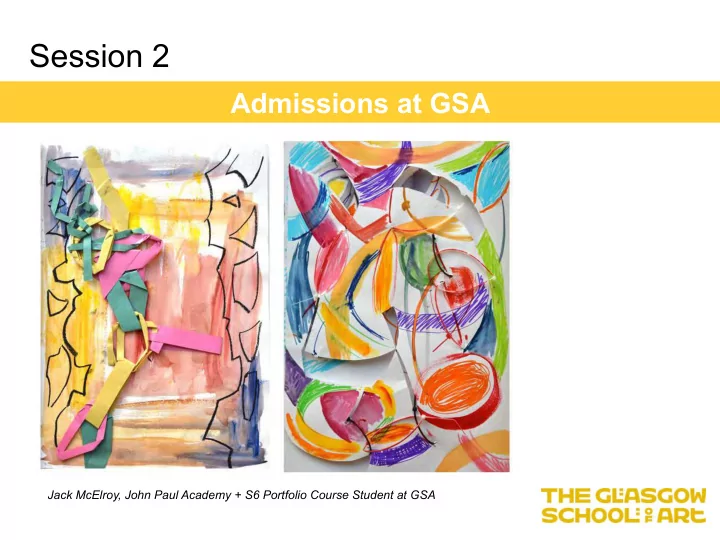
Jack McElroy, John Paul Academy + S6 Portfolio Course Student at GSA
Session 2 Admissions at GSA Jack McElroy, John Paul Academy + S6 - - PowerPoint PPT Presentation
Session 2 Admissions at GSA Jack McElroy, John Paul Academy + S6 Portfolio Course Student at GSA Applying to the Glasgow School of Art What's needed to apply? Portfolio Qualifications Good Qualifications are important but remember...
Jack McElroy, John Paul Academy + S6 Portfolio Course Student at GSA
What's needed to apply?
…Good Qualifications are important but remember... “we are willing to consider applications for admission from those who do not have the published conventional qualifications” ¡
Choice Use all 5 choices There is no ranking – institutions can only see their own applications Entry Point HNC/D applicants should consider applying for advanced entry (Entry Point 2 or 3)
List other things outside coursework that would support the application.
Ardentinney Summer Art Residential Life Drawing Classes GSA WP Programme Tramway Visual Arts Studio classes The University of Glasgow (Top-up, Reach, Taster Weeks, Summer School) Glasgow Caledonian University (Fashion Brand Retailing course) Any other classes or courses taken at weekends or in the evening
¡ Mention any Widening Participation activities or other courses, for example:
Widening participation printmaking course at Glasgow Print Studio
Applicants can tell us about these activities in a number of ways:
Higher Education section on UCAS form Ideally mention it in all 3 places!
S4 Taster Week at the Glasgow School of Art
In the UCAS Personal Statement: This applicant listed no less than 10 separate additional activities.
GSA Saturday morning classes, summer workshops and Art School open day visits in London, Glasgow and Edinburgh are extra-curricular activities that have enriched my experience so far. Additionally, life drawing classes, Ardentinny summer art residential, Tramway visual arts studio portfolio classes, Fashion Retail and Branding at GCU and the most recent two day BP Portrait workshop (Edinburgh) have supported my development. Visiting
stimulating and inspiring, something I have touched on in a 'Pop up' art school three-day course at Glasgow Art Club. ¡
In the Reference:
Callum works constantly on his artistic development. He has attended classes at the Glasgow School of Art and courses at GOMA. He has also attended various artists' talks, additional night classes, life-drawing classes, art portfolio classes, gallery visits and open days. Furthermore, Callum has won national competitions for his designs. Our school is a partner in the Focus West (previously GOALS) project, a key initiative that aims to widen participation in higher education. Chris is participating in the Top-Up programme at the University of Glasgow. This will provide him with a greater insight into the demands of University life, which he now feels prepared for. A number of admissions tutors at universities in Scotland are prepared to take this into account when considering an applicant's profile.
In the Activities in preparation for Higher Education section:
The Sponsor for GSA can be listed as FOCUS West This applicant has listed that they attended the 20 week S6 Portfolio Course at the Glasgow School of Art.
10 most common opening lines in 2015 were¹:
¹ ¡2015 UCAS Data
12 ¡
We’ve prepared some questions to help generate relevant content for UCAS Personal Statements
Applicants can try our Trigger Questions
College Referees - please tell us in your reference:
It is obvious that Sophie has talent and she is obviously passionate and keen to
elsewhere.
Daniel is a brilliant student who wholeheartedly embraces creative challenges and
keeps with him at all times. His work is well researched and he is very open to discussion and proactive with advice. Discuss the strengths and weaknesses of both examples. Which do you think is more appropriate?
applying
making work
work
practitioners (visually and in the statement)
The efolio + statement should show that an applicant:
Number of image files: Fine Art – 25 Design – 15 Architecture – 15 To show as much work as possible, we recommend placing multiple images on one image file, where appropriate. This often works well in showing development work. Helpful guides available on the GSA Website: Photographing work for efolio Preparing an efolio
Files must be .jpeg .png or .gif Files must be 200kb or less Must upload the exact number of files required
¡
Files must be .jpeg .png or .gif Files must be 200kb or less Must upload the exact number of files required Number of image files Fine Art – 25 Design – 15 Architecture – 15 Multiple images can be composed onto one image file Helpful guides available on the GSA Website: Photographing work for efolio Preparing an efolio This is an example of development work on one image file
in greater detail
their work. These influences don’t have to be just within the specialism they are applying for.
*Excluding Product Design Engineering
There are 5 different sets of assessment criteria according to programme applied for:
Applicants are scored against criteria from 1 (Unsatisfactory) to 7 (Excellent)
This is an example of the assessment screen viewed by assessors
Note what happens if the images are less than 200kb!
In my second project, which was all about working in multiples, I chose to work with balloons and string. I was interested in experimenting with the balloons in various states of inflation and thinking about how I could use the string to install the balloons as obstructions in public spaces.
I have a keen interest in not only art but also photography I enjoy discovering new places and capturing the beauty of them within a photograph. Discuss the strengths and weaknesses of both examples. Which do you think is more appropriate?
The portfolio interview shows if an applicant:
GSA generally
relevant sources and influences
cultural influences
project
Work in the portfolio should:
Portfolios can be annotated or have labels to give a little bit more context Helpful guides available on the GSA website: Physical Portfolio Getting Ready for Interview
Sketchbooks are important for showing process and research There are many different ways of using sketchbooks:
engagement with a range of about visual art/design
Some standard questions:
Some trickier questions:
talk about space.
As in the e-folio, there are 5 different sets of assessment criteria according to programme applied for:
Applicants are scored against criteria from 1 (Unsatisfactory) to 7 (Excellent)
Charlie Cook, Sculpture & Environmental Art, 98 Lift-offs
3 possible outcomes for an application to GSA
Unsuccessful applicants can email registry@gsa.ac.uk to find out what their numerical scores were for e-folio and interview. Students with conditional offers should read the conditions very carefully. If the conditions are BBB at Higher level, that is exactly what they are looking for e.g. an Advanced Higher B and BB at Higher level may not be accepted! Unconditional offer means that they are able to start in September regardless of their exam results.
wp@gsa.ac.uk