
SLIDE 1
Developing EEA art 20.3b assessment
Trine Christiansen I 27/10/215 I Marine team meeting, Copenhagen
Developing EEA art 20.3b assessment The sea area in Europe is about - - PowerPoint PPT Presentation
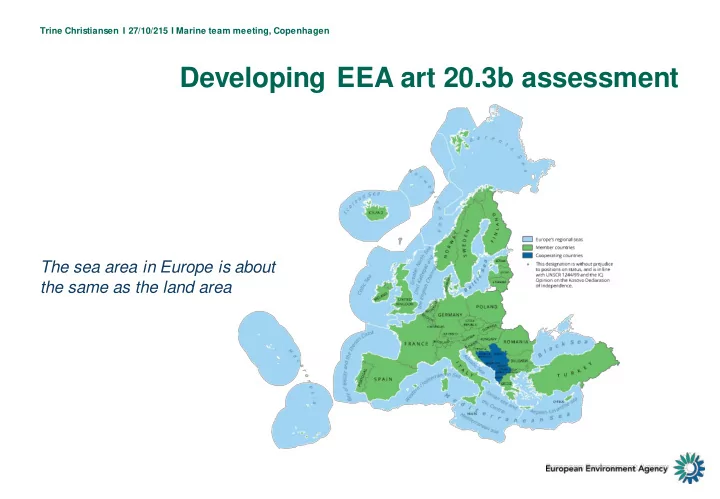
Trine Christiansen I 27/10/215 I Marine team meeting, Copenhagen Developing EEA art 20.3b assessment The sea area in Europe is about the same as the land area Our partners and networks: the Eionet
Trine Christiansen I 27/10/215 I Marine team meeting, Copenhagen
SUSTAINABILITY
2050 2014/2018
WFD targets Nature Directives targets MSFD Baseline 2020 targets MSFD target (Good Environmental Status) Halt biodiversity loss Fisheries below Max. Sustainable Yield 20-20-20 targets Vision in 7EAP Reduce GHG 80- 95% Water blueprint Zero impacts (air) SDGs ?
TIME
2014-2018 thematic policies timelines and deadlines 2020/2030 comprehensive policies (Europe 2020, 7th EAP), or specific targets 2050 long term visions and targets with a societal transition perspective
Recognising connections Multiple
Cumulative impacts Spatial approach
http://www.eea.europa.eu/publications/state-of-europes-seas
RSC and fisheries assessments & indicators Art 8, 9, 10, 11, 13 EEA indicators and SoES Outputs from research projects MSFD information base
Holas II OSPAR IA UNEP/MAP Ecap Black Sea Regional fisheries
Annex III element Name of indicator MSFD descriptor (DPSIR) compon ents RSC/Or g in roof Report ? Regions covered Next publi- cation year Sectio n of SoES 2015 Birds B-3: Marine bird breeding success/failur e D1 - Biological diversity State OSPAR Yes regions I (partial), II, III, IV Dec 2015 Birds B-1: Marine bird abundance D1 - Biological diversity; D4 - Marine food webs State OSPAR Yes regions I (partial), II, III, IV Dec 2015 in Section 3.7 Birds Abundance of waterbirds in the breeding season D1 - Biological diversity; D4 - Marine food webs State HELCO M Yes NA tbc Birds Abundance of waterbirds in the wintering season D1 - Biological diversity; D4 - Marine food webs State HELCO M Yes NA tbc Birds White-tailed eagle productivity D1 - Biological diversity; D4 - Marine food webs; D8 - Contaminants State HELCO M Yes NA tbc
Year Art 20.3b activities 2015 Develop overview of information base that can be expected from Regional Sea Convention (first complete
Agreement with MS and RSC on indicator structure to achieve same structure between RSC and EEA. (1.6.1c) European streamlining of state, pressure and impacts through cross-cutting paper and launch associated GES assessment guidance. EEA analytical framework matches the European approach. (no task) 2016 Develop ideal assessment scope and storyline and
Complete overview of technical content: indicator and assessment inventory and map to assessment outline (1.6.1c) Identify information needs from art 8 assessment reporting (1.6.1c and 1.6.2a?) Identify analytical needs (1.6.1g, 1.6.2a) Develop presentation of MS assessment results (1.6.1a?) Test and adjust assessment tools to MSFD guidance (1.6.1g) Output early autumn 2016 draft ‘dummy’ report (1.6.2a) Consult draft ‘dummy’ report with Eionet, MS, RSC and Commission (EEA)
Year Art 20.3b activities 2017 Adjust assessment scope and storyline, and outline based on consultation (1.6.2a) Develop analysis (1.6.2a) Update or complete technical content (inventory) (1.6.2a) Develop assessment demonstration using assessment tools (1.6.1g) Begin to write assessment contributions (1.6.2a) Secure technical connection between art 8 reports and GES presentation in report to enable fast uptake of MS results.(1.6.1a?) Consult draft report with Eionet, MS, RSC and Commission (EEA) 2018 Prepare almost final draft of assessment (1.6.2a) 2019 Update assessment with MS results as possible (1.6.1a) Update and finalise assessment text (EEA) Consult final draft report with Eionet, MS, RSC and Commission (spring 2019) May-Nov: Finalise report (editing, graphics, etc) (EEA) Publish report Nov 2019