SLIDE 1 P1 Sep–Oct 2012 • Timothy Van Zandt • Prices & Markets Session 16 • Wrap up Page 1
1
Session 16: Wrap up
1. ➥ Strategic commitment (from Session 15).
- 2. Entry as a congestion game.
- 3. Wrap up.
2
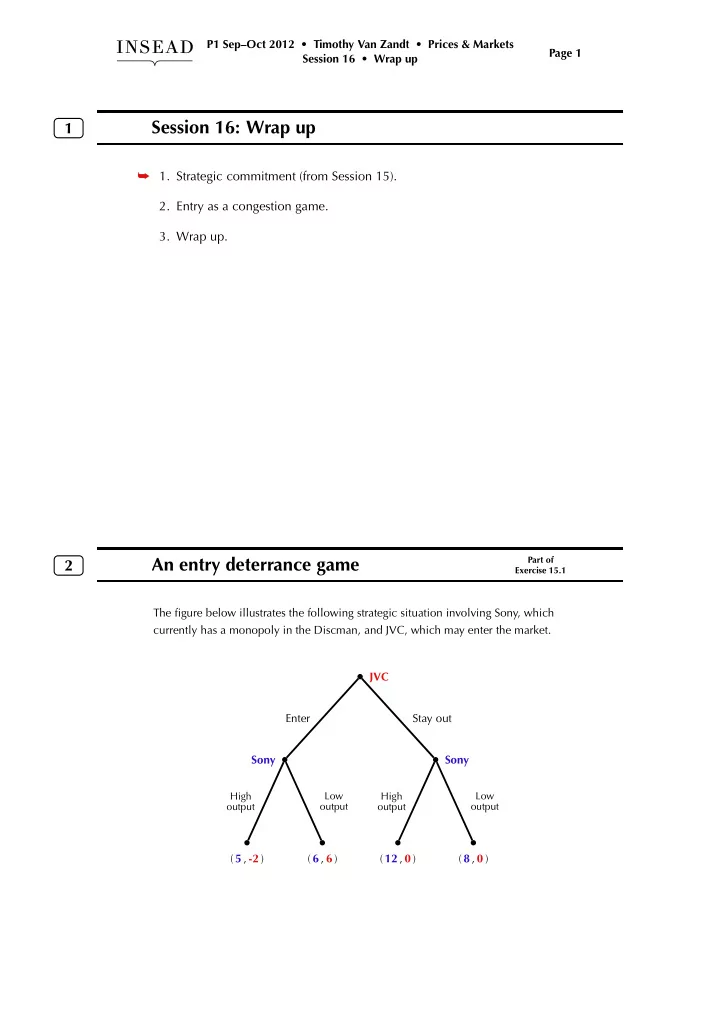
An entry deterrance game
Part of Exercise 15.1
The figure below illustrates the following strategic situation involving Sony, which currently has a monopoly in the Discman, and JVC, which may enter the market. JVC Sony Enter ( 5 , -2 )
High
( 6 , 6 )
Low
Sony Stay out ( 12 , 0 )
High
( 8 , 0 )
Low
SLIDE 2 P1 Sep–Oct 2012 • Timothy Van Zandt • Prices & Markets Session 16 • Wrap up Page 2
3
Suppose Sony is making plans to build a new plant
Sony JVC Large plant Sony Enter ( 4 , -2 )
High
( 3 , 6 )
Low
Sony Stay out ( 11 , 0 )
High
( 5 , 0 )
Low
JVC Small plant Sony Enter ( 5 , -2 )
High
( 6 , 6 )
Low
Sony Stay out ( 12 , 0 )
High
( 8 , 0 )
Low
4
Pricing game from Session 12
Firm B Low Med High Low 19 20 18 25 10 33 Firm A Med 24 23 28 31 22 38 High 30 15 40 27 34 42
SLIDE 3
P1 Sep–Oct 2012 • Timothy Van Zandt • Prices & Markets Session 16 • Wrap up Page 3
5
Suppose that Firm B can commit to its price first
Firm B Firm A
( 24 , 23 )
Low ( 19 , 20 ) Low ( 24 , 23 ) Med
( 30 , 15 )
High
( 28 , 31 ) Firm A
Med ( 18 , 25 ) Low
( 28 , 31 )
Med ( 40 , 27 ) High
( 34 , 42 ) Firm A
High
( 10 , 33 )
Low ( 22 , 38 ) Med ( 34 , 42 ) High
6
Summary: What are Stackelberg games?
From these ingredients: two players: 1 and 2 player 1 chooses action A1 and player 2 chooses action A2 We can have three different strategic situations, depending on the timing: Simultaneous moves Sequential game in which player 1 moves first Sequential game in which player 2 moves first Such sequential games are called Stackelberg games. Player who moves first is the leader; other player is the follower.
SLIDE 4
P1 Sep–Oct 2012 • Timothy Van Zandt • Prices & Markets Session 16 • Wrap up Page 4
7
Summary: What about Stackelberg games?
They let us see how timing and strategic commmitment matter. Who is behaving differently in Stackelberg vs. Nash? Follower? Leader?
8
Preemptive investments
Your firm is first to develop the next generation memory chip. You thus will be the first firm to install capacity. What are you thinking?
SLIDE 5 P1 Sep–Oct 2012 • Timothy Van Zandt • Prices & Markets Session 16 • Wrap up Page 5
9
Wrap up on strategic commitment
When you have the chance to commit, think about:
- 1. In what way you want to influence the other players’ actions.
- 2. How you can achieve this.
10
Session 16: Wrap up
1. ✓ Strategic commitment (from Session 15). 2. ➥ Entry as a congestion game.
SLIDE 6 P1 Sep–Oct 2012 • Timothy Van Zandt • Prices & Markets Session 16 • Wrap up Page 6
11
Congestion games
What do these situations have in common?
- 1. Entering a market.
- 2. Going to study at the INSEAD library.
- 3. Entering a random draw for free tickets to a concert.
- 4. Deciding whether to focus on the finance job market.
12
Congestion games — simple version
Simplification: “How many” not “who”. Each player cares about how many other players are in, but not on their identities.
SLIDE 7 P1 Sep–Oct 2012 • Timothy Van Zandt • Prices & Markets Session 16 • Wrap up Page 7
13
Example
Value of being in, excluding entry cost
Session 16: Wrap up
1. ✓ Strategic commitment (from Session 15). 2. ✓ Entry as a congestion game. 3. ➥ Wrap up.
SLIDE 8 P1 Sep–Oct 2012 • Timothy Van Zandt • Prices & Markets Session 16 • Wrap up Page 8
15
What is this course about?
Consumers
Firms Markets
Prices Quantities
Our focus is on Firms. And the topics differ according to how we treat firms.
16
Main structure
(Sessions 1–6)
(Firms’ decisions & equilibrium)
Firms are price-takers (Perfect competition) Firms have market power (Imperfect competition)
(Sessions 7–11)
Firms’ decisions
(Sessions 12–15)
Equilibrium
In each case: fixed firms in the market, then entry/exit
SLIDE 9 P1 Sep–Oct 2012 • Timothy Van Zandt • Prices & Markets Session 16 • Wrap up Page 9
17
Imperfect competition
Perfect competition
Fixed firms in market
MC = MR = P ⇓ s i (P) Firms’ decisions s(P) = d(P) Equili- brium
Entry & exit
VΠ > FC? P > AC u ? Firms’ decisions
Each active firm has economic profit ≥ 0 . No potential entrant could make economic profit > 0 by entering.
Equilibrium
18
Perfect competition
Imperfect competition
Fixed firms in market
MC = MR ⇓ P, Q Firms’ decisions Nash eqm. Equili- brium
Entry & exit
VΠ > FC? Firms’ decisions
Each active firm has economic profit ≥ 0 . No potential entrant could make economic profit > 0 by entering.
Equilibrium
SLIDE 10 P1 Sep–Oct 2012 • Timothy Van Zandt • Prices & Markets Session 16 • Wrap up Page 10
19
More economics by economists
- Macroeconomics in Global Economy
(P3 core)
Interest rates, exchange rates, employment, …
(P4)
Applied, but for those who find rigorous modeling useful.
- Economics and Management of Developing Countries
(P4 elective)
Title says it all.
- Business and Public Policy
(P4 mini)
Trade, globalization, environment, labor markets, …
20
More microeconomics-related courses
Including Corporate Financial Policy (P2 core)
- Pricing Strategies and Tactics
(P5 elective)
More pricing!
- Dynamic Pricing and Revenue Management
(P5 elective)
Pricing and screening, plus the complications of stochastic demand
- Industry and Competitive Analysis
(P4 & P5 elective)
Much more applied but similar frameworks as in P&M.
Incomplete information, behavioral biases, commitment problems