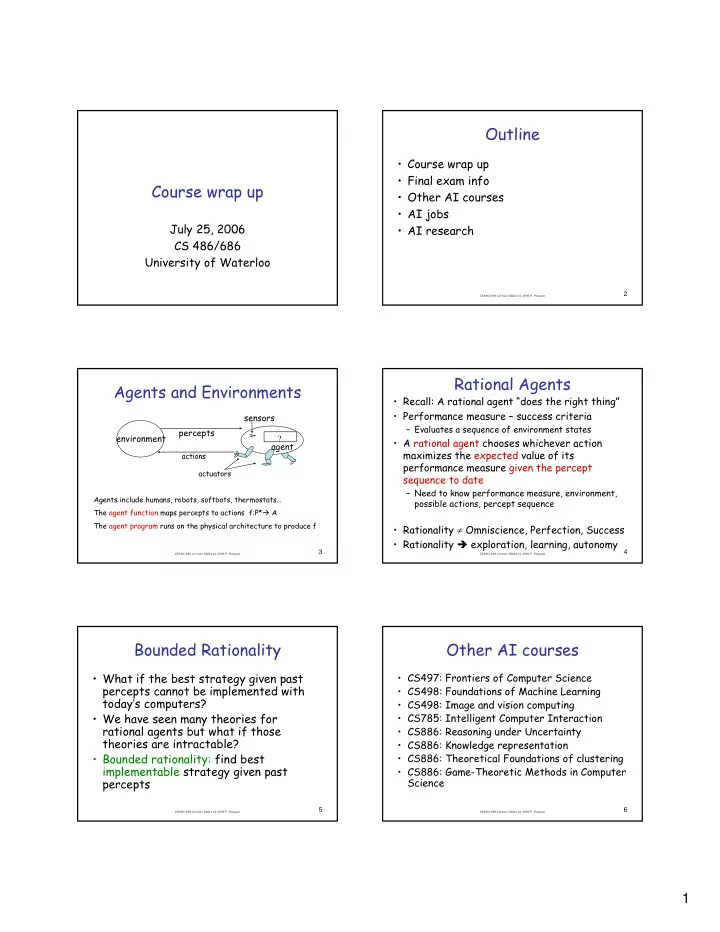
Outline Course wrap up Final exam info Course wrap up Other AI - - PDF document

outline
SMART_READER_LITE
LIVE PREVIEW

Outline Course wrap up Final exam info Course wrap up Other AI - - PDF document

Outline Course wrap up Final exam info Course wrap up Other AI courses AI jobs July 25, 2006 AI research CS 486/686 University of Waterloo 2 CS486/686 Lecture Slides (c) 2006 P. Poupart Rational Agents Agents and


slide-1
SLIDE 1

1

Course wrap up

July 25, 2006 CS 486/686 University of Waterloo

CS486/686 Lecture Slides (c) 2006 P. Poupart

2

Outline

  • Course wrap up
  • Final exam info
  • Other AI courses
  • AI jobs
  • AI research

CS486/686 Lecture Slides (c) 2006 P. Poupart

3

Agents and Environments

environment percepts

actions

? agent sensors

actuators Agents include humans, robots, softbots, thermostats… The agent function maps percepts to actions f:P* A The agent program runs on the physical architecture to produce f

CS486/686 Lecture Slides (c) 2006 P. Poupart

4

Rational Agents

  • Recall: A rational agent “does the right thing”
  • Performance measure – success criteria

– Evaluates a sequence of environment states

  • A rational agent chooses whichever action

maximizes the expected value of its performance measure given the percept sequence to date

– Need to know performance measure, environment, possible actions, percept sequence

  • Rationality ≠ Omniscience, Perfection, Success
  • Rationality exploration, learning, autonomy

CS486/686 Lecture Slides (c) 2006 P. Poupart

5

Bounded Rationality

  • What if the best strategy given past

percepts cannot be implemented with today’s computers?

  • We have seen many theories for

rational agents but what if those theories are intractable?

  • Bounded rationality: find best

implementable strategy given past percepts

CS486/686 Lecture Slides (c) 2006 P. Poupart

6

Other AI courses

  • CS497: Frontiers of Computer Science
  • CS498: Foundations of Machine Learning
  • CS498: Image and vision computing
  • CS785: Intelligent Computer Interaction
  • CS886: Reasoning under Uncertainty
  • CS886: Knowledge representation
  • CS886: Theoretical Foundations of clustering
  • CS886: Game-Theoretic Methods in Computer

Science

slide-2
SLIDE 2

2

CS486/686 Lecture Slides (c) 2006 P. Poupart

7

CS497: Frontiers of Computer Science

  • Instructor: Shai Ben David
  • Term: Winter 2007
  • Objectives:

– The purpose of this course is to expose undergraduate students to research. It is meant to be a stimulating course where students get a taste of various research topics as well as the opportunity to explore in more depth a topic of their choice.

CS486/686 Lecture Slides (c) 2006 P. Poupart

8

CS498: Foundations of Machine Learning

  • Instructor: Shai Ben David
  • Term: Winter 2007
  • Objectives:

– The course is aimed to familiarize the students with the basic theoretical tools and issues underlying some of the most useful machine learning techniques. The theory of machine learning draws from several established mathematical areas including statistics, geometry, combinatorics, and computational complexity.

CS486/686 Lecture Slides (c) 2006 P. Poupart

9

CS498: Image and Computer Vision

  • Instructor: Richard Mann
  • Term: ???
  • Topics: TBA

CS486/686 Lecture Slides (c) 2006 P. Poupart

10

CS785 Intelligent Computer Interaction

  • Instructor: Robin Cohen
  • Term: ???
  • Topics:

– multiagent systems, – intelligent tutoring systems and knowledge-based systems, – datamining, – user modeling, – natural language generation and dialogue, – plan recognition

CS486/686 Lecture Slides (c) 2006 P. Poupart

11

CS886: Topics in AI: Reasoning under Uncertainty

  • Instructor: Pascal Poupart
  • Term: ???
  • Objectives:

– This course will focus on the principles of probabilistic reasoning and sequential decision making for a wide range of settings including adaptive and multi-agent systems. The modeling techniques that will be covered are quite versatile and can be used to tackle a wide range of problems in many fields including robotics (e.g., mobile robot navigation, control), computer systems (e.g., autonomic computing, query

  • ptimization), human-computer interaction (e.g., spoken

dialog systems, user modeling), bioinformatics (e.g., gene sequencing, design of experiments), operations research (e.g., resource allocation, maintenance scheduling, planning),

  • etc. Hence, the course should be of interest to a wide

audience beyond artificial intelligence.

CS486/686 Lecture Slides (c) 2006 P. Poupart

12

CS886: Topics in AI: Knowledge Representation

  • Instructor: Chrysanne DiMarco
  • Term: ???
  • Topics: TBA
slide-3
SLIDE 3

3

CS486/686 Lecture Slides (c) 2006 P. Poupart

13

CS886: Topics in AI:

Theoretical Foundations of clustering

  • Instructor: Shai Ben David
  • Term: Fall 2006
  • Topics: TBA

CS486/686 Lecture Slides (c) 2006 P. Poupart

14

CS886: Topics in AI: Game-Theoretic Methods in Computer Science

  • Instructor: Kate Larson
  • Term: Fall 2006
  • Topics: TBA

CS486/686 Lecture Slides (c) 2006 P. Poupart

15

AI research group

  • Web: ai.uwaterloo.ca
  • Professors:

– Shai Ben David (learning theory) – Chrysanne DiMarco (natural language processing) – Peter Van Beek (constraint programming) – Robin Cohen (multi-agent systems, user modeling) – Pascal Poupart (reasoning under uncertainty, machine learning, natural language processing) – Kate Larson (game theory, mechanism design) – Richard Mann (computational vision)

CS486/686 Lecture Slides (c) 2006 P. Poupart

16

My research projects

  • http://www.cs.uwaterloo.ca/~ppoupart/projects.html
  • Partially observable Markov decision processes
  • Intelligent assistive technologies
  • Spoken dialogue systems
  • Bayesian reinforcement learning
  • Trust modeling in electronic markets
  • Ontology learning
  • Preference elicitation

CS486/686 Lecture Slides (c) 2006 P. Poupart

17

AI jobs

  • Very few “AI companies”
  • AI tends to be embedded in many applications
  • Many companies have AI R&D groups

– Intel, Microsoft, IBM, Google, NEC, Yahoo, HP

  • AI is a growing industry
  • Has the potential to revolutionize the

computer industry!