
SLIDE 1
Services Librarian Sturgis Library, Barnstable L IBRARIES AND THE S - - PowerPoint PPT Presentation
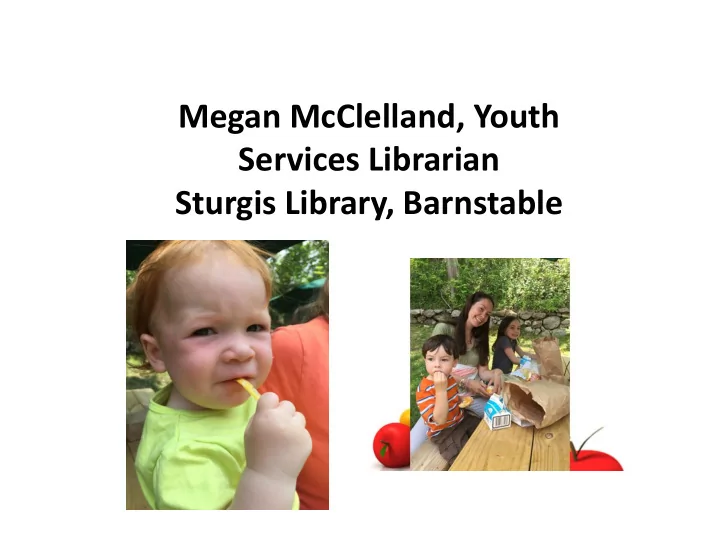
Megan McClelland, Youth Services Librarian Sturgis Library, Barnstable L IBRARIES AND THE S UMMER F OOD S ERVICE P ROGRAM Cate Merlin, Peabody Institute Library W HY IS THIS PROGRAM NEEDED ? Of Peabodys population of 51,000, 6% of families
Cate Merlin, Peabody Institute Library
Of Peabody’s population of 51,000, 6% of families
live below the poverty line
The kids and teens who spend their afternoons
and summers at the PIL often do not have reliable computer or internet access at home, and use the library for this technology as well as our programs, events and Makerspace equipment and classes
Kids who need free or discounted school lunches
still need somewhere to eat during the summer
Neutral place for children and teens to comfortably
eat lunch without stigma or embarrassment of needing “free” food
Known community center “Usual” summer programming partnered with
lunches is an easy tie-in for kids and the library
Specialized programming
(week-long “camps”, etc.) becomes possible now that lunch is included
At the PIL, lunch is served from at 12pm Mondays-
Thursdays during the summer, with a craft or activity available to children and teens after lunch. Daily attendance since the program began in 2009 is between 30-50 kids, depending on the year, weather, etc.
Do kids have to sign up? Who provides the food? Who serves the food? Staff Requirements Space Requirements Equipment Requirements
Full commitment by all library staff is needed. This is a big undertaking,
depending on attendance, and having the support of all staff is necessary for kids and teens to truly feel welcome to eat, laugh and be merry in a setting that doesn’t always encourage eating and noise, especially in the same place!
A dedicated staff member in charge of day-to-day technicalities (food
temperature, lunch counts, etc.) turns the program in a well-oiled machine
Teen/adult volunteers can help with
set up, distribution and after-lunch activities and programs (bonus if your library has access to summer internship or volunteer program for local teens)
Community partners can help advertise, staff and promote your
Summer Foods program. Even if an organization can’t contribute financially, they can still donate the time and effort of employees and volunteers.
Advertise programs and events that include lunch, so parents know
their kids will both have access to a nutritious meal while participating in fun activities
School districts are often able to place “robo-calls” informing all
parents of Summer Foods program- this will bring incredible attendance, so only do this if you’re prepared!
Grants to purchase programming equipment (i.e. tables, chairs,
playground toys) or supplies for specific programs and events can expand your programming abilities and provide support for truly amazing summer events that combine the SFSP with the national summer reading theme
Think about how the SFSP fits into your library and its mission. Why should your library run summer foods? Thinking through this part early will help if your colleagues and potential partners have questions about the library’s role in a program like this.
Talk to your library director and co-workers about the SFSP. Explain why you think your library should get involved.
See if a SFSP is already operating in your community. If so, it may be fairly easy to add your library as a feeding site. The public school Food Service Department in your city or town may be a good place to start.
If you are starting from scratch, contact the state agency in charge of Child Nutrition Programs. To find your state’s agency, check out: http://www.fns.usda.gov/cnd/Contacts/StateDirectory.htm#M
Brainstorm partners. Start with organizations in your community who have an interest in serving youth (schools, churches, recreation departments, YMCAs,), but don’t stop there. If a potential partner can’t participate, think outside the box about who else could fulfill the needed role.
Involve elected officials early. Your mayor, council and school board members or library trustees may have contacts and influence that can benefit your SFSP.
Explore funding options. The federal reimbursement rate may not cover all expenses, especially if you plan to offer programs and activities at your site. In Massachusetts, the statewide non-profit Project Bread (www.projectbread.org) offers grants for new sponsors and sites and for programs wishing to offer locally grown produce as part of their summer meals. Also, consider local businesses, hospitals and foundations as potential funders.
Don’t limit partners to only those who can provide financial support. Look for in-kind contributions and for partners who can step in for each other should problems arise.
Refrigerated Mobile Summer Meal Program
ensuring continuous access to nutritious meals when school is not in session during end of June, July, and August, some sites on Saturday's doubled the number of meals from 13,000 year I to 26,000 year II 2 DCR pool locations 3 City Libraries: main and 2 branches Libby Mobile Library (year 2): high need neighborhood 10 Parks (year 2): afternoon programming 2 Central Mass YMCA Camps (year 2): open sites
Farmers Market with activities on Saturday
SFSP Kickoff
Deeana Ijaz, MS, MPH February 10th, 2016
children participating in SFSP
Source: http://www.fns.usda.gov/sites/default/files/NutritionGuide.pdf
activity.
Source: http://www.fns.usda.gov/sites/default/files/NutritionGuide.pdf
children healthy behaviors
and activities
Help the youth you serve develop healthy habits at a young age that can last a lifetime
25-35 Min Sessions 15 Minute Physical Activities Easy to print handouts Handouts can be used as a group or in pairs of children
Use fruits and vegetables you are already serving to make SFSP more fun!