Service for Watertown December 9, 2014 fEB 1 Agenda Recap of - - PowerPoint PPT Presentation

service for watertown
SMART_READER_LITE
LIVE PREVIEW

Service for Watertown December 9, 2014 fEB 1 Agenda Recap of - - PowerPoint PPT Presentation

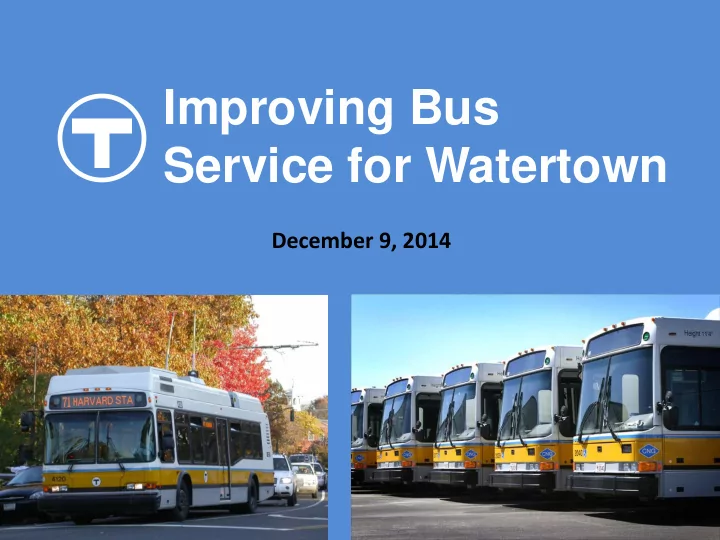
Improving Bus Service for Watertown December 9, 2014 fEB 1 Agenda Recap of August 6th meeting Transportation Management Association (TMA) Corridor Transit Study Scope of Work Overview of current MBTA service


slide-1
SLIDE 1

Improving Bus Service for Watertown

1 fEB

December 9, 2014
slide-2
SLIDE 2

Agenda

  • Recap of August 6th meeting
  • Transportation Management Association (TMA)
  • Corridor Transit Study Scope of Work
  • Overview of current MBTA service
  • Possible short-term improvements
  • Possible medium and long-term improvements
  • Next Steps

2

slide-3
SLIDE 3

August 6th Meeting

  • Improve bus service quality (trip times, reliability, crowding)
  • Transit needs of the new development
  • Expand Watertown bus service
  • Operate and maintain additional buses
  • Possible short and long term strategies

3

slide-4
SLIDE 4

TMA Discussion

4

slide-5
SLIDE 5

Corridor Transit Study Discussion

5

slide-6
SLIDE 6

Draft Timeline

2015 2016

J F M A M J J A S O N D J F M A M J J A S O N D

Retain Study Consultant Hold Community Meetings Perform Study of Short Term Improvements Perform Corridor Transportation Study

6

slide-7
SLIDE 7

7

slide-8
SLIDE 8

Watertown MBTA Bus Service

Route Route Description Daily Ridership 52 Dedham Mall – Watertown Yard 765 57 Watertown Yard – Kenmore Station 12,059 59 Needham Junction – Watertown Square 1,497 70/70A Cedarwood – Central Sq. Cambridge (incl. 70A) 7,357 71 Watertown Square – Harvard Station 5,548 73 Waverley Square – Harvard Station 6,424 502 Watertown Yard – Copley Square 1,205 504 Watertown Yard – Downtown Boston 1,547 554 Waverley Square – Downtown Boston 658 558 Auburndale – Downtown Boston 432

slide-9
SLIDE 9

Watertown MBTA Bus Service

  • Routes 70/70A, 71, and 73 are most heavily used routes by

Watertown travelers

  • Routes 71 & 73 recently upgraded as part of the Key Bus Routes

Improvement Program.

– Some changes on the 73 will be completed as part of the Trapelo Road re-construction. – Trackless trolleys are being replaced by diesel buses due to Trapelo Road re-construction through 2015.

  • The 500-series are express routes serving Downtown & Back Bay via

the MassPike

  • Route 57 is a Key Route with a Watertown terminus, but with very

few stops in Watertown

slide-10
SLIDE 10

Improvement Opportunities

10

slide-11
SLIDE 11

Recent / What’s Underway

  • On Routes 70/70A: More

buses and 6 additional round trips added to weekday evenings and Sundays

  • Key Bus Route Improvements,

including stop spacing, accessibility, and amenities, recently completed on the 71, and underway on the 73

11

slide-12
SLIDE 12

Early Action Opportunities

  • Add or Reallocate Off-Peak Bus Trips
  • Target most crowded times as resources become available
  • Shift resources from less crowded times to more crowded times
  • Improve Reliability
  • Use GPS data to give buses the right amount of run time and recovery
  • time. May require either frequency adjustments or additional

buses/drivers, as resources allow

  • Coordinate 70 and 70A Service / smooth headways
  • High priority since 74% of riders can use either route
  • Headway / frequency irregularity leads to bunching and lower effective

frequencies than more evenly spaced trips

12

12

slide-13
SLIDE 13

Route 70/70A Cedarwood, North Waltham or Watertown Sq. - University Park

slide-14
SLIDE 14

Route 70/70A Profile

14

Route Route Segment Length (miles) Headways (peak/off

peak minutes)

Trip time (minutes) # of Stops (inbound /

  • utbound)

Share of route ridership Combined 70/70A Waltham Center – Cambridge 8.0 6-16/10- 40 22-55 43/50 74% Unique 70 Cedarwood – Waltham Center 2.4 20-30/20- 40 6-10 16/16 17% Unique 70A North Waltham – Waltham Center 6.7 35/40-60 13-24 33/18 or 17/34 9%

slide-15
SLIDE 15

70/70A Coordination, inbound

15

0:00 0:07 0:14 0:21 0:28 0:36 0:43 6:00 8:00 10:00 12:00 14:00 16:00 18:00 20:00 22:00 24:00

Route 70/70A Weekday inbound scheduled headways at Central Sq Waltham

Smoothed Current

slide-16
SLIDE 16

70/70A Coordination, outbound

16

0:00 0:07 0:14 0:21 0:28 0:36 0:43 6:00 8:00 10:00 12:00 14:00 16:00 18:00 20:00 22:00 24:00

Route 70/70A Weekday outbound scheduled headways at Central Sq Cambridge

Smoothed Current

slide-17
SLIDE 17

What would it take to smooth 70/70A scheduled headways?

  • Using existing 70/70A route structure, would

require adding wait time at Waltham Center, which requires extra buses and operators. Not feasible.

17

70A 70

slide-18
SLIDE 18

What if we restructure the routes and split off the 70A from 70?

  • North Waltham could have one bus to Waltham Center every 40 minutes

(compared to 35-60 minutes to Cambridge now).

  • Cedarwood could see 50% more trips and more evenly spaced trips
  • Most current 70/70A riders—74% of riders—would see better scheduled

frequencies—9% inbound and 4% outbound—with same number of trips. May also contribute to less “unscheduled” bunching.

  • Route structure changes would require public process, more survey of

existing customers, and conversations with affected users—especially in North Waltham.

18

70

slide-19
SLIDE 19

Key Bus Route Improvement Program— possible model for Route 70 improvements

  • 850+ bus stops
  • Routes with highest ridership & most frequent

service

  • 15 Routes Account for 33% of Bus Ridership
  • Over 35% of stops serve minority/low Income

neighborhoods

  • More reliable bus service
  • Less bus bunching & overcrowding
  • Faster trips
  • Fewer bus stops & reduced delays
  • Improved safety & accessibility
  • For seniors and persons with disabilities
  • Optimizing stop locations for safety and

security

  • Enhanced passenger amenities
  • Shelters, benches, signage, trash receptacles

19

19

slide-20
SLIDE 20

20

Optimizing stop spacing to minimize passenger travel time

MBTA Standard: All stops shall be spaced between 750’ and 1300’

Route 70/70A # of bus stops Stops closer than 750’ Stops closer than 500’ Inbound 87 50% 14% Outbound 92 50% 26%

slide-21
SLIDE 21

Bus Stop Consolidation

21

Former Bus Stop New Consolidated Bus Stop Former Bus Stop Existing Stop Spacing: 560’ (Less than MBTA Minimum of 750’)

slide-22
SLIDE 22

Accessibility & Safety

  • Move stops to safer locations
  • Lengthen stops for full

curbside access

  • New ADA landing pads
  • Reconstructed sidewalks
  • New pavement markings and

stop signage

22

Buses blocking crosswalks Uneven surface-tripping hazard

slide-23
SLIDE 23

Customer Comfort & Conveneince

23

  • Shelters
  • Benches
slide-24
SLIDE 24

New Bus Stop Signs & Pavement Markings

24

slide-25
SLIDE 25

Signal Improvements / Transit Signal Priority

  • Buses running behind schedule can

request a longer green light to speed up service

  • Currently active at four locations on

Route 57 (plus eight locations on the Silver Line)

  • Under consideration at additional Boston
  • intersections. Intersections must be

connected to Boston’s traffic control center.

  • Cambridge and Brookline are also

considering TSP

25

slide-26
SLIDE 26

Typical Queue Jump / Right Turn Lane

26

Existing

  • Bus stop is nearside
  • Westbound bus gets

delayed in traffic queue at signalized intersection

With Queue Jump Lane

  • Bus stop moved to

farside

  • Bus bypasses most of

queue by utilizing right turn lane to go straight.

N

slide-27
SLIDE 27

Other Potential Improvements

Fare Collection Improvements Dedicated Bus Lanes

slide-28
SLIDE 28
  • Improvements to the Mount Auburn Street/Fresh

Pond Parkway intersection to reduce congestion

  • Fare collection: MassDOT study currently underway

for future implementation

  • Implement parking restrictions during peak hours
  • Evaluate possible need for extension of bus routes

from Pleasant St. & Bridge St. to Pleasant St. & Watertown Yard

Other Opportunities

slide-29
SLIDE 29

A Bus Facility in Watertown Yard?

  • Historically opposed by the

Town due to traffic concerns

  • Existing facility not code
  • compliant. Would require

costly renovation

  • Small size would create an

inefficient operation

  • Will be considered as part of a

larger systemwide bus facility strategic plan.

30

slide-30
SLIDE 30

Next Steps

  • MassDOT to initiate corridorwide

Transportation Study

  • MBTA to evaluate feasibility of service changes

along the Route 70/70A

  • Survey of North Waltham customers to

understand travel patterns

  • Public process along Route 70/70A corridor to

support route structure changes

31

slide-31
SLIDE 31

Contact Information

Ammie Rogers MassDOT Office of Transportation Planning phone: 857.368.8884 Email: ammie.rogers@state.ma.us

32