Sequential Monte Carlo Methods Click to edit Master text styles - - PowerPoint PPT Presentation

sequential monte carlo methods
SMART_READER_LITE
LIVE PREVIEW

Sequential Monte Carlo Methods Click to edit Master text styles - - PowerPoint PPT Presentation

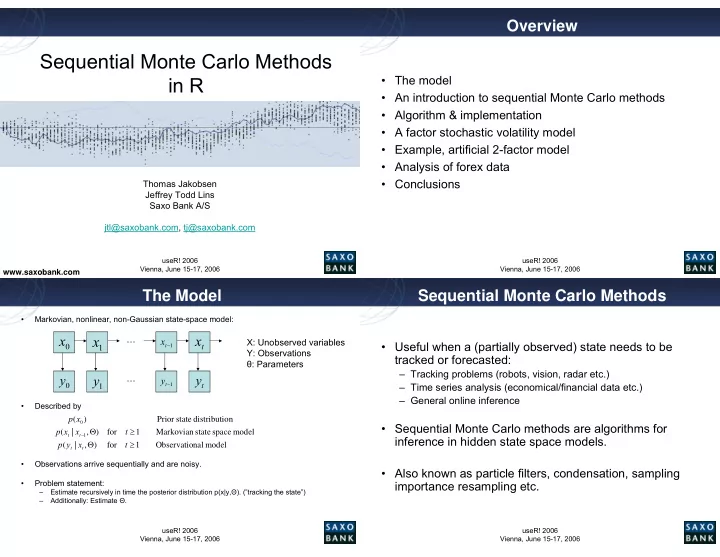
Overview Sequential Monte Carlo Methods Click to edit Master text styles Click to edit Master text styles in R The model An introduction to sequential Monte Carlo methods Second level Second level Algorithm &


slide-1
SLIDE 1

useR! 2006 Vienna, June 15-17, 2006

  • Click to edit Master text styles
  • Second level
  • Third level
  • Fourth level
  • Fifth level

Sequential Monte Carlo Methods in R

Thomas Jakobsen Jeffrey Todd Lins Saxo Bank A/S jtl@saxobank.com, tj@saxobank.com

www.saxobank.com

useR! 2006 Vienna, June 15-17, 2006

  • Click to edit Master text styles
  • Second level
  • Third level
  • Fourth level
  • Fifth level

Overview

  • The model
  • An introduction to sequential Monte Carlo methods
  • Algorithm & implementation
  • A factor stochastic volatility model
  • Example, artificial 2-factor model
  • Analysis of forex data
  • Conclusions

useR! 2006 Vienna, June 15-17, 2006

  • Click to edit Master text styles
  • Second level
  • Third level
  • Fourth level
  • Fifth level

The Model

  • Markovian, nonlinear, non-Gaussian state-space model:
  • Described by
  • Observations arrive sequentially and are noisy.
  • Problem statement:

– Estimate recursively in time the posterior distribution p(x|y,Θ). (”tracking the state”) – Additionally: Estimate Θ.

x

1

x

1 − t

x

t

x

… X: Unobserved variables Y: Observations θ: Parameters

y

1

y

1 − t

y

t

y

… model nal Observatio 1 for ) , | ( model space state Markovian 1 for ) , | (

  • n

distributi state Prior ) (

1

≥ Θ ≥ Θ

t x y p t x x p x p

t t t t

useR! 2006 Vienna, June 15-17, 2006

  • Click to edit Master text styles
  • Second level
  • Third level
  • Fourth level
  • Fifth level

Sequential Monte Carlo Methods

  • Useful when a (partially observed) state needs to be

tracked or forecasted:

– Tracking problems (robots, vision, radar etc.) – Time series analysis (economical/financial data etc.) – General online inference

  • Sequential Monte Carlo methods are algorithms for

inference in hidden state space models.

  • Also known as particle filters, condensation, sampling

importance resampling etc.

slide-2
SLIDE 2

useR! 2006 Vienna, June 15-17, 2006

  • Click to edit Master text styles
  • Second level
  • Third level
  • Fourth level
  • Fifth level

Sequential Monte Carlo Methods

  • SMC methods: Basically a nonlinear, non-Gaussian

version of the Kalman filter (but approximate – not closed form)

  • The posterior at time t-1 is represented by a set of

weighted particles. The particles are drawn i.i.d. and recursively updated.

  • Next slide: Illustration of update

useR! 2006 Vienna, June 15-17, 2006

  • Click to edit Master text styles
  • Second level
  • Third level
  • Fourth level
  • Fifth level

A bootstrap approach (from [1])

Unweighted measure Compute importance weights using info at time t-1 Weighted measure Resampling Prediction

  • Apprx. of p(x_t|y_1:t-1)

useR! 2006 Vienna, June 15-17, 2006

  • Click to edit Master text styles
  • Second level
  • Third level
  • Fourth level
  • Fifth level
  • Comb. Parameter and State Estimation
  • Often the parameters are known (or obtained through

separate analysis).

  • However: If parameters are unknown, how to carry out

combined estimation of x and Θ?

  • Liu & West describe a simple approach.

useR! 2006 Vienna, June 15-17, 2006

  • Click to edit Master text styles
  • Second level
  • Third level
  • Fourth level
  • Fifth level

Algorithm

  • Liu & West, Combined Parameter and State Estimation:

(auxiliary particle filter with state estimation)

) ( ) ( ) ( (j) t ) ( ) ( 1 1 ) ( 1 ) ( 1 1 ) ( 1 ) ( 1 ) ( ) ( 2 ) ( ) ( 1 ) ( ) ( 1 1 ) ( ) ( 1 ) ( ) ( 1 ) ( 1 ) ( ) ( ) (

weights and from matrix variance and mean Posterior : , ) 1 ( m accurate. ly sufficient is ion approximat until 5.

  • 2.

Repeat ) , | ( ) , | ( : weight Evaluate . 5 ). , | ( ~ Sample . 4 ). , | ( ~ Sample . 3 ) , | ( y probabilit with N} {1,..., integer an Sample 2. ) , | ( : ,..., 1 For 1. . ,..., 1 , weights and ) , ( sample Carlo Monte : Input

j t j t t t t j t k t k t t k t k t t k t k t k t k t t k t k t j t j t t j t j t j t j t t j t j t j t j t

w V a a m y p x y p w x p x V h m N m y p w g k x x E N j N j w x Θ Θ Θ − + Θ = Θ ∝ Θ ⋅ ⋅ Θ ∝ ∈ Θ = = = Θ

+ + + + + + + + + + + + +

µ µ µ

slide-3
SLIDE 3

useR! 2006 Vienna, June 15-17, 2006

  • Click to edit Master text styles
  • Second level
  • Third level
  • Fourth level
  • Fifth level

R Implementation

  • To describe the model, the user supplies his own

functions as arguments to main SMC function (together with Y and [hyper]parameters).

  • R language very suitable for implementation,

especially because of

– Vectorization – Built-in statistical functions – The possibility of supplying user-defined functions as arguments – Ease of visualization and interaction

  • Quite efficient but still computationally heavy.

– For large datasets, a C/C++ optimization is needed (we already developed a faster C# version).

useR! 2006 Vienna, June 15-17, 2006

  • Click to edit Master text styles
  • Second level
  • Third level
  • Fourth level
  • Fifth level

Factor Stochastic Volatility Model

  • (similar to the model of Liu & West)

) ,..., diag( variances noise tic Idiosyncra ) | ( ~ matrix variance s Innovation s Innovation ) | ( ~ iances factor var Log ) ( ) exp( iances Factor var ) , , ( diag Factors ) , | ( ~ matrix loadings Factor level series Local ns Observatio

1 1 1 k t t t t ti ti tk t t t t t t t t t

N N λ h h h N y Ψ Ψ = ⋅ ⋅ + − + = = = ⋅ + + =

Ψ Ψ 0, ε U U 0, γ µ λ Φ µ λ H H f X α ε Xf α

t

γ Κ

useR! 2006 Vienna, June 15-17, 2006

  • Click to edit Master text styles
  • Second level
  • Third level
  • Fourth level
  • Fifth level

Example, artificial 2-factor model

useR! 2006 Vienna, June 15-17, 2006

  • Click to edit Master text styles
  • Second level
  • Third level
  • Fourth level
  • Fifth level

Example, artificial 2-factor model

slide-4
SLIDE 4

useR! 2006 Vienna, June 15-17, 2006

  • Click to edit Master text styles
  • Second level
  • Third level
  • Fourth level
  • Fifth level

Example, FX data

  • Model exchange rates with a factor stochastic volatility

model.

  • Per-minute data

– EURUSD, GBPUSD, JPYUSD, CHFUSD.

  • The log return for currency i on day t is given by

where s is the spot rate in US dollars.

) log(

, 1 i t ti ti

s s y

=

useR! 2006 Vienna, June 15-17, 2006

  • Click to edit Master text styles
  • Second level
  • Third level
  • Fourth level
  • Fifth level

FX data, example

Spot rates. 434 bank days of data. Index 1.0 at 2004-10-01. EURUSD GBPUSD JPYUSD CHFUSD

useR! 2006 Vienna, June 15-17, 2006

  • Click to edit Master text styles
  • Second level
  • Third level
  • Fourth level
  • Fifth level

FX data, example

Log return, log (s(t)/s(t-1)) (50 data points) EURUSD GBPUSD JPYUSD CHFUSD

useR! 2006 Vienna, June 15-17, 2006

  • Click to edit Master text styles
  • Second level
  • Third level
  • Fourth level
  • Fifth level

FX data, results

Volatility factor 1 Log returns Volatility factor 2

slide-5
SLIDE 5

useR! 2006 Vienna, June 15-17, 2006

  • Click to edit Master text styles
  • Second level
  • Third level
  • Fourth level
  • Fifth level

Conclusion

  • R is flexible and powerful enough for implementing

efficient particle filters

  • For large datasets, however, an optimized C/C++

version is really needed (because of the heavy computational burden).

  • Combined parameter and state estimation can be useful

but also unstable when there are too many parameters

– Alternative: Do separate/offline estimation of parameters (using, e.g., full MCMC)

  • Package may be forthcoming

useR! 2006 Vienna, June 15-17, 2006

  • Click to edit Master text styles
  • Second level
  • Third level
  • Fourth level
  • Fifth level

References

[1] A. Doucet, N. de Freitas and N. Gordon, editors, Sequential Monte Carlo Methods in Practice, Springer, 2001. [2] Liu and West: Combined Parameter and State Estimation in Simulation-Based Filtering, pp. 197-223, in [1].

useR! 2006 Vienna, June 15-17, 2006

  • Click to edit Master text styles
  • Second level
  • Third level
  • Fourth level
  • Fifth level

Questions?

  • Thanks for your attention.
  • Emails:

» jtl@saxobank.com » tj@saxobank.com

  • Web site:

» www.saxobank.com