Seniors and Disabled Clients Navigating Calculation of Rent, Special - - PowerPoint PPT Presentation

seniors and disabled clients
SMART_READER_LITE
LIVE PREVIEW

Seniors and Disabled Clients Navigating Calculation of Rent, Special - - PowerPoint PPT Presentation

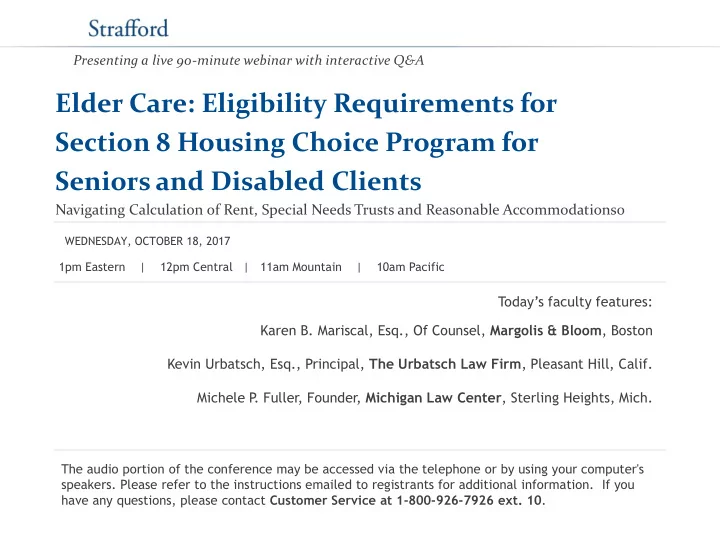
Presenting a live 90-minute webinar with interactive Q&A Elder Care: Eligibility Requirements for Section 8 Housing Choice Program for Seniors and Disabled Clients Navigating Calculation of Rent, Special Needs Trusts and Reasonable


slide-1
SLIDE 1

The audio portion of the conference may be accessed via the telephone or by using your computer's

  • speakers. Please refer to the instructions emailed to registrants for additional information. If you

have any questions, please contact Customer Service at 1-800-926-7926 ext. 10.

Presenting a live 90-minute webinar with interactive Q&A

Elder Care: Eligibility Requirements for Section 8 Housing Choice Program for Seniors and Disabled Clients

Navigating Calculation of Rent, Special Needs Trusts and Reasonable Accommodations0

Today’s faculty features:

1pm Eastern | 12pm Central | 11am Mountain | 10am Pacific WEDNESDAY, OCTOBER 18, 2017

Karen B. Mariscal, Esq., Of Counsel, Margolis & Bloom, Boston Kevin Urbatsch, Esq., Principal, The Urbatsch Law Firm, Pleasant Hill, Calif. Michele P . Fuller, Founder, Michigan Law Center, Sterling Heights, Mich.

slide-2
SLIDE 2

Tips for Optimal Quality

Sound Quality If you are listening via your computer speakers, please note that the quality

  • f your sound will vary depending on the speed and quality of your internet

connection. If the sound quality is not satisfactory, you may listen via the phone: dial 1-866-258-2056 and enter your PIN when prompted. Otherwise, please send us a chat or e-mail sound@straffordpub.com immediately so we can address the problem. If you dialed in and have any difficulties during the call, press *0 for assistance. Viewing Quality To maximize your screen, press the F11 key on your keyboard. To exit full screen, press the F11 key again.

FOR LIVE EVENT ONLY

slide-3
SLIDE 3

Continuing Education Credits

In order for us to process your continuing education credit, you must confirm your participation in this webinar by completing and submitting the Attendance Affirmation/Evaluation after the webinar. A link to the Attendance Affirmation/Evaluation will be in the thank you email that you will receive immediately following the program. For additional information about continuing education, call us at 1-800-926-7926

  • ext. 35.

FOR LIVE EVENT ONLY

slide-4
SLIDE 4

Program Materials

If you have not printed the conference materials for this program, please complete the following steps:

  • Click on the ^ symbol next to “Conference Materials” in the middle of the left-

hand column on your screen.

  • Click on the tab labeled “Handouts” that appears, and there you will see a

PDF of the slides for today's program.

  • Double click on the PDF and a separate page will open.
  • Print the slides by clicking on the printer icon.

FOR LIVE EVENT ONLY

slide-5
SLIDE 5

ElderCare: Eligibility Requirements for Section 8 Housing Choice Program for Seniors and Disabled Clients

Presented By:

Michele P. Fuller, Esq.

michele@michiganlawcenter.com

Karen B. Mariscal, Esq.

kbm@margolis.com

Kevin Urbatsch, Esq.

kevin@urbatsch.com

slide-6
SLIDE 6

Today’s Program

Overview of Section 8 Program Eligibility Calculating Rent Reasonable Accommodation for Persons with Disabilities SNTs and Section 8 DeCambre Decision SNT Buying a Home

6

slide-7
SLIDE 7

Section 8 Terms to Know

  • Area Median Income
  • Extremely low income (30% of AMI)
  • Annual Income
  • Voucher
  • Fair Market Rent
  • Total Tenant Payment (TTP)
  • Public Housing Agencies (PHA, aka MHA)

7

slide-8
SLIDE 8

Congress Appropriates funding to the Housing and Urban Development (HUD) PHA HUD funds Public Housing Agency (PHA) that manages the local Section 8 program TENANT Family that pays a percentage of rent to the property Owner after being selected by the PHA OWNER HUD and Owner enter into Housing Assistance Payment (HAP) Contract for subsidized portion of rent

Lease

$$ $$ Rent subsidy $$ Reduced Rent

Voucher

How Section 8 Works

8

slide-9
SLIDE 9

Section 8 – Housing Benefits

  • Rules issued by Housing and Urban

Development (HUD)

  • Administered by local Public Housing

Agencies (PHA)

  • Voucher Program vs.

Project Based Assistance

  • Not an entitlement benefit

9 Housing is the single greatest concern that disabled persons and their families face.

9

slide-10
SLIDE 10

Qualifying for Section 8

  • Income limits: www.huduser.org
  • Asset Test
  • Transfer for less than fair market value
  • Applying for Vouchers
  • Waiting lists
  • First-come vs. Lottery
  • May take years to get

10

10

slide-11
SLIDE 11

Annual Income

  • All amounts that are received by the family head, spouse
  • r co-head, or any other family member, or
  • All amounts anticipated in the 12 month period in

advance of when the determination is made, and

  • Which are not specifically excluded in §5.609(c)
  • Annual income includes income from assets to which

any member had access

24 C.F.R. § 5.609(a)

What is Income

11

slide-12
SLIDE 12

Calculation of Rent: What is Income

  • Wages and salaries
  • Profit from a business
  • Interest and dividends
  • SSI, SSDI, annuities, pensions, 401K

distributions

  • Money in lieu of salary, such as unemployment

benefits, disability

12

slide-13
SLIDE 13

24 C.F.R. § 5.609(c)

Income Exclusions

Among the lengthy list of items excluded from income are: All lump-sum additions to family assets, (c)(3)

  • Inheritances
  • Insurance payments
  • Capital gains
  • Settlement for personal or property losses

The cost of medical expenses for any family member, (c)(4) Temporary, nonrecurring or sporadic income (c)(9)

13

slide-14
SLIDE 14

Tenant Rent and Subsidy

How rent subsidy is calculated: Determine the Total Tenant Payment (TTP)

  • The “rent burden” that family can sustain.
  • 30% of the annual income

Next determine subsidy the PHA will pay the landlord

  • Fair Market Rent (FMR) for the size of unit minus TTP
  • FMR-TTP=Rent Subsidy

14

slide-15
SLIDE 15

Tenant Rent Burden

Example:

  • Fair market rent for 2 bedroom apartment in City suburb=

$811.00

  • Tenant income = $600/month
  • TTP (30% x annual income) is $180
  • Section 8 subsidy (TTP-FMR) is $631.00

15

slide-16
SLIDE 16

24 C.F.R. §5.603(b)(definitions)

Treatment of Trusts

Definition of “Net Family Assets”

  • Revocable Trusts
  • Treated as an asset if any family member can withdrawal.
  • Irrevocable Trusts (…and those not controlled by a

family member)

  • NOT an asset. But, “any income distributed from the trust

fund shall be counted when determining annual income under §5.609”

16

slide-17
SLIDE 17

Special Needs Trust and Section 8

  • Regular recurring distributions are

problematic

  • Cell Phone, Cable, Internet
  • Common exclusions
  • Sporadic income/gifts
  • Medical expense
  • Benefit back-pay, settlements,

lump-sum inheritance

17

slide-18
SLIDE 18

Legal Basis for Reasonable Accommodations

Reliance on three bodies of law:

  • Fair Housing Act (42 USC Sec. 3604): prohibits discrimination

based on race, color, religion, sex, handicap, familial status, or national origin.

  • Rehabilitation Act of 1973, Sec. 504: unlawful to discriminate

against disabled people, “under any program, service, or activity receiving Federal financial assistance…” (Applies to Sec. 8 and

  • ther HUD programs)
  • Americans with Disabilities Act of 1990: prohibits

discrimination against persons with disabilities in government services, programs, and activities.

18

slide-19
SLIDE 19

What is a Reasonable Accommodation?

  • A change or alteration of a rule, policy, practice, or service

necessary in order to allow the person with a disability an equal

  • pportunity to enjoy the benefits of the housing program.
  • Can be rejected if unduly burdensome or imposes a hardship on

the party making the accommodation

  • Creates undue financial or administrative burden on provider
  • If fundamentally alters provider operations
  • Housing modifications
  • Tenant’s expense: under Fair Housing Act
  • Provider’s expense: 504 in subsidized housing

19

slide-20
SLIDE 20

Reasonable Accommodation Strategies

“Get in and stay in,” Blaine Brockman

  • Get in: qualify
  • Stay in: make appropriate requests under the rules and

guidelines for accommodation and modification to stay in an affordable unit

20

slide-21
SLIDE 21

Reasonable Accommodation Strategies

  • Understand definition of a “disabled household:” may be used to

reduce countable household income. e.g., unreimbursed medical expenses reduce income, attendant care and live-in aids income not counted

  • Move up the waiting lists
  • Live in a higher rent locale
  • Utility allowance to reduce the rent payment (some persons with

disabilities have higher utility costs as a result of their disability)

  • Renting from a family member
  • Funding for modifications to accommodate their disabilities

21

slide-22
SLIDE 22

Olmstead v. L.C.

527 U.S. 581 (1999) ADA violation where a state did not take steps to ensure institutionalized people with disabilities could live in the least restrictive setting that could accommodate their disabilities

22

slide-23
SLIDE 23

Finley v. City of Santa Monica

2011 WL 7116184 (Cal. Super. Ct. May 25, 2011)

  • Sheila Finley: 64 year old, with a disability
  • Annual income of $10,260 (Social Security)
  • Receives Section 8 rent assistance from Santa Monica Housing Authority

(SMHA)

  • Personal injury and workers’ comp. settlement with former employer = $47,800
  • Court established SNT – 42 U.S.C. 1396p(d)(4)(A)
  • Finley promptly notifies the SMHA
  • Trust funds are earning no interest
  • Annual re-certification triggers the dispute

23

slide-24
SLIDE 24

Finley v. City of Santa Monica

At issue: SNT distributions

  • Over 6 months Trustee paid 3rd parties = $3,886
  • Texaco
  • Exxon Mobil
  • AFLAC
  • Rocket Smog
  • Fantastic Sam
  • A+ Auto Repair
  • Time Warner
  • Trustee fee

24

slide-25
SLIDE 25

Finley v. City of Santa Monica

  • Distributions were regular and periodic payments from

the trust and therefore annual income

  • The trust itself was not countable
  • Rent recalculation
  • Increase in TTP of $101 per month, retroactive for
  • ne year
  • ($14 was due to increase in FMR)

25

slide-26
SLIDE 26

Finley v. City of Santa Monica

The Court confronted a “strange dichotomy”

  • The lump sum was not countable, whether given to

Finley directly or to the SNT under §5.609(c)(3)

  • But, expenditures suddenly become income simply

because they are made from the trust under §5.603(b)(2) “If Finley were to . . . place the money under her mattress, she could use it for any purpose . . . . When [the money is] placed in a SNT . . . any distribution . . . is converted to annual income.”

26

slide-27
SLIDE 27

Finley v. City of Santa Monica

Opinion: The Court’s resolved the tension between §5.609(c)(3) and §5.603(b)(2) to give the “plain meaning” to both

  • The lump sum making up the trust principal is excluded
  • Only principal was distributed (the funds did not earn interest)
  • The distributed principal originated from excludable income source
  • Therefore, the distributions are excluded also

The court did not address the issue of “periodic” payments

27

slide-28
SLIDE 28

DeCambre v. Brookline Housing

U.S. District Court, D. Massachusetts, NO. 14-13425-WGY

Why is this case important?

  • Very few court opinions on SNT’s and Section 8
  • Specifically analyzes and rejects oft-cited Finley
  • Thorough opinion (40 pages, a lot of dicta)
  • Deference to HUD and the housing authority
  • Significant reliance on HUD advisories and guidebooks
  • Likely to have great weight in with housing authorities
  • May embolden more entrenched agencies
  • Might advance the trend towards suspicion of first party SNT

28

slide-29
SLIDE 29

DeCambre v. Brookline Housing Authority

  • Brookline: Kimberly DeCambre no

longer qualified for Section 8 because $60,000 had been distributed to her from her SNT that year

  • In 2015 the District Court agreed

29

slide-30
SLIDE 30

DeCambre v. Brookline

The First Circuit reversed, 826 F.3d 1 (June, 2016). HUD regulations are unclear. 24 C.F.R. Sec. 5.603(b): “In cases where a trust fund has been established and the trust is not revocable by, or under the control of, any member of the family or household, the value of the trust fund will not be considered an asset so long as the fund continues to be held in trust. Any income distributed from the trust fund shall be counted when determining annual income . . .”

30

slide-31
SLIDE 31

DeCambre v. Brookline

5.609 Annual income does not include the following: (3) Lump-sum additions to family assets, such as inheritances, insurance payments (including payments under health and accident insurance and worker's compensation), capital gains and settlement for personal or property losses

31

slide-32
SLIDE 32

DeCambre v. Brookline

But a lump sum payment that is excluded from income if given to the tenant directly doesn’t become income simply because it was first put into a trust. First Circuit holding: Only distributions from a trust of income made from the investment of the trust funds constitutes income. DeCambre’s distributions were 100% principal.

32

slide-33
SLIDE 33

NAELA Public Policy Committee

Working with HUD to make DeCambre HUD Policy nationwide Election in January put a “permanent” hold on implementation

33

slide-34
SLIDE 34

ABLE Act and Housing

  • ABLE is like a 529 college savings account, but for

disabled people. The law is set forth in IRC section 529A.

  • Money can grow tax-free, and be used for many

different things, not just education.

  • Particularly helpful for those receiving SSI benefits

34

slide-35
SLIDE 35

ABLE - SSI Reduction Avoided

  • Ordinarily, if an SSI’s recipients’ housing or food

is paid for by others, the SSI check is reduced by the amount of the contribution, up to 1/3 of the full amount of the monthly SSI.

  • If an ABLE account pays for the food and

housing, no 1/3 reduction

35

slide-36
SLIDE 36

Purchasing a Home

Special Needs Trusts can purchase a house/condo

  • Considerations:
  • Ownership (Beneficiary vs. Trust)
  • Sustainability
  • Consider property taxes, home owners

insurance, upkeep and maintenance; accessibility and in-home supports for the beneficiary; the safety of the beneficiary

36

slide-37
SLIDE 37

SNT Home Ownership

Outright purchase of principal residence is ISM

  • 1/3 penalty in the month of purchase
  • Same penalty even if home is held in the trust
  • No effect on benefits as long as principal residence
  • 20 CFR §§416.1210(a), 416.1212

If home is owned by SNT:

  • SSA considers beneficiary to have “equitable ownership under a

trust”

  • SI 01120.200(F)(1),
  • 1/3 ISM reduction month of purchase
  • Beneficiary can live rent free without reduction or penalty
  • SI 01120.200(F)(2)

37

slide-38
SLIDE 38

SNT being Section 8 Landlord to Beneficiary

  • Excellent way to obtain more funding for beneficiary’s

SNT

  • SNT Trustee qualifies as Section 8 landlord
  • Beneficiary pays 30% of income for rent
  • HUD pays balance of fair market rent
  • Beneficiary has more money for additional special needs
  • Not easy, but doable with some work
  • Can allow for roommates who pay rent and share

services

38

slide-39
SLIDE 39

Sources of Law and Regulations

  • Housing and Community Development Act (“Section 8), 42

U.S.C. § 1437

  • HUD 811 Program, 42 U.S.C. § 8013
  • Fair Housing Amendments Act, 42 U.S.C. § 3604
  • Rehabilitation Act (“Section 504”), 29 U.S.C. §794
  • Americans with Disabilities Act of 1990, 42 U.S.C. 12101,

et seq.

  • Tax Reform Act – (Low Income Housing Tax Credits), IRC

§ 42

39

slide-40
SLIDE 40

Sources-Continued

Code of Federal Regulations 24 C.F.R. § 5, Federal housing regulations (including important definitions) 24 C.F.R. § 982, Tenant Based Voucher Section 8 regulations 24 C.F.R. § 983, Project Based Voucher Section 8 regulations 24 C.F.R. § 891, HUD Section 811 Regulations Collaborative, Inc (TAC)

40

slide-41
SLIDE 41

On-line Resources

HUD Occupancy Requirements of Multifamily Housing Programs Handbook 4350.3 HUD Housing Choice Voucher (Section 8) Guidebook – Handbook 7420.10g HUD Supportive Housing for Persons with Disabilities – Handbook 4571.2 Section 8 Made Simple – by the Technical Assistance

41

slide-42
SLIDE 42

Take Away on Section 8

  • Consider ALL public assistance programs
  • Don't be afraid of the HUD regulations
  • Make requests for accommodations and modifications

in policies

  • Consider the "appearance" of distributions from SNTs
  • Expect more requests for trust expenditures

42

slide-43
SLIDE 43

Questions & Answers

slide-44
SLIDE 44

Thank You

Michele P. Fuller

Attorney at Law

Michigan Law Center

12900 Hall Rd., Suite 470 ▪ Sterling Heights, MI 48313 Phone: 586-803-8500 ▪ Fax: 586-803-8508 Email: michele@michiganlawcenter.com www.MichiganLawCenter.com

Presented By: