
SLIDE 1
1 1
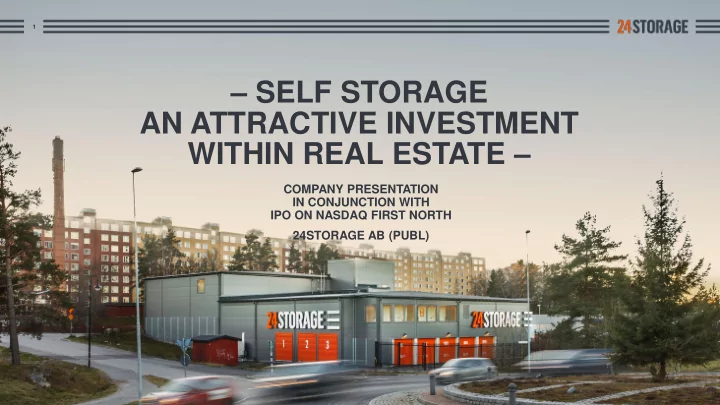
– SELF STORAGE AN ATTRACTIVE INVESTMENT WITHIN REAL ESTATE –
COMPANY PRESENTATION IN CONJUNCTION WITH IPO ON NASDAQ FIRST NORTH 24STORAGE AB (PUBL)
SELF STORAGE AN ATTRACTIVE INVESTMENT WITHIN REAL ESTATE COMPANY - - PowerPoint PPT Presentation
1 SELF STORAGE AN ATTRACTIVE INVESTMENT WITHIN REAL ESTATE COMPANY PRESENTATION IN CONJUNCTION WITH IPO ON NASDAQ FIRST NORTH 24STORAGE AB (PUBL) 1 1. INTRODUCTION PAGE 3 2. THE SELF STORAGE MARKET PAGE 5 3. COMPANY OVERVIEW
1 1
COMPANY PRESENTATION IN CONJUNCTION WITH IPO ON NASDAQ FIRST NORTH 24STORAGE AB (PUBL)
2
1. INTRODUCTION PAGE 3 2. THE SELF STORAGE MARKET PAGE 5 3. COMPANY OVERVIEW PAGE 15 4. SHAREHOLDERS & CORPORATE GOVERNANCE PAGE 28 5. FINANCIALS PAGE 32 6. APPENDIX PAGE 37
3
24STORAGE AT A GLANCE
player in the Swedish market
(mainly freehold not leasehold)
“proptech” enables a centralized and scalable business
such as Stockholm, Gothenburg and Malmö
realized since inception in 2015
(Staffan Persson), Michael Fogelberg, Realm (the Tilander family), Hajskäret Invest (Carl Rosvall), Per Josefsson and Inbox Capital (the Wattin family)
Introduction
200 400 600 800 1 000 1 200 2015 2016 2017 2018 Q3 2019
SEKm
Property value
10 20 30 40 50 60 70 2015 2017 Jan-Sep 2019
SEKm
Revenue
1.1 bn SEK
24Storage property value 2015 2016 2017 2018 2019 # Facilities 9 14 20 # 23 7
23 SELF STORAGE FACILITIES 3 REGIONS OF GROWTH >50,000 SQM >10,000 STORAGE UNITS
YTD
4
INVESTMENT HIGHLIGHTS
Introduction
Leading player in under-penetrated Swedish market Proven ability to develop and
with “proptech” approach A story of rapid growth and improving profitability Attractive self storage asset set for long-term value Urbanization is the primary demand driver
1 2 3 4 5 Urbanization, housing shortages, limited storage space, high property prices and more benefit the self storage industry as a whole. Swedish citizens move 11 times during a lifetime in average, more often than Europeans. Sweden is a growing and under-penetrated market with favourable real estate market drivers supporting a freehold strategy. Second largest player in Sweden with significant growth ambitions, growing with 3-5 new self storage facilities per year. 23 high quality facilities in prime locations operated through a centralized
unique tech platform for genuine automation. Current portfolio of over 10,000 storage units in three regions of growth with more than 6,000 customers. Property portfolio provides asset backed valuation and viewed as fairly “recession proof”,
estate assets in the past. Existing portfolio has significant upside potential at mature level from current occupancy of 70% to 90%. Revenue CAGR of 46% since 2016 with NOI margin to improve as property portfolio matures providing proof of a scalable business model. NOI of 70% at mature level implies high return potential with revaluation
5 5
6
FAVOURABLE REAL ESTATE MARKET DRIVERS IN SWEDEN
The Self Storage Market Source: SCB, Thomson Reuters, Ekonomifakta
0,0 % 0,5 % 1,0 % 1,5 % 2,0 % 2,5 % 3,0 % 2010 2018
STIBOR 3M
62% 64% 66% 68% 70% 2010 2011 2012 2013 2014 2015 2016 2017 2018
Employment rate
80 90 100 110 120 130 140 150 160 170 Index
Development in housing prices
Stockholm Gothenburg Malmö Sweden
7
12% 13% 12% 13% 9% 13% 10% 17% 0% 5% 10% 15% 20% Office Industrial Retal Residential Diversified Health Care Lodging/Resorts Self Storage Total annual return (%)
Self storage has outperformed other real estate asset classes over the last decades…
Total return
A “RECESSION-PROOF” INVESTMENT CLASS WITH STRONG HISTORICAL RETURNS
The Self Storage Market Source: Company Data, Self-storage Almanac 2018 NAREIT Link: https://www.reit.com/data-research/reit-indexes/annual-index-values-returns
3%
5% 35% 41% 3%
0% 20% 40% 60% 1994 1995 1996 1997 1998 1999 2000 2001 2002 2003 2004 2005 2006 2007 2008 2009 2010 2011 2012 2013 2014 2015 2016 2017 2018 Total annual return (%)
...and is viewed as fairly “recession proof” in light of strong relative performance during the US financial crisis
Difference Average other real estate segments Self Storage Average total return Average total return and average price return by US property sectors 1994 - 2018
Recession
8
URBANIZATION AND SMALLER LIVING SPACES DRIVING DEMAND GROWTH
~ 600,000 new living spaces will be needed until 2025 – most being built with too small or with no storage at all.1
population in Stockholm, Gothenburg and Malmö since year 2000 (13% rest of Sweden).2
1 Source: The National Board of Housing, Building and Planning, report of new living spaces 2018-2025 (In Swedish). 2 Source: SCB, 2018.
The Self Storage Market
80% 81% 82% 83% 84% 85% 86% 87% 88% 2000 2001 2002 2003 2004 2005 2006 2007 2008 2009 2010 2011 2012 2013 2014 2015 2016 2017 2018
Urban population (% of total population)
0%
9
GROWING TREND IN AN IMMATURE EUROPEAN MARKET
0,005 0,01 0,015 0,02 0,025 6 6,5 7 7,5 8 8,5 9 9,5 10
2015 2016 2017 2018
Lettable area, million sqm Sqm per capita
Total lettable sqm area Lettable sqm per capita
+12%
vs -17
Growing European self storage market
2018 Sweden Europe US Self-storage facilities # 159 3,792 54,100 Lettable sqm per capita 0.04 0.02 0.87 Self-storage facilities per million inhabitants 15.9 7.7 165.6 Population density per sqkm 23 125 25
The Self Storage Market
it become popular in the 1960’s, spreading to Europe in the 1990’s.
but growing steadily. Number of facilities and lettable area have experienced CAGR’s of 11.7% and 6.3% since 2014, respectively.
lettable area.
sqm, with the average being 4,200 sqm.
Source: FEDESSA Annual Survey 2018 and 2019.
340x
US vs SWE
20x 10x
10
PEOPLE MOVING BEING THE PRIMARY DEMAND DRIVER IN SWEDEN
situation.
1 Source: FEDESSA Annual Survey 2018. 2 SCB, 2018.
. The Self Storage Market
0% 10% 20% 30% 40% 50%
% population in cities who moved within the last five years
11
SWEDEN IS A FRAGMENTED MARKET - MAJORITY OF THE OPERATORS 1-2 FACILITIES EACH
were founded after 2000.
market with presence of large multinational firms.
particularly for low-end facilities.
could be considered as high barriers of entry, due to requirement of location, knowledge and substantial capital.
facilities each implies room for consolidation.
Company Initiation SWE # Facilities 2018 Shurgard 1997 36 24Storage 2015 20 Magasinera 2006 11 Big Pink
1
2014 9 Servistore
3
2002 7 Pelican Self Storage 2007 6 City Self-Storage
2,3
1993 6 Others 64 Total 159
The Self Storage Market
1 Owned by the Swedish real estate company Klövern. 2 Owned by Self Storage Group. 3 Mainly leasehold facilities.
420 82 57 35
Largest operators by revenue, SEKm 2018 Operators by # facilities 2018
Source: FEDESSA Annual Survey 2018.
13% Share of # facilities, Sweden 2018 24Storage Total 24Storage Shurgard Pelican City Self- Storage 20 36 6 6 Largest competiors # facilities,Sweden 2018
12
revenue optimization begins: ‐ Size adaptation of storage spaces is done gradually. Non-rented storage spaces are being re-built and adapted to market needs. Smaller units gives higher revenue per sqm. ‐ Rent increase of existing customers. ‐ Optimization of facility and land. Built-
existing facility increases the rentable capacity.
facility opens up to the public and the renting out period begins.
mature levels of >85% occupancy it is seen as stable.
3-4 years after opening.
PLANNING AND CONSTRUCTION (6-18 MONTHS)
Evaluation of environment, planning and authority approvals is being done before land acquisition.
major costs of the project.
first 14 months.
RENT UP PERIOD (3-4 YEARS) REVENUE OPTIMIZATION (+5 YEARS) COST DEVELOPMENT REVENUE DEVELOPMENT TIME
The Self Storage Market
10% 30% 50% 70% Year 6 Year 5 Year 4 Year 3 Year 2 Year 1
NOI margin simulation year 1 - 6
NOI margin
13
OCCUPANCY RATE INDICATING GROWTH OPPORTUNITIES
The Self Storage Market
This level will allow the business to continue to offer space to customers and maximize yield for the business.
lowering of occupancy rates but the occupancy rate in Sweden is still above the European average rate in total.
Source: FEDESSA Annual Survey 2014-2018. Occupancy defined as rented area of built out area
10% 30% 50% 70% 90% 2014 2015 2016 2017 2018
Occupancy rate
Europe Sweden 24Storage (BO sqm)
24Storage is in a build-up phase, with new storage space diluting
Average
Europe 2018
14
2 350 3 051 1 606 2 889 2 846 2 824 1 538 Sweden Great Britain Norway France Spain Europe US 500 1 000 1 500 2 000 2 500 3 000 3 500 SEK
Average rent per sqm
. AVERAGE RENT VARIES WITH LOCATION AND TYPE OF SERVICE DELIVERED
greatly both between countries and within countries. The variation among countries can be explained mainly by large differences across Europe in purchasing power.
temperature and humidity regulation is likely to be more expensive than one located far outside the city offering only cold storage.
property assets in general.
phase.
constitutes actual lettable area. ~1,900 SEK
24Storage Average rent per occupied sqm 2018
Source: FEDESSA Annual Survey 2018. Average rent converted from EUR to SEK with currency rate SEK 10.78. The Self Storage Market
15 15
16
✓ Owns, operates and develops own self storage facilities throughout Sweden ✓ One of the leading players in the Swedish market ✓ Focus to expand in metropolitan areas such as Stockholm, Gothenburg and Malmö ✓ Cash flow comes from operating activities such as renting out storage space to residential and corporate customers ✓ By digitalizing manual processes a centralized operational models is enabled,
Company Overview
17
1After revaluation of real estate. 2 Built out storage units.
10 20 30 40 50 60 70 2015 2016 2017 2018 SEKm
Revenue
Company Overview
10 000 20 000 30 000 40 000 50 000 60 000 2015 2016 2017 2018 Q3 2019 sqm
Built Out area
2 000 4 000 6 000 8 000 10 000 12 000 2015 2016 2017 2018 Q3 2019 #
Storage units2
200 400 600 800 1 000 1 200 2015 2016 2017 2018 Q3 2019 SEKm
Property value1
18
6,000 23
FACI LI TI E S TE NANTS CURRE NT LE TTA B LE M ²
~70
OCCUP ANCY, %
~1,900
AV E RAGE RE NT P E R OCC M ² AS S E T V ALUE , S E K BN
$ =
>50,000 1.1
Company Overview
19
2,300 sqm in average.
is rented is 4.5 sqm.
non-insulated storage.
Company Overview
20
“During the first nine months of 2019, we have signed agreements
April, we successfully opened our new facility in Hyllie, Malmö, in September we opened a new facility in Vallentuna and in November, we opened a new facility in Borås which have attracted great interest in demand. We also have an exciting pipeline when it comes to new projects.”
PORTFOLIO November 2019
Company Overview
Uddevalla Sundbyberg Tule Trollhättan Kungsholmen Borås Tullen Vallentuna Bällsta Orminge Göteborg Kungsbacka Tumba Tyresö Kungälv Farsta Kallhäll Handen Open stores Stores under construction/development Pipeline Stores Vallentuna Centrum Alvik Malmö Lundavägen Borås Regementet Malmö Hyllie Uppsala Täby Sundbyberg Lilla Alby Bromma Solna Mölndal Vällingby
24Storage Built Out-area
>50,000 sqm
Eskilstuna
21
Close to customers - majority of potential customers live, work
High visibility from major roads creates top of mind awareness Enabling authority approvals for residential builders
passage for a safer local environment
Company Overview
24Storage facilities in Stockholm
22
85% 15% Corporate Residential
CUSTOMERS
Customer split
AVERAGE RENTAL TIME PER CUSTOMER
months
Company Overview
51% 13% 25% 11%
Call Walk In Web Other
▪ Movers ▪ Renovators ▪ Collectors ▪ Sales people ▪ Handyman's ▪ Longtime archiving ▪ E-commerce
Sales per channel
*Other = E-mail, chat, intercom and kiosk
23
Company Overview
24Storage - Smart Facility
Smart facility is a key component for enable 24Storages business model. The platform is a combined package of components that can be monitored and controlled from any place. Examples: An agent in our Call Center can remotely:
by opening the doors/ gates.
A facility manager can remotely:
and potentially reduce energy cost.
Customer safety and theft protection Centralized and remote control from anywhere Ensuring optimal storage conditions Live video surveillance Video recording Fire alarm Burglar alarm Automated doors Automated gates Automated lights Temperature control Humidity control
24
Scheduled appointments by CSC and traditional manned stores
Customer service adapted in all channels Meeting appointments Fully automated processes Customer self-service at location
Company Overview
25
Higher availability for customers
“Centralized operations enables yield of properties smaller than traditional self storage facilities and
We have opened three facilities since December 2018 without adding new staff”
1 2 3 4
More flexible to meet customer demands
Lower FTE cost per facility
(peers 2-2.5 FTE per facility) Standardized processes and dedicated staff for different tasks
Company Overview
26
24Storage Shurgard Pelican
Customer access to the facility 24 h
(with some exceptions)
05.30-22.00 05.30-24.00 Website with transactional eCommerce Personal account with self service through My Pages Digitalized facility operations Opening hours of customer service center Mon-Fri: 08.00-20.00 Sat-Sun: 10.00-16.00 Mon-Fri: 08.00-18.00 Sat: 10.00-16.00 Sun: 11.00-16.00 Mon-Fri: 10.00-18.00 Sat-Sun: 10.00-14.00 Employees per self-storage facility Manned facilities Manned facilities Centrally manage real-time video surveillance with recording around the clock
Company Overview
Centralized operational model
27
Modern platform Core components
Company Overview
▪ Build on a Micro service architecture ▪ Flexible, easy to add and remove components and services ▪ Based on .Net and C# ▪ Cloud hosting by Microsoft Azure (Cella, CRM) ▪ Fully web-based ▪ Hosting by IT-partner (Phone system, Smart Facility) ▪ All parts are either fully integrated or tightly connected ▪ Cella – ERP (built inhouse) ▪ Dynamic 365 (Microsoft CRM) ▪ Web (Public web, MyPages) ▪ BI (Microsoft PowerBI) ▪ PowerApps ( Microsoft) ▪ Smart Facility (Access control, Video surveillance, etc.) ▪ Cisco Platform (Audio Calls , Video Calls, call center, videokiosk) Screenshot from Cella Screenshot from CRM Screenshot from BI
Unique combination of ”off the shelf” systems mixed with inhouse built software for genuine automation
28 28
29
SHAREHOLDERS AND THE SHARE
Shareholders & corporate governance Ownership prior to the offering (shares and votes) Ownership after the offering (assuming the offer is fully subscribed) Shareholder # of shares % # of shares % Ernström Kapital AB 2 919 720 23% 2 919 720 20% Swedia HighP AB 2 250 000 18% 2 250 000 15% Michael Fogelberg with family (private and through company) 1 825 170 14% 1 399 642 9% Realm AB 1 460 820 11% 1 460 820 10% Per Josefsson Invest AB 977 420 8% 977 420 7% Ulf & Bo Eklöf Invest AB 727 740 6% 727 740 5% Hajskäret Invest AB 727 740 6% 727 740 5% Other shareholders 1 907 410 15% 2 332 938 16% New shareholders (including cornerstone investors) 2 128 000 14% Total 12 796 020 100% 14 924 020 100%
30
BOARD OF DIRECTORS
Henrik Forsberg Schoultz Fredrik Tilander Staffan Persson Jan-Olof Backman Maria Åkrans Kenneth Eriksson Patrick Metdepenninghen
Shareholders & corporate governance
31
MANAGEMENT
Fredrik Sandelin CEO Krister Moberger CFO Gabriel Bergqvist Head of Brand & Business Karin Lindblom Head of HR Sebastian Refai Head of Operations Mikael Teljstedt Head of Real Estate Jim Forsell Head of IT
Shareholders & corporate governance
CEO
Real Estate Development Operations IT Brand & Business Finance HR
32 32
33
INCOME STATEMENT
Financials
SEKm 2019 2018 2018 2017 Jan-Sep Jan-Sep Jan-Dec Jan-Dec Revenue 52,2 41,0 57,3 35,0 Operating cost
Gross profit (NOI) 12,2 6,9 9,4 5,3 Administration cost
Profit/loss before value adjustments
Change in fair value of investment properties 11,9 6,1 38,3 95,6 EBIT
4,9 72,0 Financial income 0,0 0,0 0,0 0,1 Financial expense
Net financial items
Profit/loss before tax
54,2 Income tax expense 0,0 0,0 9,6
Profit/loss for the period
39,5
34
BALANCE SHEET
Financials
SEKm 2019 2018 2017 30-Sep 31-dec 31-dec Assets Intangible assets 22,7 29,3 30,3 Tangible assets 10,3 10,7 7,4 Investment property 1 099,2 989,2 762,8 Long-term receivables 2,8 1,4 1,3 Fixed assets 1 135,0 1 030,6 801,8 Inventories 0,5 0,5 0,2 Accounts receivables 4,2 3,3 2,0 Prepared costs and accrued income 23,0 4,1 4,1 Other receivables 6,7 8,9 7,1 Cash and bank deposits 95,9 62,5 47,6 Current assets 130,4 79,4 61,1 Total assets 1 265,5 1 110,0 862,9 Equity and liabilities Issued share capital 0,8 0,8 0,5 Unregistered share issue 0,5 Other contributed capital 385,6 256,5 163,4 Retained earnings including earnings for the period 24,5 65,0 79,1 Total equity 411,3 322,2 243,0 Long-term liabilities Long term interest bearing liabilities 578,3 625,5 469,5 Deferred tax liability 41,6 41,5 50,0 Long term debt 619,9 667,0 519,5 Current liabilities Interest-bearing liabilities 197,8 82,3 57,5 Accounts payable 14,7 13,5 16,7 Tax 0,0 0,6 0,0 Other current liabilities 1,3 2,6 1,6 Accrued expenses and defferd income 20,5 21,6 24,6 Total current liabilities 234,2 120,7 100,4 Total liabilities 854,1 787,7 619,9 Total equity and liabilities 1 265,5 1 110,0 862,9
35
CASH FLOW
Financials
SEKm 2019 2018 2018 2017 Jan-Sep Jan-Sep 31-dec 31-dec Profit/loss before tax
54,2 Replacement of depriciation 9,5 5,8 0,0 0,0 Replacement value adjustment property
Other adjustments for items not included in cash flow 4,6 1,5 0,3 7,3 Income tax paid 0,0 0,0
0,0 Cash flow from operating activities before changes in working capital
Change in inventories
Change in operating receivables
Change in operating liabilities 3,2
Change in working capital
0,0 0,0 Cash flow from operating activities
Acquisition of inventories
Acquisition of systems and goodwill 1,2
Investment in investment properties
Acquisition of investment properties
Sale of investment properties 0,0 2,3 2,3 0,0 Change financial fixed assets
Cash flow from investing activities
Share issue 128,3 82,5 82,5 75,6 Warrants 1,3 0,0 0,0 0,0 Borrowings 173,2 193,3 228,8 268,1 Amortization and redemption of loans
Amortization of leasing loans
0,0 0,0 0,0 Change debenditure loan
0,0 2,5 38,3 Change convertible loan 0,0
0,0 Cash flow from financing activities 185,5 218,8 240,3 298,0 Cash flow for the period 33,4 51,0 14,9 2,4 Liquid funds at beginning of the period 62,5 47,6 47,6 45,2 Liquid funds at end of period 95,9 98,6 62,5 47,6
36
KEY RATIOS
2019 2018 2018 2017 Jan-Sep Jan-Sep Jan-Dec Jan-Dec IFRS performance measures Revenue MSEK 52,2 41,0 57,3 35,0 Profit/loss for the period, MSEK
39,5 Alternative performance measures Net operating income 12,2 6,9 9,4 5,3 Net operating income, percent 23,5% 16,8% 16,4% 15,3% Change in fair value of investment properties, MSEK 11,9 6,1 38,3 95,6 EBIT, MSEK
4,9 72,0 Equity, MSEK 411,3 285,7 322,2 243,0 Equity per share, SEK 32,15 36,13 40,75 47,11 Net interest bearing debt, MSEK 680,2 563,5 655,7 479,4 Total assets, MSEK 1 265,5 1 036,0 1 110,0 862,9 Solidity, percent 32,5% 27,6% 29,0% 28,2% Cash flow from operating activities, MSEK
EPRA net asset value (EPRA NAV), SEK 38,17 38,75 42,07 59,77 Loan ratio, procent 61,9% 64,7% 66,3% 62,8% Operational performance measures Investment property value, MSEK 1 099,2 871,3 989,2 762,8 Number of properties 22 19 20 14 Number of units 9 707 8 059 8 803 6 078 Current lettable area, sqm 50 773 41 247 45 088 32 939 Revenue per current lettable area (RevPAM), SEK 1 309 1 278 1 293 1 147 Occupancy (area), percent 69,1% 75,3% 68,3% 71,8% Occupancy (number/units), procent 67,5% 70,8% 65,3% 67,5% Book value of properties in operation per sqm, SEK 19 184 18 172 19 435 20 750 Share related performance measures Number of shares at the end of the period 12 796 020 7 907 470 7 907 470 5 157 470 Average number of shares 8 396 325 5 707 470 6 215 162 3 604 421 Number of shares at the end of the period after dilution 13 515 020 13 291 470 13 291 470 5 241 470 Average number of shares after dilution 13 758 325 6 851 470 8 337 624 3 688 421 Employees Average number of employees 30 37 35 27
37 37
38
CURRENT LEGAL STRUCTURE
24Storage AB
556996-8141 24Storage Service AB 559014-3763 24Storage Systems & Brand AB 559014-3755 24Storage Sverige AB 556543-1326 100% 100% 100%
* 24Storage Service 3 AB (969641-4573) is complementary (komplementär) and 24Storage Service 2 AB (559139-9836 ) is a limited partner (kommanditdelägare). Note that the owning is 99% 24Service 3 AB and 1% 24Service 2 AB.
24Storage Service 2 AB 559139-9836
100% 100% 100% 24Storage Service 3 AB 559203-6684 100%
100%
Appendix
39
KEY RISKS TO THE 24STORAGE INVESTMENT CASE
RISKS RELATED TO THE COMPANY’S BUSINESS AND INDUSTRY
Risks related to competition in the Company's market 24Storage conducts rental operations of storage units, so-called self storage, to private individuals and companies, mainly in Sweden's three metropolitan regions Stockholm, Gothenburg and Malmö. The market for rental of storage space is subject to fierce competition from a number of large and established companies offering similar services as 24Storage. In addition, the Company believes that there is a risk of increased competition from new players, with new service offerings and logistic solutions that could potentially change the market. These new players are for example companies that offer services where the company picks up one or several boxes for storage instead of requiring the customer to travel to the storage facility. Furthermore, there are smaller competitors with strong local roots in local markets in which the Company operates. Increased competition from existing as well as new players may mean that 24Storage market shares and occupancy rates will decrease. As a consequence, there is a risk that the Company may experience difficulties in attracting new customers, which could have a negative impact on the Company's revenues, operating income and operations. Risks related to destruction or damage of 24Storage storage facilities 24Storage operations is dependent on the fact that the buildings managed by the Company have a high degree of protection and security, both directly and indirectly. There is a risk that some or all of the Company's facilities will be exposed to, for example, fire, damage or other impact on the properties. At the beginning of 2019, a storage facility in the UK, managed by a competitor to the Company, was completely destroyed. The fire affected hundreds of people who got their stored property destroyed. There is a risk, for example, of a fire or damage in the Company's storage facilities. Such a risk exists, among other things, as the Company does not have direct control over what the Company's customers keep in their storage spaces or what customers do during their visits to a facility. In addition, people with access to a facility can also move freely in the storage facilities without the Company's staff present. If one of the Company's buildings is destroyed or damaged, there is a risk that the incident will also result in damage to 24Storage reputation with existing and potential customers, partners and municipalities, which may lead to existing or potential customers choosing another supplier for storage services. Furthermore, there is a risk that the Company's access to properties for future projects will be impaired through a decreased reputation and that the Company will to a lesser extent be prioritized by, for example, municipalities. Risks related to the occupancy rate and price level in relation to the Company's storage facilities The Company's long-term objective for each storage facility is to achieve an occupancy rate (calculated on the number of storages leased) of approximately 90 percent. The Company estimates that, from the time of launch of a storage facility, it will take approximately six years to achieve the long-term objective. There is a risk that the Company will not achieve a sufficiently high occupancy rate or that the
reduced revenues, which would have a material adverse effect on the Company's operating profit. If a storage facility is not profitable for an extended period of time, the Company may need to sell the
Risks related to demand for storage in metropolitan areas The Company's storage facilities are located in metropolitan areas in Sweden. There is a risk that the demand for storage in these regions will decrease due to the slowdown of urbanization, reduced mobility in the housing market or changed housing conditions for private individuals. Since the Company has chosen to relocate the majority of its storage facilities in metropolitan regions and most of the Company's income derives from these storage facilities, such negative changes can have a material adverse effect on the Company's operating profit. Appendix
40
KEY RISKS TO THE 24STORAGE INVESTMENT CASE
Risks related to external partners and contractors In the construction, development and renovation of the Company's storage facilities, the Company uses consultants and contractors to carry out the work. Furthermore, the Company is dependent on suppliers in both operating and maintaining the infrastructure of the storage facilities as third parties conduct these tasks. There is a risk that the costs of contracting and consulting assignments will increase due to unforeseen events in connection with the construction, development, renovation or operation and infrastructure of the storage facilities. Increased costs for consulting services would affect the Company's operating profit. There is also a risk that the Company may not enter into or renegotiate agreements with existing suppliers or that these agreements may not be entered into on terms favorable to the Company. If the Company is unable to enter into agreements with suppliers, certain operational functions in the Company's storage facilities cannot be used, which would affect the Company's
there is a risk that the contracting companies which the Company uses will go bankrupt, which may result in the Company not being able to recover payments made for incomplete work, increased costs to procure a new contract with another contracting company and legal processes, and that one or several projects are delayed, which in the long run leads to loss of revenue. Risks related to the Company’s IT system The Company uses an internally developed business system with a modern architecture that is integrated with a number of systems and components developed by third parties. Third-party IT systems allow the Company to offer an automated system for, inter alia, entry and exit from the Company's storage facilities without the presence of personnel from 24Storage. If the Company's IT system or third party systems are down due to, for example, disruptions or computer crashes, the Company's customers would not be able to access their storage facilities without 24Storage staff being present. If the Company's IT system or third party's IT system linked to the Company's storage facilities on repeated or longer occasions is down, it can lead to increased costs for, for example, personnel, upgrades and troubleshooting of the Company's system and can adversely affect the Company's reputation. The Company's website is also operated and maintained by third parties. The Company's website is used to present the Company's various storage services and also enables the Company's customers to enter into agreements online. Approximately 30 percent of the Company's customer agreements are entered into through the Company's website. If the Company's website would have downtime for an extended period of time, there is a risk of reduced revenues as agreements cannot be concluded via the website and that the customers choose another provider of storage services. Risks related to customers' storage of illegal or harmful items 24Storage has no direct control over the items that customers store in their storage unit. Consequently, there is a risk that customers who rent the Company's store units are storing illegal items. Customers can use the storage unit to conduct illegal activities by storing, for example, stolen goods, weapons or drugs. It has on a few occasions come to the Company’s knowledge that illegal activities have been carried out in the Company's storage facilities. There is a risk that the Company's storage facilities in the future will be used for the storage of illegal items, which may lead to a deteriorating reputation for the Company among customers and thus reduced leasing revenues and a negative impact on the Company's operating profit. Appendix
41
KEY RISKS TO THE 24STORAGE INVESTMENT CASE
PROPERTY RELATED RISKS
Risks related to the valuation of 24Storage's properties 24Storage reports investment properties at fair value. The Company orders an external valuation of its real estates at least once a year. The value of the Company's property is affected by a number of
and capital costs. 24Storage reports in accordance with IFRS where assets must be measured at fair value. Unrealized changes in value affect both the income statement and the balance sheet and can have a significant impact on the result for the period and contribute to the result being more volatile, as well as affecting the financial commitments that are in some cases linked to the Company's loan agreements (covenants). The value of the properties is further determined by supply and demand, where the price is mainly dependent on the expected operating surplus of the properties and the buyer's return requirement. Increasing demand will result in lower yield requirements and thus an upward price adjustment, while declining demand will have the opposite effect. Similarly, a positive development of the operating surplus will result in an upward adjustment of prices, while a negative development will have the opposite effect. In property valuations, an uncertainty interval should be taken into account, which in a functioning market usually amounts to +/– 5 to 10 percent to reflect the uncertainty contained in the assumptions and calculations made. If the valuation of 24Storage real estates changes, 24Storage may be forced to write down the value of one or several of its properties, which could have a material adverse effect on the Company's operating profit. Risks related to macroeconomic developments in the real estate industry The Company acquires and manages properties in order to be able to build storage facilities that the Company sublets to individuals and companies. The real estate industry is largely affected by macroeconomic factors, such as general, global or national economic trends, growth, employment development, production rate for new housing and premises, changes in infrastructure, regional economic development, population growth, inflation and changes in interest rates. There is a risk that one or several of these factors will develop in a negative direction for the Company, which may affect the Company's ability to obtain loans to acquire new properties, higher costs due to interest rate increases, customers' ability to pay and the ability to pay for storage rents, which may in the long run have a material adverse effect on 24Storage ability to conduct its operations and the Company's financial position. Furthermore, the return on the sale of the properties is largely due to, among other things, the Company's ability to realize the intended objectives for the properties, which mainly consists of leasing of storage on the properties, but also in some cases sales, and the costs and expenses for development and redevelopment of the properties. If the Company should sell a real estate during a period where the price of a real estate is lower, it may have a negative impact on the Company's financial position. Risks associated with the competition for attractive project properties Property acquisitions, which can be carried out directly or indirectly through a company transfer, are part of 24Storage operations. In order for the property acquisitions to be completed, appropriate investment objects must be available on terms that the Company deems to be advantageous. The Company conducts its operations in metropolitan regions where there is a great deal of competition for attractive property. The competition consists of companies within the entire real estate industry and thus not only competitors to the Company. Generally, there are greater values in building and managing rental properties or in building condominiums (Sw. bostadsrätter), which means that the Company has difficulty competing for attractive project properties. In the event of a high demand for the investment
attractive enough. In addition, competitors in the real estate market with investment strategies similar to 24Storage may have greater financial resources, lower capital costs and/or lower return requirements compared to 24Storage. Due to the strong competition for project properties, there is a risk that the Company will not be able to acquire attractive project properties, which would affect the Company's growth and long-term profitability. Furthermore, there is a risk that the Company acquires project properties at a price that is not adapted for the Company’s business, since the price is adjusted for the property industry in general, which could lead to impairment of the property value and have a negative impact on the Company's operating profit. Environmental risk related to the Company’s property The Company's acquisition strategy is to acquire properties within three metropolitan areas in Sweden - Stockholm, Gothenburg and Malmö. The properties that the Company acquires has often been used for other business operations during the years before the acquisitions. Some of these properties are located on land where industrial operations have previously been conducted. There is a risk that these properties may be subject to unforeseen environmental requirements. Responsibility for environmental damage related to real estate is regulated in accordance with the Swedish Environmental Code (SFS 1998: 808). The main rule is that the party that has carried out environmentally hazardous activities on the real estate is responsible for environmental damage. If the operator who caused a serious environmental damage or pollution damage cannot perform or pay for the restoration of the property, the party who acquired the contaminated property is responsible, if the acquirer was aware of the pollution at the time of the acquisition or should have discovered it. There is a risk that there are environmental damages in the Company's properties where industrial operations were previously conducted and that the Company has not discovered this despite the fact that they should in connection with the acquisition, which may lead to the Company having to pay for the restoration of the property. Furthermore, there is a risk that, following the sale of such property to a third party, the Company may be accused of conducting environmentally hazardous activities, which could lead to costly administrative procedures and legal processes. Appendix
42
KEY RISKS TO THE 24STORAGE INVESTMENT CASE
LEGAL AND REGULATORY RISKS
Risks related to the handling of personal data In its operations, the Company handles personal data in relation to the Company's customers. There is a risk that the Company's handling of personal data is or has been inaccurate, or that due to security deficiencies a data breach occurs which leads to the spreading of personal data without the Company's control. In August 2019, the Swedish Data Protection Authority issued its first penalty fee, which amounted to SEK 200,000. In determining the size of the penalty charge, the Swedish Data Protection Authority has taken into account how many data subjects were affected by the violation. In the aforementioned case, the number of data subjects amounted to 22. As the Company handles a large amount of personal data, incorrect handling or data breach could lead to many data subjects being affected, which could lead to high administrative penalties from the Swedish Data Protection Authority, civil and / or criminal law measures and damaged reputation, and consequently may affect the Company's operations and financial position. Risks related to insufficient insurance cover 24Storage insurance covers among other things, real estate insurance for all the Company's properties. In addition, the Company offers, through an external insurance company, an insurance for each customer in connection to entering into a rental agreement. However, there are customary limitations regarding the scope of insurance coverage and possible amount of reimbursement. Furthermore, some types of losses are generally not covered by insurance as such losses are not considered insurable. This may include, for example, damage caused by service or personal responsibility where there has been negligence, willfulness or criminal acts. There is a risk that the Company's property insurance will not cover damages that occur on the Company's properties or in relation to an individual property, which may mean that the Company is not fully compensated for claims from customers, renovations or construction of buildings, and taken into account the value of an individual property, may have a material adverse effect on 24Storage financial position and operating profit. Another consequence is that the Company's reputation in the market is deteriorating as customers who have entered into insurance expect the insurance to cover damage that occurs. FINANCIAL RISKS Risks related to financing and liquidity Liquidity risk is the risk that a company within the Group will not be able to fulfill its payment obligations, both foreseen and unforeseen, at the due date without increasing the cost of obtaining the necessary
an extent that several projects can be started and run in parallel. There is a risk that the Company will not be able to obtain loans from lenders or that existing or future shareholders are not willing to invest capital in the company through new share issues. If the liquidity in 24Storage does not prove to be sufficient, it can have a material adverse effect on the Company's growth and long-term profitability. Risks related to an increase of interest rates Interest rate risk refers to the risk of changes in the capital market that may affect the interest rate conditions and thus borrowing costs for 24Storage. Interest rate risk is expressed as the cost change for the interest-bearing liabilities, expressed in SEK. Since the majority of 24Storage operations relate to leasing of storage space in accordance with signed agreements it may cause difficulties for the Company to increase revenues to compensate for higher interest costs. A higher interest expense also risks having an effect on profitability, which can negatively affect both the Company's liquidity and interest coverage
financial conditions or coventants in loan agreements may lead to early repayment of loans, and may force the Company to sell properties. If the prevailing interest rate levels were to change in a negative way for the Company, it could have a material adverse effect on 24Storage operating income, balance sheet and cash flow. Appendix
43
KEY RISKS TO THE 24STORAGE INVESTMENT CASE
FINANCIAL RISKS
Risks related to financing and liquidity Liquidity risk is the risk that a company within the Group will not be able to fulfill its payment obligations, both foreseen and unforeseen, at the due date without increasing the cost of obtaining the necessary
an extent that several projects can be started and run in parallel. There is a risk that the Company will not be able to obtain loans from lenders or that existing or future shareholders are not willing to invest capital in the company through new share issues. If the liquidity in 24Storage does not prove to be sufficient, it can have a material adverse effect on the Company's growth and long-term profitability. Risks related to an increase of interest rates Interest rate risk refers to the risk of changes in the capital market that may affect the interest rate conditions and thus borrowing costs for 24Storage. Interest rate risk is expressed as the cost change for the interest-bearing liabilities, expressed in SEK. Since the majority of 24Storage operations relate to leasing of storage space in accordance with signed agreements it may cause difficulties for the Company to increase revenues to compensate for higher interest costs. A higher interest expense also risks having an effect on profitability, which can negatively affect both the Company's liquidity and interest coverage
financial conditions or covenants in loan agreements may lead to early repayment of loans, and may force the Company to sell properties. If the prevailing interest rate levels were to change in a negative way for the Company, it could have a material adverse effect on 24Storage operating income, balance sheet and cash flow.
RISKS RELATED TO THE OFFERING AND THE COMPANY’S SHARES
Risk that the trading in the Company’s shares will not be liquid 24Storage shares have not previously been traded on a marketplace. It is therefore difficult to predict the level of trading and what interest the players in the stock market will show for the shares. The price at which the shares are traded and the price at which investors can make their investments will be affected by a number of factors, some of which are specific to 24Storage and its operations, while others are general to companies listed on the Nasdaq First North Growth Market and outside the Company's control. The listing and admission to trading of the Company's shares on the Nasdaq First North Growth Market should not be interpreted as a liquid market for the shares. Furthermore, there is a risk that the price of the shares will be very volatile in connection with admission to trading on the Nasdaq First North Growth Market. If an active and liquid trading does not develop or does not remain sustainable, this may cause difficulties for shareholders to sell the shares and the market price may differ significantly from the share price in the Offer. If any of these risks were realized, it could have a material adverse effect on the price of the shares and the possibility for investors to liquidate their investment. Risks with transactions relating to major holdings in the Company Significant sales of shares carried out by major shareholders, members of the Board of Directors or senior executives of the Company, or a perception in the market that such may occur, as well as a general market expectation that further issues will be completed, may adversely affect the price of the Company's shares. In addition, any further new share issues would result in dilution of ownership for shareholders who for some reason cannot participate in such share issue or choose not to exercise their right to subscribe for shares. The same applies if share issues are directed to other than shareholders. Risk of dilution in future share issues 24Storage may need additional capital to finance its operations. In addition, 24Storage may need to make investments in, for example, technology and acquire additional funds through the issue of shares, share-related instruments or convertible debt securities. There is a risk that additional financing under acceptable terms will not be available to the Company when required, or will not be available at all. If the Company decides to raise additional capital, for example through a new share issue, there is a risk that the Company's shareholders' may be diluted, which may also affect the price of the shares. These risks could have a material adverse effect on investors' invested capital and/or the price of the shares. Risk related to the Company's ability to pay dividends The ability of 24Storage to pay dividends in the future depends on a number of factors, such as future income, financial position, cash flows, need for working capital, costs for investments and other factors. 24Storage may lack sufficient distributable funds and 24Storage shareholders may not decide to pay dividends. Appendix
44 44
WWW.24STORAGE.SE