Security Proofs ---- Asymmetric Encryption Introduction without - - PDF document

security proofs asymmetric encryption
SMART_READER_LITE
LIVE PREVIEW

Security Proofs ---- Asymmetric Encryption Introduction without - - PDF document

Summary Summary Security Proofs ---- Asymmetric Encryption Introduction without Redundancy Provable Security Asymmetric Encryption Rennes January 2004 New Schemes Joint work with Duong Hieu Phan David Pointcheval David Pointcheval


slide-1
SLIDE 1

David Pointcheval CNRS-ENS, Paris, France David Pointcheval CNRS-ENS, Paris, France David Pointcheval CNRS-ENS, Paris, France David Pointcheval CNRS-ENS, Paris, France David Pointcheval CNRS-ENS, Paris, France

Security Proofs

  • Asymmetric Encryption

without Redundancy

Rennes – January 2004

Joint work with Duong Hieu Phan

Security Proofs and Asymmetric Encryption without Redundancy David Pointcheval – CNRS - ENS

Summary Summary

Introduction Provable Security Asymmetric Encryption New Schemes

Security Proofs and Asymmetric Encryption without Redundancy David Pointcheval – CNRS - ENS

Summary Summary

Introduction Provable Security Asymmetric Encryption New Schemes

Security Proofs and Asymmetric Encryption without Redundancy David Pointcheval – CNRS - ENS

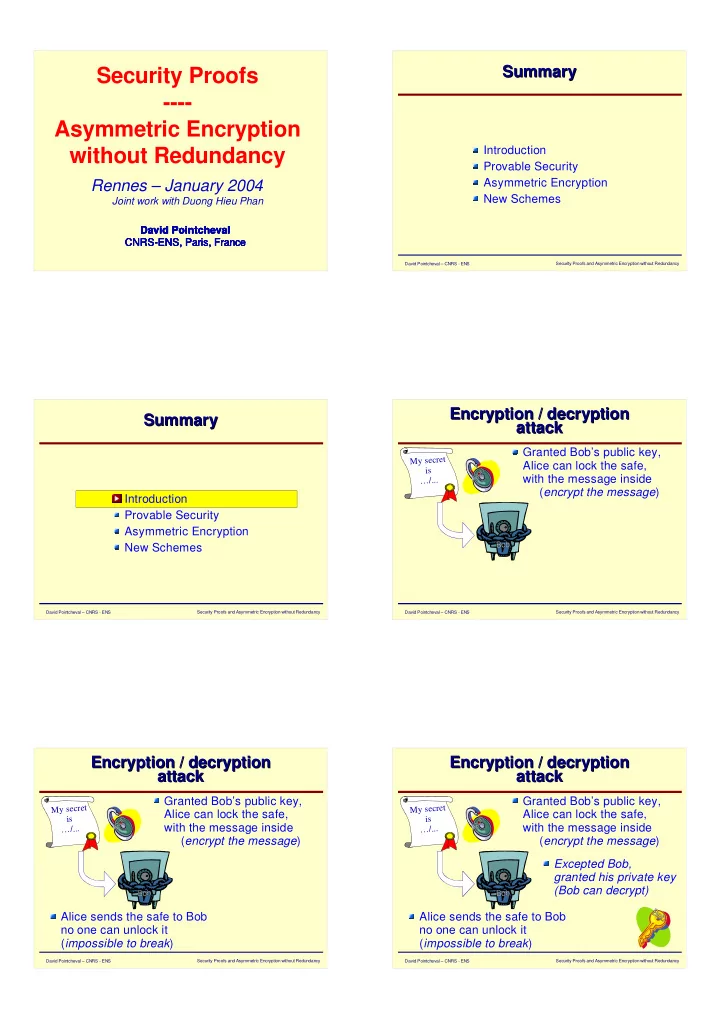
Encryption / decryption Encryption / decryption attack attack

M y s e c r e t i s … / . . .

Granted Bob’s public key, Alice can lock the safe, with the message inside (encrypt the message)

Security Proofs and Asymmetric Encryption without Redundancy David Pointcheval – CNRS - ENS

Encryption / decryption Encryption / decryption attack attack

M y s e c r e t i s … / . . .

Alice sends the safe to Bob no one can unlock it (impossible to break) Granted Bob’s public key, Alice can lock the safe, with the message inside (encrypt the message)

Security Proofs and Asymmetric Encryption without Redundancy David Pointcheval – CNRS - ENS

Encryption / decryption Encryption / decryption attack attack

M y s e c r e t i s … / . . .

Alice sends the safe to Bob no one can unlock it (impossible to break) Granted Bob’s public key, Alice can lock the safe, with the message inside (encrypt the message) Excepted Bob, granted his private key (Bob can decrypt)

slide-2
SLIDE 2

Security Proofs and Asymmetric Encryption without Redundancy David Pointcheval – CNRS - ENS

Kerckhoffs’ Principles (1) Kerckhoffs’ Principles (1)

In 1883, in “La Cryptographie Militaire” Kerckhoffs wrote: Le système doit être matériellement, sinon mathématiquement, indéchiffrable

The system should be, if not theoretically unbreakable, unbreakable in practice

Security Proofs and Asymmetric Encryption without Redundancy David Pointcheval – CNRS - ENS

Kerckhoffs’ Principles (2) Kerckhoffs’ Principles (2)

Il faut qu’il n’exige pas le secret, et qu’il puisse sans inconvénient tomber entre les mains de l’ennemi

Compromise of the system should not inconvenience the correspondents

Security Proofs and Asymmetric Encryption without Redundancy David Pointcheval – CNRS - ENS

Kerckhoffs’ Principles (3) Kerckhoffs’ Principles (3)

La clef doit pouvoir en être communiquée et retenue sans le secours de notes écrites, et être changée ou modifiée au gré des correspondants

the key should be rememberable without notes and should be easily changeable

etc …

Security Proofs and Asymmetric Encryption without Redundancy David Pointcheval – CNRS - ENS

Symmetric Encryption Symmetric Encryption

Principles 2 and 3 define the concept

  • f the symmetric cryptography:

Encryption Algorithm, Decryption Algorithm, Security = secrecy: impossible to recover m from c only (without k)

k k

  • m

c m

Security : heuristic

1st Principle

Security Proofs and Asymmetric Encryption without Redundancy David Pointcheval – CNRS - ENS

Asymmetric Cryptography Asymmetric Cryptography

Extends 2nd principle

Diffie-Hellman 1976

Asymmetric Encryption: Bob owns two “keys”

A public key (encryption ke)

so that anybody can encrypt a message for him

A private key (decryption kd)

to help him to decrypt

Alice Bob

secrecy authenticity ⇒ known by everybody (included Alice) ⇒ known by Bob only

Security Proofs and Asymmetric Encryption without Redundancy David Pointcheval – CNRS - ENS

Integer Factoring and RSA Integer Factoring and RSA

Multiplication/Factorization:

p, q n = p.q easy (quadratic) n = p.q p, q difficult (super-polynomial) One-Way Function

slide-3
SLIDE 3

Security Proofs and Asymmetric Encryption without Redundancy David Pointcheval – CNRS - ENS

Integer Factoring and RSA Integer Factoring and RSA

One-Way Function RSA Problem

RSA Function, from n in n (with n=pq)

for a fixed exponent e

Rivest-Shamir-Adleman 1978

x xe mod n easy (cubic) y=xe mod n x difficult (without p or q) x = yd mod n where d = e-1 mod (n)

Multiplication/Factorization:

p, q n = p.q easy (quadratic) n = p.q p, q difficult (super-polynomial)

Security Proofs and Asymmetric Encryption without Redundancy David Pointcheval – CNRS - ENS

encryption

Integer Factoring and RSA Integer Factoring and RSA

One-Way Function

RSA Function, from n in n (with n=pq)

for a fixed exponent e

Rivest-Shamir-Adleman 1978

x xe mod n easy (cubic) y=xe mod n x difficult (without p or q) x = yd mod n where d = e-1 mod (n)

Multiplication/Factorization:

p, q n = p.q easy (quadratic) n = p.q p, q difficult (super-polynomial)

Security Proofs and Asymmetric Encryption without Redundancy David Pointcheval – CNRS - ENS

difficult to break

Integer Factoring and RSA Integer Factoring and RSA

One-Way Function

RSA Function, from n in n (with n=pq)

for a fixed exponent e

Rivest-Shamir-Adleman 1978

x xe mod n easy (cubic) y=xe mod n x difficult (without p or q) x = yd mod n where d = e-1 mod (n)

Multiplication/Factorization:

p, q n = p.q easy (quadratic) n = p.q p, q difficult (super-polynomial)

Security Proofs and Asymmetric Encryption without Redundancy David Pointcheval – CNRS - ENS

decryption

Integer Factoring and RSA Integer Factoring and RSA

One-Way Function

RSA Function, from n in n (with n=pq)

for a fixed exponent e

Rivest-Shamir-Adleman 1978

x xe mod n easy (cubic) y=xe mod n x difficult (without p or q) x = yd mod n where d = e-1 mod (n)

Multiplication/Factorization:

p, q n = p.q easy (quadratic) n = p.q p, q difficult (super-polynomial) trapdoor

key

Security Proofs and Asymmetric Encryption without Redundancy David Pointcheval – CNRS - ENS

Summary Summary

Introduction Provable Security Asymmetric Encryption New Schemes

Security Proofs and Asymmetric Encryption without Redundancy David Pointcheval – CNRS - ENS

Algorithmic Assumptions Algorithmic Assumptions necessary necessary

n=pq : public modulus e : public exponent d=e-1 mod (n) : private RSA Encryption (m) = me mod n (c) = cd mod n If the RSA problem is easy, secrecy is not satisfied: anybody may recover m from c

slide-4
SLIDE 4

Security Proofs and Asymmetric Encryption without Redundancy David Pointcheval – CNRS - ENS

Algorithmic Assumptions Algorithmic Assumptions sufficient? sufficient?

Security proofs give the guarantee that the assumption is enough for secrecy: if an adversary can break the secrecy

  • ne can break the assumption

“reductionist” proof Extends the 1st Principle

Security Proofs and Asymmetric Encryption without Redundancy David Pointcheval – CNRS - ENS

Proof by Reduction Proof by Reduction

Reduction of a problem to an attack Atk: Let be an adversary that breaks the scheme Then can be used to solve

  • Security Proofs and Asymmetric Encryption without Redundancy

David Pointcheval – CNRS - ENS

Provably Secure Scheme Provably Secure Scheme

To prove the security of a cryptographic scheme,

  • ne has to make precise

the algorithmic assumptions

some have been presented

the security notions to be guaranteed

depends on the scheme

a reduction: an adversary can help to break the assumption

Security Proofs and Asymmetric Encryption without Redundancy David Pointcheval – CNRS - ENS

Practical Security Practical Security

Complexity theory: T polynomial Exact Security: T explicit Practical Security: T small (linear)

Adversary within t Algorithm against within t’ = T (t)

slide-5
SLIDE 5

Security Proofs and Asymmetric Encryption without Redundancy David Pointcheval – CNRS - ENS

Summary Summary

Introduction Provable Security Asymmetric Encryption New Schemes

Security Proofs and Asymmetric Encryption without Redundancy David Pointcheval – CNRS - ENS

Encryption Scheme Encryption Scheme

(ke,kd)

  • ω

kd ke

  • r

c m m

3 algorithms:

  • key generation
  • encryption
  • decryption

Security Proofs and Asymmetric Encryption without Redundancy David Pointcheval – CNRS - ENS

Security Notions Security Notions

One-Wayness (OW) :

without the private key, it is computationally impossible to recover the plaintext

Semantic Security (IND - Indistinguishability) :

the ciphertext reveals no more information about the plaintext to a polynomial adversary

Security Proofs and Asymmetric Encryption without Redundancy David Pointcheval – CNRS - ENS

Attacks Attacks

Chosen-Plaintext Attacks (CPA)

the basic attack in the public-key setting

the adversary can encrypt any message of its choice

More information: oracle access Chosen-Ciphertext Attacks (CCA)

the adversary has access to the decryption oracle

  • n any ciphertext of its choice (except the challenge)

non-adaptive (CCA1): only before receiving the challenge adaptive (CCA2): unlimited oracle access

Security Proofs and Asymmetric Encryption without Redundancy David Pointcheval – CNRS - ENS

IND-CCA2 IND-CCA2

  • c

m or ⊥ m1 m0

kd ke

  • r

mb c* b’ b{0,1} r random

  • c ≠

c* m or ⊥

b’ = b

?

CCA2

  • CCA1

Security Proofs and Asymmetric Encryption without Redundancy David Pointcheval – CNRS - ENS

Indistinguishabilit Indistinguishability: Probabilistic y: Probabilistic

To achieve indistinguishability, a public-key encryption scheme must be probabilistic

Otherwise, with the challenge c = (mb)

  • ne computes c0 = (m0)

and checks whether c0 = c

For any plaintext, the number of possible ciphertexts must be lower-bounded by 2k, for a security level in 2k : at least length(c) length(m) + k

slide-6
SLIDE 6

Security Proofs and Asymmetric Encryption without Redundancy David Pointcheval – CNRS - ENS

Chosen-Ciphertext Security: Chosen-Ciphertext Security: Redundancy Redundancy

To resist chosen-ciphertext attacks,

  • ne makes the decryption oracle unuseful:

Very few ciphertexts are valid For building a valid ciphertext, the adversary necessarily knows the corresponding plaintext

Examples

Zero-knowledge proof of knowledge of the plaintext Zero-knowledge proof of validity (CCA1 - Naor-Yung 90) C = (c1, c2, p) where c1 = pk1(m1), c2 = pk2(m2) and p is a proof that m1 = m2

Security Proofs and Asymmetric Encryption without Redundancy David Pointcheval – CNRS - ENS

CCA: Redundancy (Cont'd) CCA: Redundancy (Cont'd)

Practical constructions: OAEP: redundancy in the padding REACT: MAC in the ciphertext Cramer-Shoup: Proof of validity = redundancy Such a redundancy makes that a random ciphertext is valid (a possible output of the encryption algorithm) with a very small probability, less than 2-k: in practice: at least length(c) length(m) + 2k

Security Proofs and Asymmetric Encryption without Redundancy David Pointcheval – CNRS - ENS

Optimal Size = No Redundancy Optimal Size = No Redundancy

No redundancy = any ciphertext is valid: is a possible output of (m,r) the function :

(m,r)

  • → c is a surjection

Advantages:

  • ptimal bandwidth

no reaction attack / implementation issues easier distribution of the decryption process

Security Proofs and Asymmetric Encryption without Redundancy David Pointcheval – CNRS - ENS

Summary Summary

Introduction Provable Security Asymmetric Encryption New Schemes

Security Proofs and Asymmetric Encryption without Redundancy David Pointcheval – CNRS - ENS

Full-Domain Permutation Encryption Full-Domain Permutation Encryption

First candidate: in the same vein as the Full-Domain Hash Signature Public permutation (Random Permutation Model)

  • nto

{0,1}n

  • {0,1}k

≈ {0,1}l Trapdoor one-way permutation f onto {0,1}l :

  • (m,r)

c = f ((m,r))

the public key is the pair ( f , ) which includes -1 the private key is the trapdoor f -1

slide-7
SLIDE 7

Security Proofs and Asymmetric Encryption without Redundancy David Pointcheval – CNRS - ENS

Game IND-CCA2 Game IND-CCA2

  • c

m or ⊥ m1 m0

kd ke

  • r

mb c* b’ b{0,1} r random

  • c ≠

c* m or ⊥

b’ = b

?

CCA2

  • CCA1

Security Proofs and Asymmetric Encryption without Redundancy David Pointcheval – CNRS - ENS

FDP Encryption is IND-CCA2 Secure FDP Encryption is IND-CCA2 Secure

Simulation of the oracles , for generating f and , outputting y , -1 and using a list

  • f tuples {(m, r, p, c)}

p = (m,r), c = f (p) = (m,r)

problem if (m,r) is assumed to correspond to -1( f -1(c)) from the -simulation, and asks for (m,r): the simulation should output p = f -1(c), which is unknown but outputs m only: r is unpredictable unless there are collisions on m, the probability of such an event is less than q/2k

Security Proofs and Asymmetric Encryption without Redundancy David Pointcheval – CNRS - ENS

FDP Encryption: Properties FDP Encryption: Properties

No redundancy Optimal bandwidth: length(c) = length(m) + k High security level: IND-CCA2 with efficient reduction but in the Random-Permutation Model Can we weaken the assumptions?

Security Proofs and Asymmetric Encryption without Redundancy David Pointcheval – CNRS - ENS

The Random-Oracle Model The Random-Oracle Model

A weaker model : the random-oracle model access to a truly random function How to build a random permutation from a random function? Luby-Rackoff: a Feistel construction not that easy: here, one has access to the internal function... Let us try anyway: OAEP, a 2-round Feistel Network

Security Proofs and Asymmetric Encryption without Redundancy David Pointcheval – CNRS - ENS

2-round OAEP 2-round OAEP

(m) : c = f (s || t) (c) : s || t = f -1(c) then invert OAEP, if the redundancy is satisfied,

  • ne returns m

M = m || 0k r random

  • , : random functions

s t

Security Proofs and Asymmetric Encryption without Redundancy David Pointcheval – CNRS - ENS

2-round OAEP (cont'd) 2-round OAEP (cont'd)

In the random-oracle model If f is a trapdoor partial-domain OW permutation:

(s,t) f (s || t) trapdoor one-way f (s || t) s also hard to compute

With a redundancy 0k and random of size k0 The encryption scheme f -OAEP: IND-CCA2 with quadratic lost (in qq/ 2k0: k0 = 2k) length(c) = length(m) + 3k

slide-8
SLIDE 8

Security Proofs and Asymmetric Encryption without Redundancy David Pointcheval – CNRS - ENS

What About the Redundancy? What About the Redundancy?

For IND-CCA2: redundancy Plaintext-awareness = invalid ciphertexts Without redundancy... is it still IND-CCA2?

2-round OAEP: no known attack, but no proof either

Any simulation seems to be subject to the Shoup's attack (malleability of OAEP)

3-round OAEP: can be proven

Security Proofs and Asymmetric Encryption without Redundancy David Pointcheval – CNRS - ENS

3-round OAEP 3-round OAEP

(m) : c = f (t || u) (c) : t || u = f -1(c) then invert OAEP, and return m m

  • , and : random functions

t u r s

  • Security Proofs and Asymmetric Encryption without Redundancy

David Pointcheval – CNRS - ENS

Idea of the Security Idea of the Security

2-round OAEP: as in the Shoup's attack,

the adversary can forge a ciphertext c, with the same r as in the challenge ciphertext the simulator cannot check it the adversary can always distinguish the simulation

With one more round:

the adversary is stuck!

  • ne can simulate everything

in a consistent way

at random when not already known anticipating some future answers, when determined

Security Proofs and Asymmetric Encryption without Redundancy David Pointcheval – CNRS - ENS

Tightness of the Reduction Tightness of the Reduction

Everything works well with lists, , , , But for g = (s), which implies

(r) = m

  • ⊕ s for r = t

⊕ g for any (t, h)

  • ∈ , and (m,c)

such that c = f (t, h

  • ⊕ s)

in case such a query is asked later

Problem if such a query has already been asked... Since g is random, the overall probability of such a bad event is upper-bounded by q q / 2k.

Security Proofs and Asymmetric Encryption without Redundancy David Pointcheval – CNRS - ENS

Security Result Security Result

With a random of size k0, but no redundancy In the ROM, a (t,)-IND-CCA2 adversary helps to partially invert f within t' ≈ t + qqTf, and with success probability greater than – qQ/ 2k0 The 3-round OAEP is: IND-CCA2 with quadratic lost (k0 = 2k) length(c) = length(m) + 2k

Security Proofs and Asymmetric Encryption without Redundancy David Pointcheval – CNRS - ENS

Conclusion Conclusion

We have proposed the first IND-CCA2 encryption schemes, without redundancy: the FDP encryption is optimal based on the OW of the trapdoor permutation

  • ptimal bandwidth

but in the Random-Permutation Model the 3-round OAEP with similar characteristics as the 2-round OAEP but without redundancy