The RSA Algorithm Private-key cryptosystems: - Alice and Bob agree - - PowerPoint PPT Presentation

the rsa algorithm
SMART_READER_LITE
LIVE PREVIEW

The RSA Algorithm Private-key cryptosystems: - Alice and Bob agree - - PowerPoint PPT Presentation

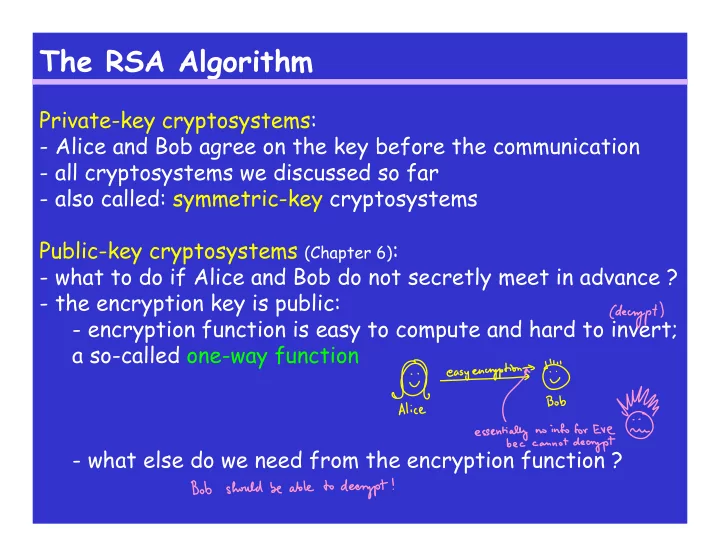
The RSA Algorithm Private-key cryptosystems: - Alice and Bob agree on the key before the communication - all cryptosystems we discussed so far - also called: symmetric-key cryptosystems Public-key cryptosystems (Chapter 6) : - what to do if


slide-1
SLIDE 1

The RSA Algorithm

Private-key cryptosystems:

  • Alice and Bob agree on the key before the communication
  • all cryptosystems we discussed so far
  • also called: symmetric-key cryptosystems

Public-key cryptosystems (Chapter 6):

  • what to do if Alice and Bob do not secretly meet in advance ?
  • the encryption key is public:
  • encryption function is easy to compute and hard to invert;

a so-called one-way function

  • what else do we need from the encryption function ?
slide-2
SLIDE 2

The RSA Algorithm

Remarks:

  • we do not know if one-way functions exist…
  • we work with functions that are believed to be one-way
  • a one-way function that is easy to invert if one has a

corresponding private key (a trapdoor) is called a trapdoor

  • ne-way function
slide-3
SLIDE 3

The RSA Algorithm

Public-key cryptography:

  • Diffie-Helman, 1976 (it was documented earlier in classified

documents)

  • Rivest-Shamir-Adleman, 1977: The RSA Cryptosystem
  • never give perfect secrecy – why not ?

Note:

  • public-key cryptosystems usually used to encrypt a private

key, not the complete message – why ?

slide-4
SLIDE 4

The RSA Algorithm

  • 1. Bob chooses secret odd primes p and q, computes n=pq.
  • 2. Bob chooses e with gcd(e,Φ(n))=1.
  • 3. Bob computes d = e-1 mod Φ(n).
  • 4. Bob makes n and e public, keeps p, q, and d private.
  • 5. Alice encrypts m ∈ Zn as c = me mod n and sends c to Bob.
  • 6. Bob decrypts by computing m = cd mod n.

What is Φ(n) ?