Section 2 Energy Fundamentals 1 Energy Fundamentals Open and - - PowerPoint PPT Presentation

section 2 energy fundamentals
SMART_READER_LITE
LIVE PREVIEW

Section 2 Energy Fundamentals 1 Energy Fundamentals Open and - - PowerPoint PPT Presentation

Section 2 Energy Fundamentals 1 Energy Fundamentals Open and Closed Systems First Law of Thermodynamics Second Law of Thermodynamics Examples of heat engines and efficiency Heat Transfer Conduction, Convection, Radiation


slide-1
SLIDE 1

Section 2 Energy Fundamentals

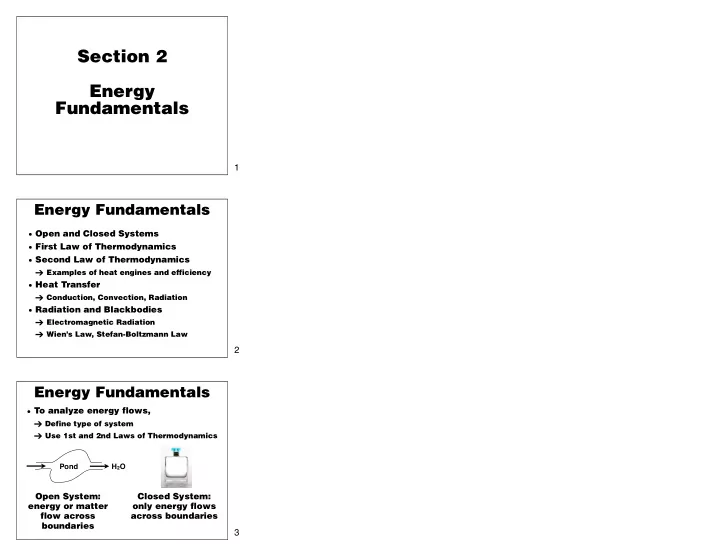
Energy Fundamentals

  • Open and Closed Systems
  • First Law of Thermodynamics
  • Second Law of Thermodynamics

➔ Examples of heat engines and efficiency

  • Heat Transfer

➔ Conduction, Convection, Radiation

  • Radiation and Blackbodies

➔ Electromagnetic Radiation ➔ Wien’s Law, Stefan-Boltzmann Law

Energy Fundamentals

  • To analyze energy flows,

➔ Define type of system ➔ Use 1st and 2nd Laws of Thermodynamics

Open System: energy or matter flow across boundaries Closed System:

  • nly energy flows

across boundaries

H2O Pond

1 2 3

slide-2
SLIDE 2

First Law of Thermodynamics

  • “Energy cannot be created or destroyed”
  • Energy balance equation:

Energy in = Energy out + Change in internal energy

➔ Change in internal energy ΔU commonly due

to change in temperature: ΔU = mcΔT m = mass c = specific heat ΔT = temperature change Units of specific heat c (definitions): 1 BTU is the energy required to raise the temperature of 1 lb of water by 1°F. 1 calorie is the energy required to raise the temperature of 1 gram of water by 1°C. 1 kilojoule (preferred) For water,

Energy Unit mass × Temperature

c = 1 cal g i °C = 4.184 kJ kg i K

4 5 6

slide-3
SLIDE 3

When a substance changes phase by freezing

  • r boiling,

ΔU = mHL HL = latent heat m is the mass of substance Internal energy changes due to phase changes: Changing from solid → liquid: Latent Heat of Fusion Changing from liquid → gas: Latent Heat of Vaporization

HL (fusion of 0°C water) = 333 kJ/kg HL (vaporization of 100°C H2O) = 2257 kJ/kg

Example: Global Precipitation

Over entire globe (area of globe 5.1x10¹⁴ m2), precipitation averages 1 m/yr. What energy is required to evaporate all of the precipitation if the temperature of the water is 15 °C?

Specific heat (15°C) 4.184 kJ/kg Heat of Vaporization (100°C) 2257 kJ/kg Heat of Vaporization (15°C) 2465 kJ/kg Heat of Fusion 333 kJ/kg

7 8 9

slide-4
SLIDE 4

Use First Law of Thermodynamics: Energy = Energy + Change in In Out Internal Energy In this case, assume “energy out” = 0 (no losses, and all energy put into the system is used for evaporation) ⇒ Energy In = Change in Internal Energy = mHL m = (1m/yr)(5.1 × 1014 m2)(1000 kg/m3 ) = 5.1 × 10¹⁷ kg/yr Energy = (5.1 × 10¹⁷ kg/yr)(2465 kJ/kg) = 1.3 × 10²¹ kJ/yr IMPORTANT: use the latent heat for water at 15°C, not 100°C This is ~4000 times larger than world energy consumption! (Global fossil fuel consumption is about 3.5 × 10¹⁷ kJ/yr)

Example: An Open System

Many practical situation exist where both mass and energy flow across boundaries: heat exchangers, cooling water, flowing rivers Rate of change in stored energy (due to flow) where is the mass flow rate across boundaries of the system of interest  m

=  mcΔT 10 11 12

slide-5
SLIDE 5

A coal-fired powerplant converts one-third of the coal’s energy into electricity, with an electrical output rate of 1000 MW (1 MW = 106 J/s) The other 2/3 goes back into the environment: 15% to the atmosphere, up the stack 85% into a nearby river The river flows at 100 m3/s and is 20°C upstream of the plant If the stream of water that is put back into the river is to be at no more than 30°C, how much water needs to be drawn from the river? Amount of waste heat going into the river: Rate of change in stored energy due to flow  m kg/s

( ) = waste heat

cΔT

=  mcΔT

= 1.700 × 10⁹ J

s

4184

J kg K × 10 K = 4.063 × 10⁴ kg s

2000 MW × 85% = 1700 MW = 1700 × 106 J s = 1.700 × 10⁹ J s

  • “The entropy of a system tends to

increase.”

  • Entropy is a measure of

disorganization in a system

➔ Thermal energy not available for

conversion into mechanical work

➔ Conversion of heat to work results in

some waste heat—a heat engine cannot be 100% efficient

Second Law of Thermodynamics

13 14 15

slide-6
SLIDE 6
  • A coal-fired powerplant is a type
  • f heat engine

➔ Burn coal for heat ➔ Boil water to make steam ➔ Steam turns turbine—some of heat in steam converted to electricity ➔ Exiting steam is at a lower temperature—waste heat

— Co-generation?

Heat Engine

Hot reservoir Th Cold reservoir Tc Heat to engine Qh Qc Waste heat Work W

Efficiency ≡ work heat input = W Qh = η

  • Theoretically, the most efficient

heat engine is the Carnot Engine:

For Carnot, Tc, Th = absolute temperature, in K or R

c = cold, h = hot, h = efficiency

  • As Th increases h increases;

as Tc decreases, h increases

➡ The larger the difference in temperature,

the more efficient the process η = 1 − Tc Th

16 17 18

slide-7
SLIDE 7

Typical Powerplant

Energy output = 1000 MW Pressurized steam boiler = 600°C = 873 K Cooled to ambient temperature = 20°C = 293 K Real-world efficiencies in U.S. powerplants average 33% (range ~ 25 to 40% depending

  • n age of plant)

ηmax = 1 − 293 873 = 0.66 = 66%

Some conversions

Kilowatt-hour (KWH or kW-hr)

1 W = 1 J/s ⇒ 1 J = 1 W • s 1 Watt-hour = 1 W • 3600 s = 3600 J 1 kW-hr = 1000 • 1 W • 3600 s = 3.6 # 106 J = 3.6 MJ

Example (Prob. 1.31)

  • a. If an incandescent lamp costs 60¢ and

the CFL costs $2, what is the “payback” period?

  • b. Over the 9000-hr lifetime, what would

be saved in carbon emissions? (280 g carbon emitted per kW-hr)

  • c. At a (proposed) carbon tax of $50/tonne,

what is the equivalent dollars saved as carbon emissions? (1 tonne = 1000 kg) A 15W compact fluorescent lamp (CFL) provides the same light as a 60W incandescent lamp. Electricity costs the end user 10¢ per kW-hr.

19 20 21

slide-8
SLIDE 8

Energy saved with the CFL: (60W – 15W)(9000 hr) = 405 kW-hr At 10¢ per kW-hr, this is $40 over the lifetime of the lamp. Payback period: As an example, use 6 hr/day usage. Then

= $0.027 saved per day $2/$0.027 per day = 74 days or about 2.5 months

Emissions savings: (280 g carbon/kW-hr)(405 kW-hr) = 113400 g C

⇒ 0.113 T × $50/T = $5.65

60W − 15W

( ) 6 hr

day

( ) $0.10

1 kW-hr

( )

1000 W-hr

kW-hr

Example

Could the temperature difference between the top and bottom of a lake be used as a cheap, renewable source of a megawatt of electricity? Say the temperatures are 25°C and 15°C, maintained by sunlight (~ 500 W/m2) and the lake has an area of 104 m2. Are the first and second laws of thermodynamics obeyed? [first: energy is conserved; second: entropy of systems increase and there is a limit on the efficiency

  • f any process]

Evaluate maximum efficiency, then calculate energy output What is the maximum possible energy output from this system, given the solar energy input? η = 1 − Tc Th

ηmax = 1 − 288 298 = 0.034

500 W

m2

( ) 104 m2 ( ) 0.034

( ) = 170000 W = 0.17 MW 22 23 24

slide-9
SLIDE 9

Example

A very efficient gasoline engine runs at 30% efficiency. If the engine expels gas into the atmosphere, which has a temperature of 300 K, what is the temperature of the cylinder immediately after combustion? If 837 J of energy are absorbed from the hot reservoir during each cycle, how much energy is available for work? η = 1 − Tc Th η = W Qh

Heat Transfer

  • Heat transfer always occurs between

hot and cold objects

➔ Conduction: heat

transfer occurs when there is direct physical contact; kinetic energy is transferred when atoms or molecules collide

➔ Convection: heat transfer is mediated by

the flow of a fluid

–Free convection occurs without human

intervention; forced convection requires mechanical pumping of the fluid

➔ Radiation: heat

transfer mediated by the propagation

  • f electromagnetic

radiation (such as light)

25 26 27

slide-10
SLIDE 10

Radiation

  • All objects radiate energy

continuously in the form of electromagnetic waves, if their temperature is greater than 0 K

  • Type of radiation depends on

wavelength

λ

Wavelength

Blackbody Radiation

  • Blackbodies absorb and emit at all

wavelengths

  • Amount of radiation emitted depends
  • n temperature

Stefan-Boltzmann Law

E = total blackbody emission rate (W) σ = Stefan-Boltzmann constant = 5.67 × 10⁻⁸ W/m2K4 T = temperature (K) A = surface area of blackbody (m2)

E = σAT 4 28 29 30

slide-11
SLIDE 11

A more familiar form uses the energy flux F, where F = E/A W/m2

Wien’s Law

F = σT 4

λmax µm

( ) = 2898 µm ⋅ K

T (K) 31 32 33

slide-12
SLIDE 12

Example: Human Body as an Energy Converter

How high can you climb on the energy from a liter of milk? One liter of milk contains about 2.4 × 10⁶ J. Work needed to move your body = mgh where m = your mass, g = acceleration due to gravity, h = change in height 2.4 × 10⁶ J

( ) ×

1 kJ 1000 J ⎛ ⎝ ⎜ ⎞ ⎠ ⎟ × 1 cal 4.184 kJ ⎛ ⎝ ⎜ ⎞ ⎠ ⎟ = 574 cal Work available from milk = (metabolic efficiency)Q = εQ where Q is the internal energy of the milk Example input values: m = 50 kg (110 lb), efficiency ~ 100% Considering that Mt. Whitney has an elevation gain of about 3000 m, does this sound reasonable? εQ = mgh 1.0

( ) 2.4 × 10⁶ J

( ) =

50 kg

( ) 9.8 m s2

( )h

h = 4900 m

34 35