Searches for Rare Exclusive Higgs Boson Decays with ATLAS Rhys Owen - - PowerPoint PPT Presentation

searches for rare exclusive higgs boson decays with atlas
SMART_READER_LITE
LIVE PREVIEW

Searches for Rare Exclusive Higgs Boson Decays with ATLAS Rhys Owen - - PowerPoint PPT Presentation

Searches for Rare Exclusive Higgs Boson Decays with ATLAS Rhys Owen 1 , 2 University of Birmingham 1 , Rutherford Appleton Laboratory 2 11th January 2017 Rhys Owen (University of Birmingham, RAL) Rare Exclusive Higgs Boson Decays 11th January


slide-1
SLIDE 1

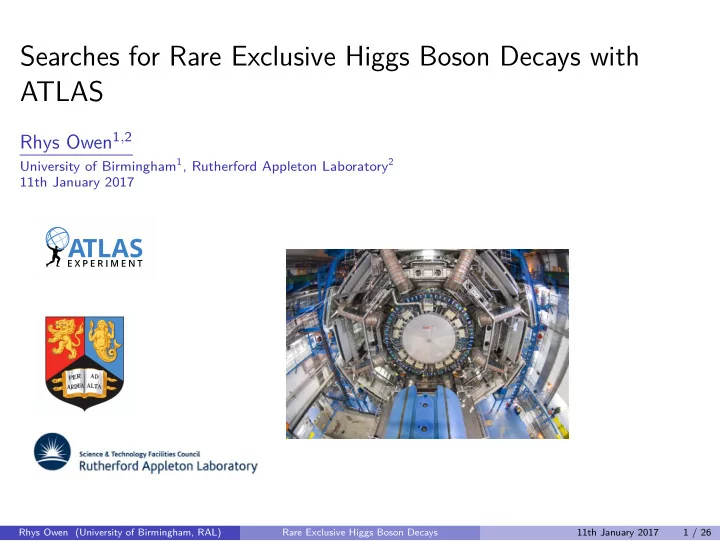
Searches for Rare Exclusive Higgs Boson Decays with ATLAS

Rhys Owen1,2

University of Birmingham1, Rutherford Appleton Laboratory2 11th January 2017

Rhys Owen (University of Birmingham, RAL) Rare Exclusive Higgs Boson Decays 11th January 2017 1 / 26

slide-2
SLIDE 2

Introduction

Higgs Boson discovered at LHC Leading discovery channels all involve bosons

[GeV]

4l

m 80 90 100 110 120 130 140 150 160 170 Events/2.5 GeV 5 10 15 20 25 30 35

Data = 125 GeV)

H

Higgs (m ZZ* t Z+jets, t +V, VVV t t Uncertainty

4l → ZZ* → H

  • 1

13 TeV, 14.8 fb

ATLAS Preliminary ATLAS-CONF-2016-079

[GeV]

γ γ

m

110 120 130 140 150 160 weights - bkg

5 − 5 10 weights / GeV

20 40 60 80 100 120 140 160 180 200 Data Background Signal + Background Signal

Preliminary ATLAS

  • 1

= 13 TeV, 13.3 fb s = 125.09 GeV

H

, m γ γ → H S/B weighted sum of event categories

ATLAS-CONF-2016-067 200 400 600 800 50 100 150 200 250 300 50 100 150 stat ± Obs syst ± Bkg Higgs WW Misid VV Top DY Bkg

  • Obs

syst ± Bkg Higgs (b) Background-subtracted [GeV]

T

m Events / 10 GeV µ µ ee/ + µ e , 1 ≤

j

n (a) Events / 10 GeV

ATLAS

  • 1

fb 20.3 TeV, =8 s

  • 1

fb 4.5 TeV, =7 s

WW* → H

Phys.Rev. D92 (2015) no.1, 012006 Rhys Owen (University of Birmingham, RAL) Rare Exclusive Higgs Boson Decays 11th January 2017 2 / 26
slide-3
SLIDE 3

BEH Mechanism

This mechanism underpins all of the Higgs Physics Introduces a new field into the standard model φ = φ+ φ0

  • Four new degrees of freedom

◮ 3 mix with the W ±, Z 0 giving

them mass

◮ The fourth gives rise to the

standard model Higgs boson

This explains the link between the Higgs boson, the electroweak bosons and their masses but says nothing about fermions

Rhys Owen (University of Birmingham, RAL) Rare Exclusive Higgs Boson Decays 11th January 2017 3 / 26

slide-4
SLIDE 4

Fermion Masses

Lfermion = −yf · [ ¯ ψLφψR + ¯ ψR ¯ φψL] Lfermion = − yf v √ 2 · ¯ ψψ

  • mass term

− yf √ 2 · h ¯ ψψ

  • Yukawa coupling term

This combination of the Higgs field and fermions gives: gauge invariant mass terms for the fermions Introduces a Yukawa coupling directly between the fermions and the Higgs boson But masses are not generated directly by the spontaneous symmetry breaking as for the bosons

Rhys Owen (University of Birmingham, RAL) Rare Exclusive Higgs Boson Decays 11th January 2017 4 / 26

slide-5
SLIDE 5

Existing Results

H → ττ

(S / B)

10

log

  • 4
  • 3
  • 2
  • 1

1 Events / bin 1 10

2

10

3

10

4

10

ATLAS

  • 1

, 20.3 fb = 8 TeV s

  • 1

, 4.5 fb = 7 TeV s τ τ → H

Data =1.4) µ Background ( =0) µ Background ( =1.4) µ ( τ τ → (125) H =1) µ ( τ τ → (125) H

JHEP 04 (2015) 117

H → b¯ b

[GeV]

bb

m 50 100 150 200 250 Weighted events after subtraction / 20.0 GeV 2 4 6 8 10

Data 2012 =1.0) µ VH(bb) ( Diboson Uncertainty

ATLAS

  • 1

Ldt = 20.3 fb

= 8 TeV s 0+1+2 lep., 2+3 jets, 2 tags Weighted by Higgs S/B

JHEP 01 (2015) 069

top associated production

=125 GeV

H

for m

H t t

µ 0.5 − 0.5 1 1.5 2 2.5 3 3.5 4 ln(L) ∆

  • 1

2 3 4 5

σ 1 σ 2 σ 3 ) γ γ → H(H t t /ZZ) τ τ WW/ → H(H t t ) b b → H(H t t H combination t t

ATLAS Preliminary

  • 1

=13 TeV, 13.2-13.3 fb s

ATLAS-CONF-2016-068

There are several searches on-going with sensitivity to the Yukawa couplings The first direct evidence came from the observation of H → ττ (4.5(3.2)σ) Most “Obvious” channels suffer from large backgrounds and other experimental challenges

Rhys Owen (University of Birmingham, RAL) Rare Exclusive Higgs Boson Decays 11th January 2017 5 / 26

slide-6
SLIDE 6

Higgs Boson → Qγ

Photon Meson Decay Higgs Boson

One promising channel is Higgs boson decays to a photon and a meson Gives direct access the Yukawa couplings A distinctive topology to trigger and select the events At the cost of a small SM branching ratio Channel SM Branching Ratio BR(H → c¯ c) 3 × 10⁻² BR(H → J/ψγ) 3 × 10⁻⁶

Rhys Owen (University of Birmingham, RAL) Rare Exclusive Higgs Boson Decays 11th January 2017 6 / 26

slide-7
SLIDE 7

The ATLAS Experiment

The ATLAS experiment is a general purpose detector based at the Large Hadron Collider.

Rhys Owen (University of Birmingham, RAL) Rare Exclusive Higgs Boson Decays 11th January 2017 7 / 26

slide-8
SLIDE 8

ATLAS Searches for Higgs Boson → J/ψγ I

  • Phys. Rev. Lett. 114 (2015) 121801

[GeV]

T

p 20 40 60 80 100 120 140 Events/2 GeV 0.02 0.04 0.06 0.08 0.1

Before selection After selection

T 1 µ

p

T 2 µ

p

T γ

p

Simulation ATLAS

γ ψ J/ → H

[GeV]

  • µ

+

µ

m 2.7 2.8 2.9 3.0 3.1 3.2 3.3 3.4 3.5 Events / 0.02 GeV 50 100 150 200 250 300 350

Data Fit ψ J/ Background

ATLAS

  • 1

L dt = 19.2 fb

= 8 TeV s

T

Loose Isol. Soft p channel γ ψ J/ Barrel Categories 1 MeV ± = 44 σ

[GeV]

γ µ µ

m 40 80 120 160 200 Events / 4 GeV 2 4 6 8 10 12 14 16 18 20 22 24 ATLAS

=8 TeV s

  • 1

Ldt = 19.2 fb

Data S+B Fit Background ]

  • 3

H [B=10 ]

  • 6

Z [B=10

[GeV]

γ µ µ T

p 50 100 150 200 Events / 4 GeV 5 10 15 20 25 ATLAS

=8 TeV s

  • 1

Ldt = 19.2 fb

Data S+B Fit Background ]

  • 3

H [B=10 ]

  • 6

Z [B=10

h → J/ψγ First search for a decay of this type using √s = 8 TeV Previously presented in this forum by Andrew Chisholm

Rhys Owen (University of Birmingham, RAL) Rare Exclusive Higgs Boson Decays 11th January 2017 8 / 26

slide-9
SLIDE 9

ATLAS Searches for Higgs Boson → Υ(nS)γ

  • Phys. Rev. Lett. 114 (2015) 121801

[GeV]

T

p 20 40 60 80 100 120 140 Events/2 GeV 0.02 0.04 0.06 0.08 0.1 0.12

Before selection After selection

T 1 µ

p

T 2 µ

p

T γ

p

Simulation ATLAS

γ (nS) ϒ → H

[GeV]

  • µ

+

µ

m 8.0 8.5 9.0 9.5 10.0 10.5 11.0 11.5 12.0 Events / 0.1 GeV 10 20 30 40 50 60 70 80

Data Fit (nS) ϒ Background

ATLAS

  • 1

L dt = 20.3 fb

= 8 TeV s

T

Loose Isol. Soft p channel γ (nS) ϒ Barrel Categories 13 MeV ± = 108

1S

σ [GeV]

γ µ µ

m 40 80 120 160 200 Events / 4 GeV 10 20 30 40 50 60 70 80 ATLAS

=8 TeV s

  • 1

Ldt = 20.3 fb

Data S+B Fit Combinatoric (nS) ϒ Z FSR ]

  • 3

H [B=10 ]

  • 6

Z [B=10

[GeV]

γ µ µ T

p 50 100 150 200 Events / 4 GeV 10 20 30 40 50 ATLAS

=8 TeV s

  • 1

Ldt = 20.3 fb

Data S+B Fit Combinatoric (nS) ϒ Z FSR ]

  • 3

H [B=10 ]

  • 6

Z [B=10

[GeV]

µ µ

m 8 8.5 9 9.5 10 10.5 11 11.5 12 Events / 0.125 GeV 5 10 15 20 25 30 35 ATLAS

=8 TeV s

  • 1

Ldt = 20.3 fb

Data S+B Fit Combinatoric (nS) ϒ Z FSR ]

  • 3

H [B=10 ]

  • 6

Z [B=10

h → Υ(nS)γ

Rhys Owen (University of Birmingham, RAL) Rare Exclusive Higgs Boson Decays 11th January 2017 9 / 26

slide-10
SLIDE 10

ATLAS Searches for Higgs Boson → J/ψγ II

Set limits on the Branching ratio of the order 1 × 10⁻³ Compared with a predicted SM branching ratio of 3 × 10⁻⁶ (JHEP 1508 (2015) 012) Any large deviation could be a sign of physics from beyond the standard model.

H → J / ψ γ

H → J/ψγ 19.2 fb−1

H → Υ ( 1 S ) γ

H → Υ(1S)γ 20.3 fb−1

H → Υ ( 2 S ) γ

H → Υ(2S)γ 20.3 fb−1

H → Υ ( 3 S ) γ

H → Υ(3S)γ 20.3 fb−1

H → Υ ( n S ) γ

H → Υ(nS)γ 20.3 fb−1

Z → J / ψ γ

Z → J/ψγ 19.2 fb−1

Z → Υ ( 1 S ) γ

Z → Υ(1S)γ 20.3 fb−1

Z → Υ ( 2 S ) γ

Z → Υ(2S)γ 20.3 fb−1

Z → Υ ( 3 S ) γ

Z → Υ(3S)γ 20.3 fb−1

Z → Υ ( n S ) γ

Z → Υ(nS)γ 20.3 fb−1

95% CL upper limit on Branching Fraction 10−6 10−5 10−3 10−2 H/Z → Qγ Observed Expected (±1, 2σ) 95% CLs upper limit on Branching Fraction

.

ATLAS √s = 8 TeV

  • Phys. Rev. Lett. 114 (2015) 121801

Rhys Owen (University of Birmingham, RAL) Rare Exclusive Higgs Boson Decays 11th January 2017 10 / 26

slide-11
SLIDE 11

ATLAS Searches for Higgs Boson → φγ

h γ γ/Z

h γ h γ

The Latest Qγ search from ATLAS is for H → φγ

  • Phys. Rev. Lett. 117, 111802

This is an analogous decay to the J/ψγ decay mode SM prediction B(H → φγ) = (2.3 ± 0.1) × 10−6(JHEP 1508 (2015) 012) The direct diagrams give access to the strange Yukawa coupling.

Rhys Owen (University of Birmingham, RAL) Rare Exclusive Higgs Boson Decays 11th January 2017 11 / 26

slide-12
SLIDE 12

Analysis Strategy

Analysis performed using 2015 pp dataset Data is selected with a dedicated trigger Backgrounds are modelled with a data driven model SM signals are generated using the ATLAS simulation infrastructure. These are combined in a Maximum Likelihood fit to obtain CLs limits on the Branching Ratio

Day in 2015

  • 1

fb Total Integrated Luminosity 1 2 3 4 5 1/6 1/7 1/8 1/9 1/10 1/11

= 13 TeV s

Preliminary ATLAS

LHC Delivered ATLAS Recorded All Good for Physics Total Delivered: 4.2 fb-1 Total Recorded: 3.9 fb-1 All Good for Physics: 3.2 fb-1

Rhys Owen (University of Birmingham, RAL) Rare Exclusive Higgs Boson Decays 11th January 2017 12 / 26

slide-13
SLIDE 13

Event Selection

Events from LHC stable beams with all ATLAS sub-detectors operating normally Dedicated trigger Specificaly developed for this analysis photon of pT greater than 35 GeV Two tracks consistent with the φ meson mass Leading track pT > 15 GeV Trigger efficiency is (w.r.t. offline selection) ≈ 80%

[GeV]

T

p 20 40 60 80 100 120 Events / 2 GeV 0.02 0.04 0.06 0.08 0.1 0.12

Before selection After selection

T subleading K

p

T leading K

p

T γ

p

Simulation ATLAS

γ φ → H Rhys Owen (University of Birmingham, RAL) Rare Exclusive Higgs Boson Decays 11th January 2017 13 / 26

slide-14
SLIDE 14

Track Selection

ATLAS has no PID in the relevant pT range All tracks assumed to to be K ± The K ± with the highest pT has the requirement pT > 20 GeV pT > 15 GeV is required for the second track di-track invariant mass is required to be within ±20 MeV of the φ meson mass The sum of pT of the tracks within ∆R = 0.2 of the φ meson is required to be less than 10% of the di-track pT (excluding the selected tracks) The tracks are expected to be very collimated.

KK

R ∆ 0.01 0.02 0.03 0.04 0.05 Events / 0.01 0.01 0.02 0.03 0.04 0.05 0.06 0.07 0.08

Before selection After selection

γ φ → H

Simulation ATLAS

Rhys Owen (University of Birmingham, RAL) Rare Exclusive Higgs Boson Decays 11th January 2017 14 / 26

slide-15
SLIDE 15

Photon Selection

Photons reconstructed from clusters in the electromagnetic calorimeter Photon pT > 35 GeV Within η acceptance |η| < 2.37 avoiding the transition region between calorimeter barrel and end-caps 1.37 < |η| < 1.52 Passing “Tight” photon identification requirements Both track and calorimeter isolation

[GeV]

T γ

p 20 40 60 80 100 120 140 Events / 2 GeV 0.01 0.02 0.03 0.04 0.05 0.06

Before selection After selection

γ φ → H

Simulation ATLAS

Rhys Owen (University of Birmingham, RAL) Rare Exclusive Higgs Boson Decays 11th January 2017 15 / 26

slide-16
SLIDE 16

Final φγ Selection

A further requirement is placed on the candidates that the azimuthal angle between the meson and the photon must be ∆φ(K +K −, γ) > 0.5 in the case of multiple candidates in event a single φγ pair is selected based on:

◮ Highest photon pT ◮ Di-track pair closest to the φ

mass

A final pT requirement is placed on the φ candidate dependant on the three body mass. 40 GeV at the Zmass rising linearly to 45 GeV at the Higgs boson mass

[GeV]

  • K

+

K

m 0.99 1.00 1.01 1.02 1.03 1.04 1.05 Candidates / 0.002 GeV 20 40 60 80 100 120 140

Data Fit Result

  • K

+

K → φ Combinatoric Background

ATLAS

  • 1

= 13 TeV, 2.7 fb s Rhys Owen (University of Birmingham, RAL) Rare Exclusive Higgs Boson Decays 11th January 2017 16 / 26

slide-17
SLIDE 17

Signal Modelling

Several Higgs boson production modes considered Gluon fusion Vector Boson Fusion WH,ZH associated production Gluon fusion cross section scaled to include other processes Higgs boson decay simulation Modelled in Pythia 8.1.86 φ helicity not simulated but corrected for (≈ 1% effect)

[GeV]

γ

  • K

+

K

m 110 115 120 125 130 135 140 Candidates / 0.5 GeV γ

  • K

+

K 0.0 0.5 1.0 1.5 2.0 2.5

3

10 ×

Signal MC Double Gauss. Fit

ATLAS Simulation

γ )

  • K

+

(K φ → H Inclusive Rhys Owen (University of Birmingham, RAL) Rare Exclusive Higgs Boson Decays 11th January 2017 17 / 26

slide-18
SLIDE 18

Background Modelling

Background dominated by multijet and γ-jet events Data here from a loosened selection Background shows a kinematic peak at ≈ 100 GeV. Difficult to generate a Monte Carlo sample with a large acceptance to the signal region Also difficult to model with a reasonable polynomial Instead a nonparametric data driven method is used to model this shape

[GeV]

γ

  • K

+

K

m 50 100 150 200 250 300 Events / 5 GeV 20 40 60 80 100 120 140 160 180 200

  • 1

= 13 TeV, 2.7 fb s Data Background Model Model Shape Uncertainty

ATLAS

Rhys Owen (University of Birmingham, RAL) Rare Exclusive Higgs Boson Decays 11th January 2017 18 / 26

slide-19
SLIDE 19

Background Procedure

Use loose selection of events The isolation cuts are removed The di-track pTcut is loosened Selecting ≈ 4000 events Produce Kinematic and Isolation PDF’s The pT,η,φ values for the candidate tracks and photons are transformed to PDFs PDFs are also generated for the associated isolation values Multidimensional PDFs are used to retain the correlations Create pseudo-candidates Kinematic variables are sampled from the PDFs (retaining their correlations) This enables the generation of a large ensemble of pseudo-candidates

Rhys Owen (University of Birmingham, RAL) Rare Exclusive Higgs Boson Decays 11th January 2017 19 / 26

slide-20
SLIDE 20

Background Validation

Generated pseudo-candidates then exbibit the same kinematic and isolation properties that they were modelled from Independently applying the loosened selection criteria shifts both the shape and normalisation of the data This is matched accurately with the behaviour of the pseudo-candidates

[GeV]

γ

  • K

+

K

m 50 100 150 200 250 300 Events / 5 GeV 20 40 60 80 100 120 140 160 180 200 220

  • 1

= 13 TeV, 2.7 fb s Data Background Model Model Shape Uncertainty

ATLAS

pT CR

[GeV]

γ

  • K

+

K

m 50 100 150 200 250 300 Events / 5 GeV 20 40 60 80 100 120 140 160 180 200

  • 1

= 13 TeV, 2.7 fb s Data Background Model Model Shape Uncertainty

ATLAS

Photon Isolation CR

[GeV]

γ

  • K

+

K

m 50 100 150 200 250 300 Events / 5 GeV 20 40 60 80 100 120 140 160 180 200 220 240

  • 1

= 13 TeV, 2.7 fb s Data Background Model Model Shape Uncertainty

ATLAS

Meson Isolation

Rhys Owen (University of Birmingham, RAL) Rare Exclusive Higgs Boson Decays 11th January 2017 20 / 26

slide-21
SLIDE 21

Background Systematics

The normalisation of the background is unconstrained in the final fit so the largest systematic effect would be from deviation in the shape These variations are introduced by altering the PDFs describing the di-track pT and ∆φ(K +K −, γ) A further global shift of the three body mass shape is included motivated by the changes seen when removing the smallest correlation. These three shape variations describe the uncertainty shown in the plot.

[GeV]

γ

  • K

+

K

m 50 100 150 200 250 300 Events / 5 GeV 20 40 60 80 100 120 140 160 180 200

  • 1

= 13 TeV, 2.7 fb s Data Background Model Model Shape Uncertainty

ATLAS

Rhys Owen (University of Birmingham, RAL) Rare Exclusive Higgs Boson Decays 11th January 2017 21 / 26

slide-22
SLIDE 22

Signal Systematics

The following systematics are calculated for the signal yield with the help

  • f the ATLAS combined performance groups

Systematic Signal Uncertainty Total H Cross section 12% Trigger Efficiency 2% Photon Identification and Reconstruction 2.6% Track Reconstruction 6% Luminosity 5% The track uncertainty covers material effects and the behaviour of the tracking algorithms with two close by tracks

Rhys Owen (University of Birmingham, RAL) Rare Exclusive Higgs Boson Decays 11th January 2017 22 / 26

slide-23
SLIDE 23

Final mK +K −γ Fit

The final limits are determined using an unbinned maximum likelihood fit Signal modelled with a Gaussian with parameters from Monte Carlo The background shape is allowed to vary between the nominal and systematic templates.

Events/ 5 GeV 20 40 60 80 100 120 ATLAS

  • 1

=13 TeV, 2.7 fb s

Data Background Fit

  • 3

)=10 γ φ → B(H

  • 6

)=10 γ φ → B(Z

[GeV]

γ

  • K

+

K

m

50 100 150 200 250 300 Data/Fit 0.5 1 1.5 2

Rhys Owen (University of Birmingham, RAL) Rare Exclusive Higgs Boson Decays 11th January 2017 23 / 26

slide-24
SLIDE 24

Results

No significant excess was observed so limits are set on the branching ratio

Observed (Expected) Background Expected Signal Mass Range [GeV] Z H All 81–101 120–130 B[10−6] B[10−3] 1065 288 (266 ± 9) 89 (87 ± 3) 6.7 ± 0.7 13.5 ± 1.5

The small excess around 100 GeV is estimated to be ≈ 2σ This leads to a slight degradation of the limits with respect to the expectation Branching Fraction Limit (95% CL) Expected Observed B (H → φ γ) [ 10−3 ] 1.5+0.7

−0.4

1.4 B (Z → φ γ) [ 10−6 ] 4.4+2.0

−1.2

8.3

Rhys Owen (University of Birmingham, RAL) Rare Exclusive Higgs Boson Decays 11th January 2017 24 / 26

slide-25
SLIDE 25

Future Prospects

Some preliminary studies of H → J/ψγ at HL-LHC HL-LHC is targeting 3000fb−1 Meaning O(200M) Higgs bosons Interestingly as SM sensitivity for this channel is approached the channel H → µµ where one of the muons emits a final state photon becomes a significant background

Expected branching ratio limit at 95% CL B (H → J/ψγ) [ 10−6 ] B (Z → J/ψγ) [ 10−7 ] Cut Based Multivariate Analysis Cut Based 300 fb−1 185+81

−52

153+69

−43

7.0+2.7

−2.0

3000 fb−1 55+24

−15

44+19

−12

4.4+1.9

−1.1

Standard Model expectation B (H → J/ψγ) [ 10−6 ] B (Z → J/ψγ) [ 10−7 ] 2.9 ± 0.2 0.80 ± 0.05

ATL-PHYS-PUB-2015-043 (GeV)

γ µ µ

m 60 80 100 120 140 160 180 Events / ( 2 GeV ) 100 200 300 400 500 600 700 800 900 Simulation ATLAS

Preliminary

  • 1

=14 TeV, 3000 fb s

Data (Bkg. Only) S+B Fit Background 100 × H Signal 10 × Z Signal

(GeV)

γ µ µ T

p 20 40 60 80 100 120 140 Events / ( 2 GeV ) 200 400 600 800 1000 1200 1400 1600 Simulation ATLAS

Preliminary

  • 1

=14 TeV, 3000 fb s

Data (Bkg. Only) S+B Fit Background 100 × H Signal 10 × Z Signal

Rhys Owen (University of Birmingham, RAL) Rare Exclusive Higgs Boson Decays 11th January 2017 25 / 26

slide-26
SLIDE 26

Conclusions

Discovering the Higgs boson was just the beginning Probing it’s couplings especially to fermions can provide a telling window to the standard model Exclusive decays to mesons and photons can provide an opertunity to directly observe these couplings Work is on-going to explore these channels at the LHC with ATLAS

(GeV)

γ µ µ

m 60 80 100 120 140 160 180 Events / ( 2 GeV ) 100 200 300 400 500 600 700 800 900 Simulation ATLAS

Preliminary

  • 1

=14 TeV, 3000 fb s

Data (Bkg. Only) S+B Fit Background 100 × H Signal 10 × Z Signal

Events / ( 2 GeV ) [GeV]

γ µ µ

m 40 80 120 160 200 Events / 4 GeV 2 4 6 8 10 12 14 16 18 20 22 24 ATLAS

=8 TeV s

  • 1

Ldt = 19.2 fb

Data S+B Fit Background ]

  • 3

H [B=10 ]

  • 6

Z [B=10

[GeV]

γ µ µ T

p 50 100 150 200 Events / 4 GeV 5 10 15 20 25 ATLAS

=8 TeV s

  • 1

Ldt = 19.2 fb

Data S+B Fit Background ]

  • 3

H [B=10 ]

  • 6

Z [B=10 Events/ 5 GeV 20 40 60 80 100 120 ATLAS

  • 1

=13 TeV, 2.7 fb s Data Background Fit

  • 3

)=10 γ φ → B(H

  • 6

)=10 γ φ → B(Z

[GeV]

γ

  • K

+

K

m

50 100 150 200 250 300 Data/Fit 0.5 1 1.5 2

Rhys Owen (University of Birmingham, RAL) Rare Exclusive Higgs Boson Decays 11th January 2017 26 / 26