Search Aware Tuning for Machine Translation 0 1 2 3 4 Lemao - - PowerPoint PPT Presentation

search aware tuning for machine translation
SMART_READER_LITE
LIVE PREVIEW

Search Aware Tuning for Machine Translation 0 1 2 3 4 Lemao - - PowerPoint PPT Presentation

Search Aware Tuning for Machine Translation 0 1 2 3 4 Lemao Liu Liang Huang City University of New York EMNLP 2014. Presented by Taro Watanabe. Search Aware Tuning for Machine Translation Lemao Liu Liang Huang City University


slide-1
SLIDE 1

Search Aware Tuning for Machine Translation

Lemao Liu Liang Huang City University of New York

EMNLP 2014. Presented by Taro Watanabe.

1 2 3 4
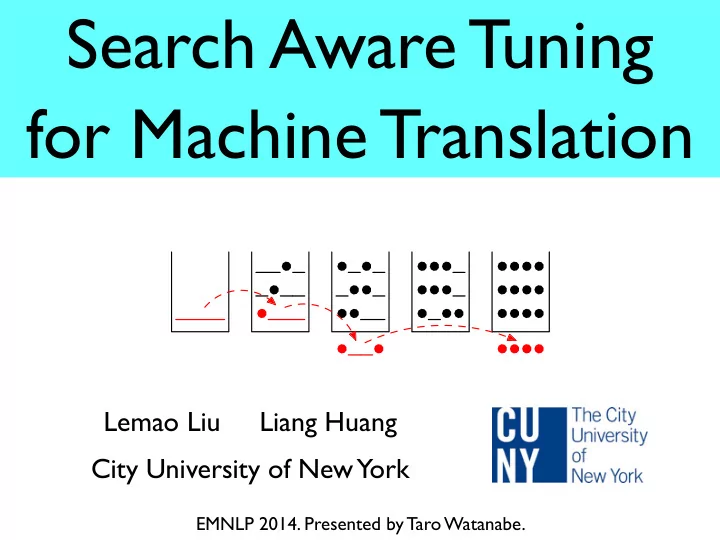
slide-2
SLIDE 2

Search Aware Tuning for Machine Translation

Lemao Liu Liang Huang City University of New York

EMNLP 2014. Presented by Taro Watanabe.

slide-3
SLIDE 3

Search-Aware Tuning - Liu & Huang (CUNY)

Parameter Tuning for MT

  • most tuning methods view MT decoder as a black box
  • “search-agnostic” tuning (MERT, MIRA, PRO, ...)
  • but actually search error is a main reason of bad quality
  • potentially good sub-translations pruned early in search
  • final k-best list also lacks diversity

2

y

eval & update w

x

decoder

1 2 3 4

slide-4
SLIDE 4

Search-Aware Tuning - Liu & Huang (CUNY)

Parameter Tuning for MT

  • most tuning methods view MT decoder as a black box
  • “search-agnostic” tuning (MERT, MIRA, PRO, ...)
  • but actually search error is a main reason of bad quality
  • potentially good sub-translations pruned early in search
  • final k-best list also lacks diversity

2

y

eval & update w

x

decoder

1 2 3 4

slide-5
SLIDE 5

Search-Aware Tuning - Liu & Huang (CUNY)

Parameter Tuning for MT

  • most tuning methods view MT decoder as a black box
  • “search-agnostic” tuning (MERT, MIRA, PRO, ...)
  • but actually search error is a main reason of bad quality
  • potentially good sub-translations pruned early in search
  • final k-best list also lacks diversity

2

y

eval & update w

x

decoder

cf.: Y-chromosome Adam Mitochondria Eva

1 2 3 4

slide-6
SLIDE 6

Search-Aware Tuning - Liu & Huang (CUNY)

Search Error in MT

3

slide-7
SLIDE 7

Search-Aware Tuning - Liu & Huang (CUNY)

Parameter Tuning for MT

4

y

eval & update w

x

decoder

1 2 3 4

slide-8
SLIDE 8

Search-Aware Tuning - Liu & Huang (CUNY)

Parameter Tuning for MT

  • most tuning methods view MT decoder as a black box
  • “search-agnostic” tuning (MERT, MIRA, PRO, ...)
  • but actually search error is a main reason of bad quality
  • potentially good sub-translations pruned early in search

4

y

eval & update w

x

decoder

1 2 3 4

slide-9
SLIDE 9

Search-Aware Tuning - Liu & Huang (CUNY)

Parameter Tuning for MT

  • most tuning methods view MT decoder as a black box
  • “search-agnostic” tuning (MERT, MIRA, PRO, ...)
  • but actually search error is a main reason of bad quality
  • potentially good sub-translations pruned early in search

4

y

eval & update w

x

decoder

slide-10
SLIDE 10

Search-Aware Tuning - Liu & Huang (CUNY)

Parameter Tuning for MT

  • most tuning methods view MT decoder as a black box
  • “search-agnostic” tuning (MERT, MIRA, PRO, ...)
  • but actually search error is a main reason of bad quality
  • potentially good sub-translations pruned early in search
  • Q: how to promote these promising sub-derivations?
  • A: tune the ranking of non-final bins as well as final bin
  • “search-aware tuning” (SA-MERT, SA-MIRA, SA-PRO, ...)
  • Q: how to evaluate the “potential” of a sub-derivation?

4

y

eval & update w

x

decoder

slide-11
SLIDE 11

Search-Aware Tuning - Liu & Huang (CUNY)

Outline

  • Motivations
  • Evaluating Partial Derivations
  • challenges
  • method 1: naive partial BLEU
  • method 2: novel potential BLEU
  • Search-Aware MERT, MIRA, and PRO
  • Experiments
  • consistent +1 BLEU improvement with dense features

5

slide-12
SLIDE 12

Search-Aware Tuning - Liu & Huang (CUNY)

Challenges in Partial Evaluation

  • challenge 1: there is no “partial” references
  • challenge 2: in phrase-based MT, partial translations in

the same bin may cover different source words

6

1 2 3 4

slide-13
SLIDE 13

Search-Aware Tuning - Liu & Huang (CUNY)

Challenges in Partial Evaluation

  • challenge 1: there is no “partial” references
  • challenge 2: in phrase-based MT, partial translations in

the same bin may cover different source words

6

source: 我 从 上海 ⻜食 到 北京

1 2 3 4

slide-14
SLIDE 14

Search-Aware Tuning - Liu & Huang (CUNY)

Challenges in Partial Evaluation

  • challenge 1: there is no “partial” references
  • challenge 2: in phrase-based MT, partial translations in

the same bin may cover different source words

6

source: 我 从 上海 ⻜食 到 北京 gloss: I from Shanghai fly to Beijing

1 2 3 4

slide-15
SLIDE 15

Search-Aware Tuning - Liu & Huang (CUNY)

Challenges in Partial Evaluation

  • challenge 1: there is no “partial” references
  • challenge 2: in phrase-based MT, partial translations in

the same bin may cover different source words

6

source: 我 从 上海 ⻜食 到 北京 gloss: I from Shanghai fly to Beijing reference: I flew from Shanghai to Beijing

1 2 3 4

slide-16
SLIDE 16

Search-Aware Tuning - Liu & Huang (CUNY)

Challenges in Partial Evaluation

  • challenge 1: there is no “partial” references
  • challenge 2: in phrase-based MT, partial translations in

the same bin may cover different source words

6

source: 我 从 上海 ⻜食 到 北京 gloss: I from Shanghai fly to Beijing reference: I flew from Shanghai to Beijing partial 1: I from

1 2 3 4

slide-17
SLIDE 17

Search-Aware Tuning - Liu & Huang (CUNY)

Challenges in Partial Evaluation

  • challenge 1: there is no “partial” references
  • challenge 2: in phrase-based MT, partial translations in

the same bin may cover different source words

6

source: 我 从 上海 ⻜食 到 北京 gloss: I from Shanghai fly to Beijing reference: I flew from Shanghai to Beijing partial 1: I from partial 2: I fly

1 2 3 4

slide-18
SLIDE 18

Search-Aware Tuning - Liu & Huang (CUNY)

Method 1: Naive Partial BLEU

  • naive solution: just evaluate against the full reference
  • but using a prorated reference length
  • proportional to number of source words translated so far
  • inspired by oracle extraction (Li & Khudanpur 10; Chiang 12)
  • problem: favoring those translating “easier” words first

7

source: 我 从 上海 ⻜食 到 北京 gloss: I from Shanghai fly to Beijing reference: I flew from Shanghai to Beijing partial 1: I from partial 2: I fly

unigram=2 unigram=1

slide-19
SLIDE 19

Search-Aware Tuning - Liu & Huang (CUNY)

Method 1: Naive Partial BLEU

  • naive solution: just evaluate against the full reference
  • but using a prorated reference length
  • proportional to number of source words translated so far
  • inspired by oracle extraction (Li & Khudanpur 10; Chiang 12)
  • problem: favoring those translating “easier” words first

7

source: 我 从 上海 ⻜食 到 北京 gloss: I from Shanghai fly to Beijing reference: I flew from Shanghai to Beijing partial 1: I from partial 2: I fly

unigram=2 unigram=1 ✔︎

slide-20
SLIDE 20

Search-Aware Tuning - Liu & Huang (CUNY)

Evaluating the “Potential”

  • better not evaluate partial translation as is, but its potential
  • do we want the oracle (best) or average potential?
  • oracle is too hard to compute, and maybe not that useful
  • want the “most likely” potential given the current model

8

  • racle

worst

current state start state

slide-21
SLIDE 21

Search-Aware Tuning - Liu & Huang (CUNY)

Evaluating the “Potential”

  • better not evaluate partial translation as is, but its potential
  • do we want the oracle (best) or average potential?
  • oracle is too hard to compute, and maybe not that useful
  • want the “most likely” potential given the current model

8

  • racle

worst “most likely” potential

current state start state

slide-22
SLIDE 22

Search-Aware Tuning - Liu & Huang (CUNY)

Method 2: Potential BLEU

  • the “most likely potential” BLEU of a derivation
  • extend partial derivation to cover uncovered words
  • using best monotonic translation for uncovered portions
  • inspired by “future cost” in phrase-based decoding
  • (inadmissible) A* heuristic computed by DP (Koehn, 2004)

9

source: 我 从 上海 ⻜食 到 北京 gloss: I from Shanghai fly to Beijing reference: I flew from Shanghai to Beijing partial 1: I from partial 2: I fly

e(d) future(d, x) x = ¯ ex(d) =

monotonic reordering

slide-23
SLIDE 23

Search-Aware Tuning - Liu & Huang (CUNY)

Method 2: Potential BLEU

  • the “most likely potential” BLEU of a derivation
  • extend partial derivation to cover uncovered words
  • using best monotonic translation for uncovered portions
  • inspired by “future cost” in phrase-based decoding
  • (inadmissible) A* heuristic computed by DP (Koehn, 2004)

9

source: 我 从 上海 ⻜食 到 北京 gloss: I from Shanghai fly to Beijing reference: I flew from Shanghai to Beijing partial 1: I from partial 2: I fly

Shanghai fly to Beijing

e(d) future(d, x) x = ¯ ex(d) =

monotonic reordering

slide-24
SLIDE 24

Search-Aware Tuning - Liu & Huang (CUNY)

Method 2: Potential BLEU

  • the “most likely potential” BLEU of a derivation
  • extend partial derivation to cover uncovered words
  • using best monotonic translation for uncovered portions
  • inspired by “future cost” in phrase-based decoding
  • (inadmissible) A* heuristic computed by DP (Koehn, 2004)

9

source: 我 从 上海 ⻜食 到 北京 gloss: I from Shanghai fly to Beijing reference: I flew from Shanghai to Beijing partial 1: I from partial 2: I fly

Shanghai fly to Beijing from Shanghai to Beijing

e(d) future(d, x) x = ¯ ex(d) =

monotonic reordering

slide-25
SLIDE 25

Search-Aware Tuning - Liu & Huang (CUNY)

Method 2: Potential BLEU

  • the “most likely potential” BLEU of a derivation
  • extend partial derivation to cover uncovered words
  • using best monotonic translation for uncovered portions
  • inspired by “future cost” in phrase-based decoding
  • (inadmissible) A* heuristic computed by DP (Koehn, 2004)

9

source: 我 从 上海 ⻜食 到 北京 gloss: I from Shanghai fly to Beijing reference: I flew from Shanghai to Beijing partial 1: I from partial 2: I fly

Shanghai fly to Beijing from Shanghai to Beijing unigram=5, bi=2

e(d) future(d, x) x = ¯ ex(d) =

monotonic reordering

slide-26
SLIDE 26

Search-Aware Tuning - Liu & Huang (CUNY)

Method 2: Potential BLEU

  • the “most likely potential” BLEU of a derivation
  • extend partial derivation to cover uncovered words
  • using best monotonic translation for uncovered portions
  • inspired by “future cost” in phrase-based decoding
  • (inadmissible) A* heuristic computed by DP (Koehn, 2004)

9

source: 我 从 上海 ⻜食 到 北京 gloss: I from Shanghai fly to Beijing reference: I flew from Shanghai to Beijing partial 1: I from partial 2: I fly

Shanghai fly to Beijing from Shanghai to Beijing unigram=5, bi=2 unigram=5, bi=3, tri=2, 4gram=1

e(d) future(d, x) x = ¯ ex(d) =

monotonic reordering

slide-27
SLIDE 27

Search-Aware Tuning - Liu & Huang (CUNY)

Method 2: Potential BLEU

  • the “most likely potential” BLEU of a derivation
  • extend partial derivation to cover uncovered words
  • using best monotonic translation for uncovered portions
  • inspired by “future cost” in phrase-based decoding
  • (inadmissible) A* heuristic computed by DP (Koehn, 2004)

9

source: 我 从 上海 ⻜食 到 北京 gloss: I from Shanghai fly to Beijing reference: I flew from Shanghai to Beijing partial 1: I from partial 2: I fly

Shanghai fly to Beijing from Shanghai to Beijing unigram=5, bi=2 unigram=5, bi=3, tri=2, 4gram=1

✔︎

e(d) future(d, x) x = ¯ ex(d) =

monotonic reordering

slide-28
SLIDE 28

Search-Aware Tuning - Liu & Huang (CUNY)

Towards Search-Aware Tuning

10

slide-29
SLIDE 29

Search-Aware Tuning - Liu & Huang (CUNY)

Towards Search-Aware Tuning

10

Traditional tuning MERT/MIRA/PRO

slide-30
SLIDE 30

Search-Aware Tuning - Liu & Huang (CUNY)

Towards Search-Aware Tuning

10

Traditional tuning MERT/MIRA/PRO Search-aware tuning

slide-31
SLIDE 31

Search-Aware Tuning - Liu & Huang (CUNY)

Experiments: Ch-to-En

  • on phrase-based decoder (Huang & Chiang 07;

Yu et al 13)

  • partial BLEU not helpful, but potential BLEU very helpful
  • all experiments use only dense features

11

slide-32
SLIDE 32

Search-Aware Tuning - Liu & Huang (CUNY)

Beam Size

  • helps more in smaller beam sizes

12

30 31 32 33 34 35 1 2 4 8 16 32 64 BLEU Beam Size Traditional MERT Tuning Search-aware MERT Tuning

100

slide-33
SLIDE 33

Search-Aware Tuning - Liu & Huang (CUNY)

Oracle Improvement

  • search-aware tuning improves k-best oracle in final bin
  • quality of k-best list improves more than 1-best
  • more improvement on test than tuning

13

tuning test

1 2 3 4

slide-34
SLIDE 34

Search-Aware Tuning - Liu & Huang (CUNY)

More Diversity in the Final Bin

  • search-aware tuning does promote diversity
  • even though we do not include diversity in the objectives
  • adapt n-gram diversity metric (Gimpel et al 2013) with modifications

14

cf.: Y-chromosome Adam Mitochondria Eva

slide-35
SLIDE 35

Search-Aware Tuning - Liu & Huang (CUNY)

Drawback: Slow Optimization

  • search-aware tuning does slow down optimization
  • but decoding is the bottle-neck in tuning
  • though parallelizable
  • overall slowdown is not significant for MIRA/PRO

15

decoding time: 20 min. on single CPU

slide-36
SLIDE 36

Search-Aware Tuning - Liu & Huang (CUNY)

Conclusions

  • search error is a major reason for bad translation
  • search-agnostic tuning does not address this problem
  • our search-aware tuning promotes promising translations
  • potential BLEU is a good evaluator for sub-translations
  • also works for TER and other metrics
  • very simple framework; applies to MERT/MIRA/PRO...
  • first consistent ~1 BLEU point improvement with dense features
  • only drawback: slower optimization

16

1 2 3 4