SEAFARERS MENTAL HEALTH: Learnings from walking a mile in their - - PowerPoint PPT Presentation

seafarers mental
SMART_READER_LITE
LIVE PREVIEW

SEAFARERS MENTAL HEALTH: Learnings from walking a mile in their - - PowerPoint PPT Presentation

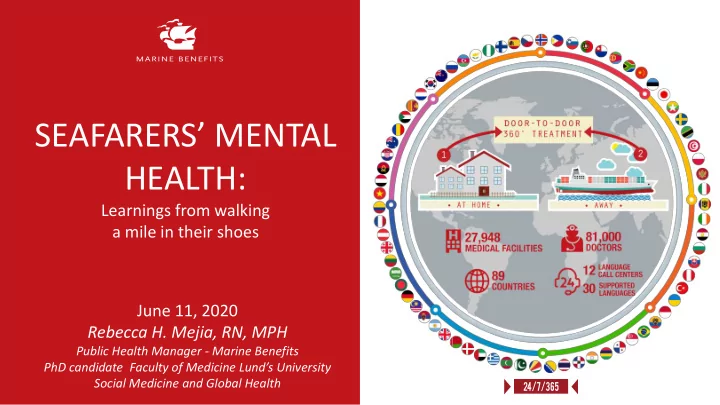
SEAFARERS MENTAL HEALTH: Learnings from walking a mile in their shoes June 11, 2020 Rebecca H. Mejia, RN, MPH Public Health Manager - Marine Benefits PhD candidate Faculty of Medicine Lunds University Social Medicine and Global Health


slide-1
SLIDE 1

Information Classification: General

June 11, 2020 Rebecca H. Mejia, RN, MPH

Public Health Manager - Marine Benefits PhD candidate Faculty of Medicine Lund’s University Social Medicine and Global Health

SEAFARERS’ MENTAL HEALTH:

Learnings from walking a mile in their shoes

slide-2
SLIDE 2

Information Classification: General

COVID-19

Placing the seafarer in precarious situations Seafarers are frontline workers

Travel restrictions - impact on seafarers:

  • >150 000 seafarers prevented from crew change
  • Delay in urgent medical assistance
  • Prolonged time onboard
  • Quarantine & curfews
  • Termination and unemployment
  • Uncertainty
  • Isolation
  • Loneliness
  • Stress
  • Depression

Time to be proactive!

slide-3
SLIDE 3

Information Classification: General

Get to know your crew

slide-4
SLIDE 4

Information Classification: General

2016 Philippines

2,405 seafarers

2018 India

3,712 seafarers

2019 Myanmar

1,565 seafarers

2019 Women in shipping

297 female seafarers

33 company studies >21,000 seafarers surveyed > 15 different nationalities

slide-5
SLIDE 5

Information Classification: General

Stress Depression Worries

slide-6
SLIDE 6

Information Classification: General

No Stress Mild to Moderate High Stress

20 15 40

13.0 Global average All industries 19.1 All companies

STRESS

Consequences of stress: Colds & flu, cancer, depression, PTSD, Eczema, stomach ulcers, heart disease, asthma, etc.

Cohen’s perceived stress scale

slide-7
SLIDE 7

Information Classification: General

All Well Mild Depression Moderate Depression Severe Depression

88% 12%

DEPRESSION

1 depressed seafarer in every 2 ships

WHO-5 Wellbeing Index

slide-8
SLIDE 8

Information Classification: General

Result: Depression is relatively stable from 0 to 9 months onboard, but is growing exponentially from 10 months.

Depression

Months onboard

slide-9
SLIDE 9

Information Classification: General

OTHER CONCERNS

Feelings of loneliness, social relationships activities on board

slide-10
SLIDE 10

Information Classification: General

MAKING LIFE BETTER ONBOARD

1. POLICY 2. FROM EXPEREINCE

  • Require a hobby
  • Social Sunday

OTHER GOOD EXAPMLES:

  • Regular & organized physical activivity
  • Music
  • Limit WiFi
  • Healthy food
  • Group activites
  • Create meaning
  • Be proud of job – abandon victim mentality

Reduce medical P&I Eliminate suicide

slide-11
SLIDE 11

Information Classification: General

“You can’t change the beginning, but you can start where you are and change the ending.” C.S Lewis

THE EQUATION FOR A HEALTHIER LIFE

slide-12
SLIDE 12

Information Classification: General

Level Health Promotion Disease Prevention Disease Treatment Outcome Organization

  • Improve work content
  • Fitness program
  • Career development
  • Improve

communication & decision making

  • Conflict management
  • Vocational rehab
  • Out placement
  • Productivity
  • Turnover
  • Absenteeism
  • Financial claims

Individual & Organization

  • Time management
  • Improve interpersonal

skills

  • Work/home balance
  • Peer support groups
  • Coaching
  • Career planning
  • Post traumatic stress

assistance

  • Group psychotherapy
  • Job stressors
  • Demand control
  • Support
  • Role ambiguity
  • Relationships

Individual

  • Pre-employment

medical exam

  • Stress management
  • Cognitive/mental
  • Behavioral/social

Techniques

  • Relaxation
  • Rehab after sick leave
  • Disability management
  • Individual

psychotherapy

  • Mood states
  • Psychosomatic

complaints

  • Subjective experienced

stress

  • Psychological

parameters

  • Sleep
  • Disturbances
  • Health balance

COST

ROI: High Cost: Low ROI: Medium Cost: Minimize potetial future cost ROI: Low to negative Cost: High

Make a strategic plan

Stress

PEME

YOUR MOST IMPORTANT ASSET

slide-13
SLIDE 13

Information Classification: General

An ounce of prevention is worth a pound of cure.

Thomas Edison

THANK YOU!

www.marinebenefits.no