
SLIDE 1
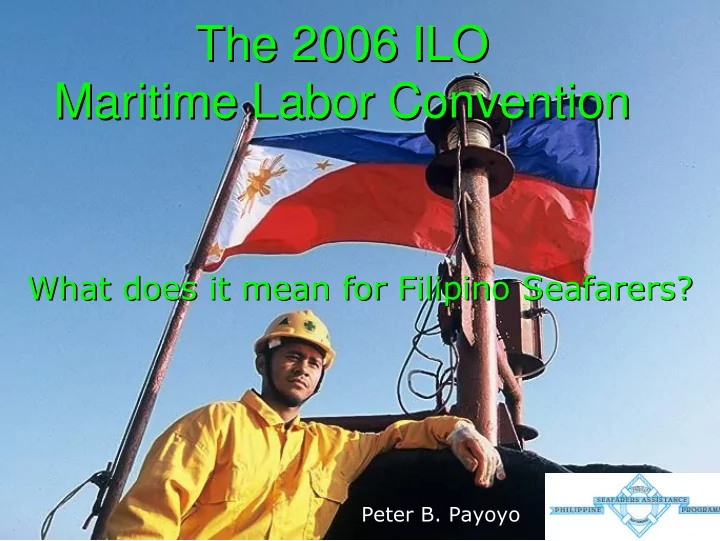
The 2006 ILO The 2006 ILO Maritime Labor Convention Maritime Labor Convention
What does it mean for Filipino Seafarers? What does it mean for Filipino Seafarers?
Peter B. Payoyo
The 2006 ILO The 2006 ILO Maritime Labor Convention Maritime Labor - - PowerPoint PPT Presentation
The 2006 ILO The 2006 ILO Maritime Labor Convention Maritime Labor Convention What does it mean for Filipino Seafarers? What does it mean for Filipino Seafarers? Peter B. Payoyo Underlying Purposes of Underlying Purposes of the Convention
Peter B. Payoyo
to lay down a firm set of rights and principles; principles;
to allow countries considerable degree of flexibility in the implementation of those flexibility in the implementation of those rights and principles; and rights and principles; and
to ensure that the rights and principles are properly complied with and enforced. properly complied with and enforced.
Consolidate and update all relevant ILO instruments (conventions and recommendations) instruments (conventions and recommendations)
“decent work decent work” ”; ; “ “Level the playing field Level the playing field” ”; universal ; universal and comprehensive and comprehensive “ “quality shipping quality shipping” ” standards; standards; “ “4 4th
th Pillar
Pillar” ” of international regulatory regime
(+ SOLAS, MARPOL, ICSW) (+ SOLAS, MARPOL, ICSW)
Bring the international system of protection closer to the seafarer (bill of rights perspective) closer to the seafarer (bill of rights perspective)
The Convention does NOT cover/benefit seafarers The Convention does NOT cover/benefit seafarers who work on certain categories of ships: who work on certain categories of ships:
Ships navigating exclusively in inland waters or nearby areas where port regulations apply where port regulations apply
Fishing vessels
Warships and naval auxiliaries
Ships of traditional built e.g., dhows & junks
Ships < 200 GT, as determined by a Flag State
The Convention does NOT deal with Seafarers The Convention does NOT deal with Seafarers’ ’ Identity Documents Identity Documents The Convention is NOT YET LAW The Convention is NOT YET LAW
(appropriate governmental/State action and implementation) (appropriate governmental/State action and implementation)
Participation in the practical implementation and enforcement of the Convention enforcement of the Convention
Continuing education and awareness about rights
Involvement in self-
Tripartism
Articles
Fundamental principles and rights
Employment and social rights
Procedural and final clauses
New amendment procedure
Tripartite Committee
Regulations
Substantive rights and obligations
Articles and Regulations establish framework of basic obligations framework of basic obligations
Code A and B: details for the implementation of the Regulations: implementation of the Regulations: mandatory standards and non mandatory standards and non-
mandatory guidelines Code B (non-mandatory) Code A (mandatory) Regulations (mandatory) Articles (mandatory)
Seafarers Seafarers’ ’ Employment and Social Rights Employment and Social Rights
seafarers about the requirements seafarers about the requirements
WHAT ARE YOUR RIGHTS UNDER THE MAGNA CARTA? WHAT ARE YOUR RIGHTS UNDER THE MAGNA CARTA?
Fundamental Rights & Fundamental Rights & Seafarers Seafarers’ ’ Employment and Social Rights Employment and Social Rights
(a) freedom of association and the effective recognition of the right to collective bargaining; (b) the elimination of all forms of forced or compulsory labour; (c) the effective abolition of child labour; and (d) the elimination of discrimination in respect of employment and occupation.
WHAT ARE YOUR RIGHTS UNDER THE MAGNA CARTA? WHAT ARE YOUR RIGHTS UNDER THE MAGNA CARTA?
Fundamental Rights & Fundamental Rights & Seafarers Seafarers’ ’ Employment and Social Rights Employment and Social Rights
right to “ “decent work decent work” ”
that complies with safety standards.
conditions on board ship.
welfare measures and other forms of social protection.
WHAT ARE YOUR RIGHTS UNDER THE MAGNA CARTA? WHAT ARE YOUR RIGHTS UNDER THE MAGNA CARTA?
Seafarers Seafarers’ ’ Rights as Rights as specific requirements or specific requirements or normative expectations derived normative expectations derived under the 5 Titles of the Convention under the 5 Titles of the Convention
social security protection
WHAT ARE YOUR RIGHTS UNDER THE MAGNA CARTA? WHAT ARE YOUR RIGHTS UNDER THE MAGNA CARTA?
Seafarers Seafarers’ ’ Rights as specific normative expectations derived under Rights as specific normative expectations derived under Title 1 of the Convention Title 1 of the Convention Minimum requirements for seafarers to work on a ship
Purpose: To ensure that no under-age persons work
Purpose: To ensure that all seafarers are medically fit to perform their duties at sea
Purpose: To ensure that seafarers are trained or qualified to carry out their duties on board ship
Purpose: To ensure that seafarers have access to an efficient and well-regulated seafarer recruitment and placement system
WHAT ARE YOUR RIGHTS UNDER THE MAGNA CARTA? WHAT ARE YOUR RIGHTS UNDER THE MAGNA CARTA?
Seafarers Seafarers’ ’ Rights as specific normative expectations derived Rights as specific normative expectations derived under Title 2 of the Convention under Title 2 of the Convention Conditions of employment
employment agreements Purpose: To ensure that seafarers have a fair employment agreement
Purpose: To ensure that seafarers are paid for their services
Purpose: To ensure that seafarers have regulated hours of work or hours of rest
Purpose: To ensure that seafarers have adequate leave
Purpose: To ensure that seafarers are able to return home
Purpose: To ensure that seafarers are compensated when a ship is lost or has foundered
Purpose: To ensure that seafarers work on board ships with sufficient personnel for the safe, efficient and secure operation of the ship
employment Purpose: To promote career and skill development and employment opportunities for seafarers
WHAT ARE YOUR RIGHTS UNDER THE MAGNA CARTA? WHAT ARE YOUR RIGHTS UNDER THE MAGNA CARTA?
Seafarers Seafarers’ ’ Rights as specific normative expectations derived Rights as specific normative expectations derived under Title 3 of the Convention under Title 3 of the Convention Accommodation, recreational facilities, food and catering
Purpose: To ensure that seafarers have decent accommodation and recreational facilities on board
Purpose: To ensure that seafarers have access to good quality food and drinking water provided under regulated hygienic conditions
WHAT ARE YOUR RIGHTS UNDER THE MAGNA CARTA? WHAT ARE YOUR RIGHTS UNDER THE MAGNA CARTA?
Seafarers Seafarers’ ’ Rights as specific normative expectations derived Rights as specific normative expectations derived under Title 4 of the Convention under Title 4 of the Convention Health protection, medical care, welfare, and social security protection
Purpose: To protect the health of seafarers and ensure their prompt access to medical care on board ship and ashore
liability Purpose: To ensure that seafarers are protected from the financial consequences of sickness, injury or death occurring in connection with their employment
Purpose: To ensure that seafarers’ work environment on board ships promotes occupational safety and health
Purpose: To ensure that seafarers working on board a ship have access to shore-based facilities and services to secure their health and well-being
Purpose: To ensure that measures are taken with a view to providing seafarers with access to social security protection
WHAT ARE YOUR RIGHTS UNDER THE MAGNA CARTA? WHAT ARE YOUR RIGHTS UNDER THE MAGNA CARTA?
Seafarers Seafarers’ ’ Rights as specific normative expectations derived Rights as specific normative expectations derived under Title 5 of the Convention under Title 5 of the Convention Compliance and enforcement
Purpose: To ensure that each Member implements its responsibilities under this Convention with respect to ships that fly its flag
Purpose: To enable each Member to implement its responsibilities under this Convention regarding international cooperation in the implementation and enforcement of the Convention standards on foreign ships
WHAT CAN A SEAFARE DO TO REALIZE WHAT CAN A SEAFARE DO TO REALIZE HIS RIGHTS AND EXPECTATIONS? HIS RIGHTS AND EXPECTATIONS?
SEAFARERS AS PARTNERS IN THE REALIZATION/IMPLEMENTATION SEAFARERS AS PARTNERS IN THE REALIZATION/IMPLEMENTATION OF THE REQUIREMENTS OF THE CONVENTION OF THE REQUIREMENTS OF THE CONVENTION AS PRESCRIBED UNDER SPECIFIC LAWS AND REGULATIONS AS PRESCRIBED UNDER SPECIFIC LAWS AND REGULATIONS E.g.
supply State) rights violations committed by private recruitment and placement agencies
intervals
certificate’ and ‘declaration of maritime labour compliance’, including inspection ‘record’
deficiencies (>500 GT)
WHAT DOES A SEAFARER DO TO REALIZE WHAT DOES A SEAFARER DO TO REALIZE HIS RIGHTS AND EXPECTATIONS? HIS RIGHTS AND EXPECTATIONS?
The “Right to report”: Conditions for onshore seafarer complaint- handling procedures under port State control
requirements, including seafarers’ rights
WHAT DOES A SEAFARER DO TO REALIZE WHAT DOES A SEAFARER DO TO REALIZE HIS RIGHTS AND EXPECTATIONS? HIS RIGHTS AND EXPECTATIONS? SUSTAINING COMPLIANCE CULTURE SUSTAINING COMPLIANCE CULTURE THROUGH PORT THROUGH PORT-
STATE ENFORCEMENT
The “Right to report”: Working and living conditions to be inspected by port state control officer:
Minimum age Medical certification Qualifications of seafarers Seafarers’ employment agreements Use of any licensed or certified or regulated private recruitment and placement service Hours of work or rest Manning levels for the ship On-board recreational facilities Food and catering Accommodation Health and safety and accident prevention On-board medical care On-board complaint procedures
WHAT DOES A SEAFARER DO TO REALIZE WHAT DOES A SEAFARER DO TO REALIZE HIS RIGHTS AND EXPECTATIONS? HIS RIGHTS AND EXPECTATIONS?
Instances when national tripartite consultations are required to implement the Convention:
consultation with S&SO concerned”
with S&SO concerned”
recruitment and placement services
seafarers, management of occupational safety and health on board, welfare facilities in appropriate ports
to investigate complaints relating to calculation and payment of wages
to receive reports from port State control officials: after detailed PSC inspections; when on-shore complaint-handling procedure does not resolve a seafarer’s complaint
(appropriate governmental/State action and implementation) (appropriate governmental/State action and implementation)
Participation in the practical implementation and enforcement of the Convention enforcement of the Convention
Continuing education and awareness about rights
Involvement in self-
tripartism
Variance: existing POEA contract Variance: existing POEA contract + POEA Rules & Regulations + POEA Rules & Regulations and requirements of new ILO Convention and requirements of new ILO Convention
POEA Sec. 20G (Compensation and benefits): “The seafarer or his successor in interest acknowledges that payment for injury, illness, incapacity, disability or death of the seafarer under this contract shall cover all claims arising from or in the course of the seafarer’s employment, including but not limited to damages arising from contract, tort, fault or negligence under the laws of the Philippines or any other country.” ILO Reg. 4.2 (Shipowner’s Liability): “This regulation does not affect any other legal remedies that a seafarers may seek.”
Variance: existing POEA contract Variance: existing POEA contract + POEA Rules & Regulations + POEA Rules & Regulations and requirements of new ILO Convention and requirements of new ILO Convention
POEA Sec 32-A (occupational diseases): the burden of proof for work-related
establish “all of the following conditions: 1. The seafarer’s work must involve the risks described herein; 2. The disease was contracted as a result of the seafarer’s exposure to the described risk; 3. The disease was contracted within a period of exposure and under such other factors necessary to contract it; 4. There was no notorious negligence on the part of the seafarer.” ILO Regulation 4.2 (Shipowner’s liability): the burden of proof is on shipowner because shipowner bears cost for sickness arising from seafarers employment between date of duty commencement and date of repatriation; although national laws and regulations may exclude the shipowner from liability in respect of sickness due to the willful misconduct of sick seafarer, or sickness intentionally concealed.
Variance: existing POEA contract Variance: existing POEA contract + POEA Rules & Regulations + POEA Rules & Regulations and requirements of new ILO Convention and requirements of new ILO Convention
POEA Sec. 22 (Termination due to shipwreck): “where the vessel is wrecked necessitating the termination of the employment contract before the date indicated in the contract, the seafarer shall be entitled to …. one month basic wage as termination pay. ILO Reg. 2.6 (compensation for ship’s loss of foundering): “The indemnity against unemployment resulting from a ship’s foundering or loss should be paid for the days during which the seafarer remains in fact unemployed at the same rate as the wages payable under the employment agreement, but the total indemnity payable to any one seafarer may be limited to two months’ wages.”
Variance: existing POEA contract Variance: existing POEA contract + POEA Rules & Regulations + POEA Rules & Regulations and requirements of new ILO Convention and requirements of new ILO Convention
POEA Sec 8 (Allotments and remittances):
“A seafarer is required to make an allotment …. The allotment shall be at least 80% of the seafarer’s monthly basic pay ….”
ILO Reg. 2.2 (Wages): “Measures to ensure that seafarers are able to
transmit their earnings to their families include: a system for enabling seafarers, at the time of their entering employment or during it, to allot, if they so desire, a proportion of their wages for remittance at regular intervals to their families by bank transfers or similar means.”
Variance: existing POEA contract Variance: existing POEA contract + POEA Rules & Regulations + POEA Rules & Regulations and requirements of new ILO Convention and requirements of new ILO Convention
POEA Sec 11 (Open overtime work rate): “125% of basic hourly rate based on 208 regular working hours per month”; (Guaranteed/fixed overtime rate): “not less than 30% of basic monthly rate” ILO Regulation 2.2 (Wages): minimum rate of 125% based on the number of normal working hours per week that “should not exceed 48 hours per week”; minimum rate of 125% “to be applied to the overtime hours included in the consolidated wage”
Variance: existing POEA contract Variance: existing POEA contract + POEA Rules & Regulations + POEA Rules & Regulations and requirements of new ILO Convention and requirements of new ILO Convention
ILO Reg. 1.4 (Recruitment and Placement)
for private seafarer recruitment and placement services (e.g., “procedures to prevent the
advances or any other financial transaction between the ship-owner and the seafarers which are handled by the seafarer recruitment and placement services”
means, mechanisms or lists intended to prevent or deter seafarers from gaining employment for which they are qualified
Variance: existing POEA contract Variance: existing POEA contract + POEA Rules & Regulations + POEA Rules & Regulations and requirements of new ILO Convention and requirements of new ILO Convention
POEA Sec 16 (Grievance Machinery): complaint procedure can lead to disciplinary action against the seafarer; seafarer may seek assistance from highest ranking Filipino onboard ILO Regulation 5.1 (On-Board complaint procedures): Complaint procedures “shall include the right of the seafarer to be accompanied or represented during the complaint procedures, as well as safeguards against the possibility of victimization of seafarers for filing complaints”; in addition to POEA-approved agreement, “all seafarers shall be provided a copy of the on-board complaint
confidential basis, provide seafarers with impartial advice and assist them in following complaint procedures on board”
Variance: existing POEA contract Variance: existing POEA contract + POEA Rules & Regulations + POEA Rules & Regulations and requirements of new ILO Convention and requirements of new ILO Convention
POEA R&R Part VI (Disciplinary action against seafarers): any violation in the course of a seafarer’s employment, “which will not implicate the vessel”
will implicate the vessel”; “behaving with disrespect towards a superior officer”; any activity which will hamper the efficient operation of the vessel”; “any activity which tends to destroy harmonious relationship of the company”
penalty from suspension to delisting and disqualification from maritime employment; seafarer subject to pending complaint shall be temporarily suspended from maritime employment program ILO Regulation 5.1 & 5.2 re on-board complaint procedures and onshore seafarer complaint-handling procedures: procedures to safeguard against possible victimization of seafarer for filing complaint; seafarers have the “right to report” complaints re breaches of Convention requirements and seafarers’ rights; confidentiality of on-shore complaints to be assured; inadequacy of ships’ procedures or fear of reprisal for lodging complaint could lead to detailed inspection of ships under port state control, and possible ship detention
Correcting the variance between Correcting the variance between existing POEA contract + POEA Rules & Regulations existing POEA contract + POEA Rules & Regulations and the requirements of new ILO Convention and the requirements of new ILO Convention
POEA R&R: Part IV (Employment Standards)
formulate and establish minimum separate and distinct standard employment contracts for seafarers in accordance with accepted international standard and maritime practice. These standard employment contracts, which shall be reviewed periodically to keep them attuned to international requirements and demands, shall be the minimum requirement in every individual contract approved by the Administration.”
Peter B. Payoyo
Why should the Philippine Government move towards Why should the Philippine Government move towards the soonest ratification of the Convention? the soonest ratification of the Convention?
☻
Assure decent working and living conditions of all Filipino seafarers
☻ Sustain the competitive advantage of Filipino
seafarers in the global maritime labour market
☻ Pursue on-going agenda of policy and
administrative reform, including realizing robust tripartism and social dialogue
What are steps and policy processes to be pursued What are steps and policy processes to be pursued to maximize national objectives on the to maximize national objectives on the International Bill of Rights for Seafarers? International Bill of Rights for Seafarers?
☻
Review of existing legislative and institutional frameworks using a ‘bill of rights’ approach, rather than an ‘administrative reform’ approach
☻ Policy choices on the translation of the ILO Convention at national level:
a single consolidated ‘national magna carta’ instrument VERSUS implementation through
discrete “substantially equivalent” regulations
inclusion or exclusion of ship- and/or seafarer- categories under national regulations identification of the “competent authority/ies” to issue and enforce relevant regulations
☻ Continuing international cooperation and national consultations/social dialogue
to realize the requirements of the new ILO Convention
Framework of State Responsibilities to Framework of State Responsibilities to Implement the ILO Convention Implement the ILO Convention ☻ Flag State (regulation of social, technical, and administrative aspects, including ship certification and inspection) ☻ Port State (inspection/control) ☻ Labor-supplying Responsibilities of a State (inspection and monitoring responsibilities re recruitment & placement; including social security protection)
Existing National Framework: Existing National Framework: Where do we find the rights of seafarers? Where do we find the rights of seafarers? ☻ Constitution and the Labor Code of the Philippines ☻ Migrant Workers and Overseas Filipinos Act 1995 ☻ Philippine ratification of ILO Conventions 23, 53, 93, 165, 179 (1926 Repatriation of Seamen; 1936 Officers Competency Certificates, 1949; Wages, Hours of Work & Manning,
1987 Seafarers’ Social Security, 1996 Recruitment & Placement)
☻ POEA R&R Governing Recruitment and Employment of Seafarers ☻ POEA Standard Terms and Conditions Governing Employment of Filipino Seafarers Onboard Ocean Going Vessels, including CBAs
Framework of State Responsibilities for Framework of State Responsibilities for Seafarer Seafarer’ ’s Working and Living Conditions s Working and Living Conditions
Flag State Flag State Implementation Implementation Port State Capabilities Port State Capabilities Labour Labour-
supplying Responsibilities Responsibilities mandatorily mandatorily consists of substantive consists of substantive national legislation and regulations national legislation and regulations + control, enforcement, + control, enforcement, certification, and inspection certification, and inspection capabilities in the following areas: capabilities in the following areas: consist of optional Port State consist of optional Port State inspection capabilities and related inspection capabilities and related administrative machinery to control administrative machinery to control ships in the following areas: ships in the following areas: are mandatory obligations to are mandatory obligations to establish substantive regulations, establish substantive regulations, with relevant control and inspection with relevant control and inspection capabilities, in the following area: capabilities, in the following area:
Minimum age
Medical certification
Qualifications of seafarers
Seafarers’ ’ employment agreements employment agreements
Use of any licensed or certified or regulated private recruitment and regulated private recruitment and placement service placement service
Hours of work or rest
Manning levels for the ship
Accommodation
On-
board recreational facilities
Food and catering
Health and safety and accident prevention prevention
On-
board medical care
On-
board complaint procedures
Payment of wages
Minimum age
Medical certification
Qualifications of seafarers
Seafarers’ ’ employment agreements employment agreements
Use of any licensed or certified or regulated private recruitment and regulated private recruitment and placement service placement service
Hours of work or rest
Manning levels for the ship
Accommodation
On-
board recreational facilities
Food and catering
Health and safety and accident prevention prevention
On-
board medical care
On-
board complaint procedures
Payment of wages
Use of any licensed or certified or regulated private recruitment and regulated private recruitment and placement service placement service
Framework of State Responsibilities for Framework of State Responsibilities for Seafarer Seafarer’ ’s Working and Living Conditions (CONT s Working and Living Conditions (CONT’ ’D) D)
Flag State Flag State Implementation Implementation Port State Port State Responsibility Responsibility Labour Labour-
supplying Responsibilities Responsibilities Also consists of substantive national legislation Also consists of substantive national legislation and regulations in the following areas to be and regulations in the following areas to be implemented in accordance with the relevant implemented in accordance with the relevant terms of the ILO Convention: terms of the ILO Convention: A mandatory consequence of A mandatory consequence of ratification of the convention ratification of the convention is the introduction of is the introduction of measures and regulations measures and regulations concerning: concerning: Includes implementation of Includes implementation of requirements of the requirements of the Convention in the Convention in the following area: following area:
Entitlement to Leave
Repatriation
Seafarer compensation for ship’ ’s loss s loss
Career and skill development and
Shipowners’ ’ liability liability
Social Security
Authorization of recognized
Marine casualties
Access to shore-
based welfare facilities welfare facilities
Social Security Protection Protection
STATE RESPONSIBILITIES STATE RESPONSIBILITIES
’ Working and Living Conditions Working and Living Conditions with direct impact on countries that do not ratify the Conventio with direct impact on countries that do not ratify the Convention n Each Member shall require, in respect of seafarers who work on ships that fly its flag, that shipowners who use seafarer recruitment and placement services that are based in countries or territories in which this Convention does not apply, ensure that those services conform to the requirements set out in the Code. Each Member shall implement its responsibilities under this Convention in such a way as to ensure that the ships that fly the flag of any State that has not ratified this Convention do not receive more favourable treatment than the ships that fly the flag of any State that has ratified it.
Framework of Framework of Shipowners Shipowners’ ’ Responsibilities for Responsibilities for Seafarer Seafarer’ ’s Working and Living Conditions s Working and Living Conditions especially on vessels > 500 GT especially on vessels > 500 GT
Measures in the following areas shall be drawn up, Measures in the following areas shall be drawn up, to ensure ongoing compliance between inspections: to ensure ongoing compliance between inspections:
Minimum age
Medical certification
Qualifications of seafarers
Seafarers’ ’ employment agreements employment agreements
Use of any licensed or certified or regulated private recruitment and placement service nt and placement service
Hours of work or rest
Manning levels for the ship
Accommodation
On-
board recreational facilities
Food and catering
Health and safety and accident prevention
On-
board medical care
On-
board complaint procedures
Payment of wages
Instances when a national tripartite approach is required to implement the Convention:
consultation with S&SO concerned”
with S&SO concerned”
recruitment and placement services
seafarers, management of occupational safety and health on board, welfare facilities in appropriate ports
to investigate complaints relating to calculation and payment of wages
to receive reports from port State control officials: after detailed PSC inspections; when on-shore complaint-handling procedure does not resolve a seafarer’s complaint
SOME QUESTIONS FOR THE PHILIPPINES AS THE LEADING MARITIME LABOR SUPPLY COUNTRY IN THE WORLD TODAY
maritime sector?
imperatives under the new Convention?
move the ratification process quickly forward?
Why should the Philippine Government ratify Why should the Philippine Government ratify the Convention sooner rather than later? the Convention sooner rather than later? ☻The global shipping industry demands that urgent attention be given to the dignity and rights
☻The Philippines needs to take a forward-looking stance to the Convention in order to maintain it’s lead position in the global maritime labor market.
Preamble, 2006 Maritime Labour Convention