SDN controller: Intent-based Northbound Interface realization for - - PowerPoint PPT Presentation

sdn controller intent based northbound interface
SMART_READER_LITE
LIVE PREVIEW

SDN controller: Intent-based Northbound Interface realization for - - PowerPoint PPT Presentation

SDN controller: Intent-based Northbound Interface realization for extended applications Introduction 1. SDN Controller 2. Intent-based Northbound Interface (NBI) 3. The Intent framework in ONOS controller 4. The proposed architecture for


slide-1
SLIDE 1

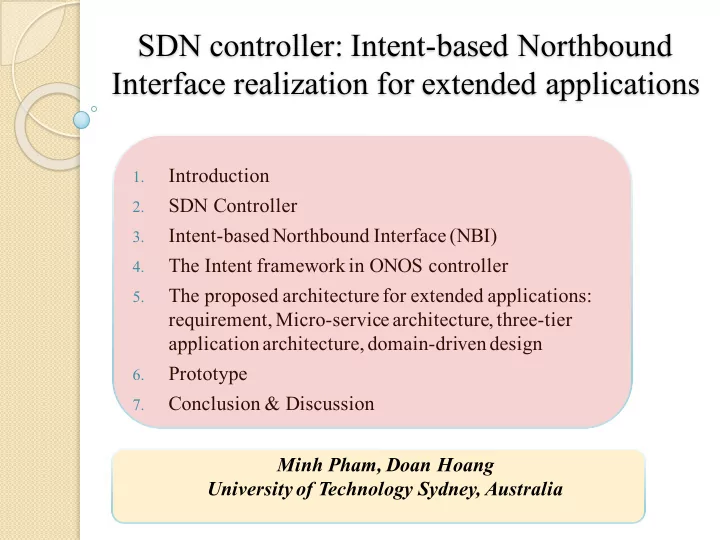
SDN controller: Intent-based Northbound Interface realization for extended applications

1.

Introduction

2.

SDN Controller

3.

Intent-based Northbound Interface (NBI)

4.

The Intent framework in ONOS controller

5.

The proposed architecture for extended applications: requirement, Micro-service architecture, three-tier application architecture, domain-driven design

6.

Prototype

7.

Conclusion & Discussion Minh Pham, Doan Hoang University of Technology Sydney, Australia

slide-2
SLIDE 2

Introduction

  • The adoption of SDN introduces an emerging class of extended

network applications

  • Open Networking Foundation (ONF) principles of intent-based

NBI lack functionality to support the above extended applications

  • We adopt the Intent-based NBI principles and propose an

architecture to realise extended network applications

  • The proposed architecture is built on Micro-service architecture,

Domain driven design and three-tier application architecture

  • The prototype is to build the Dynamic Resource Application

(DRM) using Open Network Operating System (ONOS) controller

slide-3
SLIDE 3

NORTHBOUND API SOUTHBOUND API Distribution Packet Processing Device Manager Topology Manager Routing Processing Stats Manager Interface Management Device Device Device Application OS components

SDN Controllers

Application Application

slide-4
SLIDE 4

Intent-based NBI

(Janz 2015)

  • ONF identified two types of NBI usages: prescribed and intent-based
  • In intent-based NBI, users describe their request in normal conversation

language, it is the WHAT question, not HOW question

  • Each request has two main components: substance and constraint,

substance contains the objects and constraint contains the conditions

slide-5
SLIDE 5

Open Network Operating System (ONOS) Intent framework

  • ONOS provides application intent framework as the NBI to describe

network connectivity as network policy. It is a sub-system of ONOS.

  • Intents in the framework are organised into a hierarchy; developers

will select the intents that are closest to their network models.

  • Each intent has its compiler to compile the intent into flow rules;

flow rules are installed as table entries in network devices based on the Openflow protocol.

slide-6
SLIDE 6

Intent life cycle (ONOS, 2014)

ONOS Intent life cycle

slide-7
SLIDE 7

CREATE INTENT Compiling intents Saving flow rules successful Installable intents Install on devices Failed intents Errors SOUTHBOUND INTERFACE DEVICE Recompiling intents NETWORK EVENTS DEVICE DEVICE Searching for intent WITHDRAW INTENT found? removing from stores Uninstall

  • n devices

INTENT FRAMEWORK NORTHBOUND INTERFACE Y Y N N

ONOS Intent framework

slide-8
SLIDE 8

SERVICE COMPOSITION Language Interpreter Adapt to context changes Service, Application Reuse Service Discovery Ease of use, User friendly Handle complex business rules Adapt to Controller Structure Availability, Scalability, Modifiability Use & Extend Core Services Create new services

  • Service composition is the main attribute to support intent’s composability

attribute

  • Requiring creating of new services, reuse of existing services and composing

them into applications

  • Other requirements: user friendly, availability, scalability, modifiability

The proposed architecture - Requirements

slide-9
SLIDE 9

Fine-grained Service Composition

A B C C

Decentralised data management (Fowler, 2013)

MSA design principles:

  • Data decentralized
  • Componentized application
  • Application design robustness
  • Process isolation

Patterns: Self registration, Service registry, Client service lookup (Richardson, 2014) MSA is used to promote the service composition for the intent realisation

Microservice architecture (MSA)

slide-10
SLIDE 10

Experts + Development Team SD1 SD2 SD3 Problem domain Domain Knowledge Bounded Context 1 Bounded Context 2 Bounded Context 3

Bounded Context 5 Bounded Context 4

Solution domain Sub problem domain

  • Promoting modular design and divide-and-conquer solution approach
  • Working well with the Micro-service architecture

Domain driven design

slide-11
SLIDE 11

Rest API CLI New service creation Service Integration element Service registry Core network services Other existing services New composite service DB TIER BUSINESS TIER UI TIER API

  • Three-tier application architecture satisfies the requirements and serves well

in the development of commercial applications

  • Database tier persists states
  • Business tier handles business logic via creation of new services, reuse

existing services and service composition

  • Presentation tier to interact with users: CLI, REST API, API

Three-tier application architecture

slide-12
SLIDE 12

Intent-based NBI SDN Control Logic Intent manager Intent execution environment Intent store Intent interpreter

executes

Prescribed NBI Topology API L3 VPN API vRouterAPI

Virtualizer

(Tadepalli, 2014)

  • Service composition and intent realization in the proposed architecture are

parts of the intent execution environment of the virtualizer of NBI

slide-13
SLIDE 13

Dynamic Resource Management (DRM) Application

(Mijumbi, 2014)

  • DRM proposed a solution for network virtualisation in an efficient

resource management

  • In virtual network creation, the least cost path is selected based on the

least ratio of usage resource over available resource for switches and links

slide-14
SLIDE 14

Java Virtual Machine OSGi framework (felix, equinox) Programming model (spring/blueprint/DS)

Shell /SSH Logging Deployers Provisioning

Configuration admin

Security Instances JMX

Web container (pax web) Enterprise features (JPA, JNDI, JTA) Web console

(Apache Karaf 2015)

Apache Karaf container architecture

slide-15
SLIDE 15

Intent Interpreter Resource Request Location 1, Location 2, Location n Bandwidth Choreography platform Path Intent DRM Least-cost calculation functions INTENT STORE SERVICE REGISTRY Replication Process Device Manager Event Management APPLICATION LAYER NORTHBOUND API CORE SERVICE LAYER SOUTHBOUND API Flow rules DRM Services

INTENT EXECUTION ENVIRONMENT

DRM application

The visualisation of the NBI Intent-based realisation

Intent realization Topology service Other core services

slide-16
SLIDE 16

Prototype results

slide-17
SLIDE 17

Conclusion & Discussion

  • The intent-based NBI is needed to develop extended, business-like

network application

  • Service composition, the creation of new services and reuse existing

services are the main requirements

  • The proposed architecture is based on micro-service principles,

three-tier application architecture and domain driven design

  • The architecture avoids the ad-hoc and self-explored way and

promotes a systematic approach so developers can concentrate on the business requirement

slide-18
SLIDE 18

QUESTIONS

THANK YOU