SDG4-Education 2030 Agenda and its Relevance for Teacher - - PowerPoint PPT Presentation

sdg4 education 2030 agenda and its relevance for teacher
SMART_READER_LITE
LIVE PREVIEW

SDG4-Education 2030 Agenda and its Relevance for Teacher - - PowerPoint PPT Presentation

SDG4-Education 2030 Agenda and its Relevance for Teacher Professional Development SDG4 Teacher Conference: Yayoi Segi-Vltchek and Charles Obiero Quality and Innovation in Teacher UNESCO Regional Bureau for Education in the Arab States, Beirut


slide-1
SLIDE 1

UNESCO EDUCATION SECTOR

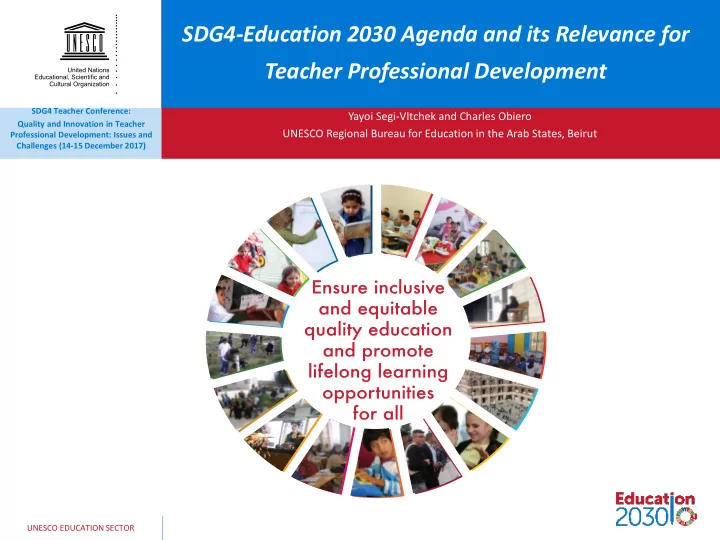
SDG4-Education 2030 Agenda and its Relevance for Teacher Professional Development

SDG4 Teacher Conference: Quality and Innovation in Teacher Professional Development: Issues and Challenges (14-15 December 2017)

Yayoi Segi-Vltchek and Charles Obiero UNESCO Regional Bureau for Education in the Arab States, Beirut

slide-2
SLIDE 2

UNESCO EDUCATION SECTOR 2

Contents of Presentation

  • Education in the 2030 Agenda and teachers in

SDG4

  • Education 2030 Framework for Action
  • Food for thought: What does data say about

learning and teachers?

slide-3
SLIDE 3

UNESCO EDUCATION SECTOR 3

Education in the 2030 Agenda

Outcome Targets [7] 4.1 Quality primary/secondary education for all 4.2 Early childhood & pre-primary education 4.3 Equal access to TVET & higher education 4.4 Relevant skills for work 4.5 Gender equality & equal access for all 4.6 Youth and adult literacy 4.7 Global citizenship education for sustainability Means of implementation [3] 4.a Safe & inclusive learning environments 4.b Scholarships for higher education 4.c Teachers’ training and working conditions

Goal 4 : Ensure inclusive and equitable quality education and promote lifelong learning opportunities for all

slide-4
SLIDE 4

UNESCO EDUCATION SECTOR 4

slide-5
SLIDE 5

UNESCO EDUCATION SECTOR 5

  • Strengthening policies, plans, legislation and

system (teacher data as part of EMIS)

  • Emphasizing equity, inclusion and gender equality

(teacher availability; teaching materials; teacher training on inclusive education, etc.)

  • Focusing on quality and learning (learner-

centered, active and collaborative pedagogical approaches; teacher policies and regulations; assessment, etc.)

  • Promoting lifelong learning (quality educators in

post-basic education levels)

  • Addressing education in emergencies (teacher

preparedness, support and training) FIVE STRATEGIC APPROACHES

slide-6
SLIDE 6

KEY MESSAGE: ACCOUNTABLE TEACHERS

  • Teachers have primary responsibility for

providing high-quality instruction, but they are expected to do far more than teach.

  • Student test scores and classroom observation

form part of teacher evaluations. But the time and capacity development required to ensure it generates useful feedback to improve teacher effectiveness should not be underestimated.

  • Professional learning communities are an

accountability approach that has helped increase teachers’ pedagogical and content knowledge, with associated changes in practice. But they are less common in poorer settings, where mentoring and collaborative practices can be rare.

slide-7
SLIDE 7

UNESCO EDUCATION SECTOR 7 68 79 85 62 84 93 84 81 55 44 74 56 66 60 68 67 42 30 41 30 50 39 44 49 19 11 16 23 21 BAHRAIN IRAQ JORDAN KUWAIT OMAN PALESTINE QATAR SAUDI ARABIA primary lower secondary upper secondary tertiary 20 40 60 80 100 120 Bahrain Egypt Iraq Jordan Kuwait Libya Morocco Oman Palestine Qatar Syrian Arab Republic Tunisia Youth literacy rate Adult literacy rate

% of Population (25 years and above) who have attained level of education Youth and Adult Literacy Rates, 2010-2016

What does data say about learning and teachers?

slide-8
SLIDE 8

UNESCO EDUCATION SECTOR 8

% of pupils in early primary grades (2 or 3) achieving at least minimum proficiency level, 2010-2015 (Source:

GEM Report, 2017/18)

% of pupils in end of lower secondary education achieving at least minimum proficiency level, 2010-2015

(Source: GEM Report, 2017/18)

19 46 58 65 95 98 72 50 41 61 64 43 93 95 Bahrain Jordan Morocco Oman Qatar Saudi Arabia Sudan Syrian Arab Republic Reading Mathematics 21 54 30 48 28 60 19 75 47 32 45 40 41 52 41 34 43 25 51 Algeria Bahrain Egypt Jordan Kuwait Lebanon Morocco Oman Qatar Saudi Arabia Syrian Arab Republic Tunisia United Arab Emirates Reading Mathematics

What does data say about learning and teachers?

slide-9
SLIDE 9

UNESCO EDUCATION SECTOR 9 10 20 30 40 50 60 70 80 90 100

United Arab Emirates Qatar Jordan OECD average Lebanon Finland Algeria Tunisia

The teachers in our school co-

  • perate by exchanging

ideas or material when teaching specific units or series of lessons Our school invites specialists to conduct in-service training for teachers Our school organises in- service workshops that deal with specific issues that our school faces Our school organises in- service workshops for specific groups of teachers

slide-10
SLIDE 10

UNESCO EDUCATION SECTOR 10

Thank you!

Learn more on SDG4-Education 2030 in the Arab States http://www.education2030-arab-states.org/