Scientific Research on Yoga and the Workplace Yoga Alliance Webinar - - PowerPoint PPT Presentation

scientific research on yoga and the workplace
SMART_READER_LITE
LIVE PREVIEW

Scientific Research on Yoga and the Workplace Yoga Alliance Webinar - - PowerPoint PPT Presentation

Brigham & Womens Hospital Harvard Medical School Scientific Research on Yoga and the Workplace Yoga Alliance Webinar June 4, 2020 Sat Bir S. Khalsa, Ph.D. Assistant Professor of Medicine, Harvard Medical School Director of Yoga


slide-1
SLIDE 1

Brigham & Women’s Hospital

Harvard Medical School
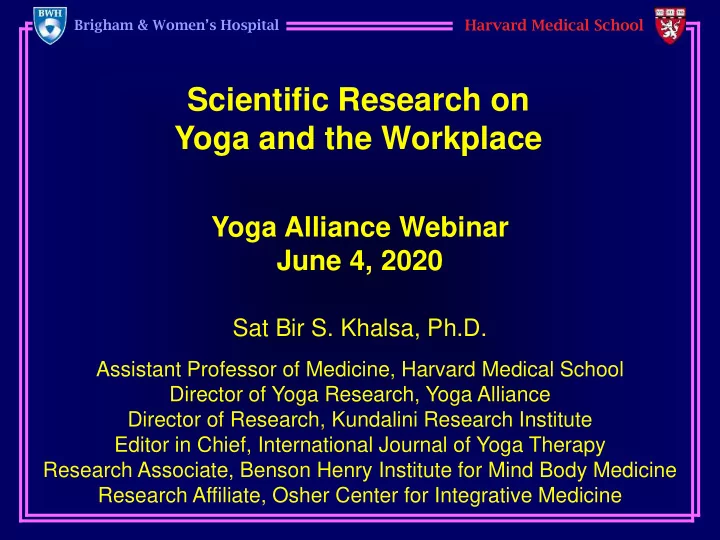
Scientific Research on Yoga and the Workplace

Sat Bir S. Khalsa, Ph.D.

Assistant Professor of Medicine, Harvard Medical School Director of Yoga Research, Yoga Alliance Director of Research, Kundalini Research Institute Editor in Chief, International Journal of Yoga Therapy Research Associate, Benson Henry Institute for Mind Body Medicine Research Affiliate, Osher Center for Integrative Medicine

Yoga Alliance Webinar June 4, 2020

slide-2
SLIDE 2
slide-3
SLIDE 3

“Developing workplace health initiatives, tools and methods for empowering companies and

  • ther work settings to take better care of health,

without unduly relying on professional health services.”

slide-4
SLIDE 4
slide-5
SLIDE 5
slide-6
SLIDE 6
slide-7
SLIDE 7
slide-8
SLIDE 8

“One profound demographic shift facing many industrialized nations is the increasing longevity and average age of the

  • population. As the population ages, the available workforce

is also aging. By 2020, at least quarter of the workforce in many countries is expected to be age 55 and older. At the same time, chronic health conditions are becoming increasingly important as a cause of work disability across the globe, affecting not only aging workers, but also youth in transition, and mid-career workers. Over 40 % of US workers have a chronic health condition and 15–20 % of workers report health-related work limitations…”

slide-9
SLIDE 9

“The most common factor identified for early retirement was ill health, with ill health associated with people not being able to work or with people having difficulty in performing as expected at work.” “Occupational health programmes were often suggested as a way of maintaining or improving the health of working people and thus ensuring or enabling their work continuation.”

slide-10
SLIDE 10

Workplace Challenges

⚫ Stress and resilience ⚫ Burnout ⚫ Fatigue ⚫ Mood/emotion disturbance ⚫ Musculoskeletal conditions ⚫ Well-being/quality of life ⚫ Behavior ⚫ Sleep disturbance ⚫ Empowerment ⚫ Creativity ⚫ Productivity ⚫ Performance ⚫ Efficiency ⚫ Absenteeism ⚫ Presenteeism ⚫ Turnover ⚫ Job Satisfaction ⚫ Relationships ⚫ Inequality/stigma ⚫ Discrimination

slide-11
SLIDE 11

Yoga Practices

Postures, Breathing, Relaxation, Meditation

Fitness

↑Flexibility ↑Strength ↑Coordination/Balance ↑Respiratory Function ↑Self-Efficacy

Global Human Functionality

↑Physical & Mental Health, ↑Physical Performance ↑Stress & Emotion Regulation, ↑Awareness/Mindfulness, ↑Meta-cognition ↑Positive Behavior, ↑Wellbeing, ↑Values, ↑Life Purpose & Meaning, ↑Spirituality

Self-Regulation

↑Stress Regulation ↑Emotion Regulation ↑Resilience ↑Equanimity ↑Self-Efficacy

Awareness

↑Attention ↑Mindfulness ↑Concentration ↑Cognition ↑Meta-cognition

Spirituality

↑Unitive State ↑Transcendence ↑Flow ↑Transformation ↑Life Meaning/Purpose

slide-12
SLIDE 12

Ashrams, Studios, Yoga Centers, Gyms, Spas

The Professional Transformation

  • f Yoga into Mainstream Society

Public Schools, Workplaces, Healthcare Research

slide-13
SLIDE 13

“Workplace physical activity and yoga programmes are associated with a significant reduction in depressive symptoms and anxiety, respectively.”

https://www.researchgate.net/profile/Foong- Ming_Moy/publication/262562056_Do_workplace_physical_activity_interventions_improve_mental_health_outcomes/links /569723bb08aea2d74374ac82/Do-workplace-physical-activity-interventions-improve-mental-health-outcomes.pdf

slide-14
SLIDE 14

https://www.ncbi.nlm.nih.gov/pmc/articles/PMC4866336/?report=printable

slide-15
SLIDE 15
slide-16
SLIDE 16
slide-17
SLIDE 17

https://www.researchgate.net/profile/Elizabeth_Kinsella/publication/32604434 7_Mindfulness_and_human_occupation_A_scoping_review/links/5d08d700a 6fdcc35c1560c3e/Mindfulness-and-human-occupation-A-scoping-review.pdf

slide-18
SLIDE 18
slide-19
SLIDE 19

Mood/Stress in Occupational Setting

From: The effectiveness of yoga for the improvement of well-being and resilience to stress in the workplace. Hartfiel N, Havenhand J, Khalsa SB, Clarke G, Krayer A. Scandinavian Journal of Work, Environment and Health, 37:70-6, 2011.

Composed-Anxious

Average Score

2.0 2.2 2.4 2.6 2.8 3.0 3.2 3.4

Elated-Depressed

Average Score

2.0 2.2 2.4 2.6 2.8 3.0 3.2 3.4

Energized-Tired

Average Score

1.6 1.8 2.0 2.2 2.4 2.6 2.8 3.0 3.2

Confident-Unsure

Average Score

2.0 2.2 2.4 2.6 2.8 3.0 3.2 3.4

Clear-Minded-Confused

Average Score

2.0 2.2 2.4 2.6 2.8 3.0 3.2 3.4 3.6

Self-Confidence During Stress

Average Score

3.0 3.2 3.4 3.6 3.8 4.0 4.2 4.4 4.6 4.8

LIfe Purpose & Satisfaction

Average Score

3.0 3.2 3.4 3.6 3.8 4.0 4.2 4.4 4.6 4.8

slide-20
SLIDE 20

Stress in Occupational Setting

From: Yoga for reducing perceived stress and back pain at work, Hartfiel N, Burton C, Rycroft-Malone J, Clarke G, Havenhand J, Khalsa SB, Edwards RT, Occupational Medicine 62:606–612, 2012.

slide-21
SLIDE 21

Back Pain in Occupational Setting

From: Yoga for reducing perceived stress and back pain at work, Hartfiel N, Burton C, Rycroft-Malone J, Clarke G, Havenhand J, Khalsa SB, Edwards RT, Occupational Medicine 62:606–612, 2012.

slide-22
SLIDE 22

“This study indicated that an 8-week Dru Yoga programme, compared with usual-care, was associated with improvements in health-related quality of life and reductions in both physical and psychosocial components

  • f back pain. Yoga in the workplace appeared to be a

cost-effective option, potentially reducing sickness absence due to musculoskeletal conditions.”

slide-23
SLIDE 23

Resilience, Integration, Self-awareness, Engagement

slide-24
SLIDE 24

Stress in Frontline Professionals

From: Improvements in Psychological Health Following a Residential Yoga- based Program for Frontline Professionals, Trent N, Miraglia M, Miraglia M, Dusek J, Pasalis E, Khalsa SBS, Journal of Occupational and Environmental Medicine, 60:357-367, 2018

80 82 84 86 88 90 92 Baseline Post Follow-up

Resilience

5 10 15 20 Baseline Post Follow-up

Perceived Stress

N=71 from fields of education, healthcare, and corrections in a residential 5-day Kripalu program

slide-25
SLIDE 25

Mindfulness in Frontline Professionals

120 125 130 135 140 145

Baseline Post Follow-up

Total Mindfulness Score

From: Improvements in Psychological Health Following a Residential Yoga-Based Program for Frontline Professionals, Trent NL, Miraglia M, Dusek JA, Pasalis E, Khalsa SBS, Journal

  • f Occupational and Environmental Medicine, 60:357-367, 2018.
slide-26
SLIDE 26

Yoga in Education Professionals

From: A Pragmatic Controlled Trial of a Brief Yoga-Based Program for Education Professionals’ Psychological and Occupational Health. Dyer NL, Borden S, Dusek JA, Khalsa SBS, (in press, Complementary Therapies in Medicine).

slide-27
SLIDE 27

Yoga in Education Professionals

From: A Pragmatic Controlled Trial of a Brief Yoga-Based Program for Education Professionals’ Psychological and Occupational Health. Dyer NL, Borden S, Dusek JA, Khalsa SBS, (in press, Complementary Therapies in Medicine).

slide-28
SLIDE 28
slide-29
SLIDE 29
slide-30
SLIDE 30
slide-31
SLIDE 31

http://www.massmed.org/News-and-Publications/MMS-News-Releases/Physician-Burnout-Report-2018/

“The prevalence of physician burnout has reached critical levels. Recent evidence indicates that nearly half of all physicians experience burnout in some form. And it appears to be getting worse. The 2018 Survey of America’s Physicians Practice Patterns and Perspectives finds that … 78% of surveyed physicians experience feelings of professional burnout at least sometimes, an increase of 4% from the 2016 survey.”

slide-32
SLIDE 32
slide-33
SLIDE 33
slide-34
SLIDE 34

https://www.ncbi.nlm.nih.gov/pmc/articles/PMC6462946/pdf/jcm-08-00284.pdf

slide-35
SLIDE 35

“A growing body of clinical studies suggests that interventions, including mindfulness, yoga, and mind-body skills training, may be helpful in building the self-awareness and resilience needed for medical students, residents, and established physicians to mitigate burnout risk. This preliminary research likely played an essential role in Harvard Medical School’s 2018 decision to now require all first years to participate in a mind-body resiliency training program.”

Wayne PM, Yeh GY, Mehta DH

slide-36
SLIDE 36
slide-37
SLIDE 37

https://www.forbes.com/sites/lipiroy/2020/05/17/doctor-heal- thyself-physician-burnout-in-the-wake-of-covid-19/#5070d462213c

Physician burnout was an epidemic BEFORE the Covid-19 pandemic. According to a 2018 study, 400 physicians die by suicide each year – double that of the general population. In addition, doctors have the highest suicide rate of any profession in the U.S including combat veterans. From an economic standpoint, studies estimate that physician burnout is costing the health care system approximately $4.6 billion per year. Burnout has nothing to do with weakness, laziness or incompetence. “The prevailing attitude,” report Pamela Hartzband, MD and Jerome Groopman, MD in a recent NEJM article, “was that burnout is a physician problem and those who can’t adapt need to get with the program or leave.” Some hospitals have created the position, Chief Wellness Officer. Others have offered resilience and meditation workshops, social hours and tips for maximizing productivity. But, according to Hartzman and Groopman, none of these “solutions” address the underlying problem: a profound lack of alignment between caregivers’ values and the reconfigured health care system.

slide-38
SLIDE 38

0.4 0.7 1 1.3 Pre Post Follow-up

Burnout Score

2.6 2.9 3.2 3.5 Pre Post Follow-up

Professional Fulfillment

0.15 0.35 0.55 0.75 Pre Post Follow-up

Interpersonal Disengagement

0.6 0.9 1.2 1.5 Pre Post Follow-up

Work Exhaustion

5.5 6.5 7.5 8.5 Pre Post Follow-up

Anxiety

4 5 6 7 Pre Post Follow-up

Depression

Kripalu RISE in Harvard Physicians

* * * * *

# #

* *

slide-39
SLIDE 39

Kripalu RISE Program in Harvard Medical School Physicians

7 11 15 19 Pre Post Follow-up 71 76 81 86 Pre Post Follow-up

Perceived Stress Resilience

From: A Yoga-based Program Decreases Physician Burnout in Neonatologists and Obstetricians at an Academic Medical Center, Scheid A, Trent N, Dusek J, Khalsa SBS, Workplace Health & Safety (in press).

slide-40
SLIDE 40

Kripalu RISE Program in Harvard Physicians

From: A Yoga-based Program Decreases Physician Burnout in Neonatologists and Obstetricians at an Academic Medical Center, Scheid A, Trent N, Dusek J, Khalsa SBS, Workplace Health & Safety (in press).

52 56 60 64

Baseline Post Follow-up

Total Mindfulness Score

slide-41
SLIDE 41

Kripalu RISE Program in Harvard Resident Physicians

From: Loewenthal, Lipsyc-Sharf, Dyer, Dusek, Mehta, Khalsa, (in preparation).

slide-42
SLIDE 42

Kripalu RISE Program in Harvard Resident Physicians

From: Loewenthal, Lipsyc-Sharf, Dyer, Dusek, Mehta, Khalsa, (in preparation).

slide-43
SLIDE 43
slide-44
SLIDE 44
slide-45
SLIDE 45