Health Literacy: Research & Findings Time to Refocus & - - PowerPoint PPT Presentation

health literacy
SMART_READER_LITE
LIVE PREVIEW

Health Literacy: Research & Findings Time to Refocus & - - PowerPoint PPT Presentation

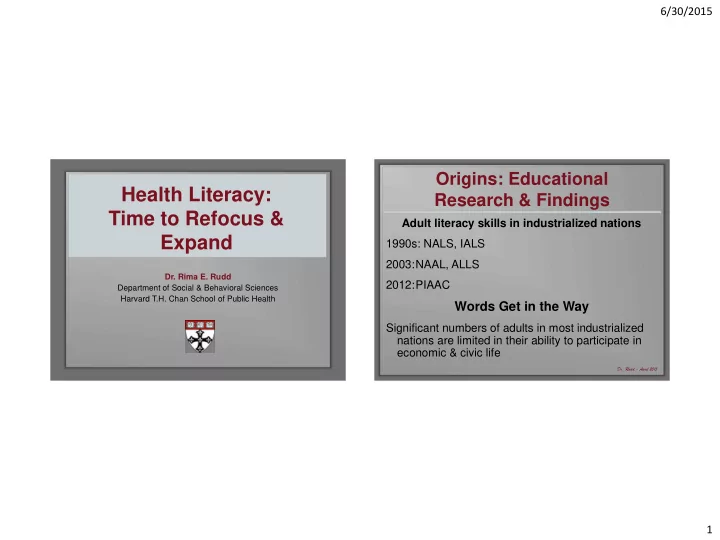
6/30/2015 Origins: Educational Health Literacy: Research & Findings Time to Refocus & Adult literacy skills in industrialized nations Expand 1990s: NALS, IALS 2003: NAAL, ALLS Dr. Rima E. Rudd 2012: PIAAC Department of Social


slide-1
SLIDE 1

6/30/2015 1

Health Literacy: Time to Refocus & Expand

  • Dr. Rima E. Rudd

Department of Social & Behavioral Sciences Harvard T.H. Chan School of Public Health

Origins: Educational Research & Findings

Adult literacy skills in industrialized nations 1990s: NALS, IALS 2003: NAAL, ALLS 2012: PIAAC

Words Get in the Way

Significant numbers of adults in most industrialized nations are limited in their ability to participate in economic & civic life

  • Dr. Rudd - April 2015
slide-2
SLIDE 2

6/30/2015 2

New Area of Inquiry: Health Literacy Research

Literacy is linked to health outcomes

  • Dr. Rudd - April 2015

AHRQ Reviews 2004 2011 IOM Report 2004

  • Health Promotion
  • Disease Prevention
  • Screening &

Early Detection

  • Chronic Disease

Management

  • Morbidity
  • Mortality

Time for Action

 Documented: Literacy & numeracy skills of adults  Documented: Literacy skills are linked to social factors  Documented: Literacy skills are linked to health

  • utcomes

Implications: Health Disparities

  • Dr. Rudd - April 2015
slide-3
SLIDE 3

6/30/2015 3

Action

Objective for the Nation:

Improve Health Literacy

  • Dr. Rudd - April 2015

Dilemma: How?

Connect the Dots: Use 4 straight connected lines Once you begin: Do not lift pen from paper

  • Dr. Rudd - April 2015
slide-4
SLIDE 4

6/30/2015 4

  • Dr. Rudd - April 2015
  • Dr. Rudd - April 2015
slide-5
SLIDE 5

6/30/2015 5

  • Dr. Rudd - April 2015

Think Outside the Box

  • Dr. Rudd - April 2015

Poised for Action

slide-6
SLIDE 6

6/30/2015 6

Boxed In

  • Dr. Rudd - April 2015

Narrow Focus on Skills Without Attention to Key Variables

Calibrate Text Complexity Examine Task Difficulty Measure Contextual Factors Literacy: Reading & Writing Speaking & Listening Calculations & Numeracy Text, Task, Context

Understand Literacy

slide-7
SLIDE 7

6/30/2015 7

Boxed In

  • Dr. Rudd - April 2015

Focus on One Player & One Side of the Coin

Accessible Information Health Materials & Tools Professionals’ Rigor & Skills Institutional Norms, Policies & Practice Health Literacy: Accessible Information, Care, & Services

Consider Key Variables

  • Dr. Rudd - April 2015
slide-8
SLIDE 8

6/30/2015 8

Boxed In

  • Dr. Rudd - April 2015

Limited Research Settings in Clinical Encounter & in Health Care

Activities at Home With and for Loved Ones Activities at Work & in Community Civic Engagement: Community Health Environmental Health Health Policy Health Literacy: Accessible Information, Engagement, Advocacy, Public Health

Thinking Outside the Box

  • Dr. Rudd - April 2015
slide-9
SLIDE 9

6/30/2015 9

Conceptual Errors

  • Dr. Rudd - April 2015

Limited Focus & Measure s Misplaced Responsibility Neglected Context

Health Literacy: An Evolving Concept

the cognitive and social skills which determine the motivation and ability of individuals to gain access to, understand and use information in ways which promote and maintain good health Nutbeam, WHO, 1998 the degree to which individuals have the capacity to

  • btain, process, and understand basic health

information and services needed to make appropriate health decisions USDHHS, 2010 engagement in a wide range of health actions that extend from personal behaviors to social action to address the determinants of health Nutbeam, SSM, 2008

  • Dr. Rudd - April 2015

Don Nutbeam, Social Science and Medicine, 2008

slide-10
SLIDE 10

6/30/2015 10

Change & Action

Current Shifts

From Skills of individuals

Mismatch

from Public’s Capabilities

Professionals’ Skills from Practitioners’ Actions Institutional Culture & Literacy Environment

  • Dr. Rudd - April 2015

New Definitions

Consider a definition that shifts attention to the capacity of professionals and health institutions to provide access to information and support the active engagement of people

Rudd, McCray, Nutbeam. Health Literacy and Definition of Terms, chapter 2 in Health Literacy in Context: International

  • Perspective. Canada: Nova Science. 2012.
  • Dr. Rudd - April 2015
slide-11
SLIDE 11

6/30/2015 11 The capacity of professionals & health institutions to provide access to information and support the active engagement of people

[Rudd 2010, Rudd, McCray, Nutbeam 2012]

  • Dr. Rudd - April 2015

Health Literacy

Needed: New Measures

A definition determines the scope of a concept A definition determines measures

We have: Over 50 measures of patients’ skills/deficits We lack: Measures of tool complexity/ease of use Measures of professionals’ skills Measures of practice attributes Measures of institutional characteristics [complexity & demands]

  • Dr. Rudd - April 2015
slide-12
SLIDE 12

6/30/2015 12

Needed Research:

Systemic Change & Health Outcomes

Deconstruct health activities to understand the complexity of health tasks, health texts, and health related tools Examine our health and health care systems & institutions and identify the facilitating factors and barriers that support or inhibit access to information and active engagement of people

  • Dr. Rudd - April 2015

Study options that Reduce Complexity, Eliminate Barriers, & Increase Access to Information, Care, and Services

Expand the Scope

Public Health Literacy

  • Accessible Information: Scientific Findings
  • Welcomed Participation: Engagement in

Identifying Community Health Issues & Problem Solving

  • Key Issues for Equity: Occupational Health,

Environmental Health, Disaster Planning & Management

  • Dr. Rudd - April 2015
slide-13
SLIDE 13

6/30/2015 13

Create a Balance

  • Dr. Rudd - April 2015

Action

  • Dr. Rudd - April 2015

Hospitals Community Clinics

Health Insurers

Pharmacies

Adult Education Programs Public Health Departments Nurses Physicians Pharmacists Dentists Public Health Workers Program Planners Educators Patient Advocates Researchers Occupational Health Workers Libraries Interpreters Social Workers Mental Health Workers Journalists Bench Scientists Environmental Health Workers