Science Sc ence in Ur n Urine ne Hand ndli ling ng and nd - - PowerPoint PPT Presentation

science sc ence in ur n urine ne hand ndli ling ng and nd
SMART_READER_LITE
LIVE PREVIEW

Science Sc ence in Ur n Urine ne Hand ndli ling ng and nd - - PowerPoint PPT Presentation

3th IWA Specialized Conference on SmallWater andWastewater Systems & 5th IWA Specialized Conference on Resources-Oriented Sanitation 14 17 September 2016, Athens, Greece Science Sc ence in Ur n Urine ne Hand ndli ling ng and nd


slide-1
SLIDE 1

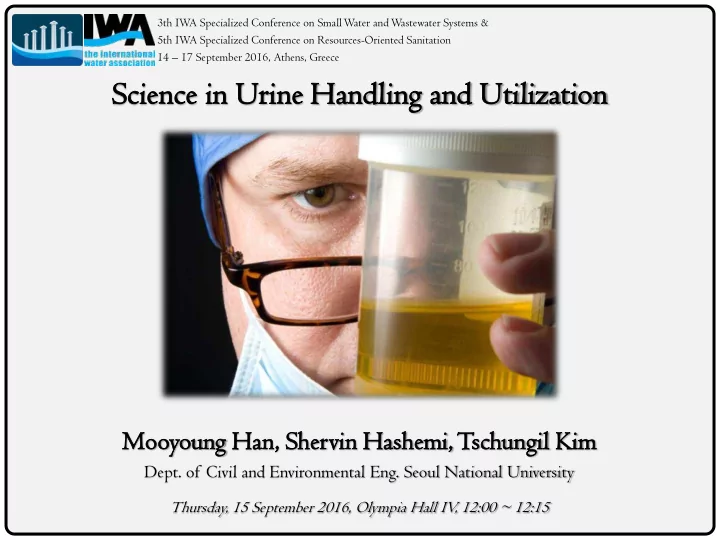
Sc Science ence in Ur n Urine ne Hand ndli ling ng and nd Utilization ization

Mooyoung

  • ung Ha

Han, , Shervin in Ha Hashemi, shemi, Tschung ungil il Kim im

  • Dept. of Civil and Environmental Eng. Seoul National University

Thursday, 15 September 2016, Olympia Hall IV, 12:00 ~ 12:15

3th IWA Specialized Conference on SmallWater andWastewater Systems & 5th IWA Specialized Conference on Resources-Oriented Sanitation 14 – 17 September 2016, Athens, Greece

slide-2
SLIDE 2

Contents

2

Introduction Science of Urine Examples of Urine Utilization Practical Implication Conclusion

slide-3
SLIDE 3

3

slide-4
SLIDE 4

Sanitation is a Worldwide Problem

4

  • 2.4 billion people lack access to basic sanitation services, such as toilets or latrines.
  • More than 80 per cent of wastewater resulting from human activities is discharged into

rivers or sea without any pollution removal.

  • Each day, nearly 1,000 children die due to preventable water and sanitation-

related diarrhea diseases.

slide-5
SLIDE 5

SDG–6 For Ending Water and Sanitation Problems

5

Objectives of SDG-6

  • By 2030, achieve access to adequate and

equitable sanitation and hygiene for all and end

  • pen

defecation, paying special attention to the needs of women and girls and those in vulnerable situations.

  • By 2030, expand international cooperation

and capacity-building support to developing countries in water- and sanitation-related activities and programs, including water harvesting, desalination, water efficiency, wastewater treatment, recycling and reuse technologies.

  • Support and strengthen the participation of

local communities in improving water and sanitation management.

slide-6
SLIDE 6

Resource Oriented Sanitation Fits SDG-6

ROS Toward SDG-6

6

Characteristics of Ideal Sanitation Toward SDG - 6

Waste Source Separation

Less or No Water Consumption

Utilizing as Fertilization

slide-7
SLIDE 7

Challenges of Urine in ROS

7

  • Managing urine in ROS is essential due to several critical challenges.
  • Challenges like awful odor or scale formation important to be solved

scientifically.

  • Urine should be handle in the way getting prepared for further utilization

(as fertilizer, etc.).

  • However, scientific knowledge in the life cycle process including collection,

transport, storage, treatment and utilization of urine limits the wide adaptation of ROS.

slide-8
SLIDE 8

SCIENCE OF URINE

8

slide-9
SLIDE 9

Composition of Fresh Urine

9

  • About

95%

  • f

fresh urine is water.

  • The rest is the minerals

and

  • ther
  • rganic

compounds.

  • Among these materials,

urea is the majority.

  • Urea is the product of

breakdown

  • f

amino acids.

slide-10
SLIDE 10

Fate of Urea in Aged Urine

10

Urea Water Ammonia Carbon Dioxide Ammonia Water Ammonium Hydroxide

pH UP!

Cause of Odor!

slide-11
SLIDE 11

Types of Urine Scales

Cause of Urine Scale Formation

11

Ca2+

Mg2+

PO4

3-

Urine Scales

slide-12
SLIDE 12

EXAMPLES OF URINE UTILIZATION

12

slide-13
SLIDE 13

Urine Deserves More Attentions

13

I Used My Own Feces and Survived in Isolated Mars!

But you know what?

I Missed Urine!

slide-14
SLIDE 14

Sulfur Charcoal KNO3

Organic Matters in Soil Mixture of Soil (Bacteria living in Soil) + Urine

NH4NO3 (aq) + KOH (aq) → NH3 (g) + KNO3 (aq) + H2O (l)

Fertilizer in Soil Available in Soil & Urine Potassium Nitrate (Goal)

Heat (Fire) to remove water, make KNO3 Scale and Have Charcoal from Soil Organic Matters

Choi Mu-Seon

Korean Recipe for Gunpowder Production

slide-15
SLIDE 15

15

PRACTICAL IMPLICATION

Time to Change Toward Solving Urine Challenges!

slide-16
SLIDE 16

Rainwater is a Solution

16

1. Do not use water with high TDS (Hong-Kong Practice). 2. Using Tap-water can help but too much water consumption is required. 3. Using little amount of rainwater can solve the issue. 4. Another solution is using acids which may not be suitable for pipelines.

slide-17
SLIDE 17

Effect of Sanitary Ware Material

17

Calcite Struvite Less Scale More Scale

slide-18
SLIDE 18

Odor of Urine and Flushing as a Solution

18

Ammonia (Cause of Urine Odor) Flushing Water

slide-19
SLIDE 19

Required Flushing Water for a Certain Amount of Urination

19

(pH = 9.8 )

  • The amount of flushing water should

be corresponded to the amount of urination as well as characteristics of flushing water such as pH and temperature.

  • For example if flushing water has 8.5

< pH < 9 with temperature = 15 oC, the dilution ratio should be 8 units

  • f water for 1 unit of urine. More

than this causes water waste and less than this causes odor.

  • Water consumption can be reduced

by using flushing water with lower

  • pH. For example for case of Austin

(pH = 9.8) the required dilution ratio can become a 4 times less if pH get adjusted to 8.5 ~ 9.

slide-20
SLIDE 20

Recipe for Making Standard Organic Fertilizer

20

Case of Untreated Urine (오줌장군) Improving Fertility Using N. Europaea Bio-Seeds

slide-21
SLIDE 21

Harvesting Nutrients from Urine

21

FOR STRUVITE

Struvite Harvesting = Solid Fertilizer

slide-22
SLIDE 22

22

slide-23
SLIDE 23

23

  • By

the advance

  • f

urine science, we can promote more to ROS by improving current problems and challenges in sanitation.

  • Let’s take SDG-6 seriously!
  • We are at the beginning of

the road ahead. More research is required in all aspects!

Conclusion

slide-24
SLIDE 24

Related Publications

24

Hashemi, S., Han, M. and Kim, T. (2016), Optimization of fertilization characteristics

  • f

urine by addition

  • f

Nitrosomonas europaea bio-seed. J. Sci. Food Agric. doi: 10.1002/jsfa.7652 Hashemi, S., Han, M., & Kim, T. (2015). The effect of material and flushing water type on urine scale formation. Water Science and Technology, 72(11), 2027-2033. Hashemi, S., Han, M., & Kim, T. (2015). Identification of urine scale problems in urinals and the solution using rainwater. Journal of Water Sanitation and Hygiene for Development, 5(2), 322-329.

slide-25
SLIDE 25

25