Mortality from Diseases of Respiratory System (URT, LRT and ORD) in - - PowerPoint PPT Presentation

mortality from diseases of respiratory system urt lrt and
SMART_READER_LITE
LIVE PREVIEW

Mortality from Diseases of Respiratory System (URT, LRT and ORD) in - - PowerPoint PPT Presentation

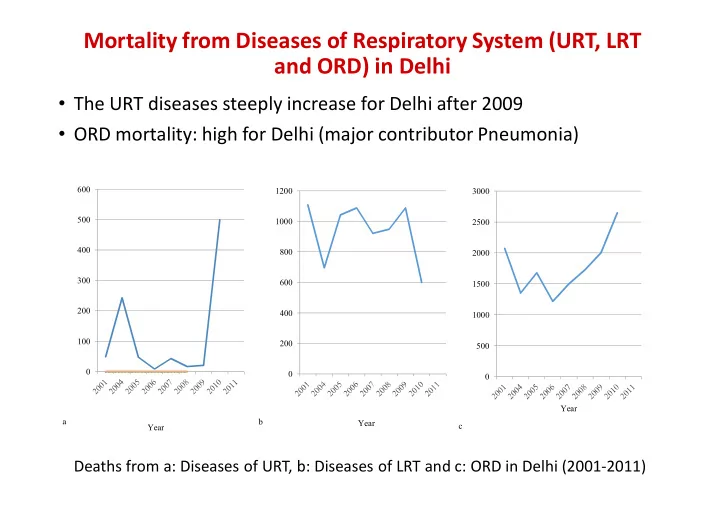
Mortality from Diseases of Respiratory System (URT, LRT and ORD) in Delhi The URT diseases steeply increase for Delhi after 2009 ORD mortality: high for Delhi (major contributor Pneumonia) 600 1200 3000 500 1000 2500 400 800 2000


slide-1
SLIDE 1

Mortality from Diseases of Respiratory System (URT, LRT and ORD) in Delhi

  • The URT diseases steeply increase for Delhi after 2009
  • ORD mortality: high for Delhi (major contributor Pneumonia)

100 200 300 400 500 600 Year a 200 400 600 800 1000 1200 Year b 500 1000 1500 2000 2500 3000 Year c

Deaths from a: Diseases of URT, b: Diseases of LRT and c: ORD in Delhi (2001‐2011)

slide-2
SLIDE 2

Deaths due to major respiratory diseases in Delhi

Deaths due to major respiratory diseases from a. Pneumonia (Institutional and hospital deaths in Delhi only) b. Influenza c. Bronchitis, broncholitis, asthma and unspecified emphysema d. Whooping cough in Delhi Source: Compiled from Directorate of Economics and Statistics and Office of Chief Registrar (Births and Deaths), 2001‐2011 (excluding 2002‐03)

2405 4206 3935 2353 2797 1678 1697 2896 3042 4386 3179 500 1000 1500 2000 2500 3000 3500 4000 4500 5000

2001 2002 2003 2004 2005 2006 2007 2008 2009 2010 2011 Number of deaths Year

6 108 208 98 122 161 234 635 222

100 200 300 400 500 600 700 2001 2004 2005 2006 2007 2008 2009 2010 2011 Number of deaths Year b

239 305 377 305 237 154 198 248 282

50 100 150 200 250 300 350 400 2001 2004 2005 2006 2007 2008 2009 2010 2011 Number of deaths Year c

1 2 7 36 60 12 50

10 20 30 40 50 60 70 2001 2004 2005 2006 2007 2008 2009 2010 2011 Number of deaths Year d

Delhi (2001-11)

Pneumonia

Max: 2010 (4,386); min: 2006 (1,678)

Influenza

Rose from 6 to 635 (2001‐10); declined later

Bronchitis, broncholitis, asthma

282 deaths in 2011

Whooping cough

1 to 60 (2001‐08); declined in 2009 & rose again (50 in 2010)
slide-3
SLIDE 3

Spatial Analysis of Impact of Air Pollution on Human Health in Delhi

  • The urban area is administered by three agencies/statutory towns:

NDMC, MCD, DCB

  • Data for segregated rural pockets is also collected
  • Maximum area and population: MCD
  • Lowest population: DCB

Statutory towns and rural areas Area (2001) (in per cent) Population (2001) Density (2001) (in persons per km2) Total institutional deaths (2001- 2012)** MCD 94 13,423,227 (97%) 9,607 460,038 NDMC 3 302,363 (2%) 7,074 224,902 DCB 3 124,917 (1%) 2,907 16,035 Urban 62 NA 13,957 NA Rural 38 NA 1,692 NA

slide-4
SLIDE 4

Trend of mortality due to pneumonia in statutory towns and rural areas of Delhi

  • Rural areas having poor

amenities, infrastructure and living conditions have highest proportion of deaths from pneumonia (2001‐2012)

  • MCD that represents mixed

population with relatively low quality of environment in comparison to NDMC and DCB also experienced rise in mortality from pneumonia (2001‐2012)

  • Note: does not include data for

2002 and 2003

y = 57.921x + 325.53 R² = 0.5297 500 1000 1500 2001 2004 2005 2006 2007 2008 2009 2010 2011 2012 y = 5.5273x + 628.8 R² = 0.0053 200 400 600 800 1000 1200 2001 2004 2005 2006 2007 2008 2009 2010 2011 2012 y = 1.7939x + 45.133 R² = 0.0867 20 40 60 80 100 2001 2004 2005 2006 2007 2008 2009 2010 2011 2012 y = 10.624x + 3.8667 R² = 0.6815 50 100 150 2001 2004 2005 2006 2007 2008 2009 2010 2011 2012 Total Female Male RURAL

slide-5
SLIDE 5

Trend of mortality due to bronchitis and asthma in statutory towns and rural areas of Delhi

  • Urban and rural regions
  • f Delhi observed steep

increase in cases of bronchitis and asthma related deaths since 2002

  • Bronchitis and asthma

are majorly caused due to SPM (Department of environment and conservation NSW, 2005) and the health condition becomes severe due to the exposure to SO2 (Chen and Kan, 2008).

y = 59.491x + 205.8 R² = 0.6215 200 400 600 800 1000 2001 2004 2005 2006 2007 2008 2009 2010 2011 2012 y = 126.12x - 324.93 R² = 0.7503

  • 500

500 1000 1500 2001 2004 2005 2006 2007 2008 2009 2010 2011 2012 y = 10.018x - 14.8 R² = 0.563

  • 50

50 100 150 2001 2004 2005 2006 2007 2008 2009 2010 2011 2012 y = 6.6182x + 20.2 R² = 0.5425 20 40 60 80 100 2001 2004 2005 2006 2007 2008 2009 2010 2011 2012 Total Female Male RURAL

slide-6
SLIDE 6

Age wise composition of deaths due to major divisions of the respiratory systems (a) URT, (b) LRT and (c) ORS in Delhi

  • a.URT
  • 55-64 year age group: most vulnerable
  • b. LRT
  • Child mortality dipped to 42 (2010) from

106 (2006)

  • 64-69 age group is most vulnerable
  • c. ORD
  • Accounts for a major share for all age

groups

  • 1 to 14 years experienced twice as much as

deaths from 2006 to 2010

  • Sharp rise in infant deaths from 151 in 2006

to 414 in 2010

  • Elderly are most vulnerable group to ORD
slide-7
SLIDE 7

Inter linkages between Pollutants and mortality due to respiratory system illness

  • The regression analysis between the pollutants and

diseases of respiratory systems suggests that

  • URT diseases are rising mainly on account of

RSPM (r2=0.45) and SPM (r2=0.40)

  • Mortality from LRT diseases is largely dependent on

SO2 (r2=0.44) and RSPM (r2=0.27)

  • The other diseases of the respiratory system seem

to be largely reliant on RSPM (88 per cent), SPM and SO2 (75 per cent each)

slide-8
SLIDE 8

Continued

  • SO2 has positive relation with abnormalities

in breathing (73 %), pneumonia (64%) and heart attack (62%)

  • NO2 shares positive correlation with

whooping cough (93%) , influenza (59 %)

  • PM are positively correlated with all the

diseases; breathing abnormalities (89%) , pneumonia (88%) and influenza

slide-9
SLIDE 9

Conclusion

  • Results reveal that asthma, bronchitis and pneumonia

are responsible for most deaths due to air pollution in Delhi.

  • Spatial and temporal analysis of mortality from these

diseases is presented for Delhi (2001‐2012).

  • The results reveal that there has been increase in the

number of death of children due to respiratory illness.

  • The other major age group facing impact of rising

pollution levels is above 60 years age group.

60

slide-10
SLIDE 10

SUGGESTIONS

  • Promote urban planning for sustainable practices

and healthy behaviors .

  • Stimulate decent lifestyle by improving urban living

conditions

  • Ensure participatory governance
  • Build sustainable, inclusive and peaceful cities that

are accessible and people‐friendly

  • Make urban areas resilient to emergencies and

disasters

slide-11
SLIDE 11

Source: UK Climate change

62

slide-12
SLIDE 12

Dimensions of Sustainable Habitat

slide-13
SLIDE 13

Why is health important for 21st century cities?

And why is urban development important for health and wellbeing-(Source-WHO at HABITAT III)

  • 1. Healthy urban policies can significantly reduce

infectious and noncommunicable diseases and enhance wellbeing.

  • 2. Sustainable design and proactive development

can enhance health equity by protecting urban populations from health risks and the impacts of extreme weather events.

  • 3. Health indicators can help document how

citizens benefit from urban investments in infrastructure and environmental and social protection.

slide-14
SLIDE 14

Cont.-

  • 4. A large body of scientific evidence on the health

impacts of urban policies can clarify risks and inform decision-making for sustainable development.

  • 5. Vulnerable populations can be afforded additional

protection when health risks are fully considered in urban planning.

  • 6. The “right to the city” includes the right to access to

spaces that promote social cohesion, support healthy lifestyles and deliver economic benefits.

  • 7. Considering health impacts promotes fuller

participation in urban decision-making by various stakeholders and members of different communities.

65

slide-15
SLIDE 15

Awareness goes a long way…

Cab with green roof in Kolkata Source: The Telegraph, 17th May 2015

THANK YOU