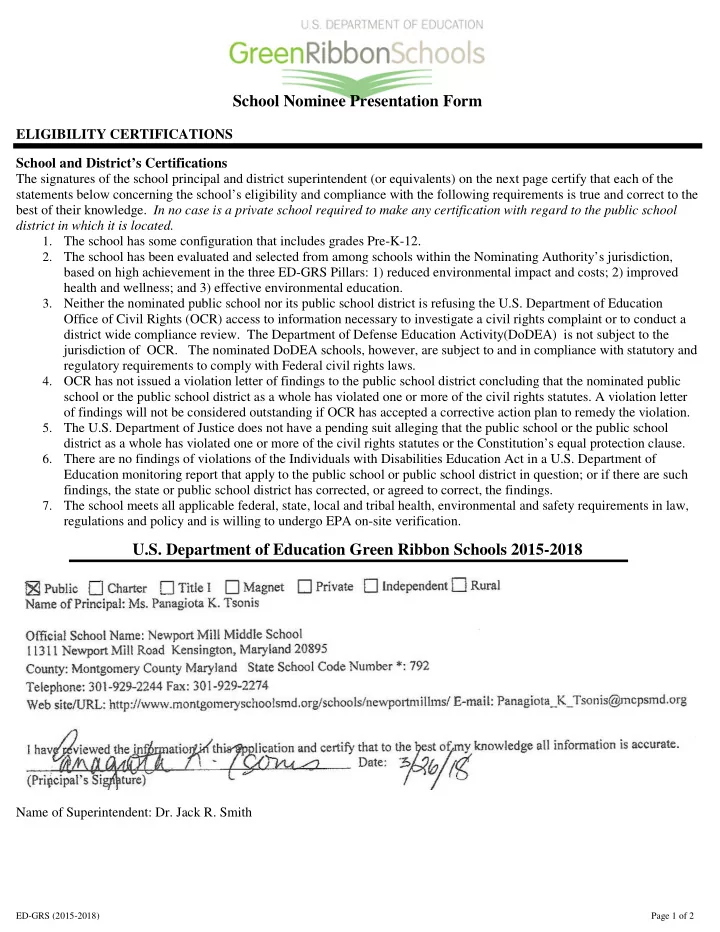
School Nominee Presentation Form ELIGIBILITY CERTIFICATIONS School - - PDF document

school nominee presentation form
SMART_READER_LITE
LIVE PREVIEW

School Nominee Presentation Form ELIGIBILITY CERTIFICATIONS School - - PDF document

School Nominee Presentation Form ELIGIBILITY CERTIFICATIONS School and Districts Certifications The signatures of the school principal and district superintendent (or equivalents) on the next page certify that each of the statements below


slide-1
SLIDE 1

ED-GRS (2015-2018) Page 1 of 2

School Nominee Presentation Form

ELIGIBILITY CERTIFICATIONS School and District’s Certifications The signatures of the school principal and district superintendent (or equivalents) on the next page certify that each of the statements below concerning the school’s eligibility and compliance with the following requirements is true and correct to the best of their knowledge. In no case is a private school required to make any certification with regard to the public school district in which it is located.

  • 1. The school has some configuration that includes grades Pre-K-12.
  • 2. The school has been evaluated and selected from among schools within the Nominating Authority’s jurisdiction,

based on high achievement in the three ED-GRS Pillars: 1) reduced environmental impact and costs; 2) improved health and wellness; and 3) effective environmental education.

  • 3. Neither the nominated public school nor its public school district is refusing the U.S. Department of Education

Office of Civil Rights (OCR) access to information necessary to investigate a civil rights complaint or to conduct a district wide compliance review. The Department of Defense Education Activity(DoDEA) is not subject to the jurisdiction of OCR. The nominated DoDEA schools, however, are subject to and in compliance with statutory and regulatory requirements to comply with Federal civil rights laws.

  • 4. OCR has not issued a violation letter of findings to the public school district concluding that the nominated public

school or the public school district as a whole has violated one or more of the civil rights statutes. A violation letter

  • f findings will not be considered outstanding if OCR has accepted a corrective action plan to remedy the violation.
  • 5. The U.S. Department of Justice does not have a pending suit alleging that the public school or the public school

district as a whole has violated one or more of the civil rights statutes or the Constitution’s equal protection clause.

  • 6. There are no findings of violations of the Individuals with Disabilities Education Act in a U.S. Department of

Education monitoring report that apply to the public school or public school district in question; or if there are such findings, the state or public school district has corrected, or agreed to correct, the findings.

  • 7. The school meets all applicable federal, state, local and tribal health, environmental and safety requirements in law,

regulations and policy and is willing to undergo EPA on-site verification.

U.S. Department of Education Green Ribbon Schools 2015-2018

Name of Superintendent: Dr. Jack R. Smith

slide-2
SLIDE 2

ED-GRS (2015-2018) Page 2 of 2

Nominating Authority’s Certifications The signature by the Nominating Authority on this page certifies that each of the statements below concerning the school’s eligibility and compliance with the following requirements is true and correct to the best of the Authority’s knowledge.

  • 1. The school has some configuration that includes grades Pre-K-12.
  • 2. The school is one of those overseen by the Nominating Authority which is highest achieving in the three ED-GRS

Pillars: 1) reduced environmental impact and costs; 2) improved health and wellness; and 3) effective environmental and sustainability education.

  • 3. The school meets all applicable federal civil rights and federal, state, local and tribal health, environmental and

safety requirements in law, regulations and policy and is willing to undergo EPA on-site verification. Name of Nominating Agency: Maryland State Department of Education (MSDE) Name of Nominating Authority: Dr. Carol Williamson I have reviewed the information in this application and certify to the best of my knowledge that the school meets the SUMMARY AND DOCUMENTATION OF NOMINEE’S ACHIEVEMENTS Provide a coherent summary that describes how your school is representative of your jurisdiction’s highest achieving green school efforts. Summarize your strengths and accomplishments in all three Pillars. Then, include concrete examples for work in every Pillar and Element. Only schools that document progress in every Pillar and Element can be considered for this award. SUBMISSION The nomination package, including the signed certifications and documentation of evaluation in the three Pillars should be converted to a PDF file and emailed to green.ribbon.schools@ed.gov according to the instructions in the Nominee Submission Procedure. OMB Control Number: 1860-0509 Expiration Date: March 31, 2018 Public Burden Statement According to the Paperwork Reduction Act of 1995, no persons are required to respond to a collection of information unless such collection displays a valid OMB control number. The valid OMB control number for this information collection is 1860-0509. Public reporting burden for this collection of information is estimated to average 37 hours per response, including time for reviewing instructions, searching existing data sources, gathering and maintaining the data needed, and completing and reviewing the collection of information. The obligation to respond to this collection is required to obtain or retain benefit P.L. 107-110, Sec. 501, Innovative Programs and Parental Choice Provisions. Send comments regarding the burden estimate or any other aspect of this collection of information, including suggestions for reducing this burden, to the U.S. Department of Education, 400 Maryland Ave., SW, Washington, DC 20202-4536 or email ICDocketMgr@ed.gov and reference the OMB Control Number 1860-0509. Note: Please do not return the completed ED-Green Ribbon Schools application to this address.

slide-3
SLIDE 3

ED-GRS (2015-2018) Page 3 of 2

Lead Applicant Name: Ms. Laurie C. Jenkins Lead Applicant Email: Laurie_C_Jenkins@mcpsmd.org Phone Number: 301-924-3123 Level [ ] Early Learning Center [ ] Elementary (PK- 5 or 6) [ ] K - 8 [X] Middle (6 - 8 or 9) [ ] High (9 or 10 - 12) School Type (X) Public ( ) Private/ Independent ( ) Charter ( ) Magnet How would you describe your school? ( ) Urban (X)Suburban ( ) Rural District Name: Montgomery County Public Schools Is your school in one of the largest 50 districts in the nation? (X) Yes ( ) No Total Enrolled: 637-school; 161,546- district Does your school serve 40% or more students from disadvantaged households? (X) Yes ( ) No % receiving FRPL= 50–55% % limited English proficient = 10.5% Other measures: Learning for Independence Program– 46 students Graduation rate: N/A Attendance rate: 95%

Summary Narrative

To understand Newport Mill Middle School as an exceptional school within a Green Ribbon School District consisting of 206 schools, it is imperative to first present a picture of who we are. Newport Mill Middle School is located in Kensington, Maryland, a suburb of Washington, D.C., in a very diverse, growing, and changing community. We have a total of 637 students in grades six through eight. Our school is highly diverse, not only culturally, but economically as well. We have students who come from all different backgrounds, many regions of the world, and many different family situations. The demographics of our school population consist of 49.7 percent Hispanic, 14.9 percent Black, 20.8 percent White, 8 percent Asian, and 4 percent other. Within our ethnically diverse population, 51.7 percent of our students are eligible for free/reduced lunch, 24.4 percent receive special education services, and 10.5 percent are enrolled in English for Speakers of Other

  • Languages. We also have a large Learning for Independence (LFI) program designed for students with complex learning and

cognitive needs, including mild to moderate intellectual disabilities; our LFI population makes up 6.7 percent of our student body. Newport Mill is part of a unique cohort of middle schools in our district that hosts the International Baccalaureate Middle Years Programme (IB-MYP), an internationally adopted framework for designing authentic assessments, generating student- based inquiry, and creating real-world scenarios in which students can actively engage. The environment is used as an integrating context for this kind of learning; thus environmental literacy in woven naturally into instruction. Importantly, IB- MYP is not an exclusive program limited to a section of our population; it is a school-wide program that holds all of our

slide-4
SLIDE 4

ED-GRS (2015-2018) Page 4 of 2

students to rigorous academic standards and cultivates in them a series of 10 learner profile attributes (balanced, risk-taking, inquirer, reflective, open-minded, principled, communicator, knowledgeable, thinker, and caring) that will make them successful in any future endeavor. As an IB-MYP school, we seek to develop active learners who are internationally minded and who build transferable and marketable skills necessary to help advance our global community. To this end, our school’s instructional focus centers on establishing student-centered learning environments that promote critical thinking, academic communication, and argumentative writing – these three are why the environment is often a topic of choice for rigorous learning at NMMS. Our school has been innovative in developing school-wide Interdisciplinary Writing Assessments (IWAs) that engage students in synthesizing disciplinary knowledge to demonstrate interdisciplinary understanding. These Interdisciplinary Writing Assessments specifically support environmental literacy and promote health and fitness. In fact, last year, our students engaged in an IWA that demonstrated their thorough understanding of physical fitness components and mathematical budget restraints by assuming the role of an athletic director and writing a proposal for purchasing equipment to improve physical health and fitness, a real-world situation much like the situation we are appealing to you in now. This year,

  • ur students used their understanding of the physical fitness components and mathematical calculations to create a daily

fitness plan based on percentage of calories burned in each fitness category. Our students also wrote a letter to a construction company addressing the potential environmental impact caused by the acquisition of land for a new housing development in

  • ur community, and they used their knowledge about the digestive system to evaluate an informational video to determine its

accuracy and objectivity in presenting the impact of an over-the-counter antacid on healthy digestion. All of these Interdisciplinary Writing Assessments engaged our students in a deep exploration of concepts rooted in environmental literacy and health and fitness. In 2015, Newport Mill Middle School received the Maryland Green School Award in recognition of the work we are doing to build and sustain a green school culture. Students are involved in myriad environmental initiatives including helping to create a Green Kids Outdoor classroom, a School Energy and Recycling Team, a school wide Science and Engineering Expo, our Interdisciplinary Writing Assessments, PEPCO National Energy Education Development’s MakerFair, and EnviroScape lessons and stream study with the Audubon Naturalist Society. We are very excited that Newport Mill Middle School was recently selected to be the recipient of the National Foundation for Governors’ Fitness Councils “DON’T QUIT” fitness center designed specifically for middle school students. This $100,000 state-of-the-art fitness center has elevated the opportunities for our students to maximize their physical fitness workout to reduce obesity and promote a healthy lifestyle, while providing an opportunity for our school to focus on wellness, in general – physical and mental. We look forward to learning more about how we can use this unique chance to help students and the community build healthy habits that will last a lifetime. At Newport Mill Middle School, our community has an unwavering commitment to reduce environmental costs, promote student and staff wellness, and ensure that our students are moved well along in their path to broad and deep environmental literacy by high school graduation.

  • 1. Is your school participating in a local, state or national school program, such as EPA ENERGY STAR Portfolio

Manager, EcoSchools, Project Learning Tree, or others, which asks you to benchmark progress in some fashion in any or all of the Pillars? (X) Yes

  • EPA ENERGY STAR Portfolio Manager—Score 88.
  • Maryland Green School Program
  • A member of the GreenKids Grant for Outdoor Classroom.
  • Our Green School Club meets weekly to support the active School Energy and Recycling Team (SERT), which

is a school system wide program to promote recycling and resource conservation.

slide-5
SLIDE 5

ED-GRS (2015-2018) Page 5 of 2

  • 2. Has your school, staff or student body received any awards for facilities, health or environment?

(X) Yes

  • SERT Program Annual Recycling Award–FY17, FY15, FY10
  • SERT Program Quarterly Energy Saving Award–FY17, FY16, FY15, FY14, FY13, FY12, FY11, FY10
  • Annual MCPS system-wide “Got Paper” recycling contest winner–FY16, FY12
  • In 2017, Newport Mill Middle School was awarded the National Foundation for Governors’ Fitness Councils

“DON’T QUIT” Fitness Center. This is a $100,000 state-of-the-art fitness center for middle school students to provide our students focus on physical and mental health, both during the school day and after school.

  • In 2015, Newport Mill Middle School was awarded the Maryland Green School Award in recognition of the

work we are doing to build and sustain a green school culture.

Pillar I: Reduced Environmental Impact and Costs

Energy 1. Can your school demonstrate a reduction in Greenhouse Gas emissions? (X) Yes ( ) No Percentage reduction: 19.56% over 07/14–06/17 Initial GHG emissions rate (MT eCO2/person): 1.48 Final GHG emissions rate (MT eCO2/person): 1.19 Offsets: None How did you calculate the reduction? Using utility database records 2. Do you track resource use in EPA ENERGY STAR Portfolio Manager? (X) Yes ( ) No If yes, what is your score? 88 If score is above a 75, have you applied for and received ENERGY STAR certification? ( ) Yes (X) No 3. Has your school reduced its total non-transportation energy use from an initial baseline? (X) Yes ( ) No Current energy usage (kBTU/student/year): 8,142 Current energy usage (kBTU/sq. ft./Year): 47 Percentage reduction: 19.56% per student and 14.37% per staff over 07/14–06/17 How did you document this reduction? Using utility database records 4. What percentage of your school's energy is obtained from? On-site renewable energy generation: None Purchased renewable energy: 33% Type: Wind Participation in USDA Fuel for Schools, DOE Wind for Schools or other federal or state school energy program: None 5. In what year was your school originally constructed? 1958 What is the total building area of your school? 108,240 square feet 6. Has your school constructed or renovated building(s) in the past ten years? ( ) Yes (X) No

slide-6
SLIDE 6

ED-GRS (2015-2018) Page 6 of 2

Water and Grounds 7. Can you demonstrate a reduction in your school's total water consumption from an initial baseline? Average Baseline water use (gallons per occupant): 862 Current water use (gallons per occupant): 831 Percentage reduction in domestic water use: Compared to the average water use of the past five years, the 2017 water consumption is 4% lower. Percentage reduction in irrigation water use: N/A How did you document this reduction (ie. ENERGY STAR Portfolio Manager, utility bills, school district reports)? Using utility database records 8. How much of your landscaping is considered water-efficient and/or regionally appropriate? 1.19 acres The total drainage area for the bio-retention is 4.55 acres, of which 3.36 acres is impervious surfaces. Types of plants used and location: The following plants were planted in the bio-retention area. Additionally, 8 shade trees as listed below were planted on the school property 9. Describe alternate water sources used for irrigation. NMMS Green Team is presently looking into installing rain barrels to be used around the school for watering.

  • 10. Describe any efforts to reduce storm water runoff and/or reduce impermeable surfaces.

Montgomery County Department of Environmental Protection installed a bio-retention facility on the property. The total drainage area for the bio-retention is 4.55 acres, of which 3.36 acres is impervious surfaces (rooftop, parking lot, etc.)

slide-7
SLIDE 7

ED-GRS (2015-2018) Page 7 of 2

  • 11. Our school's drinking water comes from: (X) Municipal water source ( ) Well on school property

( ) Other: The source of drinking water at Newport Mill Middle School is municipal–Washington Suburban Sanitary Commission (WSSC)

  • 12. Describe how the water source is protected from potential contaminants.

MCPS regularly monitors the results of water quality testing done by our three water providers–WSSC, City of Rockville and Town of Poolesville. The water source for Newport Mill MS is WSSC. MCPS has environmental staff that will evaluate water quality at facilities upon request.

  • 13. Describe the program you have in place to control lead in drinking water.

In 2004, MCPS implemented a comprehensive testing program to detect elevated levels of lead in drinking water at schools. A remediation plan was instituted for those facilities where elevated lead levels were found. Currently, MCPS assesses water quality on a three year cycle and institutes the EPA’s best management practices.

  • 14. What percentage of the school grounds are devoted to ecologically beneficial uses?

Newport Mills MS was one of the four schools in MCPS partnered with Montgomery County Department of Environmental Protection (DEP) and constructed bio-retention garden on the school site. This project is designed to redirect storm water runoff into the rain garden where it is filtered through plants and soil before replenishing the groundwater. Waste

  • 15. What percentage of solid waste is diverted from landfilling or incinerating due to reduction, recycling and/or

composting? Complete all the calculations below to receive points. A - Monthly garbage service in cubic yards (garbage dumpster size(s) x number of collections per month x percentage full when emptied or collected): MCPS does not use dumpsters to collect garbage from schools. Daily garbage in placed in bags and stored in the schools trash room. The monthly total tonnage of garbage disposed for MCPS is distributed to each school based on number of building occupants (Staff and Students). Total tons of garbage distributed to Newport Mill for school year 2016-2017 is 33.63 tons B - Monthly recycling volume in cubic yards (recycling dumpster sizes(s) x number of collections per month x percentage full when emptied or collected): MCPS requires the recycling hauling contractor to have “On-board Weighing Scale” on the trucks that service all MCPS

  • sites. The weight of each dumpster is weighed before and after servicing to capture the actual amount of material recycled

from each MCPS site. Total paper/cardboard collected for school year 2016-2017 = 15.27 tons Total commingle recyclables collected for schools year 2016-201 = 1.53 tons Total pounds per person (PPP) 4.1 One eight yard dumpster for paper/cardboard recycling with two times per week service. One two-yard dumpster for commingled recyclables with one time per week service. Similar to the garbage, MCPS does not use dumpsters to collect yard waste recycling. MCPS trucks collect yard waste recycling from designated area at school sites. The monthly total tonnage of yard waste recycling taken to the county transfer station is distributed to each school based on number of building (staff and student). Total tons of yard waste recycling debuted to Newport Mills for school year 2017-2017 is 2.60 tons.

slide-8
SLIDE 8

ED-GRS (2015-2018) Page 8 of 2

C - Monthly compostable materials volume(s) in cubic yards (food scrap/food soiled paper dumpster size(s) x number of collections per month x percentage full when emptied or collected): None Recycling Rate = ((B + C) ÷ (A + B + C) x 100): (15.27 + 1.53 + 2.60) / (33.63 +15.27 +1.53 +2.60) x 100) = 37% Monthly waste generated per person = (A/number of students and staff): (33.53/679) = 0.049

  • 16. What percentage of your school's total office/classroom paper content is post-consumer material, fiber from forests

certified as responsibly managed and/or chlorine-free? Ninety-nine percent of the paper stock used by NMMS is 30% post-consumer waste and/or certified by the Sustainable Forestry Initiative (SFI). The largest publications produced centrally for system-wide distribution including NMMS, such as student daily planners, math worksheets and assessments, are printed exclusively on 30% post-consumer waste paper.

  • 17. Hazardous waste generated at your school:

How is this measured? School staff is required to properly store and use hazardous chemicals and to notify MCPS’ Systemwide Safety Programs Unit of changes in the school’s chemical inventory. The school is also required to maintain a chemical information list and material safety data sheets for all hazardous chemicals onsite. How is hazardous waste disposal tracked? Newport Mill MS disposes of hazardous chemicals by either submitting a work order to MCPS’ Division of Maintenance or contacting the MCPS Science, Technology, Engineering, Art, and Mathematics (STEAM) Supervisor. The chemicals are picked up by a licensed hazardous waste contractor for disposal in accordance with applicable regulations. Describe other measures taken to reduce solid waste and eliminate hazardous waste. Green School Club students partner with the school’s SERT student team to collect paper recycling regularly. In an effort to reduce the amount of paper used in school, the printers are automatically set to double-sided printing. For larger printing needs, NMMS staff regularly utilize MCPS’ Copy Plus printing service that is able to complete these orders more economically and efficiently. As much as possible, information is transmitted electronically to further reduce paper use. The efforts of NMMS students in reducing solid waste, actively participating in recycling, and other conservations efforts are displayed for the school community to see.

  • 18. Which green cleaning custodial standard is used?

Newport Mill MS uses the Division of School Plant Operations’ Healthy, High Performance, Green Cleaning Program that incorporates Green Seal GS-39 Criteria for Green Facilities Operations and Maintenance. Formal building inspections, including inspection of ventilation systems are performed biannually by off-site Division of School Plant Operations (DSPO) building service supervisors. This includes inspection of filters, belts, lubrication, and

  • verall cleanliness of units, indoor air quality and temperature, record keeping, etc. The on-site school building service

manager conducts daily inspections, maintains schedules and logs, performs cleaning and monitors operations of ventilation systems. What percentage of all products is certified? 94 percent What specific third party certified green cleaning product standard does your school use? Green Seal Alternative Transportation

slide-9
SLIDE 9

ED-GRS (2015-2018) Page 9 of 2

  • 19. What percentage of your students walk, bike, bus, or carpool (2 + student in the car) to/from school? (Note if your

school does not use school buses) Students who ride school buses: 27 percent (47 LFI students plus 4 buses of 50 students) Students who bike: 3 percent How is this data calculated? By taking the total number of students who ride buses and total number of student who bike and divide with the total student population.

  • 20. Has your school implemented?

[ ] designated carpool parking stalls. [X] A well-publicized no idling policy that applies to all vehicles (including school buses). [X] Vehicle loading/unloading areas are at least 25 feet from building air intakes, doors, and windows. [X] Safe Pedestrian Routes to school or Safe Routes to School Describe activities in your safe routes program: Safe routes consisting of two designated crosswalks and three crossing guards encourage students to walk and ride bikes to

  • school. MCPS collaborates with Montgomery County government who oversees the safe route program in order to ensure

that it’s implemented in the design phases for school renovations and/or construction.

  • 21. Describe how your school transportation use is efficient and has reduced its environmental impact.

Eighty percent of MCPS school buses meet or exceed EPA 2008 Emissions mandates. Annually every single route is analyzed to identify opportunities to improve efficiency. As a result, we are able to reduced environmental impacts, and increase benefits to the health and well-being of our local and global community.

  • 22. Describe any other efforts toward reducing environmental impact, focusing on innovative or unique practices and

partnerships. Students of the Green Schools Club partner with the SERT student team to collect paper recycling and ensure low energy lighting distribution throughout the building. Classrooms utilize low energy lamps and turn off lights when natural light will

  • suffice. The Green Schools team created lamp switch reminders and posted energy savings reminders. Use of Water bottle

filling stations is promoted. Printers are automatically set to double-sided printing, and staff regularly utilize MCPS’ Copy Plus printing service. The Weekly ROAR Report is distributed electronically. The work of the Green School and SERT Team are displayed for the school community to see. Staff circulates shutdown information electronically and sends reminders to reduce energy during long weekends.

Pillar 2: Improve the health and wellness of students and staff

Environmental Health 1. Describe your school’s Integrated Pest Management efforts, including IPM/green certifications earned, routine inspections, pest identification, monitoring, record-keeping, etc.: The Integrated Pest Management (IPM) program employs Maryland Department of Agriculture certified pesticide applicators to conduct regular inspections to prevent pest damage. IPM staff identifies and corrects conditions that encourage pests by reducing food, water and shelter for pests, and by eliminating unnecessary pesticide applications. This integrated approach results in the most economical long-term solution with the least possible hazard to people, property and the environment. An IPM logbook of all IPM activities is kept in the main office of the school.

slide-10
SLIDE 10

ED-GRS (2015-2018) Page 10 of 2

2. What is the volume of your annual pesticide use (gal/student/year)? Describe efforts to reduce use: The annual pesticide use at Newport Mill MS Middle School was 0.05 gal/student. 3. Which of the following practices does your school employ to minimize exposure to hazardous contaminants? Provide specific examples of actions taken for each checked practice. [X] Our school prohibits smoking on campus and in public school busses. MCPS prohibits the use of tobacco products on MCPS property and in MCPS vehicles, including buses (MCPS Regulation COF-RA). [X] Our school has identified and properly removed sources of elemental mercury and prohibits its purchase and use in the

  • school. MCPS prohibits schools from purchasing or using elemental mercury, in accordance with state law.

[ ] Our school uses fuel-burning appliances and has taken steps to protect occupants from carbon monoxide (CO) [ ] Our school does not have any fuel burning combustion appliances [ ] Our school has tested all frequently occupied rooms at or below ground level for radon gas and has fixed and retested all rooms with levels that tested at or above 4 pCi/L OR our school was built with radon resistant construction features and tested to confirm levels below 4 pCi/L. [X] Our school has identified any wood playground or other structures that contain chromate copper arsenate and has taken steps to eliminate exposure. MCPS prohibits installation of wood playground components at MCPS schools. 4. Describe how your school controls and manages chemicals routinely used in the school to minimize student and staff exposure. School’s current chemical inventory indicates at least 55 gallons, but less than 220 gallons, aggregate quantity of hazardous

  • chemicals. Disposal of hazardous chemicals is done by either submitting a work order to MCPS’ Division of Maintenance or

contacting the MCPS Science, Technology, and Engineering (STE) Supervisor and are disposed by a licensed hazardous waste contractor in accordance with applicable regulations. School staff is required to properly store and use hazardous chemicals and to notify MCPS’ Systemwide Safety Programs Unit of changes in the school’s chemical inventory. The school maintains a chemical information list and MSDS for all hazardous chemicals onsite. Employees potentially exposed to hazardous chemicals are required to receive training, in accordance with Maryland Occupational Safety and Health regulations. 5. Describe actions your school takes to prevent exposure to asthma triggers in and around the school. To prevent asthma triggers from volatile organic compounds (VOCs), MCPS developed a guidance document on the use of air fresheners. According to EPA, air fresheners constantly release chemicals into the air and present an indoor air quality (IAQ) issue for sensitive populations. Throughout the school, building service personnel routinely perform housekeeping and HVAC maintenance activities to reduce the exposure to dust mites, pollen and mold. To prevent allergic reactions to dust mites, MCPS replaces carpet with floor tile in classroom and common areas whenever possible. 6. Describe actions your school takes to control moisture from leaks, condensation, and excess humidity and promptly cleanup mold or removes moldy materials when it is found. (100 word max) To control moisture from leaks, condensation and excess humidity, MCPS formed a Mold Prevention Work Group in 2014. During the cooling season the workgroup meets biweekly to review school conditions and action items to resolve immediate and long-term issues. The group has developed and implemented several proactive initiatives including wireless remote

slide-11
SLIDE 11

ED-GRS (2015-2018) Page 11 of 2

temperature/humidity monitoring, targeted placement of supplemental dehumidification units, system-wide email delivery of Mold Prevention Alerts and annual automated service tasks. Professionally trained in-house staff conduct remediation activities for smaller scale mold projects while a qualified contractor conducts remediation activities for larger scale mold projects. 7. Our school has installed local exhaust systems for major airborne contaminant sources. (X) Yes ( ) No Kitchen vent hood is service annually. 8. Describe your school’s practices for inspecting and maintaining the building’s ventilation system and all unit ventilators to ensure they are clean and operating properly. Formal building inspections, including inspection of ventilation systems are performed biannually by off-site Division of School Plant Operations (DSPO) building service supervisors. This includes inspection of filters, belts, lubrication, and

  • verall cleanliness of units, indoor air quality and temperature, record keeping, etc. The on-site school building service

manager conducts daily inspections, maintains schedules and logs, performs cleaning and monitors operations of ventilation

  • systems. The on-site school building service manager routinely cleans unit ventilator supply and return air vents and changes

air filters on a quarterly basis. 9. Describe actions your school takes to ensure that all classrooms and other spaces are adequately ventilated with

  • utside air, consistent with state or local codes, or national ventilation standards.

On site building service staff routinely inspect and monitor HVAC system equipment operation (including outdoor air intakes) in an effort to ensure that all classrooms and other spaces are adequately ventilated with outside air. In the event where issues are identified, staff generate corrective action(s) through the MCPS automated work order process. Teaching staff are also instructed not to store materials that may block airflow from supply and return air vents. Classrooms are served by dedicated outdoor air equipment that provides direct ventilation to spaces when occupied. Common spaces receive ventilation through air handling equipment with demand control sequence of operations.

  • 10. Describe other steps your school takes to protect indoor environmental quality such as implementing EPA IAQ

Tools for Schools and/or conducting other periodic, comprehensive inspections of the school facility to identify environmental health and safety issues and take corrective action. (200 word max) As part of the MCPS Indoor Air Quality (IAQ) Complaint Response System, each IAQ complaint at Newport Mill MS is thoroughly evaluated by MCPS environmental health and safety (EH&S) professionals. Based on indoor air quality sampling and the findings of visual inspection, EH&S staff identify any action items required to improve indoor environmental conditions. Formal building inspections, including inspection of ventilation systems are performed biannually by off-site Division of School Plant Operations (DSPO) building service supervisors. This includes inspection of filters, belts, lubrication, overall cleanliness of units, indoor air quality and temperature, record keeping, etc. The on-site school building service manager conducts daily inspections, maintains schedules and logs, performs cleaning and monitors operations of ventilation systems. Nutrition and Fitness

  • 11. Which practices does your school employ to promote nutrition, physical activity and overall school health? Provide

specific examples of actions taken for each checked practice, focusing on innovative or unique practices and

  • partnerships. (100 word max each or whatever you choose to make them!)

[X] Our school participates in the USDA's Heathier US School Challenge. Level and year: Newport Mill Middle Schools is fully compliant with all USDA regulations for both meals and snacks served from the

slide-12
SLIDE 12

ED-GRS (2015-2018) Page 12 of 2

cafeteria as well as food provided from other sources, such as vending machines. Vending machines dispensing non- compliant foods/beverages are on timers and students do not have access until after 30 minutes post the school day. [X] Our school participates in a Farm to School program to use local, fresh food. NMMS participates in the Maryland Farm to School Program and is an active participant in the annual Farm to School Week Celebration where a variety of locally grown produce is purchased and served to students. All produce is purchased locally when available through the distributor. Additionally, this program seeks to maximize the number of Maryland grown foods in the National School Lunch Program while educating the students on the benefits of a healthy diet. In September, 2017 students were served local produce including sweet potatoes, fresh corn on the cob, cucumbers, spinach, apples and bell

  • peppers. The cafeteria also highlighted local fresh fruit and vegetables offerings during Nationals School Lunch week in

October, 2017. [ ] Our school has an on-site food garden. [ ] Our school garden supplies food for our students in the cafeteria, a cooking or garden class or to the community. [X] Our students spent at least 120 minutes per week over the past year in school supervised physical education. [X] At least 50% of our students' annual physical education takes place outdoors. [X] Health measures are integrated into assessments. [ ] At least 50% of our students have participated in the EPA's Sunwise (or equivalent program). [X] Food purchased by our school is certified as "environmentally preferable" Percentage: __ Type: Not measured at this time.

  • 12. Describe the type of outdoor education, exercise and recreation available.

All Physical Education classes utilize the outdoor basketball, soccer, and softball fields, tennis courts, and track. Entire school community participates in the Annual Tiger Run sponsored by the Parent Teacher Student Association (PTSA). Parents and staff are encouraged to run that one mile with our students. Every spring, Newport Mill students also participate in our school’s Miles of Champions where a grade-level competition takes place among students for the best mile run time. We also have several after-school events/activities to promote strong health and fitness that include: Softball, Basketball, Soccer, Archery, and Weight Room Club, as well as annual Soccer and Basketball Jamborees. The MCPS Outdoor Education Program promotes environmental literacy and wellness while every grade 6 students is on site.

  • 13. Describe any other efforts to improve nutrition and fitness, highlighting innovative or unique practices and

partnerships. In effort to increase student selection and consumptions of dark green vegetables and red/ orange vegetables, lunch entree

  • fferings are added or ‘bundled’ with these vegetable.

Cafeteria vending machines contain product that meet the USDA Smart Snack Guidelines. One of our IWA asks students to calculate and monitor their physical fitness in preparation for the Annual Tiger Run. Students develop a fitness plan for themselves and their classmates. The plan requires students to work out 30-60 minutes per day, at least 5 days a week. Students must burn between 1,000-1,200 calories for the week. Another IWA, through Science and English, engages students in researching malnutrition, obesity, diabetes, and high cholesterol as significant dangers in our

  • lives. Students are tasked to make a recommendation to the Federal Trade Commission on whether certain medication

advertisements should be allowed to air, be modified, or be prohibited based on how accurately and objectively they present the medication’s impact on health. Coordinated School Health, Mental Health, School Climate, and Safety

  • 14. Does your school use a Coordinated School Health approach or other health-related initiatives to address overall

school health issues? (X) Yes ( ) No Newport Mill Middle School is developing a wellness committee to promote and enhance health and wellness among the

slide-13
SLIDE 13

ED-GRS (2015-2018) Page 13 of 2

student population. The committee is comprised of a variety of diverse stakeholders. Goals and action plans are determined based on needs assessment and voices and interests from stakeholders. If yes, describe the health-related initiatives or approaches used by the school: Newport Mill Middle School actively participates in the MCPS staff wellness initiative, WellAware. Newport Mill staff has participated as a team, engaged in various physical fitness challenges, and participated in a weekly FitBit challenge. In addition, programs such as Zumba, Yoga, and The DON’T QUIT Fitness Center have been provided to staff at no cost after the school day. Increase in physical activity, as demonstrated by new work out equipment increases the awareness of healthy eating and the important benefits.

  • 15. Does your school collaborate with any postsecondary institutions, businesses, nonprofit organizations, or

community groups to support student health and/or safety? (X) Yes ( ) No If yes, describe these partnerships: Newport Mill Middle School has partnered with the following organizations to support student health and safety: Kensington Youth Services (Mental Health Services), Montgomery County Police Department (School Resource Officer, Cyber Safety), Common Sense Education Digital Literacy (including cyber safety lessons), and the Newport Mill Middle School PTSA (sponsoring cyber safety programing with speakers and films).

  • 16. Does your school have a school nurse and/or a school-based health center?

(X) Yes ( ) No

  • 17. Describe your school’s efforts to support student mental health and school climate (e.g. anti-bullying programs,

peer counseling, etc.): Newport Mill Middle School’s motto is “The Newport Mill Way,” and our slogan is, “We are Safe. We Listen to Each Other. We Speak Positively to Each Other. We are Nice!” This is announced every day on the morning announcements. In addition, Newport Mill Middle School provides several programs for student mental health and a positive school climate. Counselors conduct “Anti-bullying” and “Growth Mindset” lessons and a “Unity” campaign for all students. Our Middle Years Programme asks students to reflect on the IB Learner attributes (Communicators, Reflective, Caring, Inquirers, Thinkers, Communicators, Principled, Open-Minded, Risk-Takers, Balanced) throughout the school day. Our Media Specialist delivers “Common Sense” Digital literacy lessons. The Newport Mill Middle School Builders’ Club conducted a Kindness Campaign. In addition, our security, counseling, and administration teams utilize peer mediation to assist in communicating, problem solving, and decision-making. Newport Mill Middle School promotes a positive school climate by having “WOW–Within Our Walls” Staff Recognition during month staff meetings. Grade-level teams host potluck breakfasts, and the social committee conducts events such as our “Chili Cook Off” and staff celebrations for birthdays, weddings, and births.

Pillar 3: Effective Environmental and Sustainability Education

  • 1. Which practices does your school employ to help ensure effective environmental and sustainability education?

Provide specific examples of actions taken for each checked practice, highlighting innovative or unique practices and partnerships. [X] Our school has an environmental or sustainability literacy requirement. Our school district has a K-12 Environmental Literacy Plan that ensures environmental and sustainability education occurs as a series of learning progressions from Kindergarten through Grade 12 and involves several content areas. All of the State of Maryland Environmental Literacy Curriculum standards are addressed with grade-level appropriate content and experiences

slide-14
SLIDE 14

ED-GRS (2015-2018) Page 14 of 2

as students advance in knowledge and skill level. Graduation in the state of Maryland requires that students successfully complete a high school program that teaches all eight environmental education standards. The foundation for these MCPS high school courses is set through the elementary and middle school environmental education curriculum. Grade 6 students at NMMS focuses on three Maryland Environmental Literacy Standards (MELS) that address environmental science and sustainability as they investigate an environmental issue involving a local species and design a habitat conducive to its survival. Human impact is explored. Grade 7 student learning targets the MELS that embrace Environment and Society in their unit that includes hydroponics, while in Grade 8 students the focus is on the MELS entitled “Interactions of Earth’s Systems” as they analyze and explain phenomena like weathering and erosion. NMMS embraces its role in building students’ environmental literacy by ensuring that our district’s environmental education curriculum is taught with fidelity, and enriched through our local applications of the learning. [X] Environmental and sustainability concepts are integrated throughout the curriculum. Additionally, Grade 6 science students investigate environmental and sustainability concepts in their project-based units on Habitats, Going Green, and Alternative Energy. Outdoor Education is the site for taking more of that learning outside. First unit—students learn foundational ecology while they investigate a local species and design a habitat using engineering design that will allow the organism to survive. Second unit—students create an environmentally friendly design that improves natural resource use in an MCPS facility. Third unit— students design and build a solar collector. In Grade 6 social studies, students connect environmental factors to where people live and how their cultures evolve. In Grade 7, students study hydroponics and its use in modern agriculture. Adaptation and natural selection are central concepts in two of the Grade 7 units. In social studies, students conduct research into the effects of modification of the environment in Latin America. In Grade 8 science, students gain a better understanding of earth systems, and create an advocacy letter in social studies that focuses on an environmental topic of their choice. Art classes use recycled materials throughout the year and created a mural made from recycled glass and plastic in the Media Center. [X] Environmental and sustainability concepts are integrated into assessments. Mastery of environmental and sustainability concepts are assessed regularly in a variety of ways through formative and summative means, and include exit cards, writing to explain, drawing diagrams, oral presentations, and writing assessments. As an IB World School, Newport Middle School also uniquely administers Interdisciplinary Writing Assessments (IWAs). These are scenario-based, real world, authentic assessments that ask students to problem-solve and communicate a perspective in writing. The IWAs support sustaining environmental literacy and promote health and fitness, as evidenced through the following scenarios:

  • 6th-Grade Science and English: Engage in dialogue with HEMS Site Solutions, LLC, in reference to the

potential environmental impact caused by the acquisition of land for the new housing development in the community.

  • 7th-Grade Science and English: Evaluate an informational video to determine its accuracy and objectivity in

presenting the medication’s impact on health.

  • 8th-Grade Science and English: Compose a four-paragraph memo to NASA arguing whether to send man or

robot to Mars.

  • PE and Math: Propose a fitness plan for Newport Mill Middle School students that will be promoted by Body by
  • Jake. Your fitness plan must cause you to burn between 1,000-2,000 calories per week and should include

exercises that target the four fitness components. [ ] Students evidence high levels of proficiency in these assessments.

slide-15
SLIDE 15

ED-GRS (2015-2018) Page 15 of 2

[X] Professional development in environmental and sustainability education are provided to all teachers. Newport Mill Middle School Green School staff and science teachers have received professional development on the following topics over the past five years: Outdoor Environmental Education, IB Middle Years Programme, Energizing Student Potential collaborating with PEPCO and National Energy Education Development, MCPS Green School and SERT training, and Stream Study by the Audubon Society.

  • 2. How does your school use sustainability and the environment as a context for learning science, technology,

engineering and mathematics thinking skills and content knowledge?

  • All students at NMMS participate in the Annual Science and Engineering Expo. Students apply the scientific

method to develop a science experiment or test an engineering design, the results of which they showcase to the school community in a fair. Student experiments targeted environmental and sustainability issues and inventions.

  • Grade 8 students assessed the health of nearby creek and compared the results to the water testing done at the

Outdoor Education facility. Stream testing including stream flow, signs of erosion, and macro-invertebrate identification are used to quantify the state of the creek.

  • Grade 6 students design habitat models for the endangered species, the Maryland Checkerspot Butterfly.

Students developed recommendations to protect the butterfly and increase their population size and created presentations to share their learning.

  • Grade 6 students also research and collaborate in groups to build models of renewable energy sources, such as

solar collectors, wind turbines, and hydroelectric convertors.

  • Grade 8 students research global climate change and build models of homes that include at least three green

renewable energy resources. Students use Google Sketch-Up to construct the blue prints that give way to their designs.

  • NMMS partners with PEPCO National Energy Education Development to bring MakerFair lessons for an

energy fair.

  • 3. How does your school use sustainability and the environment as a context for learning green technologies and career

pathways? All MCPS courses for middle schools have the goal of preparing each student for college and career. Integrated into the curriculum are peeks into careers in the sciences and technology through readings and class discussion. In addition, community members with professional science careers present information about their jobs at our annual Science Night. We ensure representation in the following fields: Environmental Science, Technology, Engineering, and Mathematics. Green technology is integrated in a broader context as part of a bigger learning picture i.e. we do not teach green technology in isolation. For example, in grade 7, students learn about hydroponics, its role in new agriculture, and maintain a hydroponic garden; a student task in grade 8 is to design a sustainable building– during that unit students research green technologies that save energy in order to incorporate those items into their building. In grade 8 social studies a student may choose to promote clean transportation for the assigned task: an advocacy letter – in doing research for that project the student will investigate the green technologies involved in hybrids, electric, and solar vehicles. During our Science Expo, science careers share the spotlight with student experiments and inventions.

  • 4. Describe students’ civic/community engagement projects integrating environment and sustainability topics.

Newport Mill Middle School provides students the opportunities for civic/community engagement integrating environment and sustainability through the Middle Years Programme 8th-grade Community Projects and the Stream Studies. Middle Years Programme Community Projects include:

  • the cleanup and beautification of the Outdoor Classroom,
  • planting of perennials throughout the school site,
  • laying mulch along the side of the building,
slide-16
SLIDE 16

ED-GRS (2015-2018) Page 16 of 2

  • removing litter from neighboring parks and community centers, and
  • raising awareness about environmentally friendly efforts through poster campaigns.

In Grade 6, students participate in three days of an Outdoor Environmental Education at a residential site. There they investigate the answer to the question: How do humans impact the environment? Students continue their student of local environmental issues as they learn about invasive species and conduct an environmental service-learning project removing non-native plants. Newport Mill’s student leadership organizations, Student Government Association and Builders Club, hold an annual winter coat drive and regular food drives for Mid-County United Ministries of Wheaton which provides emergency food and assistance to people in crisis. The clubs are currently supporting the organization Comfort Cases which supports kids who are transitioning in the foster care system in conjunction with the guidance department.

  • 5. Describe students’ meaningful outdoor learning experiences at every grade level. (200 word max)
  • Newport Mill Middle School students are engaged in meaningful outdoor learning experiences every year.
  • In Grade 6, students participate in three days of an Outdoor Environmental Education at a residential site. There

they investigate the answer to the question: How do humans impact the environment? As part of learning about local environmental issues, students learn about invasive species and conduct an environmental service-learning project removing non-native plants. The curriculum includes lessons on predator/prey interactions, water quality monitoring, and reducing waste, and all involve students exploring and investigation in the outdoors.

  • In Grade 7 students participate in a MicroTrash Investigation through a grant from GreenKids and Chesapeake

Bay Trust, which includes removing trash from the school site, analyzing it, and creating a Trash Timeline.

  • Over the past four years, all Grade 8 science classes have taken a walking field trip to Rock Creek to investigate

the health of the stream, focusing on macroinvertebrate identification and observations of weathering and erosion.

  • 6. Describe how outdoor learning is used to teach an array of subjects in context, engage the broader community, and

develop civic skills. NMMS invested in an Outdoor Classroom that has become a permanent part of several content areas. Staff regularly utilize the Outdoor Classroom for teaching and learning an array of subjects. Examples include: French classes played Boules in the

  • utdoor classroom; seventh-grade English classes performed Shakespeare skits; and art teachers conducted “Art in the Park”.

Recently a student MYP Community project included the beautification and restoration of the Outdoor Classroom. Our Learning for Independence students learned life skills by maintaining the perennial garden at the school entrance with mulch and weed removal, and assist with recycling. Most of the big lessons in outdoor environmental education include a science question that involves an analysis of human impact, and thus science and social studies concepts are frequently taught together. In science students collect data, graph and analyze data that utilizes their growing math skills; and they communicate results – writing is taught in all content areas. To serve the larger community, students from our school have conducted service projects to remove invasive plants and collect native seeds for tree restoration programs during Outdoor Education week. Our Green Team makes special morning announcement to engage their fellow school citizens in helping conserve electricity and recycle.

  • 7. Describe your partnerships to help your school and other schools achieve in the 3 Pillars. Include both the scope and

impact of these partnerships. The entire Newport Mill Middle School community demonstrates an unwavering commitment to the Three Pillars of the National Green Schools. Our school community is deeply invested in sustainability, environmental literacy, and the promotion of health and fitness.

slide-17
SLIDE 17

ED-GRS (2015-2018) Page 17 of 2

Newport Mill Middle School has partnered with the following organizations to support student health and safety: Kensington Youth Services (Mental Health Services), Montgomery County Police Department (School Resource Officer, Cyber Safety), Common Sense Education Digital Literacy (including cyber safety lessons), and the Newport Mill Middle School PTSA (sponsoring cyber safety programing with speakers and films). The Newport Mill Middle School community seeks out high-quality partnerships with outside organizations who share our

  • values. These partnerships include Audubon Naturalist Society who helped us create an outdoor garden and bring stream

study to Grade 8; PEPCO who provided professional development to teachers and materials for students to learn more about energy and its conservation, and the Newport Mill Middle School PTSA Teachers, staff, and parents relentlessly self-reflect and challenge themselves to sustain a high level of education through their interactions with students and their use of the surrounding environment.

  • 8. Describe any other ways that your school integrates core environment, sustainability, STEM, green technology and

civics into curricula to provide effective environmental and sustainability education, highlighting on innovative or unique practices and partnerships. As an IB World School, we at NMMS hold common beliefs and values about teaching and learning in science, including environmental science, which elevate certain aspects of our instruction. Excerpts are included here:

  • International Dimension: Students develop an appreciation that science requires open-mindedness and freedom
  • f thought transcending gender, political, cultural, linguistic, national and religious boundaries.
  • Aesthetic Dimension: Students engage with the complexities, intricacies and beauty of science, which arouses

their curiosity and heightens their learning.

  • Ethical Dimension: Students reflect on the ethical, social, economic, political, cultural and environmental

implications of using science to solve specific problems.

  • Learning through Investigation: Students construct meaning by designing, conducting and reflecting on

scientific investigations. The scientific process, which encourages hands-on experience, inquiry, and critical thinking, enables students to make informed and responsible decisions, not only in science but also in other areas of life.

  • Collaboration: Students are provided opportunities to work individually and with their peers to learn about

science within and beyond the classroom. IB MYP Design courses also help to prepare students for the study of computer science, design technology, and information technology in a global society. These guiding principles inform the daily lesson planning of our teachers and encourage them to engage students in current and future thinking on issues of the environment and sustainability. Our students, who come to us from all over the world and from all socio-economic groups, experience relevant and rigorous learning in and out of the classroom as we, the staff at NMMS, help them become informed citizens of an increasingly complex world.