District Nominee Presentation Form CERTIFICATIONS District s - - PDF document

district nominee presentation form
SMART_READER_LITE
LIVE PREVIEW

District Nominee Presentation Form CERTIFICATIONS District s - - PDF document

District Nominee Presentation Form CERTIFICATIONS District s Certifications The signatures of the district superintendent on the next page certify that each of the statements below concerning the districts eligibility and compliance with the


slide-1
SLIDE 1

ED-GRS (2015-2018) Page 1 of 2

District Nominee Presentation Form

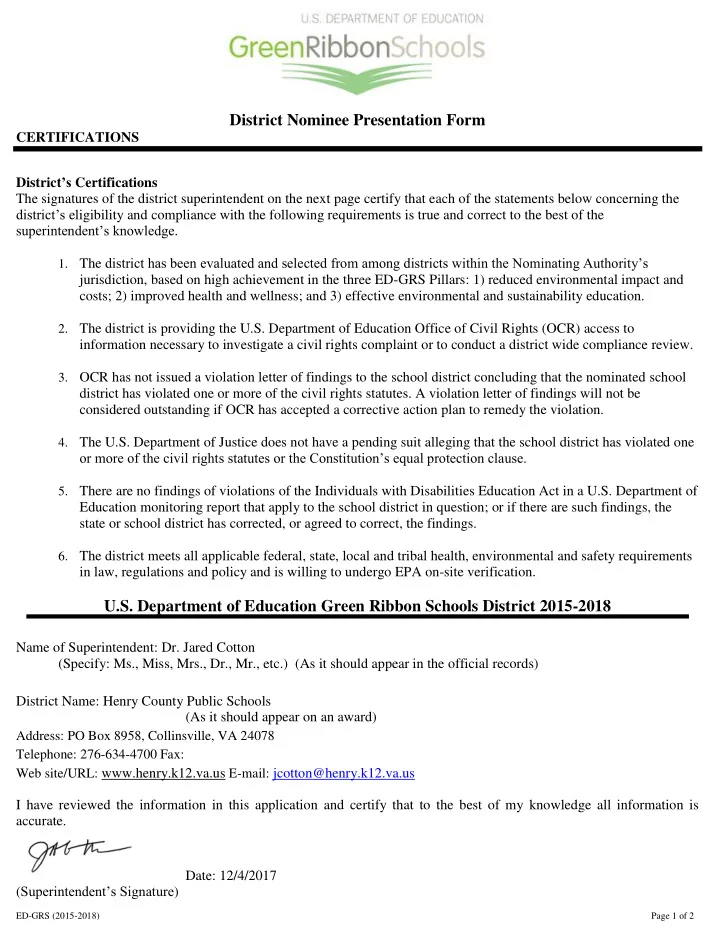
CERTIFICATIONS District’s Certifications The signatures of the district superintendent on the next page certify that each of the statements below concerning the district’s eligibility and compliance with the following requirements is true and correct to the best of the superintendent’s knowledge.

  • 1. The district has been evaluated and selected from among districts within the Nominating Authority’s

jurisdiction, based on high achievement in the three ED-GRS Pillars: 1) reduced environmental impact and costs; 2) improved health and wellness; and 3) effective environmental and sustainability education.

  • 2. The district is providing the U.S. Department of Education Office of Civil Rights (OCR) access to

information necessary to investigate a civil rights complaint or to conduct a district wide compliance review.

  • 3. OCR has not issued a violation letter of findings to the school district concluding that the nominated school

district has violated one or more of the civil rights statutes. A violation letter of findings will not be considered outstanding if OCR has accepted a corrective action plan to remedy the violation.

  • 4. The U.S. Department of Justice does not have a pending suit alleging that the school district has violated one
  • r more of the civil rights statutes or the Constitution’s equal protection clause.
  • 5. There are no findings of violations of the Individuals with Disabilities Education Act in a U.S. Department of

Education monitoring report that apply to the school district in question; or if there are such findings, the state or school district has corrected, or agreed to correct, the findings.

  • 6. The district meets all applicable federal, state, local and tribal health, environmental and safety requirements

in law, regulations and policy and is willing to undergo EPA on-site verification.

U.S. Department of Education Green Ribbon Schools District 2015-2018

Name of Superintendent: Dr. Jared Cotton (Specify: Ms., Miss, Mrs., Dr., Mr., etc.) (As it should appear in the official records) District Name: Henry County Public Schools (As it should appear on an award) Address: PO Box 8958, Collinsville, VA 24078 Telephone: 276-634-4700 Fax: Web site/URL: www.henry.k12.va.us E-mail: jcotton@henry.k12.va.us I have reviewed the information in this application and certify that to the best of my knowledge all information is accurate. Date: 12/4/2017 (Superintendent’s Signature)

slide-2
SLIDE 2

ED-GRS (2015-2018) Page 2 of 2

Nominating Authority’s Certifications The signature by the Nominating Authority on this page certifies that each of the statements below concerning the district’s eligibility and compliance with the following requirements is true and correct to the best of the Authority’s knowledge.

  • 1. The district is one of those overseen by the Nominating Authority which is highest achieving in the three

ED-GRS Pillars: 1) reduced environmental impact and costs; 2) improved health and wellness; and 3) effective environmental education.

  • 2. The district meets all applicable federal civil rights and federal, state, local and tribal health, environmental

and safety requirements in law, regulations and policy and is willing to undergo EPA on-site verification. Name of Nominating Agency: Virginia Department of Education Name of Nominating Authority: Dr. Anne Petersen (Specify: Ms., Miss, Mrs., Dr., Mr., Other) I have reviewed the information in this application and certify to the best of my knowledge that the school meets the provisions above. Date: February 23, 2018 (Nominating Authority’s Signature) SUBMISSION The nomination package, including the signed certifications, narrative summary, documentation of evaluation in the three Pillars, and photos should be submitted online according to the instructions in the Nominee Submission Procedure. OMB Control Number: 1860-0509 Expiration Date: March 31, 2018 Public Burden Statement According to the Paperwork Reduction Act of 1995, no persons are required to respond to a collection of information unless such collection displays a valid OMB control number. The valid OMB control number for this information collection is 1860-0509. Public reporting burden for this collection of information is estimated to average 37 hours per response, including time for reviewing instructions, searching existing data sources, gathering and maintaining the data needed, and completing and reviewing the collection of information. The obligation to respond to this collection is required to obtain or retain benefit P.L. 107-110, Sec. 501, Innovative Programs and Parental Choice Provisions. Send comments regarding the burden estimate or any other aspect of this collection of information, including suggestions for reducing this burden, to the U.S. Department of Education, 400 Maryland Ave., SW, Washington, DC 20202-4536 or email ICDocketMgr@ed.gov and reference the OMB Control Number 1860-0509. Note: Please do not return the completed ED-Green Ribbon Schools application to this address.

slide-3
SLIDE 3

ED-GRS (2015-2018) Page 3 of 2

Summary Narrative/Abstract Henry County Public Schools (HCPS) serves 7100 students in preschool through grade 12 in Henry County, Virginia. An economically disadvantaged locality of 384 square miles in southwestern Virginia, Henry County is a rural setting. HCPS believes all students and staff must be good stewards of the environment and the school division’s financial

  • resources. HCPS embraces energy conservation and recognizes that minimizing energy consumption and related costs

will maximize funds available for use in the classroom. HCPS’s program extends beyond the energy conservation and facilities management; our program is designed to include all facets of an environmentally responsible division to include the health and safety of both students and staff, a robust environmental education program, and community

  • utreach.

Henry County Public Schools has a comprehensive approach and demonstrated progress towards each of the Green Ribbon School award program goals. An established energy conservation program with short- and long-range strategies to reduce energy consumption has been in place since 2009. Energy monitoring and reporting of consumption and cost to engage the community in supporting the energy conservation efforts of the division has resulted in each Henry County school receiving an Energy Star rating for its reduction in electric consumption, which has been earned annually by each of the division’s fourteen schools for the last nine years. The addition of solar panels at one of the middle schools not only supports energy initiatives, they also provide a platform for educating students in the use of alternative energy and are an integral part of the middle school science instruction. Practices are also in place to ensure that the HCPS facilities are both sustainable and safe for students and staff. To promote a safe, healthy learning environment and to complement the energy management program, each campus annually reviews and adheres to the preventive maintenance and monitoring plan administered by the campus physical plant for its facilities and systems, including HVAC, building envelope, water quality and conservation, chemical safety, and moisture management. In addition to facility improvements and ongoing efforts to enhance the comfort of each student’s learning environment through elimination of allergens, HCPS also recognizes healthy behaviors of students and staff as vital to the success of the school’s instructional program. HCPS has high standards for nutrition and fitness in order to improve student and staff health, attendance, and achievement and encourages staff participation in the division’s wellness program. The use

  • f local produce as well as site grown vegetables enables schools provides students and teachers with fresh produce as

well as serving as a platform for instruction. Raised garden beds and greenhouses are located at schools throughout the division and serve as a source for environmental instruction. Each of the schools in HCPS meets all of the requirements for the USDA Healthier US School Challenge and has received the Silver Award level based on the schools’ menus and level of student participation. The division has also recently been awarded the Dorothy McAuliffe School Nutrition Award for going above and beyond by operating all available federal child nutrition programs and achieving significant participation in the school breakfast program. Environmental and sustainability education are an anchor in Henry County Public Schools’ curriculum. In addition to career and technical courses focused on green career pathways and STEM, all students participate in performance tasks embedded with environmental and sustainability standards. HCPS prepares students to be responsible stewards of their environment through its focus on environmental education, green career pathways, and STEM opportunities, as well as through collaborative community-centered initiatives that include habitat preservation, environmental awareness, and practical support for local outdoor attractions through cleanups and conservation campaigns. One particular cohort at Warrior Tech Academy is working to implement sustainable communities within the area. The team of students and their instructors have partnered with the local parks service to fortify bee and insect habitat shelters as well as to develop community gardens. The renewal of resources aspect of their project is paired with school-based recycling and environmental PSA efforts that are encouraging action from local civic groups as they work to partner with the student

slide-4
SLIDE 4

ED-GRS (2015-2018) Page 4 of 2

teams to enhance sustainability in the neighborhoods around the school. The division’s focus on environmental sustainability was recently recognized by the Virginia School Boards Association with the highest honor in the Green Schools Challenge and has led to the locality’s increased environmental awareness through participation in the Green Government Challenge. Crosscutting Questions HCPS benchmarks progress in energy efficiency and sustainability in each of the three Green Ribbon School pillars annually:

  • 1. Reducing environmental impact and cost: Cenergistics support, ENERGY STAR Portfolio Manager, water usage

and school-based recycling data, and annual energy audits and reporting

  • 2. Improving the health and wellness of students and staff: Local trail/parks system participation, partnership with

community wellness centers, staff wellness incentive system, and student illness and nurse visit data collection

  • 3. Providing effective environmental and sustainability education based on sound science and civics:

Environmental course offerings, standardized test scores, and school community horticulture partnerships Recognitions related to the Green Ribbon school pillars include Energy Excellence Award for Energy Savings (2011), Energy Excellence Award for Environmental Savings (2012), US DOE Green Ribbon School – Magna Vista High School (2013), US DOE Green Ribbon School – Bassett High School (2015), Virginia Energy Efficiency Council award (2016), annual Energy Star Excellence Rating – all schools (2010-2017), and annual Virginia School Board Association Green Schools Challenge Platinum Certification (2012-2017). Goal Area 1: Reducing Environmental Impact and Costs Element Henry County Public Schools (HCPS) adopted a division-wide Energy Management Conservation Policy in September 2008, partnering with Energy Education (now known as Cenergistics) to begin the program. The division embraces energy conservation and believes it to be our responsibility to ensure that every reasonable effort is made to conserve energy and natural resources while exercising sound financial management. We recognize the importance of adopting an energy management and conservation policy in order to govern this program. We also affirm the implementation of this policy will be the joint responsibility of the board, administration, faculty, staff, students, and support personnel. Success is based on cooperation at all levels. 1A: Energy Savings and Efficiency Accurate records of energy consumption and cost are maintained at each campus to provide verifiable performance information to the Board and Administrations of the various institutions in HCPS on the goals and progress of the energy conservation program. The designated campus Administrator is accountable for energy management on his/her campus with energy audits being conducted and feedback provided by the Energy Coordinator.

Figure 1: Energy Savings From 2009 to 2017, Henry County Public Schools’ cost avoided savings totaled $4,155,718.36 which equates to a savings of 27%.

slide-5
SLIDE 5

ED-GRS (2015-2018) Page 5 of 2

To ensure the overall success of the energy management program, the following specific areas of emphasis have been adopted: Cenergistics administers the HCPS energy conservation and management program through the Cenegistics teams and Administrators; The Board expects all personnel at each campus to make a positive contribution to maximize energy conservation and produce real energy savings; and Administrative “Energy Guidelines” have been adopted that define the “rules of engagement” in implementing the division’s energy program. To promote a safe, healthy learning environment and to complement the energy management program, each campus annually reviews and adheres to the preventive maintenance and monitoring plan administered by the campus physical plant for its facilities and systems, including HVAC, building envelope, and moisture management. The School Board embraces energy conservation and desires for the district to become a nationwide institutional leader in energy management and conservation as part of our social responsibility to respect our natural resources. The Board has implemented a comprehensive, people-based conservation program across the district. The Superintendent and his staff annually implement short and long term strategies to maximize energy conservation. HCPS uses EnergyCAP to track energy and greenhouse gas data, target reduction goals, benchmark buildings, submit to ENERGY STAR, measure and verify energy savings, streamline utility bill processing and auditing, create budgets and forecasts, and to track energy usage. A report is generated monthly and distributed to all stakeholders. The report details cost savings, energy costs, energy usage, cumulative greenhouse reduction, and cumulative energy savings. CO2 emissions are evaluated annually. Utilities are monitored daily, and, through the diligent efforts of energy coordinators at each site, HCPS has been able to increase savings every year since our initial baseline in 2008. In an effort to assure objectivity and fairness, HCPS uses industry leading energy tracking software that has become the accepted method of measurement and verification of utility savings. This software utilizes the mathematical concept of correlation-regression analysis so that you can compare “apples to apples” by recognizing changes in our organization’s energy consumption that are due to differences in billing periods, weather, square footage, equipment change or utility rates. The correlation-regression analysis that the division’s energy accounting provides gives a scientific comparison of what our cost would have been for the current period without our energy management program compared to actual costs are for the same period with our energy management program. Practically, we know that solar panels are reducing energy consumption at Laurel Park Middle School by 12 percent. AEP’s (the school division’s electrical power provider) current integrated resource plans (IRP) show that through 2030, a majority of our resources will encompass renewables and energy efficiency. As technology advances, we envision universal solar or wind projects that incorporate low-cost energy storage to minimize or smooth intermittency on the

  • grid. AEP is forming strategic partnerships to build upon their expertise and offer more choices to customers like our

school division.

Figure 2: Energy Usage HCPS has shown a 26% reduction in energy use and saving since the beginning of the division’s energy conservation program in 2009.

slide-6
SLIDE 6

ED-GRS (2015-2018) Page 6 of 2

1B: Improved Water Quality, Efficiency, and Conservation HCPS has replaced all mulch in the flowerbeds with brick chips, which are equal to mulch in ability to regulate moisture and temperature levels in the soil, but does not rot, decay, or decompose over time. The fact that stone does not need to be replaced each year helped reduce

  • perations costs and cut down on emissions by not driving large trucks to each site every year. One of the largest

benefits realized in replacing mulch with stone helped was facility pest management control because stone does not attract insects like mulch does. Additionally, HCPS has put forth efforts to reduce our water usage, including: Our horticulture program recycles their water for irrigation; Axton Elementary collects rain water for irrigation of their plant beds; A well was installed to help with irrigation on the football field at Bassett High School; and low maintenance plants that require little watering (such as knock-out rose bushes, Liriope Spicata, and golden globes) are installed as facility aesthetics are considered each season. In 2017, HCPS improved school surfaces by working with student service organizations to add new flowerbeds at Axton Elementary with new brick chips and low maintenance flowers, adding new flowerbeds to George Washington Carver Elementary and Drewry Mason Elementary with new brick chips and low maintenance flowers, adding new flower beds at Fieldale-Collinsville Middle School with new brick chips and low maintenance flowers, adding grass seed and fertilizer to several schools to help reduce muddy water run-off, and improving several sites’ storm water run-off ditches so the flow is much more efficient. Matting has also helped reduce muddy areas along with rip-rap material for clean run-off. Additionally, our custodial services company has a plan that after each outdoor school event, debris is quickly removed from the grounds and local churches have used their “Give back to the community” events to plant additional trees on several of our sites. HCPS has a very close working relationship with the Henry County Public Service Authority. This group performs regular tests on the water sources serving our schools and provides written water quality reports to our Facilities Maintenance Department. The division has also partnered with Lowe’s to install raised bed gardens for students to maintain and grow vegetables for classroom learning and “farm to table” days in the school cafeterias. Four state-of-the- art greenhouses are used for instruction in teaching students how to run a business. Several schools collect rain water for irrigation to their outside gardens and all of our greenhouses recycle water for irrigation. 1C: Reduced Waste Production Recognizing the importance of protecting the environment, HCPS contracts with paper companies that only purchase paper from environmentally responsible suppliers. Additionally, HCPS has partnered with the County of Henry for waste removal from each school site. The county’s refuse department has recorded approximately 32,000 pounds of waste/week that could potentially be removed from schools as a baseline. Through recycling and scheduling, the division has reduced the amount of waste collected at each facility. Currently 100% of our schools recycle cardboard, 95% recycle paper, 30% recycle plastics, and 1 school recycles aluminum. This recycling program is through a partnership the school system has with a local firm, EMI, which provides carts to hold the material and makes the

Figure 3: Water Usage HCPS has recognized 7.3 % or $77,709 in cost avoided savings for water and sewer to each of our sites.

slide-7
SLIDE 7

ED-GRS (2015-2018) Page 7 of 2

pickup from each site. To help reduce waste during the summer months, refuse pick-up is reduced to biweekly. All middle and high school science teachers have the opportunity to take the Flinn Scientific High School Laboratory Safety Certification Course. This course enable teachers to revisit basic safety practices and learn about new regulations including those pertaining to proper disposal of chemicals and other practices that promote healthy environment. Our Facilities Maintenance Department maintains Safety Data Sheets (SDS) on all chemicals that could be used by this department at any of our sites. There is also chemical storage container located at the maintenance department shop to help with proper inventory, which takes place quarterly. All outside contractors maintain SDS records on site. HCPS partners with the County of Henry to host biannual hazardous waste collection days in the community. This event allows the division and families in the community to properly dispose of waste. HCPS also utilizes a bulb crusher for proper disposal of CFL bulbs. Additionally, the division has a plan in place for recycling shop rags through a partnership with a community-based company. HCPS currently uses Johnson products for cleaning throughout the division because of the company’s philosophy that what makes a product eco-friendly is not necessarily what is in the bottle, but what the product does - reducing water, energy, waste, and transportation. Each division school has its own mixing station. With this type of station, we see a reduction in water usage and confirmation that the right amount of solution is mixed for a clean environment each time. 1D: Use of Alternative Efficient Transportation Though the geography of Henry County does not permit walking/biking to/from school, 86% of students ride a school bus daily. The division also employs an after-school activities bus route for students who participate in athletics so that they may participate in bus transportation rather than having individual drivers pick them up each evening. The transportation team works to regularly assess the most efficient bus routing possible so that buses are not driving excessive miles in transporting students to and from school as well. Each of these practices is helping to minimize air pollution from motor vehicles in our community. Due to state regulations for drivers under the age of 18, the majority of students are not permitted by law to have more than one additional student in their car when driving. Therefore, carpooling is only an option for students who are eighteen years old, though many parents have united to carpool within their neighborhoods for daily travel to and from

  • school. As a rural school division, there are few residences within a mile of each school that would make safely

walking or biking to school feasible for students. Therefore, HCPS is not in an ideal location for the Safe Routes to School Program. School bus drivers and families who utilize the car rider lanes at each school are encouraged to turn their vehicles off while waiting for students to minimize air pollution on school property. This policy is communicated in writing and verbally by the Coordinator for Pupil Transportation at the annual meeting for all bus drivers. 1E: Other Innovative Conservation Efforts Henry County Public Schools has a capital improvement plan in which we prioritize renovations or construction projects that have been identified as a need throughout the division. Since the conception of the energy program each renovation project that has taken place is looked at with the energy conservation in mind such as:  Renovations to the HVAC and Lighting systems at Magna Vista High School helped reduce the energy usage by 30%.

slide-8
SLIDE 8

ED-GRS (2015-2018) Page 8 of 2

 HCPS has been renovating Bassett High School in phases. We are 60% complete with replacing new equipment and lighting and we are already recognizing 12-15% reduction in our energy usage. An example of this renovation was replacing the natural gas fired boilers with more efficient equipment, leading to a 25% reduction in natural gas usage.  All new air handlers and pumps are installed with variable frequency drives. Our building automation system is connected to all new equipment, which allows us remote control for better building optimization.  A plan is in place for upgrading all outside lighting to LED.  Upgrades to gym lighting has taken place at both High Schools.  All equipment being installed during the construction of Meadow View Elementary is the highest efficiency. For example, all air handlers will employ Bi-Polar Ionization air purification technology for reduction of outside air, which results in energy savings.  Each of our schools’ building automation system is on one centralized web-based system that can be accessed from any location. This allows for better control of our facilities.  We have replaced six roofs, replacing the old ballast-type with new EPDM black roofing material with tapered increased insulation.  We have upgraded several restrooms with either waterless urinals or low flow toilets. We have also standardized push-lever faucets that only allow the water to run for a pre-set amount of time when the students are washing their hands.  Installed well to help with irrigation of the football field at Bassett High School. HCPS leaders have found that we have roughly 55% heating days and 45% cooling days in our area, which makes it more beneficial for HCPS to utilize black EPDM roofing material (versus white material). To increase the R-Value of insulation, black rubber roof material is used to help hold the heat in the building, which, in turn, reduces our carbon footprint by reducing boiler operation at each site. HCPS always looks for the Energy Star labels when making miscellaneous purchase within our buildings such as appliances and computer monitors. In partnership with Public Safety, HCPS opens school facilities for cooling centers to help our communities prevent heat related illness and deaths during the extreme heat of the summer months. Additional conservation initiatives include:  Strengthening the division’s 100% renewable energy portfolio by executing a 12-year virtual power purchase agreement (VPPA) for 25 megawatts of wind power from Southern Company subsidiary Southern Power’s Grant Plains Wind Facility  Expanding end-of-use services—helping school community members with their own sustainability goals and diverting millions of tons of furniture from the landfill  Doubling volunteering to over 38,000 hours of people making a difference in the school community  Driving down our VOCs, water and waste, making progress on our ambitious 2020 goals  Moving all files to a paperless system and employing a “hire to retire” employee e-portfolio system  Utilizing BoardDocs and web-based services for the School Board to share information with the public and with

  • ne another

 Partnering with Public Safety to implement the IconicID system in the community to aid in the event of an emergency  Utilizing electronic communication platforms to reduce the amount of paper sent to families

  • Peachjar paperless flyer solution
slide-9
SLIDE 9

ED-GRS (2015-2018) Page 9 of 2

  • School Messenger notification system and electronic report card distribution

 Replacing traditional textbooks in grades 2-9 with iPads (administrators are doing staff evaluations using this technology as well) and employing BYOT1 initiatives in the division’s two high schools to make OERs more readily available to students Goal Area 2: Improving the Health and Wellness of Students and Staff Henry County Public Schools currently follows a pest management plan, which focuses on non-chemical methods with the goal to keep the schools pest-free. The program involves setting up glue boards and monitoring devices in each facility, monthly visits to monitor any potential activity, and providing facilities supervisor reports with recommendations of next steps. If a pest problem is detected, non-toxic methods of pest prevention are always used first. HCPS facilities are all smoke-free properties (this policy2 also includes inside of motor vehicles on the property). The school district’s Facilities Maintenance Department annually performs inspection on all HVAC equipment along with running combustion analysis on each piece of equipment for proper operation. CO in each school’s boiler room is regularly monitored and testing has been performed within compliance guidelines. HCPS regularly inspects fuel burning combustion appliances as well. All potential airborne contaminant areas have exhaust fans, which are inspected regularly for proper operation. HCPS is currently completing a renovation project which includes updated exhaust fans for proper ventilation of the building at Bassett High School and is installing a state-of-the-art ventilation system throughout its school under construction, Meadow View Elementary (set to open in August 2018). Each of the division’s schools has identified and properly removed all sources of elemental mercury and prohibits its purchase and use in the school, as well as ensuring that ventilation is correctly circulating outside air to areas such as chemical storage rooms, copy/printing facilities, art rooms, science labs, and career and technical education labs. HCPS strives to limit a student's contact with all offending allergens. For instance, the school nurse discourages teachers from using scented plug-ins in classrooms for students who have allergies and discourages teachers taking students

  • utside when pollen is at its peak. For students who have problems with perfumes, the school nurse occasionally asks

teachers/students to refrain from wearing colognes/perfumes. To minimize food allergies, HCPS does not serve products with tree nuts and peanut butter has been replaced with sun butter. For students with a known allergen to peanuts, classmates are discouraged from bringing items with peanuts to school. Signage is easily visible and communication with classroom families is conducted regularly to ensure the safety of all students. All Henry County schools are now “latex-free” schools because there are numerous students and staff who are allergic to latex - including band-aids, blood pressure cuffs, and stethoscopes. Each school nurse has a peak flow monitor that is used for students with asthma, which quickly identifies a student’s aspiration volume. The school nurse strongly encourages students to keep their inhalers with them at all times instead of in the nurse’s office. Since August 2012, all Henry County schools have an adult and pediatric Epi-Pen injector for the emergency management of students with an allergic reaction. It is strongly encouraged for all students who have asthma symptoms related to an allergic reaction to have their own Epi-Pen for field trips and afterschool activities. For students who are having serious asthma issues due to weather, environment, etc., the school nurse assists the students with prescribed

1 https://www.henry.k12.va.us/Page/14702 2 http://www.boarddocs.com/vsba/hcps/Board.nsf/goto?open&id=9MHJHR4CFC9E

slide-10
SLIDE 10

ED-GRS (2015-2018) Page 10 of 2

nebulizer treatments at school. Each school in the division utilizes an energy management system to insure proper indoor air quality when the building is occupied. The school district’s Facility Maintenance Department performs quarterly inspections of units when changing air filters to ensure visible coils and air ducts are free from dirt and debris. As capital improvement funds are available, HCPS works to upgrade the systems in each of its schools – the youngest of which is 31 years old. That school’s (Magna Vista High School) heating and cooling system was upgraded in 2011, which allows the school to better control outside air intake and better air exchanges by controlling outside air dampers on rooftop units and controlling exhaust fans. Bassett High School is currently undergoing a multi-phase renovation of its HVAC and lighting systems to ensure that its environmental atmosphere is also appropriately managed. Each of the division’s schools’ energy management systems (EMS) controls the heating and controlling systems and monitors CO2 levels in critical areas to increase outside air intake when needed. At other times, units are set at a minimum outside air intake based on the engineers design. The custodial staff at each school inspects for leaks in ceilings on a daily basis and reports to the school district’s Facilities Maintenance Department. If a leak is detected, new ceiling tiles are installed immediately. All piping is properly insulated and the energy management system helps with the control of humidity in the building; the division’s Energy Manager also monitors humidity manually during routine on-site visits. In addition, HCPS monitors humidity in each school with a set point of 55% at which point the EMS will put the system into dehumidification control when

  • necessary. Maintenance staff and school administrators are able to monitor this system remotely. HCPS also has a third

party environmental testing company under contract for routine monitoring in each school. 2B: Nutrition and Fitness Efforts Each of the schools in HCPS meets all of the requirements for the USDA Healthier US School Challenge and has received the Silver Award level based on the schools’ menus and level of student participation. The division has also recently been awarded the Dorothy McAuliffe School Nutrition Award for going above and beyond by operating all available federal child nutrition programs and achieving significant participation in the school breakfast program. The division’s nutrition website3 makes important nutrition, fitness and wellness information available to families on the go via a downloadable mobile app. HCPS purchases fresh produce from a local vendor who procures products locally. The vendor also ensures that HCPS

  • btains "Virginia Grown" products for "Farm to School Week" each year (apples was the produce of choice for 2017).

Thanks to a partnership with Lowe’s, each of the ten HCPS elementary schools has a raised-bed garden on site, most of which grow vegetables for sharing in the school cafeteria. Sanville Elementary, Fieldale-Collinsville Middle, Laurel Park Middle, and Magna Vista High School each operates its own greenhouse. Bassett High School’s greenhouse will be constructed in June 2018 to begin operation in the fall. Under the guidance of its wellness committee (comprised of division staff, community members, students, and local physicians), HCPS has recently adopted an updated wellness policy4 and accompanying regulation5 that details standards for school feeding programs, wellness activities for staff and students, and general health philosophies that will be promoted within the division. Students in grades pre-K-10 discuss proper nutrition in Health classes. Secondary students also study nutrition in Biology, Nutrition, Culinary Arts, and advanced Physical Education courses. Skin health

3 http://www.henrysnp.com/index.php?sid=1205151512096397 4 http://www.boarddocs.com/vsba/hcps/Board.nsf/goto?open&id=AK4SUB71845A 5 http://www.boarddocs.com/vsba/hcps/Board.nsf/goto?open&id=AMWG3Q41DF6D

slide-11
SLIDE 11

ED-GRS (2015-2018) Page 11 of 2

is part of the health and wellness curriculum provided in pre-K-10 Health classes, as well as in secondary Biology

  • classes. HCPS uses Fitness Gram standards and assessments to measure physical fitness levels in all physical education

students and charts their progress and teachers are implementing the use of WELNET to gather student fitness data. Physical Education classes center their curriculum on the five components of fitness, ensuring students’ understanding

  • f fitness and health concepts, tracking students’ health-related habits and behaviors, supporting student goal setting,

and achieving their personal goals/outcomes. HCPS students in grades 8, 10, and 12 participate in the Youth Risk Behavior Survey6 and the results of this healthy choices survey are shared with the community in conjunction with the work of the division’s partner Piedmont Community Services, who uses the data to devise programming for students. Current partner programs include CHILL and SODA for students and parent academies that highlight areas of necessary awareness, including the region’s opioid crisis and “Hidden in Plain Sight” substance abuse awareness workshops. Each Henry County school has multiple during and after-school activities that students can participate in including physical education classes, organized sports, a Physical Activities Club, Archery Club, Get Outside Club, the Go Far and Girls on the Run Clubs, and the JROTC Raider Club. The organized sports that are offered include football, cross country, golf, track and field, baseball, softball, tennis, swimming, and soccer. Additional opportunities for recreation and outdoor education are also offered by a community partner, MHC-After 3, and through the local Boys and Girls

  • Club. These agencies provide afterschool and summer opportunities to HCPS students. The division also encourages

students to take advantage of local partnerships with the Parks and Rec trail and youth athletics services, Upward Basketball programming, and soccer and field hockey offerings provided by Smith River Sports Complex. The division also operates a summer activities camp for students in grades 4-8, during which students devise nutrition and activity plans for themselves and measure their growth and progress throughout the eight-week program. HCPS is self-insured. Part of this program includes wellness incentives for staff members who demonstrate improved lifestyle habits over time. Each month’s staff newsletter7 includes wellness tips – a monthly staff wellness challenge was initiated beginning in December 2017 as well. The local YMCA and a locally owned gym – Gym 24 – offer discounts and special promotions for HCPS staff and students who participate in activities with these businesses. The local health and wellness coalition community college offers healthy living and activity courses (ballroom dancing, yoga, etc) at a discounted rate for staff as well. Additionally, the health department provides free screenings for staff members (cholesterol, blood pressure) and free annual flu shots for staff members to reinforce healthy habits. HCPS’s Safe & Orderly Learning team works with Henry County Public Safety to coordinate drills and safety recommendations for each school, engaging the school community in preparedness drills as often as possible. The division recently collaborated with ProTint to outfit many of the division’s schools with safety film for outer windows

6 https://research.k12insight.com/zRMx/Bar_graph.aspx?share=GXF9B7Z9D 7 https://hcpsinthespotlight.blogspot.com Figure 4: Wellness Assessment The majority of staff members are participating in an optional wellness assessment program and wellness challenges to promote healthy lifestyles for working professionals in the community.

slide-12
SLIDE 12

ED-GRS (2015-2018) Page 12 of 2

and doors to mitigate broken glass injuries and reduce visibility into classrooms during crises and drop down shades for use in classrooms during lockdown drills. HCPS supports the MyPlate program and USDA Dietary Guidelines through the food nutrition program. Fitness gram standards and self-assessment are demonstrated by students in all physical activity settings. Students use a variety of resources, including technology, to analyze, assess, and improve physical activity, food nutrition, and personal fitness. The division also promotes regular Rethink Your Drink campaigns during in-school and family events to encourage healthy choices for students and their families. Students participate in Jump Rope for Heart and Hoops for Heart campaigns to raise awareness and support the efforts

  • f the American Heart Association. Several schools’ staffs also participate in supporting American Heart Association by

participating in the Wear Red campaign. The division’s participation in promotion of heart-healthy ideals led AHA to award HCPS the Excellence Award for the region in 2016. There is a full-time nurse on staff at each secondary school. Additionally, each elementary school has a Health Office Assistant on staff full-time and the division employs a School Nurse Coordinator who oversees First Aid/CPR, AED, and other training for staff and students and healthy initiatives for the district. The division’s nursing team also provides health screenings for the school community at local festivals and events using their mobile clinic and assists local

  • rganizations in properly disposing of medications through a drug takeback program, which now includes drop off

boxes in area law enforcement offices and at the community’s hospital. HCPS is proud to partner with Piedmont Community Services to provide mental health and family preservation counselors in each of the division’s schools. Additionally, programs such as CHILL and SODA allow students to provide peer guidance and counseling to one another. The division has also recently begun the VTSS/PBIS journey, implementing positive behavior supports in three schools. Each school K-12 participates in Red Ribbon Week, part of the division’s anti-bullying campaign during the month of October as well. To provide both staff and students a secure method for reporting concerns (bullying or otherwise), the division employs Let’s Talk, which can be accessed 24/7 to provide information, ask questions, or share concerns with division leaders so that the school community has the support it needs for optimal daily engagement in the learning environment. Goal Area 3: Providing Effective Environmental and Sustainability Education Henry County Public Schools is known for its solid technology infrastructure, which was pioneered with sustainability and resource conservation in mind. School-wide use of technology such as laptops, iPads, Apple TVs, and interactive white boards has reduced paper consumption at all schools. To offset energy consumption of these devices, staff members power them down when not in use. Each school utilizes laptop carts and iPad carts with time clocks. When the teacher returns the carts to the designated location, the cart is plugged in and all devices charged for a pre-set time period. The division currently has 7100 students and 650 staff members. The technology inventory for HCPS includes iPads, laptops, interactive whiteboards, personal response systems, Nooks, Kindles, document cameras, SWIVL cameras, Apple TVs, and classroom audio management systems, all of which contribute to student and staff awareness of the critical importance of conservation of natural resources and responsible use of energy-efficient tools through the training students and their families receive on the care of the devices used in daily instruction. 3A: Shared Responsibility for Environmental Learning Much of Henry County Public Schools’ science curriculum addresses environmental literacy. For example, the Earth Science curriculum emphasizes environmental costs and benefits of renewable and nonrenewable resources, effects of

slide-13
SLIDE 13

ED-GRS (2015-2018) Page 13 of 2

human usage on water quality, economic and public policy issues concerning the Chesapeake Bay, and changes to the atmosphere and climate due to human, biologic, and geologic activity. The Biology curriculum includes an entire strand devoted to dynamic equilibria within populations, communities, and ecosystems. In particular, the effects of natural events and human activities on ecosystems is addressed through focused student research projects that are shared with the school community in a capstone symposium. Environmental Science courses emphasize that human survival depends on developing practices that will achieve sustainable systems. Environmental and sustainability concepts are also integrated into the JROTC program and the Government/Civics curriculum at the secondary level. Elementary students participate in integrated English and Science experiences that emphasize environmental literacy. Each of the division’s eighteen sites (including offices and programs) practices recycling and daylighting techniques, which students regularly monitor for conservation and efficiency data measurement. Students in Henry County Public Schools have demonstrated proficient and advanced levels on assessments related to environmental and sustainability concepts. Results from classroom assessments, VA Standards of Learning assessments, and Career and Technical Education certification assessments show that the majority of students have a solid understanding of environmental and sustainability concepts. Additionally, the division has begun implementing performance tasks and senior capstone projects. Approximately 1/3 of these are related to environmental literacy and

  • preservation. HCPS partner programs such as Piedmont Governor’s School, Academy for Engineering Technology,

PHCC’s Motorsports program, and the IDEA academy all also participate in environmental literacy education by providing students with experiment and project opportunities to enhance their knowledge. Through a Virginia Department of Mines, Minerals and Energy grant, Henry County Public Schools has solar panels installed on a middle school campus for students across the county to use in energy studies. All middle school science and CTE teachers were trained in the National Energy Education Development (NEED) Solar Energy Curriculum in June

  • 2010. Through hands-on instruction with NEED curriculum kits, students have an in-depth experience with solar energy

as an alternate energy source. One of the goals of this project is to expand this training and curriculum work with solar panels to other schools in the district. In addition, all secondary school science teachers have completed the Flinn Laboratory Safety Certification Course. This course enables teachers to revisit basic safety practices and learn about new regulations including those pertaining to proper disposal of chemicals and other practices that promote a healthy environment. Pacing guides devote sixteen percent of instructional time to environmental content in Earth Science and Biology

  • courses. Environmental literacy and sustainability is addressed throughout Environmental Science courses. Career and

technical courses include programs such as Project Lead the Way (PLTW), which includes components pertaining to green engineering. In addition, agriculture and horticulture projects include sound environmental practices. 3B: Use of the Environment to Develop Science, Technology, Engineering, and Mathematics Content While sustainability and the environment are not currently the focus of the curriculum, the content area is being integrated into the inquiry/project-based learning that is being implemented in HCPS. This has been piloted in our Warrior Tech Academy (a New Tech Network school-within-a-school at Magna Vista High School) with marked success. The New Tech academies at Bassett High School and Magna Vista High School, the first in the state of Virginia, are engaged with several districts across the state and NTN schools around the country to re-imagine teaching and learning across entire systems. Together, through these district engagements, we are learning how to re-shape and innovate a broad ecosystem and ensure the integration of critical STEM and citizenship skills in all students. One particular cohort at Warrior Tech Academy is working to implement sustainable communities within the area. The team of students and their instructors have partnered with the local parks service to fortify bee and insect habitat shelters as well as to develop community gardens. The renewal of resources aspect of their project is paired with

slide-14
SLIDE 14

ED-GRS (2015-2018) Page 14 of 2

school-based recycling and environmental PSA efforts that are encouraging action from local civic groups as they work to partner with the student teams to enhance sustainability in the neighborhoods around the school. Several Career and Technical Education courses emphasize environmental sustainability. For example, in Architectural Drawing & Design, students build a model of a garage via CAD and Revit software and incorporate green technology into their design. Agriculture and horticulture courses also focus on natural resources and environmental systems. In particular, Introduction to Natural Resources and Ecology Systems and Forestry Management courses enable students to study environmental issues in great depth Curriculum is standards-based and age-appropriate. Environmental science standards spiral, K-12, so that students are working with concepts and developing skills necessary to deepen their understanding of and appreciation for the environment. Initiated by a MWEE grant, seventh grade students at Laurel Park Middle School, conduct macroinvertebrate studies of Leatherwood Creek running through the school campus. These studies incorporate analysis of biological health of waters and discussion of the impact of human activity on food chains that ultimately affect trout being raised in schools throughout the district. At Magna Vista and Bassett High Schools, these students continue to study water quality through environmental curriculum strands and continuation of Trout in the Classroom. The horticulture and agriculture teachers have developed outdoor learning facilities which enable students to practice real-world environmental sustainability skills through projects. For example, outdoor gardens and animal corrals are maintained by students at each of the division’s elementary schools and three of the four secondary schools (as well as one

  • f the elementary schools) has its own greenhouse space for environmental education. Horticulture students at Magna

Vista High School have been recognized nationally for their innovative practices and community education efforts regarding proper irrigation and environmental responsibility in plant and animal care. HCPS partners with the Dan River Basin Association (DRBA) on Trout in the Classroom; New College Institute and Patrick Henry Community College on STEM course offerings and onsite work visits for students to provide relevance to the classroom; Patrick Henry Community College on Advanced Placement and Dual Enrollment courses providing STEM and environmental/sustainability curriculum; and the Virginia Museum of Natural History in a variety of ways including educational outreach and field trip programming focused on environmental sustainability. Additionally, Streamside Trees in the Classroom (STIC), began in 2012. This program incorporates vegetation as an integral component of trout habitat. Students plant and monitor trees that will be planted alongside local streams and rivers to provide natural buffering. Magna Vista High School has STIC tanks in both the science and Career and Technical departments, and students utilize these environments as they prepare for forestry courses and club content. Elementary students in HCPS are integrating STEM into everyday activities and lessons through co-taught STEM lessons to ensure that students are experiencing enhanced maker space opportunities, learning to code, and using technology such as Osmos, LEGO We Do, Sphero, Lil Bits, and Raspberry Pi in curricular application. The integration of STEM inquiry and problem-based learning for students in environmental literacy paths of study is leading them to discovery and innovative problem-solving that is enhancing their engagement in developing critical life skills. 3C: Development and Application of Civic Knowledge and Skills One of the requirements to become a Graduate of Distinction in HCPS is to be involved in 20 hours of civic/community engagement projects per school year during high school. This requirement has become a graduation requirement for all HCPS

slide-15
SLIDE 15

ED-GRS (2015-2018) Page 15 of 2

seniors as the division continues to strengthen its focus on the 4Cs (communication, collaboration, creativity, critical thinking) in curricular development, as well as including the critical need for citizenship and character development for every student. Clubs such as FFA, BETA, and HVAC have provided environmental education activities for members of the community at local festivals, school division “meet us at the park” days, and STEM nights at our local elementary

  • schools. The division also employs student volunteers to run its annual #projectprom, which encourages reuse of prom

attire for high school students by providing a community-wide free shopping event for prom goers using donated dresses and accessories. ROTC cadets and National Honor Society members participate in the Adopt a Highway program, in which they work with community members to keep highways near each school clean as well as working in conjunction with Dan River Basin Association to keep area riverbanks clear of debris. The groups also work to clean the area’s 8-mile walking trail – The Dick and Willie Trail. Each of these groups works in conjunction with science, math, and social studies classes to research best practices, implement marketing programs for participation, and analyze statistical data for comparative analysis from clean-up to clean-up. Several student organizations coordinate recycling efforts for paper products, cell phones, and eye

  • glasses. The phones are recycled through the Hope Phones organization. Student groups have also worked to collect used

shoes for repurposing in Haiti and collecting jeans for reuse. As each school library replenishes their stock of books and magazines, “discard” materials are shared with the community through Free Little Libraries set up in seven locations around the county. This implementation at key sites in the community is inspiring students and their families to share other items and consider waste in other ways as well. Students are now participating in repurposing projects, helping to “flip” homes, and achieving honors in competitions like the DECA IDEA challenge, which tasks participants with reusing/repurposing everyday items for innovative use. 3D: Other Innovative Environmental Education Efforts HCPS has largely adopted a paperless philosophy, which includes use of a variety of technology in the classroom and around the school. Students, staff and family members undergo training on the purpose for using technology vs. paper and participate in educating peers and visitors to the building on the environmental benefits of a paperless school. New this year to the division is the IdentAKid visitor management system, which is ensuring the safety and privacy of visitors in electronic fashion (rather than using paper visitor logs). Through the ever-evolving and innovative ideas of staff and student leaders, HCPS is ensuring that its graduates enter the world prepared to be good stewards of the community they join. The commitment of students in Henry County to continue to design ways to “make the world a better place” is a catalyst for division leaders as they continue to develop

  • pportunities for learners to think critically about environmental issues and how they might resolve them.