Schedule 2019 Virtual Genealogy Fair # T IME (ET) S ESSION T ITLE - - PowerPoint PPT Presentation

schedule
SMART_READER_LITE
LIVE PREVIEW

Schedule 2019 Virtual Genealogy Fair # T IME (ET) S ESSION T ITLE - - PowerPoint PPT Presentation

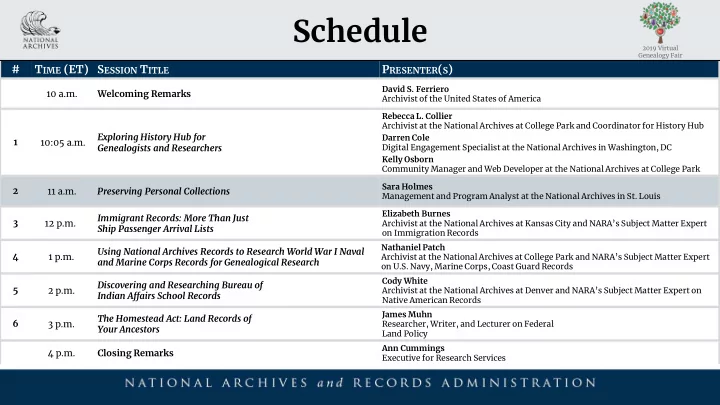
Schedule 2019 Virtual Genealogy Fair # T IME (ET) S ESSION T ITLE P RESENTER ( S ) David S. Ferriero 10 a.m. Welcoming Remarks Archivist of the United States of America Rebecca L. Collier Archivist at the National Archives at College Park


slide-1
SLIDE 1

# TIME (ET) SESSION TITLE PRESENTER(S)

10 a.m. Welcoming Remarks

David S. Ferriero Archivist of the United States of America

1 10:05 a.m. Exploring History Hub for Genealogists and Researchers

Rebecca L. Collier Archivist at the National Archives at College Park and Coordinator for History Hub Darren Cole Digital Engagement Specialist at the National Archives in Washington, DC Kelly Osborn Community Manager and Web Developer at the National Archives at College Park

2 11 a.m. Preserving Personal Collections

Sara Holmes Management and Program Analyst at the National Archives in St. Louis

3 12 p.m. Immigrant Records: More Than Just Ship Passenger Arrival Lists

Elizabeth Burnes Archivist at the National Archives at Kansas City and NARA’s Subject Matter Expert

  • n Immigration Records

4 1 p.m. Using National Archives Records to Research World War I Naval and Marine Corps Records for Genealogical Research

Nathaniel Patch Archivist at the National Archives at College Park and NARA’s Subject Matter Expert

  • n U.S. Navy, Marine Corps, Coast Guard Records

5 2 p.m. Discovering and Researching Bureau of Indian Affairs School Records

Cody White Archivist at the National Archives at Denver and NARA’s Subject Matter Expert on Native American Records

6 3 p.m. The Homestead Act: Land Records of Your Ancestors

James Muhn Researcher, Writer, and Lecturer on Federal Land Policy

4 p.m. Closing Remarks

Ann Cummings Executive for Research Services

Schedule

2019 Virtual Genealogy Fair

slide-2
SLIDE 2

Preserving Personal Collections

Sara Holmes

Audience Skill Level: All

2019 Virtual Genealogy Fair

Personal collections are valued for their importance to understanding family history. Do you know how to best preserve your treasured papers and heirlooms so they can by passed

  • n?

This sessions will provide tips and information on the care and storage of paper, books, photographs, as well as film, audio, and video. Providing the best environment and storage will allow family heirlooms to be available for generations, while understanding proper handling and copying can expand their availability and enjoyment with distant kin.

slide-3
SLIDE 3

Sara Holmes started working at the National Archives in Preservation Programs at St. Louis in 2007. She is currently a Management and Program Analyst, but previously served as a Supervisory Preservation Specialist to oversee conservation work at St. Louis. Before coming to the National Archives, she was a conservator at Texas Tech University and the Missouri State Archives. Ms. Holmes has a Master’s in Library and Information Science with a Certificate of Advanced Study in Conservation

  • f

Library and Archival Materials from the University

  • f Texas and a Master’s in History

from the University of New Orleans. She is also a Certified Archivist and was selected as a member of the first cohort of the Archives Leadership Institute in 2008.

Presenter Biography

Sara Holmes

2019 Virtual Genealogy Fair

slide-4
SLIDE 4

Preserving Personal Collections

1

slide-5
SLIDE 5

Looking at what you have

2

slide-6
SLIDE 6

What you might think a conservator’s personal collection looks like

3

slide-7
SLIDE 7

Reality!

Organizing and housing collections is time- consuming, difficult, and expensive! Don’t expect to tackle everything at once. You can determine your own priorities. Most importantly, you can improve storage even if you don’t have the “right” boxes or housings! 4

slide-8
SLIDE 8

Top Tips: Temperature and Humidity

Avoid storing your materials in basements and attics or near bathrooms and kitchens and in places with

  • High temperatures
  • High humidity
  • Extreme fluctuations in temperature and humidity

5

slide-9
SLIDE 9

Top Tips: Keep Off the Floor!

6

slide-10
SLIDE 10

Top Tips: Pests

7

slide-11
SLIDE 11

Top Tips: Light

8

slide-12
SLIDE 12

Top Tips: Dust

9

slide-13
SLIDE 13

Top Tips: Storage

10

slide-14
SLIDE 14

Good Housings Fully Support

Too large for the folder

11

slide-15
SLIDE 15

Avoid Over-Fill

12

slide-16
SLIDE 16

Watching Out for Problem Materials

Highly acetic materials like news clippings can be isolated from other materials with folders. Some older photo processes may create mirror images on surfaces they are placed against.

13

slide-17
SLIDE 17

Books

14

slide-18
SLIDE 18

Top Tips: Handling Materials

15

slide-19
SLIDE 19

Handling

16

slide-20
SLIDE 20

Photographs/Film

17

slide-21
SLIDE 21

Working with Old Albums

18

slide-22
SLIDE 22

Metal Items

19

slide-23
SLIDE 23

Textiles

20

slide-24
SLIDE 24

Electronic/Magnetic Devices

21

slide-25
SLIDE 25

22

slide-26
SLIDE 26

Making Copies or LOCKSS.org: Lots of Copies Keep Stuff Safe

23

slide-27
SLIDE 27

Digitizing Your Collections 24

slide-28
SLIDE 28

Questions to ask Vendors:

  • 1. Will you do a pilot test?
  • 2. Do you digitize in-house?
  • 3. What file type am I getting

back? (.mp3 for sharing, .wav for archiving)

  • 4. Do you adjust your equipment to

get the best quality product?

25

slide-29
SLIDE 29

Setting Your Own Priorities:

  • 1. Do as much as you can for maintaining a controlled

environment and keeping your collections away from high humidity, temperature fluctuations, or where they may be vulnerable to bugs.

  • 2. Seek to improve boxes, folders, and any additional housings

used -- as much as possible. At a minimum, use clean boxes that have never been wet and seek to isolate materials that may damage other items in your collection.

  • 3. Determine personal priorities for potential reformatting, digitization, and conservation care.
  • 4. Consider contacting cousins to determine if other copies of things you have that are damaged or

in poor condition exist elsewhere. Also consider pooling resources among family for reformatting early films, slides, etc.

26

slide-30
SLIDE 30

Where do I go for help?

www.archives.gov/preservation www.culturalheritage.org Email preservation@nara.gov 27

slide-31
SLIDE 31

Thank you! Questions?

28

slide-32
SLIDE 32

Video recording and handouts will remain available at www.archives.gov/calendar/genealogy-fair

Please stay tuned for the next session.

If we did not get to your question, you may submit it to preservation@nara.gov

Thank you for attending!

2019 Virtual Genealogy Fair

slide-33
SLIDE 33

We value your opinion.

Please take a few minutes to complete a short evaluation. Your comments help us maintain the quality of our services and plan future programs. Click ⇒ Event Evaluation www.surveymonkey.com/r/KYREventEval

Feedback

2019 Virtual Genealogy Fair