Schedule 2019 Virtual Genealogy Fair # T IME (ET) S ESSION T ITLE - - PowerPoint PPT Presentation

schedule
SMART_READER_LITE
LIVE PREVIEW

Schedule 2019 Virtual Genealogy Fair # T IME (ET) S ESSION T ITLE - - PowerPoint PPT Presentation

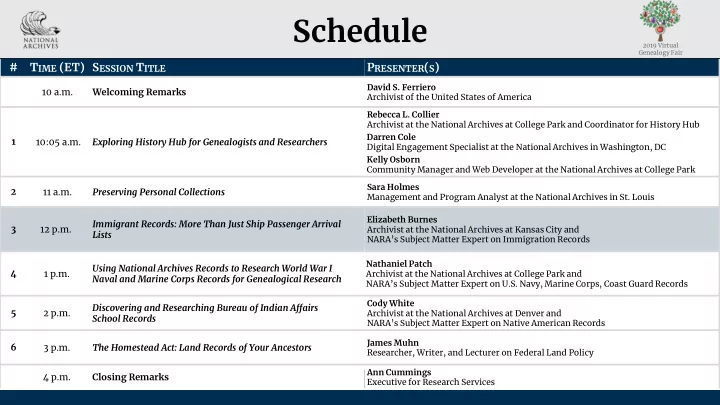
Schedule 2019 Virtual Genealogy Fair # T IME (ET) S ESSION T ITLE P RESENTER ( S ) David S. Ferriero 10 a.m. Welcoming Remarks Archivist of the United States of America Rebecca L. Collier Archivist at the National Archives at College Park


slide-1
SLIDE 1

# TIME (ET) SESSION TITLE PRESENTER(S)

10 a.m. Welcoming Remarks

David S. Ferriero Archivist of the United States of America

1 10:05 a.m. Exploring History Hub for Genealogists and Researchers

Rebecca L. Collier Archivist at the National Archives at College Park and Coordinator for History Hub Darren Cole Digital Engagement Specialist at the National Archives in Washington, DC Kelly Osborn Community Manager and Web Developer at the National Archives at College Park

2 11 a.m. Preserving Personal Collections

Sara Holmes Management and Program Analyst at the National Archives in St. Louis

3 12 p.m. Immigrant Records: More Than Just Ship Passenger Arrival Lists

Elizabeth Burnes Archivist at the National Archives at Kansas City and NARA’s Subject Matter Expert on Immigration Records

4 1 p.m. Using National Archives Records to Research World War I Naval and Marine Corps Records for Genealogical Research

Nathaniel Patch Archivist at the National Archives at College Park and NARA’s Subject Matter Expert on U.S. Navy, Marine Corps, Coast Guard Records

5 2 p.m. Discovering and Researching Bureau of Indian Affairs School Records

Cody White Archivist at the National Archives at Denver and NARA’s Subject Matter Expert on Native American Records

6 3 p.m. The Homestead Act: Land Records of Your Ancestors

James Muhn Researcher, Writer, and Lecturer on Federal Land Policy

4 p.m. Closing Remarks

Ann Cummings Executive for Research Services

Schedule

2019 Virtual Genealogy Fair

slide-2
SLIDE 2

Immigrant Records: More Than Just Ship Passenger Arrival Lists

Elizabeth Burnes

Audience Skill Level: Beginner & Experienced

2019 Virtual Genealogy Fair

The breadth of immigration records available online and in archives can seem overwhelming. This session will identify what original records you can find at the National Archives and what you can discover online. Records discussed will range from passport applications, naturalization documents, passenger arrival lists, and more! Attendees will discover how immigration laws have changed

  • ver time and how the records that exist have been impacted by those

laws; understand the different types of records available through the National Archives; and learn how to get started with research.

slide-3
SLIDE 3

Elizabeth Burnes is an Archivist for the National Archives at Kansas City who serves as NARA's Subject Matter Expert for Immigrant Records and is the lead archivist for Alien Files (A- Files) reference. Prior to joining the National Archives staff she held positions at Harry S Truman National Historic Site, Missouri History Museum, Herman T. Pott National Inland Waterways Library, and Harry S. Truman Presidential Library and Museum. She received a Bachelor’s degree in History at Truman State University, and a Master’s degree in History and Museum Studies at the University of Missouri-St. Louis.

Elizabeth Burnes

Presenter Biography

2019 Virtual Genealogy Fair

slide-4
SLIDE 4

4

Immigrant Records

More Than Just Ship Passenger Arrival Lists

OCTOBER 23, 2019

slide-5
SLIDE 5

5

Objectives

  • Understand how immigration laws have changed over time and how the records that exist have

been impacted by those laws

  • Understand the different types of records available through the National Archives
  • Learn how to get started with your research
slide-6
SLIDE 6

6

Immigration Laws

slide-7
SLIDE 7

7

Immigration Law 1789–1819

  • Customs Bureau oversaw ports starting in 1789
  • Records pre-1819 vary because they were not maintained by one single entity
  • Two exceptions of note:

1) Arrivals at New Orleans, LA, 1813–1819 (M2009, online at Ancestry.com) 2) Arrivals at Philadelphia, PA, 1800–1819 (M425, online at Ancestry.com and FamilySearch.org)

slide-8
SLIDE 8

8

Steerage Act of 1819

  • Until January 1, 1820, the US Government did not require captains or masters of vessels to

present a passenger list to US officials

  • Act was designed to protect passengers arriving from foreign ports against overcrowding and

inadequate provisions 1) Required master of ship to provide a manifest of passengers boarded at foreign port 2) Required each vessel entering the US to carry a specific quantity of provisions for each passenger 3) Each passenger was entitled by law to $3/day compensation if supplies proved deficient

slide-9
SLIDE 9

9

Immigration Act of 1891

  • Created the Office of the Superintendent of Immigration, who oversaw US Immigrant

Inspectors stationed at principal ports of entry

  • Barred polygamists, persons convicted of crimes of moral turpitude, and those suffering from

“loathsome or contagious diseases” (provided for medical examinations)

  • Required information about immigrants entering the US overland from Canada and Mexico

**NOTE: Approximately 40% of the foreign passengers arriving in Canada were bound for the US

slide-10
SLIDE 10

10

  • Imposed national-origins quota
  • State Department issued a limited

number of visas each year

  • Only immigrants who had obtained valid

visas were permitted entry An Act of May 26, 1924, Public Law 68-139, 43 STAT 153, to Limit Immigration of Aliens into the United States for Other Purposes, 05/26/1924 NAID 5752154

Immigration Acts of 1921 and 1924

slide-11
SLIDE 11

11

Immigration Stats

1821–1995 US immigration trends by continent

slide-12
SLIDE 12

12

Immigrant Records

slide-13
SLIDE 13

13

Passenger Arrival Lists

  • Forms change over time
  • Instructions to the collector can be found amongst the records

**NOTE: These can be a valuable tool for understanding notations made by the collector

  • Many lists have been digitized and are available online at Ancestry.com and FamilySearch.org

For more info: https://www.archives.gov/research/immigration/overview

slide-14
SLIDE 14

14

Passenger Lists can record:

Name Height Name and address of closest living relative in US Age Complexion If ever in US prior (when, where, how long) Sex Color of hair Whether in possession of a train ticket to final destination Occupation Color of eyes Who paid passage Able to read & write Place of birth Amount of money the passenger was carrying Identifying marks State of health Whether the passenger had ever been in prison, alms- house, or institution for the insane, or was a polygamist Nationality

slide-15
SLIDE 15

15

Passenger List Research Tips

  • TIP: Read passenger lists from back to front (last page to first page)
  • TIP: Port names are often misremembered as the name of the ship (Example: SS Bremen,

Hamburg, or Rotterdam)

  • TIP: If you aren’t sure what name an individual used, check “last residence” and “destination”

columns to narrow options

  • TIP: If an immigrant was rejected and returned from Ellis Island, check to see if they arrived

approximately two weeks later at Philadelphia, Baltimore, or via a Canadian border crossing

slide-16
SLIDE 16

16

Passenger List Research Tips (cont)

  • TIP: Remember name variations are common

the Example: Scandinavians often traveled under the father’s given or middle name, or under city/village where born

Try Interchanging Letters a-o-u d-nt g-h (Russian) k-c b-p e-i h-ch m-n b-v-mp (Greek) f-v i-j-y v-w c-k g-i-y i-oi s-cs-z-tx-tz

slide-17
SLIDE 17

17

Common Misconceptions/Errors

  • All passenger list records survive and are available for online research
  • There is a list for every ship that arrived at a US port and all passengers were listed
  • Passengers participated in the creation of the lists
  • The lists were created at Ellis Island (or the port of entry)
  • Assumptions about name of ship and/or port of entry/departure
  • “This record is not my immigrant because the [name, age, nationality, destination, etc] is

wrong” More on misconceptions: http://www.avotaynuonline.com/2009/04/just-how-were-passenger- manifests-created-by-sallyann-amdur-sack-pikus-editor/

slide-18
SLIDE 18

18

Vessel Crew Lists

  • Ship lists can include accompanying lists of crewmen, both American and foreign-born, who

worked on the vessels

  • Lists exist because of an early 19th-century law that required masters of American vessels

leaving US ports on foreign voyages, or arriving at US ports from abroad, to file crew lists with the customs agent at their port of entry **NOTE: Foreign vessels were initially exempt from the law, but the Immigration Act of 1917 required specific documentation about all alien seamen on vessels entering the US

  • Many lists have been digitized and are available on Ancestry.com or FamilySearch.org
slide-19
SLIDE 19

19

Vessel Crew Lists (cont)

Crew Lists can record: Name Ethnicity or nationality Age Birth date Gender Port of departure Last Residence Port and date of arrival Birthplace Name of vessel

slide-20
SLIDE 20

20

Ship Photos

Information for each ship can include: 1) Line sailed under and builder 2) Ship type and description including: tonnage, dimensions, and number of masts and funnels 1) Ship history and years in service Many ship photos have been digitized and can be found an Ancestry.com or through a Google search on the vessel name Franziska Beck (shown with husband Coelstin Schupfer) S.S. Friesland

slide-21
SLIDE 21

21

Border Crossing Records

  • Steamship lines and rail companies agreed to treat all passengers destined to the US as if they

would be landing at a US port of entry

  • At land border ports, inspectors prepared manifest lists

**NOTE: Prior to 10/1906 this excluded native-born Canadians

  • Only those passengers who declared a US destination will be listed in the records of arrivals
  • Many are digitized on Ancestry.com and FamilySearch.org
slide-22
SLIDE 22

22

Right: Diego Rivera Border Crossings from Mexico to US, 1903–1907

Border Crossing Records: Mexico to US

Left: Frida Kahlo (de Rivera) Border Crossings from Mexico to US, 1903–1907 For more info: https://www.archives.gov/research/immigration/border-mexico

slide-23
SLIDE 23

23

Border Crossing Records: Canada to US

  • Records are often found in “Manifests of Passengers Arriving at St. Albans, VT, District

through Canadian Pacific and Atlantic Ports, 1895–1954” (M1464) **NOTE: Ports reflected in these records include locations in Idaho, Maine, Minnesota, Montana, New York, North Dakota, Vermont, and Washington

  • The records tend to be recorded on forms with fields similar to ship passenger arrival lists

For more info: https://www.archives.gov/publications/prologue/2000/fall/us-canada-immigration-records- 1.html

slide-24
SLIDE 24

24

Passport Applications, 1795–1925

  • Early passports were generally valid for two years, so researchers should search dates covering

the individual’s entire lifetime because the same person may have multiple applications

Passport Applications can record: Name Birthplace Age Birth date Residence Date of application or issuance of passport Wife’s name Information about father and/or husband Years of residence in US Date and place of immigration to the US

slide-25
SLIDE 25

25

Passport Applications, 1795–1925

  • As a general rule, until 1941, US citizens were not required to have a passport for travel abroad

**Two exceptions: passports were required from 8/19/1861–3/17/1862 during the Civil War, and again from 3/22/1918–1921 during World War I (WWI)

  • As a general rule, the US government only issued passports to US citizens

**Two exceptions: aliens who had declared their intent to become a naturalized citizen could

  • btain a passport under the act of Congress of 3/3/1863, which was repealed 3/30/1866, and again

under the act of Congress of 3/2/1907, which was repealed 6/4/1920

slide-26
SLIDE 26

26

Passport Applications, 1795–1925

  • Digital copies are available online at Ancestry.com and Fold3.com (thru 1905)
  • Original records: National Archives at College Park, MD, archives2reference@nara.gov
  • April 1925–Present records: US State Department

https://travel.state.gov/content/travel/en/passports/after/passport-records.html For more info: https://www.archives.gov/research/genealogy/passports

slide-27
SLIDE 27

27

Visa Applications, 1914–1940

  • Except for a brief time during the Civil War, before WWI alien visitors were not required to

have visas in order to enter the US

  • The practice of requiring all aliens to obtain visas from US officials abroad before departure for

the US began in 1917 as a war measure during WWI and has continued since then

  • With the exception of precedent cases and files that contain policy material, individual case

files for 1914–1932 were destroyed by the Department of State* Original records: National Archives at College Park, MD, archives2reference@nara.gov For more info: https://www.archives.gov/research/foreign-policy/state-dept/genealogy

slide-28
SLIDE 28

28

Brief Naturalization History

  • Beginning with the Naturalization Act of 1906, Federal courts were responsible for

naturalization procedures, uniform rules were enacted, and forms were standardized

  • Locate records from Federal courts: https://www.archives.gov/research/court-records

Progression of Immigration/Naturalization-specific agencies:

  • Bureau of Immigration and Bureau of Naturalization – 1906–1933
  • Immigration and Naturalization Service (INS) – 1933–2003
  • Department of Homeland Security: US Citizenship and Immigration Service (USCIS); US

Immigration and Customs Enforcement (ICE); and US Customs and Border Protection (CBP)

slide-29
SLIDE 29

29

Naturalization Records

Declaration of Intention for Chin Wing Sew, dated 12/4/1945 NAID 595881 Declaration of Intention (AKA “First Papers”)

  • Declares an individual’s intention to file a

formal petition to become a citizen

  • Following the 1906 Act, aliens had to receive

a Certificate of Arrival that verified his/her legal immigration For more info:

https://www.archives.gov/research/immigration/naturalization

slide-30
SLIDE 30

30

Petition for Naturalization (AKA “Final Papers” or “Second Papers”)

  • Final step toward becoming a citizen
  • Filed a minimum of 2 years after the Declaration of Intention
  • Immigrants petitioned before a judge and were either granted or

denied citizenship Naturalization Record for Marie Schleimer, dated 6/19/1957 NAID 76019806

Naturalization Records (cont)

slide-31
SLIDE 31

31

Naturalization Records (cont)

Certificate of Citizenship

  • Issued by the court until October 1991 when INS took over

responsibility for naturalization proceedings

  • Given to the new citizen as proof of citizenship
  • Used to prove eligibility to vote, apply for a US passport,

and to prove eligibility for other rights of citizenship

  • Normally NOT available through the National Archives

Certificate of Naturalization from Alien Case File for Willem de Kooning NAID 5330790

slide-32
SLIDE 32

32

Naturalization Records (cont)

  • No central index exists
  • Records from county or state courts are often at state archives or county historical societies*
  • Records dated prior to October 1991 from the Federal courts are at the National Archives**
  • Records dated October 1991 and after from INS are with USCIS

Basic information needed for a successful request with the National Archives:

  • Name of individual (Variant names? Variant spellings?)
  • Approximate date of naturalization
  • Where the individual was living at the time of naturalization (city/county/state)
  • Country of origin
slide-33
SLIDE 33

33

Alien Files (A-Files)

in create

  • INS began issuing each alien an Alien Registration Number

1940, and on April 1, 1944, began using this number to individual case files

  • A-Files were originally created to house all records of any case
  • f an alien not yet naturalized as they passed through the US

immigration and inspection process. Ultimately, the files can reflect the interactions of an immigrant with the Federal government throughout their time in the US For more info: https://www.archives.gov/research/immigration/aliens A-File Folders

slide-34
SLIDE 34

34

Alien Files (A-Files)

applications,

  • Files hold a wealth of data including visas, photographs,

affidavits, correspondence, and more

  • Documents and information included may be much older

than 1944 and could date to the birth of the person

  • Files can include documents that date up to the time of any

final action related to the alien, which could be death, deportation, permanent resident status, or citizenship Sample A-File Documents

slide-35
SLIDE 35

35

All A-Files currently maintained by the National Archives are indexed in

  • ur Online Catalog:

https://catalog.nara.gov Original records:

  • National Archives at Kansas City

afiles.kansascity@nara.gov

  • National Archives at San Francisco

sanbruno.archives@nara.gov **SF has some of the A-Files from INS district offices in San Francisco, Honolulu, Reno, and Guam

slide-36
SLIDE 36

36

Immigrant Records Clues

slide-37
SLIDE 37

37

Where to Find Clues

  • Federal Records: Census; Naturalization; Military Service
  • Family Records: Naturalization Certificates; Bibles/Church Records; Newspapers;

Obituaries/Gravesites; Vital Records Photographs from immigrant records: NAID 286245 NAID 536456 NAID 286238

slide-38
SLIDE 38

38

Clues in Census Records

  • Check the “Citizenship” column on census forms starting in 1900 for clues to immigration

date and citizenship status Naturalization Codes Used on Census (1900–1930)

  • NA – Naturalized
  • PA – Papers Filed
  • AL – Alien

1940 Census

  • AmCit – American Citizen
slide-39
SLIDE 39

39

Clues in WWI Draft Cards

  • Cards have been digitized and are available
  • n Ancestry.com and FamilySearch.org
  • Original records:

National Archives at Atlanta atlanta.archives@nara.gov Registration Cards for Fred and Angelo Ferrari

slide-40
SLIDE 40

40

NARA’s Digitization Partners

https://www.archives.gov/digitization/digitized-by-partners.html

slide-41
SLIDE 41

41

US Citizenship and Immigration Services (USCIS)

  • Website: www.uscis.gov/genealogy
  • Benefit: Locate copies of immigration and naturalization

file types (post-1906) that have not yet been transferred to the National Archives for permanent retention!

slide-42
SLIDE 42

42

Questions?

slide-43
SLIDE 43

Video recording and handouts will remain available at www.archives.gov/calendar/genealogy-fair

Please stay tuned for the next session.

If we did not get to your question, you may submit it to inquire@nara.gov

Thank you for attending!

2019 Virtual Genealogy Fair

slide-44
SLIDE 44

We value your opinion.

Please take a few minutes to complete a short evaluation. Your comments help us maintain the quality of our services and plan future programs. Click ⇒ Event Evaluation www.surveymonkey.com/r/KYREventEval

Feedback

2019 Virtual Genealogy Fair