
SLIDE 1
1
Schedule of prepara.on for NR6
Sixth Na.onal Report of Japan to the Conven.on
- n Biological Diversity
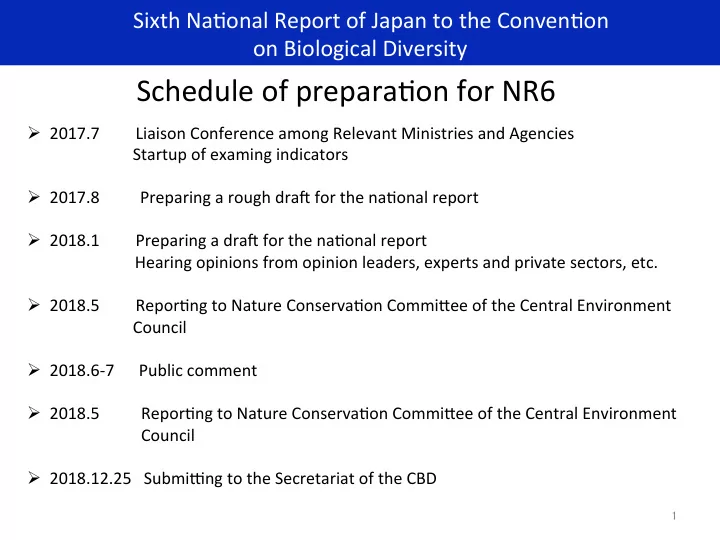
Schedule of prepara.on for NR6 2017.7 Liaison Conference among - - PowerPoint PPT Presentation
Sixth Na.onal Report of Japan to the Conven.on on Biological Diversity Schedule of prepara.on for NR6 2017.7 Liaison Conference among Relevant Ministries and Agencies Startup of examing indicators 2017.8 Preparing a rough draI for the na.onal
1
2
Ⅲ:Progress towards each national target: Choose the answer from the following choices ① On track to exceed target ② On track to achieve target ③ Progress but at an insufficient rate ④ No significant change ⑤ Moving away from target ⑥ Unknown
3
4
A-1: achieving the “mainstreaming of biodiversity across society”, etc. ・Status of recogni.on of the importance of biodiversity ・The number of municipali.es par.cipa.ng in municipal biodiversity Networks ・The number of organiza.ons par.cipa.ng in the Japan Business and Biodiversity Partnership ・・・ B-1: reduce the rate of loss of natural habitats, as well as their degrada.on and fragmenta.on ・Percentage of wetlands restored in par.cularly important water systems ・Percentage of .dal flats restored ・Percentage of areas needing improvements to their boMom sediment that were improved at three major ports ・・・ B-2: Engage in agriculture, forestry, and fisheries that ensure the conserva.on
sustainable manner ・Total number of par.cipants in regional community ac.vi.es related to the conserva.on and management of regional resources, such as agricultural land and water ・Cumula.ve number of new cer.fica.ons of eco-farmers ・Area of ini.a.ves for direct payment system for conserva.on oriented agriculture ・・・ B-3: improve the state of contamina.on from nitrogen and phosphorous, conserve aqua.corganisms, and increase biological produc.vity, etc. ・Achievement status of the Environmental Quality Standards(EQSs) for water pollu.on ・Achievement status of EQSs on total nitrogen and total phosphorous concentra.ons in closed water areas ・The number of red .des and algal blooms that occur ・・・ ・ E-2: ・ ・・・
【the four crises of biodiversity】(Caused by exploitation, decreasing population, Invasive alien species and climate change) 【Five Challenges towards the conservation of biodiversity and the sustainable use of its components 】
5
Ministry of the Environment/Relevant Ministries and Agencies
6
※81 Related Indicator Groups corresponding to national targets described in The National Biodiversity Strategy
(included in National Biodiversity Strategy of Japan 2012-2020)
Na7onal target Improved indicator (%) deteriorate d indicator (%) Reserving judgement (%) A-1 80.8 15.4 3.8 B-1 100.0 0.0 0.0 B-2 80.0 15.0 5.0 B-3 57.4 21.3 10.6 B-4 64.3 14.3 0.0 B-5 11.1 0.0 88.9 C-1 57.9 26.3 0.0 C-2 60.0 13.3 6.7 D-1 75.0 0.0 25.0 D-2 66.7 22.2 0.0 D-3
100.0 0.0 0.0 E-2 100.0 0.0 0.0
Ministry of the Environment/Relevant Ministries and Agencies
7
※81 Related Indicator Groups corresponding to national targets described in The National Biodiversity Strategy
(included in National Biodiversity Strategy of Japan 2012-2020)
Na7onal target Improved indicator (%) deteriorate d indicator (%) Reserving judgement (%) A-1 80.8 15.4 3.8 B-1 100.0 0.0 0.0 B-2 80.0 15.0 5.0 B-3 57.4 21.3 10.6 B-4 64.3 14.3 0.0 B-5 11.1 0.0 88.9 C-1 57.9 26.3 0.0 C-2 60.0 13.3 6.7 D-1 75.0 0.0 25.0 D-2 66.7 22.2 0.0 D-3
100.0 0.0 0.0 E-2 100.0 0.0 0.0
Ministry of the Environment/Relevant Ministries and Agencies
experts’ views and public
8
secondary assessment in consideration
addition to indicators (Including results of all sorts of reviews and qualitative assessment by departments in charge)
primary assessment by indicators (※) ※81 Related Indicator Groups
corresponding
to national targets described in The National
Biodiversity
Strategy
13 naional targets including mainstreaming biodiversity (included in National Biodiversity Strategy of Japan 2012-2020) Final assessment
progress towards the implementa tion ① On track to exceed target ② On track to achieve target ③ Progress but at an insuffic ient rate ④ No signific ant change ⑤Moving away from target ⑥ Unknown Difference from
impressions
in daily work Insufficie ncy, bias, so on
(assessed only by indicator) Differences, etc. (cannot be assessed
indicators)
experts’ views and public
9
A-1: Achieving the “mainstreaming of biodiversity across society”, etc. ③Progress but at an insufficient rate It is evaluated that progress towards Na7onal Target A-1 has been being made, such as the increase of collabora7ve projects with private
Meanwhile, it is not sufficient to say that mainstreaming biodiversity has been widely and generally accomplished. Since further efforts are considered to be needed, it is evaluated that progress has been achieved towards target, but at an insufficient rate. B-1: Reduce the rate of loss of natural habitats, as well as their degradation and fragmentation ③Progress but at an insufficient rate The loss of natural habitats is not considered to have significantly expanded. Meanwhile, the Report of Comprehensive Assessment of Biodiversity and Ecosystem Services in Japan (Japan Biodiversity Outlook (JBO2)), published in 2016, indicates that change in land use have been occurring at a small scale and there could be time lags before their impacts would become apparent. Accordingly, we evaluated that progress has been made towards target, but at an insufficient rate, as the closest category.
(※)In assessment of progress, choose an alterna.ve in the following six choices. ①On track to exceed target ②On track to achieve target ③Progress but at an insufficient rate ④No significant change ⑤Moving away from target ⑥Unknown
10
B-2: Engage in agriculture, forestry, and fisheries that ensure the conservation of biodiversity in a sustainable manner ③Progress towards target but at an insufficient rate As many of the related indicators show a positive progress towards the target, it is evaluated that progress towards the target has been being made. In the meantime, there are no outstanding positive tendencies in some related indicators, compared to 2012, the standard year when the National Targets were set. Accordingly, we evaluated that progress has been made towards target, but at an insufficient rate. B-3: Improve the state of contamination from nitrogen and phosphorous, conserve aquaticorganisms, and increase biological productivity, etc. ④No significant change As many of the clusters comprising related indicators have shown no considerable changes, it was evaluated that there were no significant changes. Meanwhile, since relevant efforts for improving water quality in closed water areas have been exerted from the long-term point of view, it is difficult to evaluate improvement conditions based on short-term fluctuations within the period of target achievements. B-4:
Identify invasive alien species,
to the routes by which they establish themselves, lay out the order of priority for eradicating the invasive alien species, promote a restoration
species by controlling or exterminating high priority species, promote border control measures
③Progress towards target but at an insufficient rate While progress was confirmed in many clusters of related indicators, relevant measures against alien species need to be continued to promote the restoration of habitats for rare species in the coming period. Based
the target but with insufficient rate, as the closest category.
11
B-5: Promote initiatives for minimizing human-induced pressures that cause ecosystems which are vulnerable to climate change, such as coral reefs to deteriorate ③Progress towards target but at an insufficient rate Human-induced pressures as to coral reefs were analyzed and organized to specify prioritized issues to tackle. In addition, regarding alpine vegetation and coral reefs, consideration on the implementation of relevant measures as adaptation to climate change has been promoted. Meanwhile, since the goal “establishing ecologically acceptable values of human-induced pressures” has not been achieved yet, it was evaluated that progress has been made towards the target but with insufficient rate. C-1: Appropriately conserve and manage 17% of inland areas and inland water areas, and 10% of coastal areas and ocean areas ③Progress towards target but at an insufficient rate It was observed that 20.3% of terrestrial and inland water areas are conserved and managed and therefore the target has achieved in terms
Meanwhile, the area of marine protected areas remained 8.3% as of April
towards the target but with insufficient rate. C-2: Prevent the population decrease for the known threatened species, maintain the genetic diversity of livestock animals, etc. ③Progress towards target but at an insufficient rate Significant progress was confirmed in many clusters of the related
threatened species, the number of Natural Habitat Protection Areas, and so on, remained at constant levels with no significant improvements. Therefore, it was evaluated that progress has been made towards the target but with insufficient rate.
12
D-1: Strengthen the benefits received from biodiversity and ecosystem services through the conservation and restoration of ecosystems ③Progress towards target but at an insufficient rate The Report of Comprehensive Assessment of Biodiversity and Ecosystem Services in Japan (Japan Biodiversity Outlook 2 (JBO2)), which was published in 2016, evaluated that many of the ecosystem services declined or remained at the same level compared to the past. Therefore, it cannot be said that, as a long-term trend, benefits obtained from ecosystem services have been strengthened. However, relevant indicators were confirmed to have seen progress. As such, related measures have been advanced. Accordingly, it was evaluated that progress has been made toward the target but with insufficient rate. D-2: Contribute to climate change mitigation and adaptation by restoration of 15% or greater for degraded ecosystems, etc. ③Progress towards target but at an insufficient rate The “Report of Comprehensive Assessment of Biodiversity and Ecosystem Services in Japan (Japan Biodiversity Outlook (JBO2))”, which was published in 2016, evaluated that the impacts caused by development and change in land use are very strong and have been continuing at that scale for the long-term period. Meanwhile, measures for the conservation and restoration of natural ecosystems as well as forest sink measures have been steadily conducted. Accordingly, it was evaluated that progress has been made toward the target but with insufficient rate. D-3: Ratify the Nagoya Protocol on ABS and implement the domestic measures for this Protocol ①On track to exceed target(※) Japan accepted the Nagoya Protocol and started the implementation of domestic measures for the Protocol. *already achieved
13
E-1: Promote policies based
Biodiversity Strategy of Japan, Provide support to ensure that global initiatives ②On track to achieve target Relevant measures were promoted such as the publication of Acceleration Measures towards Achieving the Aichi Biodiversity Targets, based on the result of a comprehensive review of National Biodiversity Strategy 2012-2020 conducted in JFY2014. In addition, the number of Parties that formulated their national biodiversity strategies and action plans with the support of the Japan Biodiversity Fund has been
E-2: Have respect for local communities’ traditional knowledge mainstreamed, strengthen scientific grounds and the connections between science and policy, Effectively and efficiently mobilize the resources (funds, human resources, technologies, etc.) needed to achieve theAichi Biodiversity Targets ②On track to achieve target The establishment of Regional Circular and Ecological Sphere was promoted for sustainable management of natural capital by utilizing local
strengthened through the participation in IPBES and contribution to its work, research and studies regarding marine ecosystems, and other
confirmed to have progressed. Accordingly, it was evaluated as “on track to achieve target”.
14