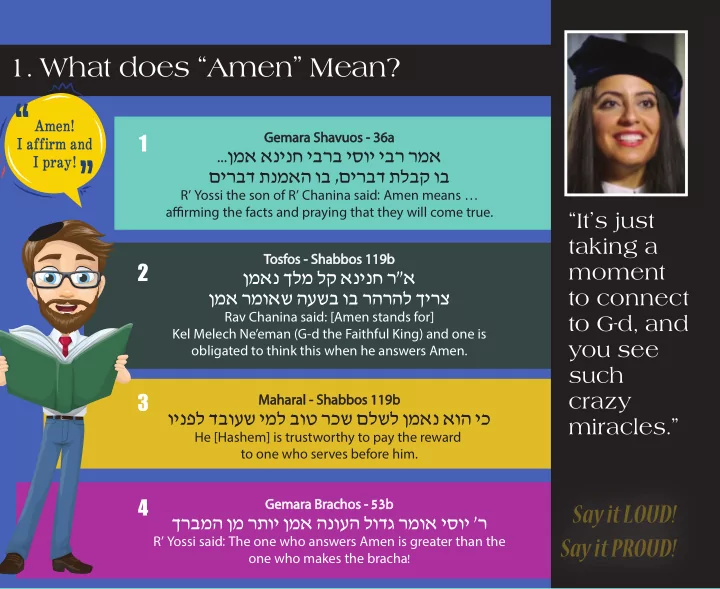
SLIDE 4 Summary The Gemara teaches us that Amen has 2
- meanings. It is both an affirmation of what
was said, and a prayer that it comes true. We should try and have both of these thoughts in mind whenever we say Amen. Tosfos tells us that another thing you should have in mind when saying Amen, is “Kel Melech Ne’eman” Hashem is the faithful king. The Maharal explains that this is a praise of
- Hashem. He is faithful in paying the reward
- f those who serve him.
The Gemara also tells us that the one who says Amen is greater than the person who made the bracha! This is because the Amen does 2 things, it affirms that which was said, and it is a prayer. The bracha on the other hand was only the affirmation, not the prayer! Rav Shlomo Elyashiv (1841-1926) was the grandfather of Rav Yosef Shalom Elyashiv, the world famous gadol hador who passed away in
- 2012. He was also well known in his own right
and was considered one of the greatest Mekub- alim of his time. He is said to have merited to be taught by Eliyahu Hanavi.
Summary:
The Gemara tells us that Amen is a powerful
- thing. It is the first ticket you can get into
Olam Habah, since it is based on belief in
- Hashem. That is why we try to teach Amen to
young children. The Minchat Eliyahu explains that Mordechai of the Purim Story did just that and taught Esther from a young age to say Amen. This fits very well with the Rokeach’s commentary. He explains that Esther was protected from a young age by angels, seemingly in the merit of saying Amen, since Amen has the same numerical value as malach – angel (91). The Zohar teaches us that if you say Amen with all your might, both mental and physical, then any bad decree against you is torn up. The Zohar also teaches us about a few amazing brachos that saying Amen can earn for us. Amen opens gates of blessing, brings good to all of the worlds, and helps our prayers be answered!
Biographies:
Rav Eliyahu Cohen (1659-1729) from Izmir, Turkey, is best known for his mussar work, the Shevet Mussar. He wrote over thirty books, including the Me’il Tzedakah, where he, as one of the wealthier members of the community, strongly encourages others to give
- charity. The sefer Minchat Eliyahu is a
compilation of his drashos. Rav Elazar of Worms (1170-1236) was known as the Rokeach, alluding to his most famous work, Sefer Rokeach. He was a prolific writer, authoring some fifty-five volumes on both Halacha and Kabbalah, in his short sixty-six
- years. He also composed tens of poems. He
lived in Germany all his life.
The Power of Amen