SLIDE 1
Presented By: Stephanie L. Gonzales, PE
LJA Engineering, Inc.
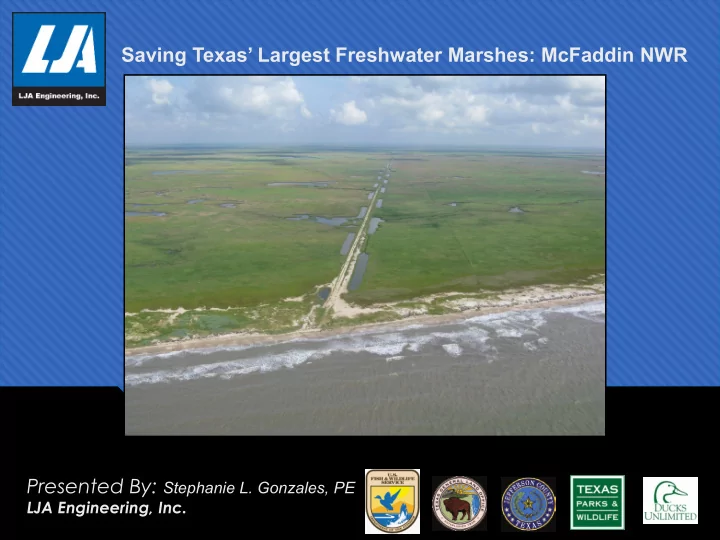
Saving Texas’ Largest Freshwater Marshes: McFaddin NWR
SLIDE 2
Overview
!! Project Area and Background !! Marsh Impacts !! Protection Berm !! Design !! Construction !! Beach and Dune Nourishment !! Sand Source Investigation !! Preliminary Design !! Dredging Method !! Sediment Delivery
SLIDE 3
Project Area and Background
!! McFaddin Beach and National Wildlife Refuge
SLIDE 4 Project Area and Background
Need !! Salt Bayou Watershed – 100,000 ac.
- f Fresh and Brackish Marsh
!! Feeding and resting habitat for waterfowl !! Protective buffer between the Gulf
Purpose
- ! Reduce frequency of saltwater
inundation into the interior marshes
- ! Protect the marshes from high tide
and low energy storm events.
- ! Reduce Erosion to that of typical
sandy beaches
SLIDE 5
Marsh Impacts: Storm Events
September 9, 2008 September 15, 2008 October 2, 2008
SLIDE 6
Marsh Impacts: Annual Erosion Rates
Erosion Rates Entire Shoreline: Aug ‘05 to Feb ‘09 = -21.4 ft/yr Feb ‘09 to Apr ‘10 = -34.0 ft/yr White’s to Perkins: Aug ‘05 to Feb ‘09 = -25.6 ft/yr Feb ‘09 to Apr ’10 = -33.4 ft/yr
SLIDE 7
Design of Protection Berm
!! 5 yr. Storm Approximation with +5ft NAVD88 Protection Berm
SLIDE 8
!"#$%&'#()*%"+,
SLIDE 9
Beach and Dune Nourishment
Alternatives Analysis !! Key Points !! Borrow Source Identification !! Sediment Configuration !! Dredge Type !! Sediment Delivery !! Screening Factors !! Costs !! Construction Time !! Impacts to the Environment !! Navigation
SLIDE 10
Sand Source Investigation
Investigation Area
SLIDE 11
Sand Source Investigation
SLIDE 12
Preliminary Design
SLIDE 13 Trailing Suction Hopper Dredge
- ! Low Mobilization & Operating Costs
- ! Utilizes Short Pipelines
- ! Can “Bottom Dump” Overburden
- ! Can work in Adverse Conditions
- ! Higher Risk to Endangered
Species
SLIDE 14
Sediment Delivery – Hopper Dredge
SLIDE 15 Cutter Suction Dredge
!! !! !!
- ! High Mobilization & Operating Costs
- ! Operates in Fair Weather
- ! High Production
- ! Low Risk to Endanger Species
- ! Works Well in Various Sediments
- ! Continuous Pumping
SLIDE 16
Sediment Delivery - CSD
SLIDE 17
Beach and Dune Nourishment
SLIDE 18 Interagency Efforts
Beach and Dune Nourishment (Phase III):
- ! CIAP providing initial funding for construction
- ! Texas General Land Office providing management and oversight
- ! GLO providing funding for engineering (CEPRA)
Protection Berm (Phase I & II):
- ! US Fish and Wildlife Services (USFWS) and Jefferson County providing
funding for construction (CIAP)
- ! Texas General Land Office (GLO) providing management and
- versight
- ! Jefferson County and GLO Disaster Recovery (DR) providing funding
for engineering & environmental management (CIAP)
SLIDE 19
Questions / Comments?
Contact Information: Stephanie Gonzales slgonzales@ljaengineering.com