
SLIDE 1
Samagra Shiksha
Way towards Systemic School Transformation
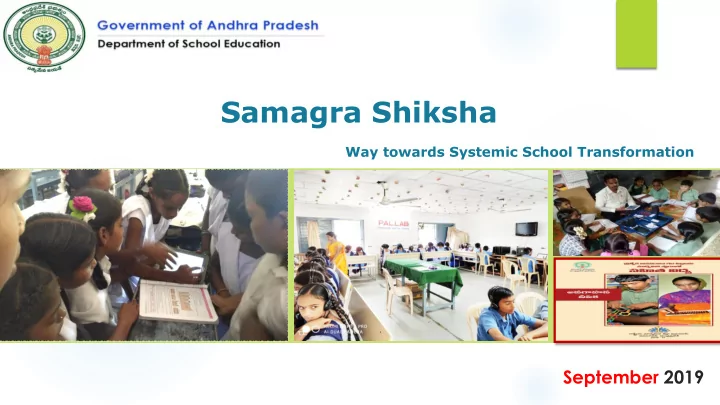
Samagra Shiksha Way towards Systemic School Transformation - - PowerPoint PPT Presentation
Samagra Shiksha Way towards Systemic School Transformation September 2019 What are Sustainable Goals? The Sustainable Development Goals (SDGs), also known as the Global Goals, were adopted by all United Nations Member States in 2015 as a
Way towards Systemic School Transformation
Sustainable Development Goal (SDG 4)
The Sustainable Development Goals (SDGs), also known as the Global Goals, were adopted by all United Nations Member States in 2015 as a universal call to action to end poverty, protect the planet and ensure that all people enjoy peace and prosperity by 2030.
Ensure that, all Boys and Girls Complete free, equitable and quality primary and secondary education To provide/support Quality Education and enhancing learning outcomes of Students; Bridging social and Gender Gaps; ensuring equity and inclusion at all levels Provided Universal Access, Equity and Quality, promoting Vocationalisation of Education and strengthening of Teacher Education Institutions (TEIs). Goal Purpose Outcome Aligned with Sustainable Development Goals (SDG 4)
Access & Retention Civil Works Entitlements Trainings Quality (Shala
Siddhi, Sports etc..)
RAA (Rashtriya
Aviskhar Abhiyan)
Community Mobilisation Gender & Equity IEDSS (Student
Oriented & Programmes)
Vocational Education Digital (ICT & Innovations)
82,490 OSC are identified with Aadhaar numbers in the Household level survey conducted through a user friendly technology based App Mana Badiki Podam. Mainly focused
“Children Never Enrolled & Children Dropped Out” based on the child info (Drop box data) for identification of OSC children in the State. Special learning modules provided to OSCC for bridging the gaps through remediation
State Average : 82.1 Highest: 85.5 Visakhapatnam Lowest : 76.3 Vizianagaram State Average : 69.3 Highest: 76.3 VISAKHAPATNAM Lowest : 62.4 KURNOOL
before class-5 , 7 during 5 and 6 and 6 dropping during Class 6-9
2017-18, which means 1.36 lakh children dropout
Source: Calculated from U-DISE data
100 96 89 85 83 20 40 60 80 100 120
Class-1 (2009-10) Class-5 (2013-14) Class-6 (2014-15) Class-8 (2016-17) Class-9 (2017-18)
Ananda Lahari Abhyasana (ALA) - Multi grade multi level teaching model adopted for joyful learning using tablet PC in 1571 Schools for classes 1-V.
Ganitha Mitra
Based Teaching and collaborative/peer group learning. Covered 2,85,511 students in 4,000 Schools. Each TLM is used for teaching multiple concepts.
Teaching at Right Level (TaRL) is a remedial group learning
& 11,02,123 Children.
PUNADI
programme in Nellore district. Competent teachers visit the schools, coach & support teachers, one-two-one.
Significant improvement in AP State Ranking in National Assessment Survey
c
500 1000 1500 2000 2500 3000 3500 4000 4500 5000
4908 164 87 187 380 352 334 14
2876.00 121.00 61.00 137.25 225.00 176.25 224.50 5.75
Schools Amount (Rs in Lakhs)
20000 40000 60000 80000 100000 120000 140000 160000 180000 200000
State Govt. & ZPP AP MODEL SCHOOLS APREI Social Welfare Tribal Welfare Muncipal Other Govt. Schools
198512 8138 3098 5106 8805 16382 210 397.02 16.28 6.20 10.21 17.61 32.76 0.42
Students Amount (Rs in Lakhs)
10000 5216 38 352 124 147 318 160 12
School s
c
students
thorough selection process
student wise Analysed feedback
Info.Booklet/child
Multi Lingual Education (MLE) & Local Dialects: developed
books in the needy tribal languages (local Mother Tongue) for classes 1st, 2nd & 3rd
all subjects. Initiated language barrier free education (Local Dialects). MLE books in Tribal languages
Savara : Srikakulam & Vizianagaram
Konda, Kuvi & Adivasi Oriya: Visakhapatnam
Koya: East Godavari & West Godavari
Sugali/Lambada:Kurnool, Ananthapuram, Prakasham & Guntur
Organized
training
Learning Outcomes to all the teachers through MANA-TV programme in four spells handling class I to class VIII.
TEXT BOOKS
Menstrual Hygiene Management capacity
building programme covering 11,230 teachers under ‘SAHAJA’ – Sanitary Napkins program covering 7,78,320 Girl students
During Swachh Pakwada 42,98,370 students
sanitation & hygiene.
Special health care through medical check-
ups viz., eye test, haemoglobin tests in KGBVs
Effective water and sanitation practices
resulted in achieving 3 National level Swachh Vidyalaya awards to KGBVs.
c Year
2011-12 163 2016-17 58 2017-18 16
Vocational Education is introduced in AP in 126 Model Schools in February 2017, and
subsequently in 80 schools in the present academic year with new Syllabus of National Vocational Education Qualification Framework (NVEQF) programme with a set of guidelines.
To enhance the employability of classes 9th to 12th (youth) on modular vocational courses
and to maintain their competitiveness through provisions of multi-entry - multi-exit learning
Two trades in each School has been introduced and 1 Vocational Trainer (VT) to teach each
Vocational Skill/ Course has been recruited by the VTPs.
A workshop for Media & Entertainment and IT/ITeS Vocational Trades has been conducted
for 2 days during 20-21 September 2017 at Guntur to sensitize on software’s and lab equipments.
Total 12 VTPs have been selected for 10 trades (2 new trades in addition to the already introduced 8 trades). Further Vocational Trainers (VTs) have been recruited by VTPs for new 80 Schools and joined.
c
Item Approve d OB
Expenditu re Incurred % of Expenditure Central Share State Share Total
Elementary 169390.74 182.23 863.08 575.38 1438.46 1598.67 98.64 Secondary 21346.18 331.24 83.54 75.11 158.65 300.66 64.00
Development of School Education (SE) with Quality, Equity & Inclusion Strengthened Institutions for Education Community Involvement in Schools Digital Schools Happy, Capable Child
నిణయ మన సమ వీద్రయ వీకిసం బలమన వీద్రయ వయ వసథలూ వీదయ లౌ సమిజ భిగస్శా మయ ం e- పిఠశిలలూ సంతౌషమన, సమరథ మన వీద్రయ ర్దథ