Sage Quick Reference: Statistics Max: v= list v.max() or - - PowerPoint PPT Presentation

sage quick reference statistics max v list v max or v max
SMART_READER_LITE
LIVE PREVIEW

Sage Quick Reference: Statistics Max: v= list v.max() or - - PowerPoint PPT Presentation

Sage Quick Reference: Statistics Max: v= list v.max() or v.max(index = True), warnings.simplefilter('ignore', Kelsey Kofmehl & Tien-Y ? index Boolean: default False(returns only int of DeprecationWarning) Sage Version ?? largest


slide-1
SLIDE 1

Sage Quick Reference: Statistics Kelsey Kofmehl & Tien-Y ? Sage Version ?? http://wiki.sagemath.org/quickref GNU Free Document License, extend for your

  • wn use

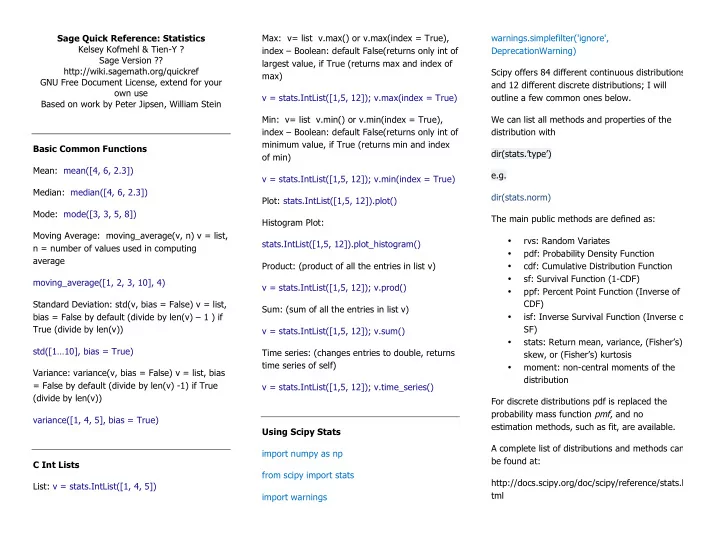
Based on work by Peter Jipsen, William Stein Basic Common Functions Mean: mean([4, 6, 2.3]) Median: median([4, 6, 2.3]) Mode: mode([3, 3, 5, 8]) Moving Average: moving_average(v, n) v = list, n = number of values used in computing average moving_average([1, 2, 3, 10], 4) Standard Deviation: std(v, bias = False) v = list, bias = False by default (divide by len(v) – 1 ) if True (divide by len(v)) std([1…10], bias = True) Variance: variance(v, bias = False) v = list, bias = False by default (divide by len(v) -1) if True (divide by len(v)) variance([1, 4, 5], bias = True) C Int Lists List: v = stats.IntList([1, 4, 5]) Max: v= list v.max() or v.max(index = True), index – Boolean: default False(returns only int of largest value, if True (returns max and index of max) v = stats.IntList([1,5, 12]); v.max(index = True) Min: v= list v.min() or v.min(index = True), index – Boolean: default False(returns only int of minimum value, if True (returns min and index

  • f min)

v = stats.IntList([1,5, 12]); v.min(index = True) Plot: stats.IntList([1,5, 12]).plot() Histogram Plot: stats.IntList([1,5, 12]).plot_histogram() Product: (product of all the entries in list v) v = stats.IntList([1,5, 12]); v.prod() Sum: (sum of all the entries in list v) v = stats.IntList([1,5, 12]); v.sum() Time series: (changes entries to double, returns time series of self) v = stats.IntList([1,5, 12]); v.time_series() Using Scipy Stats import numpy as np from scipy import stats import warnings warnings.simplefilter('ignore', DeprecationWarning) Scipy offers 84 different continuous distributions and 12 different discrete distributions; I will

  • utline a few common ones below.

We can list all methods and properties of the distribution with dir(stats.’type’) e.g. dir(stats.norm) The main public methods are defined as:

  • rvs: Random Variates
  • pdf: Probability Density Function
  • cdf: Cumulative Distribution Function
  • sf: Survival Function (1-CDF)
  • ppf: Percent Point Function (Inverse of

CDF)

  • isf: Inverse Survival Function (Inverse of

SF)

  • stats: Return mean, variance, (Fisher’s)

skew, or (Fisher’s) kurtosis

  • moment: non-central moments of the

distribution For discrete distributions pdf is replaced the probability mass function pmf, and no estimation methods, such as fit, are available. A complete list of distributions and methods can be found at: http://docs.scipy.org/doc/scipy/reference/stats.h tml

slide-2
SLIDE 2

Continuous Distributions (take the loc and scale as keyword parameters to adjust location and size of distribution e.g. for the standard normal distribution location is the mean and scale is the standard deviation) Common types of continuous:

  • Normal

from scipy.stats import norm numargs = norm.numargs [ ] = [0.9,] * numargs rv = norm()

  • Cauchy

from scipy.stats import cauchy numargs = cauchy.numargs [ ] = [0.9,] * numargs rv = cauchy()

  • Expontential

from scipy.stats import expon numargs = expon.numargs [ ] = [0.9,] * numargs rv = expon() To create a continuous class we use the base class rv_continuous: e.g. class gaussian_gen(stats.rv_continuous): "Gaussian distribution" You can then go on to define the parameters of methods: def _pdf: ... ... Discrete Distributions (The location parameter, keyword loc can be used to shift the distribution) Common types of discrete:

  • Bernoulli

from scipy.stats import bernoulli [ pr ] = [<Replace with reasonable values>] rv = bernoulli(pr)

  • Poisson

from scipy.stats import poisson [ mu ] = [<Replace with reasonable values>] rv = poisson(mu) Statistical Functions:

  • Means:
  • Geometric

stats.gmean(a, axis, dtype) a = array, axis = default 0, axis along which geometric mean is computed, dtype = type of returned array stats.gmean([1,4, 6, 2, 9], axis=0, dtype=None)

  • computed

stats.cmedian(a[, numbins]) a = array, numbins = number of bins used to histogram the data stats.cmedian([2, 3, 5, 6, 12, 345, 333], 2)

  • Trimmed

stats.tmean(a, limits=None, inclusive=(True, True))

  • Harmonic

stats.hmean(a, axis=0, dtype=None)

  • Skew

stats.skew(a, axis=0, bias=True)

  • Signal to noise ratio

stats.signaltonoise(a, axis=0, ddof=0)

  • Standard error of the mean

stats.sem(a, axis=0, ddof=1)

  • Historgram

stats.histogram2(a, bins)

  • Relative Z- scores

stats.zmap(scores, compare, axis=0, ddof=0

  • Z-score of each value

stats.zscore(a, axis=0, ddof=0)

  • Regression line
slide-3
SLIDE 3

stats.linregress(x, y=None) x = np.random.random(20) y = np.random.random(20) slope, intercept, r_value, p_value, std_err = stats.linregress(x,y) For a complete list see ‘Statistical Functions”: http://docs.scipy.org/doc/scipy/reference/stats.h tml Models

  • Linear model fit

stats.glm(data, para) Plots

  • Probability plot

stats.probplot(x, sparams=(), dist='norm', fit=True, plot=None) x = array, sample response data, sparams = tuple, optional, dist = distribution function name (default = normal), fit = Boolean (default true) fit a least squares regression line to data, plot = plots the least squares and quantiles if given. stats.probplot([6, 23, 6, 23, 15, 6, 32, 1], sparams=(), dist='norm', fit=True, plot=None)

  • Ppcc max (Returns the shape parameter

that maximizes the probability plot correlation coefficient for the given data to a one-parameter family of distributions) stats.ppcc_max(x, brack=(0.0, 1.0), dist='tukeylambda'

  • Ppcc (Returns (shape, ppcc), and
  • ptionally plots shape vs. ppcc

(probability plot correlation coefficient) as a function of shape parameter for a

  • ne-parameter family of distributions

from shape value a to b.) stats.ppcc_plot(x, a, b, dist='tukeylambda', plot=None, N=80 Markov Models: