
SLIDE 1
Safety evaluation at level crossings with the help of an automated measurement technique
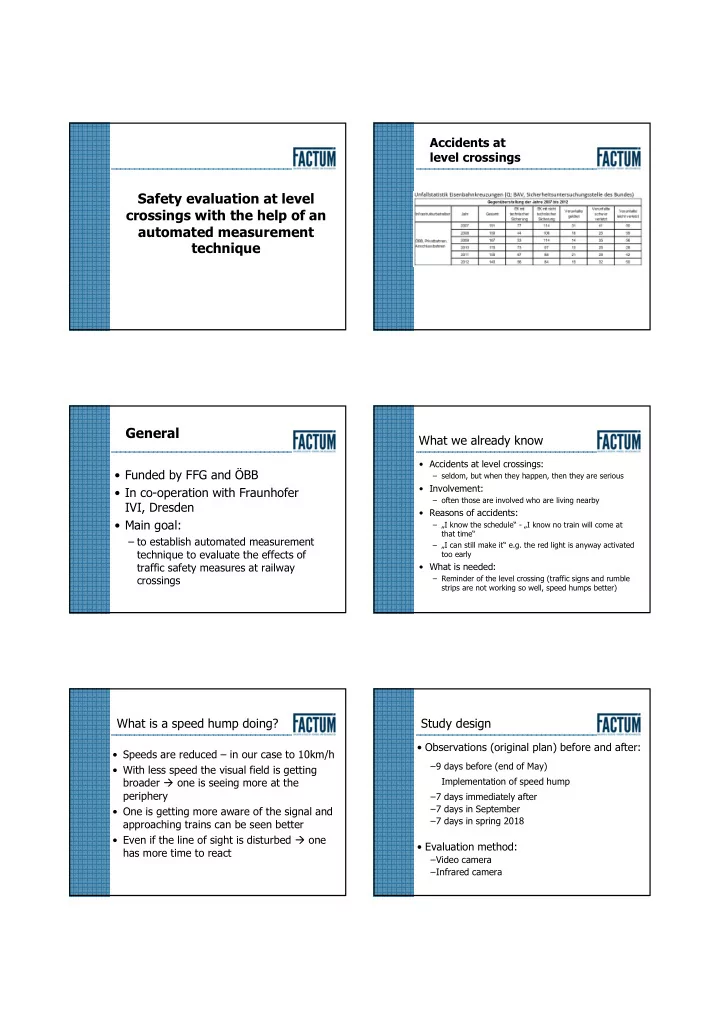
Accidents at level crossings
General
- Funded by FFG and ÖBB
- In co-operation with Fraunhofer
IVI, Dresden
- Main goal:
– to establish automated measurement technique to evaluate the effects of traffic safety measures at railway crossings
What we already know
- Accidents at level crossings:
– seldom, but when they happen, then they are serious
- Involvement:
– often those are involved who are living nearby
- Reasons of accidents:
– „I know the schedule“ - „I know no train will come at that time“ – „I can still make it“ e.g. the red light is anyway activated too early
- What is needed:
– Reminder of the level crossing (traffic signs and rumble strips are not working so well, speed humps better)
What is a speed hump doing?
- Speeds are reduced – in our case to 10km/h
- With less speed the visual field is getting
broader one is seeing more at the periphery
- One is getting more aware of the signal and
approaching trains can be seen better
- Even if the line of sight is disturbed one
has more time to react
Study design
- Observations (original plan) before and after:
–9 days before (end of May) Implementation of speed hump –7 days immediately after –7 days in September –7 days in spring 2018
- Evaluation method: