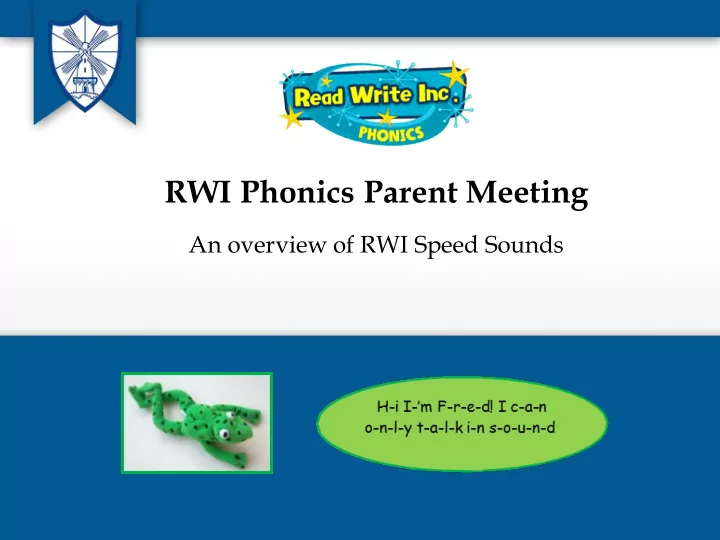
RWI Phonics Parent Meeting An overview of RWI Speed Sounds Children - - PowerPoint PPT Presentation
RWI Phonics Parent Meeting An overview of RWI Speed Sounds Children who read at home do well at school Read fluently Write confidently Speak articulately Why Speed Sounds Phonics? A complete speed sounds programme Meets the
Children who read at home do well at school
- Read fluently
- Write confidently
- Speak articulately
Why Speed Sounds Phonics?
- A complete speed sounds programme
- Meets the demands of the new national
curriculum
- Small group interventions ensure no
child is left behind
A bit of technical knowledge…
- Phonics = the sounds in our language
- The children learn the 44 sounds and the
corresponding letters/letter groups using simple picture prompt
Speed Sounds
- Do not use the letter names with your children at
this stage – ONLY the pure sounds
- When the children are taught the sounds they use
the cards and a multi-sensory approach – hold up the cards again.
It would be easy if we only had to learn Set 1 and Set 2 sounds!
The English language is a complex code…
Teaching a sound at school
- r at home…
Special Friends Tutorial
Word Time…
- Once your child knows some letters from Set 1 they learn to blend
these sounds to read words. Sometimes the words will have dots and dashes under it to help them sometimes (like in their reading books) it will not.
- Early on we introduce
the children to Fred…
Green Words
How to help your child at home
Once the children can read the first set of Speed Sounds and can sound blend, they will start to bring home storybooks. There are instructions in every book for you to follow. DO:
- Praise your child
- Keep reading time relaxed, comfortable and pleasurable
- Find a quiet place with the television turned off
- Make it a special time together
- Establish a routine in the day and read for 10 – 20 minutes
- Talk about the books, covers, stories and unfamiliar words
- Encourage the use of ‘Fred Talk’ to work out unfamiliar words
Don’t:
- Don’t correct too often or too quickly
- Make reading negative or pressured
- Get worried or frustrated with slow progress
Have fun with Fred Talk
“What a tidy r-oo-m!” “Where’s your c-oa-t?” “Time for b-e-d!”
- You can use this technique for more complex words such as