Rules Working Group Who? Why? - National Executive work group - - PowerPoint PPT Presentation

rules working group
SMART_READER_LITE
LIVE PREVIEW

Rules Working Group Who? Why? - National Executive work group - - PowerPoint PPT Presentation

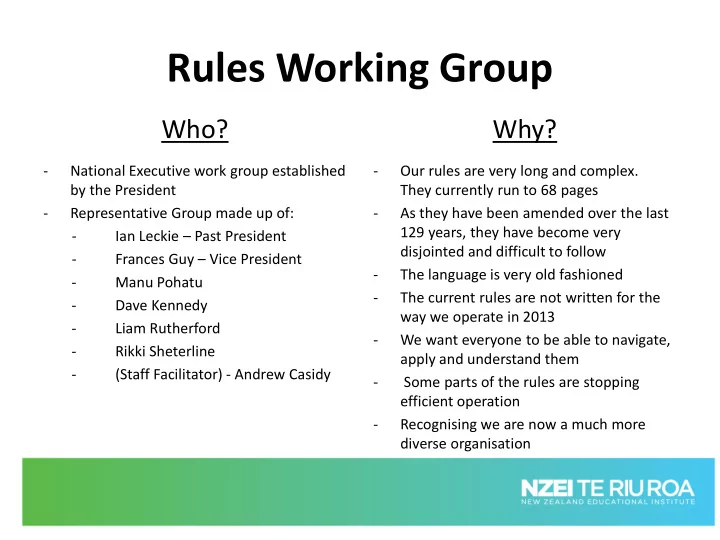
Rules Working Group Who? Why? - National Executive work group established - Our rules are very long and complex. by the President They currently run to 68 pages - Representative Group made up of: - As they have been amended over the last


slide-1
SLIDE 1

Rules Working Group

Who?

  • National Executive work group established

by the President

  • Representative Group made up of:
  • Ian Leckie – Past President
  • Frances Guy – Vice President
  • Manu Pohatu
  • Dave Kennedy
  • Liam Rutherford
  • Rikki Sheterline
  • (Staff Facilitator) - Andrew Casidy

Why?

  • Our rules are very long and complex.

They currently run to 68 pages

  • As they have been amended over the last

129 years, they have become very disjointed and difficult to follow

  • The language is very old fashioned
  • The current rules are not written for the

way we operate in 2013

  • We want everyone to be able to navigate,

apply and understand them

  • Some parts of the rules are stopping

efficient operation

  • Recognising we are now a much more

diverse organisation

slide-2
SLIDE 2

What are We Proposing & Principles to Apply

Firstly, we rewrite the rules into language which is simple, clear and easily

  • applied. The principles adopted when doing this would be:
  • Remove duplications
  • Broaden where appropriate to avoid the need for future rule changes

prompted by legislation

  • Group rules together so that all provisions relevant to each other are in

the same place

  • Shorten the document where possible
  • Aim for clarity and consistency
  • Not remove any of the ‘intent’ from the current rules
slide-3
SLIDE 3

Current Possible The main object of the Institute shall be to advance the cause of education generally while upholding and maintaining the just claims of its members individually and collectively The overarching purpose of the Institute is to advocate for Quality Public Education while advancing the just claims of members individually and collectively The Institute shall promote its members’ collective employment interests The Institute will promote and advocate for members collective employment interests The Institute shall represent its members’ interests in accordance with Section 18 of the Employment Relations Act The Institute is a union and will represent members interests with regard to any applicable legislation The Institute shall at all times respect and uphold the professional status and the individual rights of members The Institute will at all times respect and uphold the profession, its status and the individual rights of members

A Sample of ‘Simple, Clear and Easily Applied’ Rules Revision - Objects

Objects Purposes

The main object of the Institute shall be to advance the cause of education generally while upholding and maintaining the just claims of its members individually and collectively. The overarching purpose of the Institute is to advocate for Quality Public Education while advancing the just claims

  • f

members individually and collectively. The Institute shall represent its members’ interests in accordance with Section 18 of the Employment Relations Act. The Institute shall promote and protect the professional, economic, social and educational interests of its members. This maybe done by the institute alone or in co-operation with other

  • rganisations.

The Institute is a union and will represent members interests with regard to any applicable legislation. The Institute will promote and seek to improve members’ interests both nationally and globally and in doing so, may work with other

  • rganisations.
slide-4
SLIDE 4

What are We Proposing (2)?

Secondly, we address some key areas of the rules that members feel need to be changed. These could be a number of areas but some examples already known of include: a) The issue of representation at annual meeting b) Standing orders for annual meeting that are extremely complex and absorb unnecessary time at annual meeting c) The ability for some of the operations of elected structures to be done electronically rather than face-to-face d) Some rules which are too prescriptive and limiting – e.g. the rules around Honours which this meeting is considering

slide-5
SLIDE 5

The Process

  • A rules review will only work with strong membership voice and this starts here.
  • We propose a parallel two stage process whereby firstly, a revised simple

language version of the rules is suggested and widely consulted about through membership structures.

  • Secondly, based on your feedback today and that of National Executive, a

number of key areas of the rules be considered for change with proposals to be developed and once again, fully consulted on through membership structures.

  • This consultation can take many various forms but could include, written

proposals sent out to elected structures for feedback, National Executive and senior staff visits to meetings to lead discussion sessions, online forums for comment, providing a workshop resource to assist elected structures to work through the issues and so on.

  • A reminder that no rule changes could happen without agreement at Annual

Meeting . Members own and control both the process and decision making.

slide-6
SLIDE 6

Indicative Timeline

September 2013 to February 2014 Commission a specialist to develop a first draft

  • f a new simple language version of the rules

Areas for possible rule changes identified February 2014 – June 2014 Draft simple language rules version out to membership for consultation and input July 2014 Notify proposed simple language rule change proposals for Annual Meeting September 2014 Annual meeting to consider and vote on simple language version of the rules October 2014 – July 2015 Work and membership consultation on key areas of rule changes July 2015 Any proposed rule changes notified for Annual Meeting September 2015 Annual Meeting to vote on any rule changes proposed

slide-7
SLIDE 7

Questions for Round Tables

  • Do you support revising the rules into ‘simple, clear and more easily applied

language’? If so, why? If not, why not?

  • Are you comfortable with the principles suggested around this piece of work?
  • What are the five key areas of the rules that you think may be beneficial to change?

Why?

  • What are the things that most worry you about the proposed rules review?
  • Do you have any suggestions regarding the ways in which the quality of consultation

around this work could be maximised?

slide-8
SLIDE 8

Current Rules Section Headings

Page Number General 8 Membership & Subscriptions 10 Management of the Union 17 Election and Removal of National Officers 31 Meetings of the Institute 36 Administrative Requirements 41 Election of NZEI Te Riu Roa Nominee to the New Zealand Teachers Council and Method of Election 50 Other Matters 51