Role Overview How laws impacting FQHCs are made Advocacy: Shaping - - PowerPoint PPT Presentation

role overview
SMART_READER_LITE
LIVE PREVIEW

Role Overview How laws impacting FQHCs are made Advocacy: Shaping - - PowerPoint PPT Presentation

The Legislative Process: Your Role Overview How laws impacting FQHCs are made Advocacy: Shaping what those laws do why? how? ethics! How Laws Impacting FQHCs Are Made State Law by the State Legislature by


slide-1
SLIDE 1

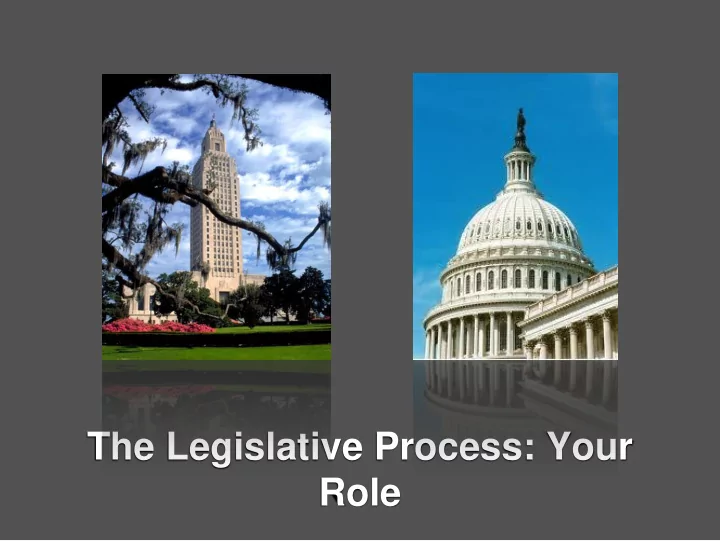
The Legislative Process: Your Role

slide-2
SLIDE 2

Overview

  • How laws impacting FQHC’s are made
  • Advocacy: Shaping what those laws do
  • why?
  • how?
  • ethics!
slide-3
SLIDE 3

How Laws Impacting FQHC’s Are Made

  • State Law
  • by the State Legislature
  • by Rulemaking Bodies
  • through the State Budgeting Process
  • by the Courts
slide-4
SLIDE 4
  • Federal Law
  • by Congress
  • by Rulemaking Agencies
  • through the Federal Budgeting Process
  • by Federal Courts

How Laws Impacting FQHC’s Are Made

slide-5
SLIDE 5

How Laws Impacting FQHC’s Are Made

  • ADVOCACY - how laws are REALLY made.
slide-6
SLIDE 6

State Level Legislation

  • 105 Representatives (House)
  • governed by the Speaker of the House
  • 39 Senators (Senate)
  • governed by the Senate President
slide-7
SLIDE 7

State Level Legislation

  • Even numbered years - 60 legislative day session; 85

calendar days; NON Fiscal Session

  • Odd numbered years - 45 legislative day session; 60

legislative days; Fiscal Session

slide-8
SLIDE 8

“Bills”

  • Legislative instruments are often called bills, but there are
  • ther types of instruments that also have “the force and

effect of law”

  • Are drafted by “authors”
  • Must get Committee approval
  • at the state level: House and Senate Health and Welfare,
  • r House and Senate Insurance
  • Must pass the “floor” of both chambers
slide-9
SLIDE 9

Rules/Regulations

  • Rulemaking “authority” is constitutionally delegated to rule

making “bodies” or agencies by the legislature/congress through the state and federal constitutions.

  • As rules are developed, the boards/commissions that

make them must comply with the public notice requirements laid out in the state or federal administrative procedures act.

slide-10
SLIDE 10

Rules/Regulations

  • Once rules become final they are codified, and become part of the

state or federal law - meaning they carry the same weight as “bills” passed by congress or the state legislature. (This body of law is known as “administrative law”)

  • Why worry about rules and regulations?
  • they fill the gaps between the general directives from the

legislature

  • they control almost every aspect of your day to day operations
  • they can become custom made for special interests if stakeholder

voices are left out of the process

slide-11
SLIDE 11

Why Advocacy?

  • Advocacy is really what “makes” the laws and regulations

impacting FQHC’s

  • Part of furthering the mission of FQHC’s:
  • expanding access to high quality care can’t happen

without advocacy

  • growing FQHC community impact won’t happen if

FQHC’s don’t thrive

slide-12
SLIDE 12

How Advocacy?

  • Communicate with those who influence policy.
  • Be a resource, not an annoyance.
slide-13
SLIDE 13

Know Your Representatives

  • Talk to them BEFORE you “need” something.
  • Ask what you can do to support them as they support

you.

slide-14
SLIDE 14

Educate Your Representatives

  • Do they know what an FQHC is?
  • Do they really understand how an FQHC is funded?
  • Have they seen your facility?
  • Do they know how many of their constituents utilize the

FQHC in their district for primary care?

slide-15
SLIDE 15

Utilize Technology!

slide-16
SLIDE 16

Communicating at Home and at the Capitol

  • LPCA Lobby Day!
  • Committee Hearings on important policies
  • Involvement in the rule making process
slide-17
SLIDE 17

Ethics

  • Advocacy vs. Lobbying
  • PUBLIC ENGAGEMENT IS NOT LOBBYING
  • Advocacy is broader than lobbying, but may include

lobbying

  • Lobbying seeks to influence the outcome of legislation or

elections

slide-18
SLIDE 18

Ethics

  • Lobbying vs. Advocacy
  • there are limitations on the amount a non-profit can

spend on lobbying

  • there are NO limitations on the amount a non-profit can

spend on advocacy

slide-19
SLIDE 19

Ethics

Lobbying vs. Advocacy

  • Did you expend money on an elected or appointed official in order to advocate for a

particular position?

  • Consult ethics regulations to see if you qualify as a person who needs to register as a lobbyist at

the state or federal level

  • Non-profits have special rules regarding how much of their budget can be spent on “lobbying”
  • Grant recipients and special tax exempt orgs have even more regulations to worry about
  • Did you intend to affect the outcome of an election?
  • This is called “political activity” and triggers tax exempt organization rules regarding

expenditures and activities

  • Doing GOTV is allowed, as long as you are not recommending or endorsing particular

candidates

slide-20
SLIDE 20
  • Did you intend to affect the outcome of a particular piece of legislation?
  • If you are not paid to do this, or if it is within the scope of your job duties but doesn’t

constitute more than a certain percentage of your job duties, no need to register as a lobbyist.

  • example: Testifying a couple of times on a bill that impacts your FQHC, sending written

comments on a rule, etc. does not require you to register as a state lobbyist.

  • Did you intend to get government to take a particular action?
  • this could be “executive branch lobbying;” see above
  • Were you paid to do any of the above?
  • depending upon how much of your time “lobbying” takes up, this could mean you need to

register as a lobbyist.

  • if your salary includes payment for lobbying duties it will count towards the amount your org

can spend on “lobbying”

slide-21
SLIDE 21

Focus Strategies LLC info@focusstrategiesla.com