Roger-the-Crab Rod Grupen Department of Computer Science - - PDF document

roger the crab
SMART_READER_LITE
LIVE PREVIEW

Roger-the-Crab Rod Grupen Department of Computer Science - - PDF document

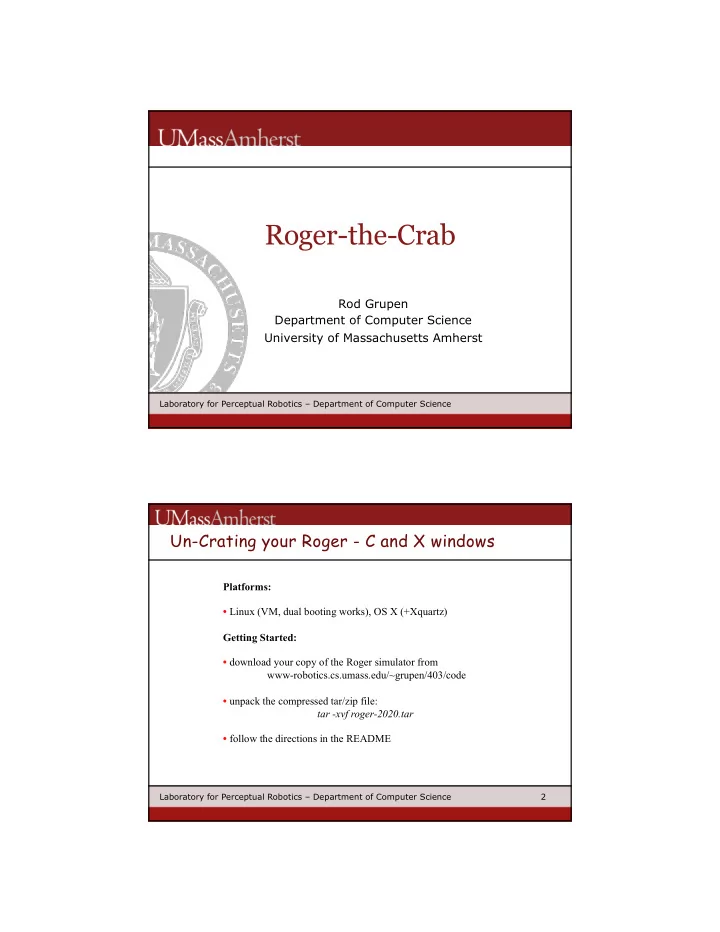
Roger-the-Crab Rod Grupen Department of Computer Science University of Massachusetts Amherst Laboratory for Perceptual Robotics Department of Computer Science Un-Crating your Roger - C and X windows Platforms: Linux (VM, dual booting


slide-1
SLIDE 1

Laboratory for Perceptual Robotics – Department of Computer Science

Rod Grupen Department of Computer Science University of Massachusetts Amherst

Roger-the-Crab

2 Laboratory for Perceptual Robotics – Department of Computer Science

Un-Crating your Roger - C and X windows

Platforms:

  • Linux (VM, dual booting works), OS X (+Xquartz)

Getting Started:

  • download your copy of the Roger simulator from

www-robotics.cs.umass.edu/~grupen/403/code

  • unpack the compressed tar/zip file:

tar -xvf roger-2020.tar

  • follow the directions in the README
slide-2
SLIDE 2

3 Laboratory for Perceptual Robotics – Department of Computer Science

The Simulator (Development) Environment

4 Laboratory for Perceptual Robotics – Department of Computer Science

configuration space left button (q1,q2) (q1) right button

  • p

+p +p

  • p

Input Modes: Joint Angle inputs

slide-3
SLIDE 3

5 Laboratory for Perceptual Robotics – Department of Computer Science

Input Modes: Base goals

Cartesian space (x,y) world frame

Input: Base goal

6 Laboratory for Perceptual Robotics – Department of Computer Science

Input Modes: Arm goals

Cartesian space right button (x,y) left button (x,y) right arm left arm world frame

Input: Arm goals

slide-4
SLIDE 4

7 Laboratory for Perceptual Robotics – Department of Computer Science

Input Modes: Introducing an Object (Ball)

Cartesian space

Input: Ball position

world frame

8 Laboratory for Perceptual Robotics – Department of Computer Science

Input Modes: Map Editor

Input: Map editor

goals

  • bstacles
slide-5
SLIDE 5

9 Laboratory for Perceptual Robotics – Department of Computer Science

Control Modes

Project-specific control 1-Motor Units 2-ArmKinematics 3-Vision 4-SearchTrack 5-StereoKinematics 6-Kalman 7-ChasePunch 8-Path Planning 9-PONG 10-Model 11-Belief

10 Laboratory for Perceptual Robotics – Department of Computer Science

Environmental Maps

different rooms

slide-6
SLIDE 6

11 Laboratory for Perceptual Robotics – Department of Computer Science

Command line I/O

accurate setpoints, gains, etc for experiments starting/stopping plot data

12 Laboratory for Perceptual Robotics – Department of Computer Science

Project Specific Visualization

Project/user defined tools location uncertainty path plans potential maps

slide-7
SLIDE 7

13 Laboratory for Perceptual Robotics – Department of Computer Science

Quiting the Simulator

14 Laboratory for Perceptual Robotics – Department of Computer Science

Roger-the-Crab - Kinematic Definition

./include/roger.h

slide-8
SLIDE 8

15 Laboratory for Perceptual Robotics – Department of Computer Science

Primary Cortical Homunculi

somatosensory homunculus motor homunculus

16 Laboratory for Perceptual Robotics – Department of Computer Science

Homunculus Man

somatosensory homunculus motor homunculus

slide-9
SLIDE 9

17 Laboratory for Perceptual Robotics – Department of Computer Science

U U

Afferents

eyes:

  • q[2], q[2], images[2][128][3]

arms:

  • q1[2], q1[2], q2[2], q2[2]
  • tactile (force) sensors: f [2] R2

mobile base:

  • position (x, x, y, y), orientation (q, q)
  • bump (force) sensor: f

R2

. . . . . .

18 Laboratory for Perceptual Robotics – Department of Computer Science

Efferents

eye torques:

  • t[2]

arm torques:

  • t1[2], t2[2]

mobile base:

  • wheel torques t[2]
slide-10
SLIDE 10

19 Laboratory for Perceptual Robotics – Department of Computer Science

Hierarchical Control

20 Laboratory for Perceptual Robotics – Department of Computer Science

Building Hierarchical Control Code

replicated control structure

slide-11
SLIDE 11

21 Laboratory for Perceptual Robotics – Department of Computer Science

Robot Interface: Project #1, #2

  • eye joint angles/velocities
  • images
  • arm joint angles/velocities
  • tactile (force) sensors
  • base position (x,y), orientation (q)
  • bump (force) sensor
  • eye motor torques
  • arm motor torques
  • wheel torques

simulator applications (MotorUnits.c) always

  • n

22 Laboratory for Perceptual Robotics – Department of Computer Science

Control Interface - control.h

typedef struct Robot_interface { // SENSORS double eye_theta[NEYES]; double eye_theta_dot[NEYES]; int image[NEYES][NPIXELS][NPRIMARY_COLORS]; /* rgb */ double arm_theta[NARMS][NARM_JOINTS]; double arm_theta_dot[NARMS][NARM_JOINTS]; double ext_force[NARMS][2]; /* (fx,fy) force on arm endpoint */ double base_position[3]; /* x,y,theta */ double base_velocity[3]; // MOTORS double eye_torque[NEYES]; double arm_torque[NARMS][NARM_JOINTS]; double wheel_torque[NWHEELS]; // TELEOPERATOR int button_event; double button_reference[2]; // CONTROL MODE int control_mode; int input_mode; Map world_map, arm_map[NARMS]; // REFERENCE VALUE double base_setpoint[3]; /* desired world frame base position (x,y,theta) */ double arm_setpoint[NARMS][NARM_JOINTS]; /* desired arm joint angles */ double eyes_setpoint[NEYES]; /* desired eye pan angle */ } Robot; typedef struct _map { int occupancy_map[NBINS][NBINS]; double potential_map[NBINS][NBINS]; int color_map[NBINS][NBINS]; } Map;

slide-12
SLIDE 12

23 Laboratory for Perceptual Robotics – Department of Computer Science

Project #1 - Code Structure

24 Laboratory for Perceptual Robotics – Department of Computer Science

MotorUnits.c

control_roger() control_base() control_arms() control_eyes() simulator control torques

S

current sensory state higher-level reference inputs + _

slide-13
SLIDE 13

25 Laboratory for Perceptual Robotics – Department of Computer Science

Cumulative Project Work

  • 1. motor units
  • 2. Cartesian goals
  • 3. oculomotor behavior
  • 4. visual reconstruction - triangulation
  • 5. hunting - integrated behavior
  • 6. …
  • ptions:
  • 1. path planning
  • 2. learning
  • 3. Pong

4.…