
SLIDE 1
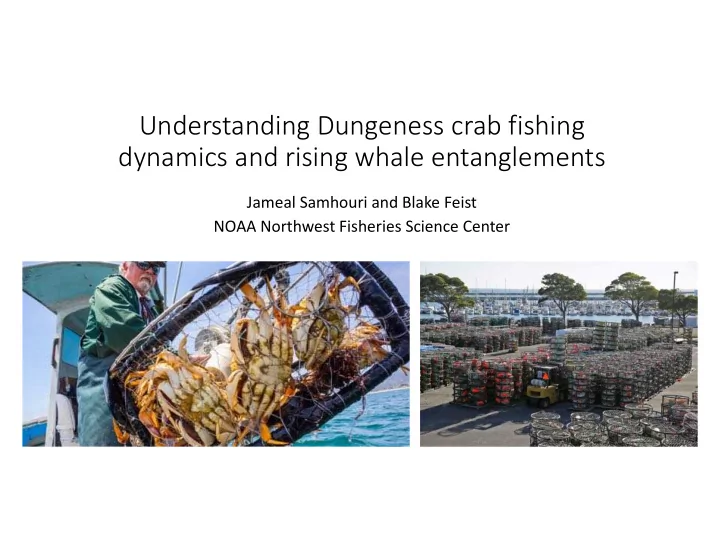
Understanding Dungeness crab fishing dynamics and rising whale - - PowerPoint PPT Presentation
Understanding Dungeness crab fishing dynamics and rising whale entanglements Jameal Samhouri and Blake Feist NOAA Northwest Fisheries Science Center How have California Dungeness crab fishery landings and activity changed over time and across
Office of National Marine Sanctuaries National Oceanic and Atmospheric Administration
West Coast Region
Ocean Acidifjcation Case Study: Dungeness Crab What is Ocean Acidifjcation?
Today, rampant burning of fossil fuels, including coal, oil, and natural gas, is releasing too much carbon dioxide into the atmosphere.
Annually, about 25% of human- caused carbon dioxide emissions is absorbed by the ocean, making the
This decrease in ocean pH over time is called ocean acidifjcation and it makes it harder for calcifying animals like Dungeness crab to thrive.
How will Ocean Acidifjcation Affect Dungeness Crab?
Dungeness crab are an abundant and valuable species throughout national marine sanctuaries along the West Coast of the United States. NOAA research shows that crabs in their early larval stages are vulnerable to low pH seawater.
Life Cycle of the Dungeness Crab
Molting from one stage to the next and carrying fertilized eggs require a lot
NOAA Research Shows Crabs are Vulnerable
Most vulnerable stages
In lab studies, exposure to lower pH seawater decreases Dungeness crab larval development rates and survival. It also impacts the prey species—such as bivalves—which they depend
a 41% decline in Dungeness crab biomass and 30% loss in economic revenue in the next 50 years due to ocean acidfjcation.
Ocean Acidifjcation Case Study: Dungeness Crab What is Ocean Acidifjcation?
Today, rampant burning of fossil fuels, including coal, oil, and natural gas, is releasing too much carbon dioxide into the atmosphere.
http://sanctuaries.noaa.gov/education/oa
Annually, about 25% of human- caused carbon dioxide emissions is absorbed by the ocean, making the
This decrease in ocean pH over time is called ocean acidifjcation and it makes it harder for calcifying animals like Dungeness crab to thrive.
How will Ocean Acidifjcation Affect Dungeness Crab?
Dungeness crab are an abundant and valuable species throughout national marine sanctuaries along the West Coast of the United States. NOAA research shows that crabs in their early larval stages are vulnerable to low pH seawater.
Life Cycle of the Dungeness Crab
Molting from one stage to the next and carrying fertilized eggs require a lot
NOAA Research Shows Crabs are Vulnerable
Most vulnerable stages In lab studies, exposure to lower pH seawater decreases Dungeness crab larval development rates and survival. It also impacts the prey species—such as bivalves—which they dependa 41% decline in Dungeness crab biomass and 30% loss in economic revenue in the next 50 years due to ocean acidfjcation. Office of National Marine Sanctuaries National Oceanic and Atmospheric Administration
West Coast RegionOcean Acidifjcation Case Study: Dungeness Crab What is Ocean Acidifjcation?
Today, rampant burning of fossil fuels, including coal, oil, and natural gas, is releasing too much carbon dioxide into the atmosphere.
http://sanctuaries.noaa.gov/education/oa
Annually, about 25% of human- caused carbon dioxide emissions is absorbed by the ocean, making the
This decrease in ocean pH over time is called ocean acidifjcation and it makes it harder for calcifying animals like Dungeness crab to thrive.
How will Ocean Acidifjcation Affect Dungeness Crab?
Dungeness crab are an abundant and valuable species throughout national marine sanctuaries along the West Coast of the United States. NOAA research shows that crabs in their early larval stages are vulnerable to low pH seawater.
Life Cycle of the Dungeness Crab
Molting from one stage to the next and carrying fertilized eggs require a lot
NOAA Research Shows Crabs are Vulnerable
Most vulnerable stages In lab studies, exposure to lower pH seawater decreases Dungeness crab larval development rates and survival. It also impacts the prey species—such as bivalves—which they dependa 41% decline in Dungeness crab biomass and 30% loss in economic revenue in the next 50 years due to ocean acidfjcation. Office of National Marine Sanctuaries National Oceanic and Atmospheric Administration
West Coast RegionOcean Acidifjcation Case Study: Dungeness Crab What is Ocean Acidifjcation?
Today, rampant burning of fossil fuels, including coal, oil, and natural gas, is releasing too much carbon dioxide into the atmosphere.
http://sanctuaries.noaa.gov/education/oa
Annually, about 25% of human- caused carbon dioxide emissions is absorbed by the ocean, making the
This decrease in ocean pH over time is called ocean acidifjcation and it makes it harder for calcifying animals like Dungeness crab to thrive.
How will Ocean Acidifjcation Affect Dungeness Crab?
Dungeness crab are an abundant and valuable species throughout national marine sanctuaries along the West Coast of the United States. NOAA research shows that crabs in their early larval stages are vulnerable to low pH seawater.
Life Cycle of the Dungeness Crab
Molting from one stage to the next and carrying fertilized eggs require a lot
NOAA Research Shows Crabs are Vulnerable
Most vulnerable stages In lab studies, exposure to lower pH seawater decreases Dungeness crab larval development rates and survival. It also impacts the prey species—such as bivalves—which they dependa 41% decline in Dungeness crab biomass and 30% loss in economic revenue in the next 50 years due to ocean acidfjcation. Office of National Marine Sanctuaries National Oceanic and Atmospheric Administration
West Coast RegionOcean Acidifjcation Case Study: Dungeness Crab What is Ocean Acidifjcation?
Today, rampant burning of fossil fuels, including coal, oil, and natural gas, is releasing too much carbon dioxide into the atmosphere.
http://sanctuaries.noaa.gov/education/oa
Annually, about 25% of human- caused carbon dioxide emissions is absorbed by the ocean, making the
This decrease in ocean pH over time is called ocean acidifjcation and it makes it harder for calcifying animals like Dungeness crab to thrive.
How will Ocean Acidifjcation Affect Dungeness Crab?
Dungeness crab are an abundant and valuable species throughout national marine sanctuaries along the West Coast of the United States. NOAA research shows that crabs in their early larval stages are vulnerable to low pH seawater.
Life Cycle of the Dungeness Crab
Molting from one stage to the next and carrying fertilized eggs require a lot
NOAA Research Shows Crabs are Vulnerable
Most vulnerable stages In lab studies, exposure to lower pH seawater decreases Dungeness crab larval development rates and survival. It also impacts the prey species—such as bivalves—which they dependa 41% decline in Dungeness crab biomass and 30% loss in economic revenue in the next 50 years due to ocean acidfjcation. Office of National Marine Sanctuaries National Oceanic and Atmospheric Administration
West Coast RegionOcean Acidifjcation Case Study: Dungeness Crab What is Ocean Acidifjcation?
Today, rampant burning of fossil fuels, including coal, oil, and natural gas, is releasing too much carbon dioxide into the atmosphere.
http://sanctuaries.noaa.gov/education/oa
Annually, about 25% of human- caused carbon dioxide emissions is absorbed by the ocean, making the
This decrease in ocean pH over time is called ocean acidifjcation and it makes it harder for calcifying animals like Dungeness crab to thrive.
How will Ocean Acidifjcation Affect Dungeness Crab?
Dungeness crab are an abundant and valuable species throughout national marine sanctuaries along the West Coast of the United States. NOAA research shows that crabs in their early larval stages are vulnerable to low pH seawater.
Life Cycle of the Dungeness Crab
Molting from one stage to the next and carrying fertilized eggs require a lot
NOAA Research Shows Crabs are Vulnerable
Most vulnerable stages In lab studies, exposure to lower pH seawater decreases Dungeness crab larval development rates and survival. It also impacts the prey species—such as bivalves—which they dependa 41% decline in Dungeness crab biomass and 30% loss in economic revenue in the next 50 years due to ocean acidfjcation. Office of National Marine Sanctuaries National Oceanic and Atmospheric Administration
West Coast RegionOcean Acidifjcation Case Study: Dungeness Crab What is Ocean Acidifjcation?
Today, rampant burning of fossil fuels, including coal, oil, and natural gas, is releasing too much carbon dioxide into the atmosphere.
http://sanctuaries.noaa.gov/education/oa
Annually, about 25% of human- caused carbon dioxide emissions is absorbed by the ocean, making the
This decrease in ocean pH over time is called ocean acidifjcation and it makes it harder for calcifying animals like Dungeness crab to thrive.
How will Ocean Acidifjcation Affect Dungeness Crab?
Dungeness crab are an abundant and valuable species throughout national marine sanctuaries along the West Coast of the United States. NOAA research shows that crabs in their early larval stages are vulnerable to low pH seawater.
Life Cycle of the Dungeness Crab
Molting from one stage to the next and carrying fertilized eggs require a lot
NOAA Research Shows Crabs are Vulnerable
Most vulnerable stages In lab studies, exposure to lower pH seawater decreases Dungeness crab larval development rates and survival. It also impacts the prey species—such as bivalves—which they dependa 41% decline in Dungeness crab biomass and 30% loss in economic revenue in the next 50 years due to ocean acidfjcation.
North: 23 week delay to May 12 South: 19 week delay to Mar 26
PacFIN Landings Database 2009-2016
North: 23 week delay to May 12 South: 19 week delay to Mar 26
PacFIN Landings Database 2009-2016 #
Becker et al. In Prep Dungeness
Holsman, Samhouri et al. 2017