Robust Transmission Planning An Application to the Case of Germany - - PowerPoint PPT Presentation

robust transmission planning an application to the case
SMART_READER_LITE
LIVE PREVIEW

Robust Transmission Planning An Application to the Case of Germany - - PowerPoint PPT Presentation

IAEE European Conference Vienna, 06 September 2017 Robust Transmission Planning An Application to the Case of Germany in 2050 Alexander Weber, Clemens Gerbaulet, Mario Kendziorski, Christian von Hirschhausen, Jens Weibezahn Research funded


slide-1
SLIDE 1
  • 1 -

TU Berlin - WIP IAEE European 2017 Vienna, 06 September 2017

IAEE European Conference Vienna, 06 September 2017

Alexander Weber, Clemens Gerbaulet, Mario Kendziorski, Christian von Hirschhausen, Jens Weibezahn

Research funded through grant „LKD-EU“, FKZ 03ET4028A, German Federal Ministry for Economic Affairs and Energy

Robust Transmission Planning – An Application to the Case of Germany in 2050

slide-2
SLIDE 2
  • 2 -

TU Berlin - WIP IAEE European 2017 Vienna, 06 September 2017

Motivation and Research Question

How should uncertainty be tackled in transmission planning?

  • What role can robust optimization play?
  • What decision calculus is appropriate from

a social perspective?

slide-3
SLIDE 3
  • 3 -

TU Berlin - WIP IAEE European 2017 Vienna, 06 September 2017

Introduction: Robust Optimization

Some Decision-Making Strategies

  • (Deterministic)
  • Stochastic Optimization; Expected

value

  • Minimize the average (expected) cost.
  • Robust Optimization
  • Minimize the cost of the worst case

realization

  • Alternatively: “Minimax Regret” to

minimize the highest extra cost of „not- knowing“

Types of Uncertainties

  • (Certainty)
  • Risk vs. Knightian Uncertainty
  • Sometimes, this may be a data problem...
  • “High” vs. “low” frequency

uncertainties

  • “High frequency” uncertainties allow for

bad outcomes to be compensated by good outcomes

Other Issues

  • Implementation of solution subject to “tolerances”
  • Problem/Model very sensitive to (small) parameter changes
slide-4
SLIDE 4
  • 4 -

TU Berlin - WIP IAEE European 2017 Vienna, 06 September 2017

dynELMOD: dynamic Electricity Model Investment options Characteristics Boundary conditions CO2 Emission Constraint

  • Electricity demand development
  • CO2 budget over time
  • CO2 storage potential per country
  • Renewable availabilities
  • Renewable investment potentials

dynELMOD –Investment and Dispatch model for Europe

1,275 1,273 965 819 598 458 270 90 19 200 400 600 800 1000 1200 1400 2000 2010 2020 2030 2040 2050 2060 Availabe CO2 emissions in Mt

  • Open source (soon)
  • diw.de/elmod
  • Objective: System Cost

minimization

  • Investment
  • Operation and Maintenance
  • Generation
  • Cross-border line expansion
  • Conventional power plants
  • Renewables

(PV, Wind On/Offshore, CSP)

  • Storage and DSM technologies

(endogenous P/E Ratio)

  • Grid expansion

(increase of NTCs)

  • 33 European Countries
  • Flow-based market coupling
  • Investment: five-year steps

2020 – 2050

  • Dispatch during optimization: hourly

resolution for about 2 weeks

  • Dispatch during validation: hourly

resolution for entire year: 8760 hours
slide-5
SLIDE 5
  • 5 -

TU Berlin - WIP IAEE European 2017 Vienna, 06 September 2017

The Case of Transmission Planning in Germany

  • Scenarios for generation and exchanges are generated using

“dynELMOD” (Gerbaulet & Lorenz, 2017)

  • European-scale, country-level fully fledged generation and transmission investment model

(EU-28 + CH + NO + Balkans)

  • Scenarios (2x2)
  • “FAST” -> 2050

carbon emission reduction of 98% (rel. to 2015)

  • “SLOW” -> only

80% reduction

  • “DE” no

interconnector expansion

  • “XB” cost-minimal

interconnector expansion

slide-6
SLIDE 6
  • 6 -

TU Berlin - WIP IAEE European 2017 Vienna, 06 September 2017

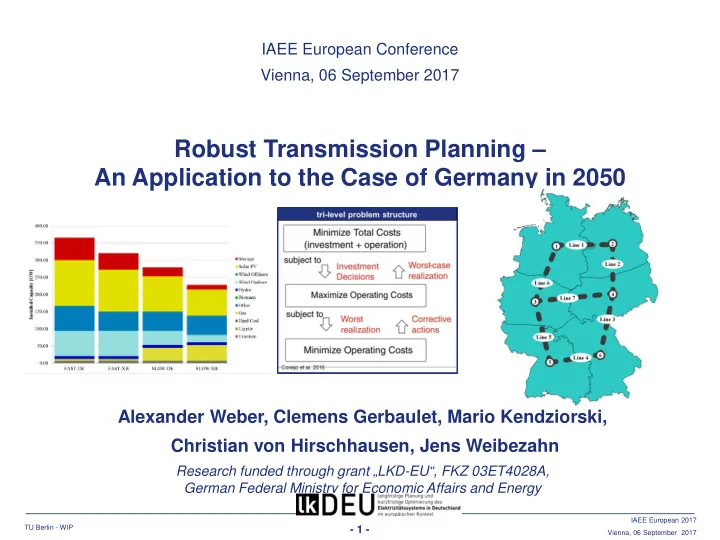
Transmission Planning in Germany: Model

  • Model
  • Simple 6-node Model (transport, zero initial

transport capacity)

  • Int’l Exchanges fixed
  • 179 time steps
  • Allocation of generation capacities using

potential maps/existing sites; Storages at RES-Sites

  • Four scenarios
  • FAST-DE and FAST-XB
  • SLOW-DE and SLOW-XB
  • Four optimization strategies
  • “Pure” Robust Optimization
  • minimax Regret (“pure” and min regret)
  • Deterministic (FAST-DE/-XB, SLOW-DE/-XB)
  • expected costs (uniform probability)
slide-7
SLIDE 7
  • 7 -

TU Berlin - WIP IAEE European 2017 Vienna, 06 September 2017

Applications of Robust Optimization to Transmission Planning

There are only few ‘advanced’ publications on robust TEP

Conejo et al. 2016

  • Jabr (2013)
  • Uncertainty set: Load and Generation

(continous)

  • 24/96 nodes
  • Ruiz/Conejo (2015)
  • (smaller) extension to Jabr (2013),

investment budgets, larger uncertainty set

  • Chen/Wang (2016)
  • Uncertainty set: generation retirements

and replacement (large discrete set)

  • 240 nodes
  • 5 investment periods
  • Challenges
  • Tri-level structure
  • Adequate uncertainty sets!

tri-level problem structure

Backup

slide-8
SLIDE 8
  • 8 -

TU Berlin - WIP IAEE European 2017 Vienna, 06 September 2017

Results: Annual System Costs (1/2)

slide-9
SLIDE 9
  • 9 -

TU Berlin - WIP IAEE European 2017 Vienna, 06 September 2017

Results: Annual System Costs (2/2)

slide-10
SLIDE 10
  • 10 -

TU Berlin - WIP IAEE European 2017 Vienna, 06 September 2017

Results: Transmission Investment

Decision Strategy Line investment levels [GW] Line cost [bn€]

#1 #2 #3 #4 #5 #6 #7

ROBUST 2 9 7 4 19 29 70 det_FAST-DE 2 9 7 4 19 29 2 72 det_FAST-XB 2 9 8 5 18 28 2 72 det_SLOW-DE 1 13 11 8 15 25 73 det_SLOW-XB 3 10 7 4 19 29 72 MINREGRET 3 9 7 4 19 29 71 EV 3 9 7 4 19 29 1 72 EXPREGRET 2 10 8 5 18 28 1 72 Backup

slide-11
SLIDE 11
  • 11 -

TU Berlin - WIP IAEE European 2017 Vienna, 06 September 2017

Results: Transmission Investment

  • Conclusion
  • Basic application of robust optimization to TEP in Germany
  • Scenarios have a high “intrinsic” cost impact => different transmission expansion

strategies play are comparatively narrow role. (Full DCLF may change this)

  • When overall costs are targeted at, robust optimization will direct all its efforts on the

alternative which is – overall – most expensive.

  • => “minimum regret” strategies may be more adequate here
  • Further extensions
  • Full transmission network representation (should increase value of robust decision

making)

  • Adaptive decision-making! (should decrease reduce the contribution of robust decision

making while increasing overall efficiency)

  • “Philosophical”(?) question:
  • From a “social” perspective – what is the correct decision calculus?
  • “Robust” vs. “Minimax Regret” vs. X?
  • Is there a well-grounded concept of social decision-making under uncertainty (except for the notion
  • f risk-neutrality)?
slide-12
SLIDE 12
  • 12 -

TU Berlin - WIP IAEE European 2017 Vienna, 06 September 2017

Literature

Chen, B. & Wang, L. (2016). Robust Transmission Planning Under Uncertain Generation Investment and Retirement. IEEE Transactions on Power Systems, PP(99), pp. 1–9. Conejo, A.J., Baringo Morales, L., Kazempour, S.J. & Siddiqui, A.S. (2016). Investment in Electricity Generation and Transmission: Decision Making under

  • Uncertainty. Heidelberg, New York: Springer.

Gerbaulet, C. & Lorenz, C. (2017). dynELMOD: A Dynamic Investment and Dispatch Model for the Future European Electricity Market. DIW Berlin, Data Documentation forthcoming, Berlin, Germany. Jabr, R.A. (2013). Robust Transmission Network Expansion Planning With Uncertain Renewable Generation and Loads. IEEE Transactions on Power Systems, 28(4), pp. 4558–4567. Ruiz, C. & Conejo, A.J. (2015). Robust Transmission Expansion Planning. European Journal of Operational Research, 242(2), pp. 390–401.