Road map Three class sessions on ethics: Ethics 1 General 2 - - PowerPoint PPT Presentation

road map
SMART_READER_LITE
LIVE PREVIEW

Road map Three class sessions on ethics: Ethics 1 General 2 - - PowerPoint PPT Presentation

Road map Three class sessions on ethics: Ethics 1 General 2 Scientific STAT8801 3 Statistical Statistical Consulting Full Disclosure School of Statistics These classes draw heavily and extensively from material assembled by University of


slide-1
SLIDE 1

Ethics

STAT8801 Statistical Consulting

School of Statistics University of Minnesota

March 29, 2010

STAT8801 (Univ. of Minnesota) Ethics March 29, 2010 1 / 26

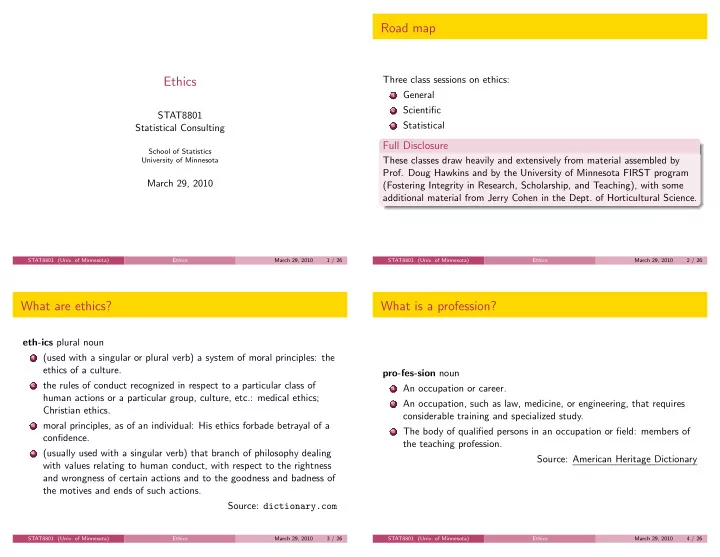
Road map

Three class sessions on ethics:

1 General 2 Scientific 3 Statistical

Full Disclosure

These classes draw heavily and extensively from material assembled by

  • Prof. Doug Hawkins and by the University of Minnesota FIRST program

(Fostering Integrity in Research, Scholarship, and Teaching), with some additional material from Jerry Cohen in the Dept. of Horticultural Science.

STAT8801 (Univ. of Minnesota) Ethics March 29, 2010 2 / 26

What are ethics?

eth-ics plural noun

1 (used with a singular or plural verb) a system of moral principles: the

ethics of a culture.

2 the rules of conduct recognized in respect to a particular class of

human actions or a particular group, culture, etc.: medical ethics; Christian ethics.

3 moral principles, as of an individual: His ethics forbade betrayal of a

confidence.

4 (usually used with a singular verb) that branch of philosophy dealing

with values relating to human conduct, with respect to the rightness and wrongness of certain actions and to the goodness and badness of the motives and ends of such actions. Source: dictionary.com

STAT8801 (Univ. of Minnesota) Ethics March 29, 2010 3 / 26

What is a profession?

pro-fes-sion noun

1 An occupation or career. 2 An occupation, such as law, medicine, or engineering, that requires

considerable training and specialized study.

3 The body of qualified persons in an occupation or field: members of

the teaching profession. Source: American Heritage Dictionary

STAT8801 (Univ. of Minnesota) Ethics March 29, 2010 4 / 26

slide-2
SLIDE 2

Professional ethics

U of M mandates training in ethical conduct of research, scholarship, and teaching (see www.research.umn.edu/ethics). Professional ethics are the ethics related to the practice of a particular profession. Professional societies and organizations codify ethical rules. For some professions, societies control access, so violators may be barred (e.g., law, medicine, accounting).

STAT8801 (Univ. of Minnesota) Ethics March 29, 2010 5 / 26

Ethical Science

“Of all the traits which qualify a scientist for citizenship in the republic of science, I would put a sense of responsibility as a scientist at the very top. A scientist can be brilliant, imaginative, clever with his hands, profound, broad, narrow but he is not much as a scientist unless he is responsible.” Alvin Weinberg, “The Obligations of Citizenship in the Republic of Science,” Minerva, 16: 1-3, 1978

STAT8801 (Univ. of Minnesota) Ethics March 29, 2010 6 / 26

Professional examples

Defense lawyers Give the client the best possible defense while respecting the

  • bligation not to lie.

Physicians Treat the patient as best they can in the patient’s best interest Research mathematician? Don’t plagiarize Don’t try to publish stuff you know not to be true

STAT8801 (Univ. of Minnesota) Ethics March 29, 2010 7 / 26

Statistical ethics

Codes of ethics and/or conduct available from American Statistical Association Royal Statistical Society International Statistical Institute probably others as well What about ethics for university teacher or student?

STAT8801 (Univ. of Minnesota) Ethics March 29, 2010 8 / 26

slide-3
SLIDE 3

Why be ethical?

Why do you want other people to be ethical? Unethical behavior harms society and may harm you. Why should you be ethical? You feel that ethical behavior is the mark of a “good” person, you think that you are a good person? You want to set a good example for others? You might be caught and punished? ??? Take the survey at http://faculty.heinz.cmu.edu/axa/index.php

STAT8801 (Univ. of Minnesota) Ethics March 29, 2010 9 / 26

Obligations

What do you see as your obligations to others? None; I look out for myself and treat other people well only when it is

  • f benefit to me.

My wants and needs are no more important than any other person’s. Circles of obligation: my children first; my family next; then my friends, colleagues, students, profession, community, etc.

STAT8801 (Univ. of Minnesota) Ethics March 29, 2010 10 / 26

Principles

Many sources of principles: religion, philosophers, national leaders, etc. Some universal themes: Nonmaleficence Do no harm to yourself or others. Beneficence Help yourself and others. Autonomy Allow rational individuals to make free, informed choices. Justice Treat people fairly; treat equals equally, unequals unequally. Utility Maximize the ratio of benefit to harm for all people. Fidelity Keep your promises and agreements. Honesty Do not lie, defraud, or mislead. Privacy Respect personal privacy and confidentiality. Resnik, D. B. 1998 The Ethics of Science, an Introduction

STAT8801 (Univ. of Minnesota) Ethics March 29, 2010 11 / 26

Ethics is hard

It’s easy to talk the talk of ethics, but it’s difficult to walk the walk. Ethical dilemmas occur when principles or obligations come into conflict. There are many tough questions, for example, Is euthanasia ethically acceptable?

STAT8801 (Univ. of Minnesota) Ethics March 29, 2010 12 / 26

slide-4
SLIDE 4

Teacher Ethics

A student about to get a C begs the professor for a B, since a C will cause the student to lose a Fellowship and return to his home country. He will do any amount of extra work to get the B. What should the professor do? Beneficence: Help the student (how best to do this?). Justice: Treat everyone fairly. Fidelity: Keep your promises and agreements. Honesty: Do not lie or mislead. Autonomy: Is the student choosing to fail? It turns out that the student is doing poorly in all classes; is this relevant?

STAT8801 (Univ. of Minnesota) Ethics March 29, 2010 13 / 26

More conflicting principles

Can I write a PhD student a glowing letter of recommendation? Nepotism? Can I buy an SUV while the globe is warming and Iraq is burning? Should we train soldiers to dive on grenades? Can people volunteer for a clinical trial that may maim them for life, but could save millions of lives if it works?

STAT8801 (Univ. of Minnesota) Ethics March 29, 2010 14 / 26

From The Ethicist, NY Times magazine

A friend and I will soon take the L.S.A.T. His father, a psychiatrist, gave him Adderall to help him take the test. I asked if he could share some with me, and he said that would be

  • unethical. Is it? Isn’t his dad’s giving him the Adderall

unethical? — Name Withheld, Austin, Tex. Medical ethics forbids a psychiatrist from prescribing drugs to close family

  • members. But no, there is no druggie’s code that bars his son from

sharing ill-gotten pills. For you to take what some call “study drugs” may violate the law, endanger your health and, if those pills are ineffectual, waste your money, but doing so does not offend ethics. Source: www.nytimes.com/2007/09/30/magazine/30wwln-ethicist-t.html

STAT8801 (Univ. of Minnesota) Ethics March 29, 2010 15 / 26

Obeying the law

The speed limit in a school zone is 20 mph. Can you ignore that law and drive faster? What if you are rushing an injured person to the hospital?

STAT8801 (Univ. of Minnesota) Ethics March 29, 2010 16 / 26

slide-5
SLIDE 5

Keeping promises

You work for a drug company. When you began, you signed a nondisclosure agreement wherein you promised to keep secret everything you learn while working at the company. The company is testing a new drug, and you discover that the company’s report to the FDA conceals that several patients taking the new drug in the clinical trial died. What do you do? A friend tells you, in the strictest confidence, that she plans to commit suicide. What do you do?

STAT8801 (Univ. of Minnesota) Ethics March 29, 2010 17 / 26

Telling the truth

During WWII, Dutch fishermen sometimes hid Jewish refugees on their boats to help them escape. If a German patrol boat stopped them to ask “Have you seen any refugees?” should they respond, “Why yes, I have half a dozen refugees below deck”? You see your next door neighbor beating up a little old lady. The police ask you if you saw the incident and if you recognized any of the people involved. How do you respond? What if it is your son doing the beating? Does this dress make me look fat?

STAT8801 (Univ. of Minnesota) Ethics March 29, 2010 18 / 26

Property

Your local market has a “Give an penny, take a penny” box. How many pennies is it OK to take? If you use pennies, do you have to put pennies in yourself? You notice a quarter lying on the sidewalk. What do you do? You notice a $20 bill lying on the sidewalk. What do you do? You walk up to an ATM and there is $1,000 in the cash dispenser

  • drawer. What do you do?

Is it ethical to avoid paying income taxes? When you buy a computer at your local Best Buy, you pay Minnesota sales tax. When you buy the computer from Amazon, you are supposed to fill out a form and send the sales tax to St. Paul. Do you?

STAT8801 (Univ. of Minnesota) Ethics March 29, 2010 19 / 26

Whistle-blowing

To suppress the use of illegal drugs, K-12 schools prohibit any use of any drug by students. You see a kid pop an Advil for a headache? What do you do? You are at Target and see someone stuff a blouse into her backpack and head for the door. Should you report her? Jeff Weise killed ten people at Red Lake High School. Before this act, he had apparently told other students his intention to kill people. Did they have a reporting obligation? To whom?

STAT8801 (Univ. of Minnesota) Ethics March 29, 2010 20 / 26

slide-6
SLIDE 6

Car crashes

Is there an ethical problem? Driver is driving down road and uses a cell phone to plan a movie for

  • Saturday. Driver is distracted while dialing and crashes into an
  • ncoming car, killing all its occupants.

Mother is driving down road with infant in car set in the back. Infant starts choking. Driver is distracted while dealing with infant and crashes into an oncoming car, killing all its occupants. Doctor is driving to hospital in response to emergency. A call from the hospital comes in on his cell phone. The doctor is distracted while answering and crashes into an oncoming car, killing all its occupants.

STAT8801 (Univ. of Minnesota) Ethics March 29, 2010 21 / 26

Conflict of interest (based on slides by Jerry Cohen)

David participates in a seminar where students, postdocs, and faculty members discuss work in progress. An assistant professor prefaces her presentation by saying that the work she is about to discuss is sponsored by a federal grant and a biotechnology firm for which she consults. David realizes that he knows a technique that could make a major contribution to the work being discussed, but his advisor is funded by a competing company.

1 How should David participate in this seminar? 2 What, if anything, should he say to his advisor-and when? 3 What implications does this case raise for the traditional openness

and sharing of data, materials, and findings that have characterized modern science?

STAT8801 (Univ. of Minnesota) Ethics March 29, 2010 22 / 26

Solution?

Science thrives in an atmosphere of open communication. When communication is limited, progress is limited for everyone. David therefore needs to weigh the advantages of keeping quiet (if in fact there are any) against the damage that accrues to science if he keeps his suggestion to himself. He might also ask himself how keeping quiet might affect his own life in science. Does he want to appear to his advisor and his peers as someone who is less than forthcoming with his ideas? What does he owe to society that supports the part of this research based on public funds? Will he enjoy science as much if he purposefully limits communication with others? Based on: On Being A Scientist: Responsible Conduct In Research, NATIONAL ACADEMY PRESS, Washington, D.C. 1995

STAT8801 (Univ. of Minnesota) Ethics March 29, 2010 23 / 26

Jodie and Mary

Jodie and Mary were born conjoined, sharing a single heart. Doctors felt that they would both die unless they were separated, and wanted to

  • perate leaving the shared heart with the stronger twin (Jodie). Of course,

Mary would then die immediately. The twins’ parents were opposed to this. What is the correct decision?

STAT8801 (Univ. of Minnesota) Ethics March 29, 2010 24 / 26

slide-7
SLIDE 7

Baby Theresa

Anencephalic babies have essentially no brain. Most die in the womb; those who are born rarely last more than a few weeks. Baby Theresa was anencephalic. Her parents decided to carry her to full term and deliver, so that her organs could be used for transplantation (critical shortage of organs for babies). She was born breathing and with a heartbeat. To transplant, doctors would need to stop her heart (kill her), and they would not do this. Theresa lived a few days, but when she died, her organs had deteriorated and were unusable for transplantation. What was the right thing to do?

STAT8801 (Univ. of Minnesota) Ethics March 29, 2010 25 / 26

Summary

Ethics are rules of conduct for individuals. Ethics are based on principles of benefit to self and others. Problems arise when principles conflict. Resolving ethical conflict can be difficult.

STAT8801 (Univ. of Minnesota) Ethics March 29, 2010 26 / 26