- Richard E. Bellman Origins A method for solving complex problems - - PowerPoint PPT Presentation

richard e bellman origins
SMART_READER_LITE
LIVE PREVIEW

- Richard E. Bellman Origins A method for solving complex problems - - PowerPoint PPT Presentation

Topic 25 Dynamic Programming "Thus, I thought dynamic programming was a good name. It was something not even a Congressman could object to. So I used it as an umbrella for my activities" - Richard E. Bellman Origins A method for


slide-1
SLIDE 1

Topic 25 Dynamic Programming

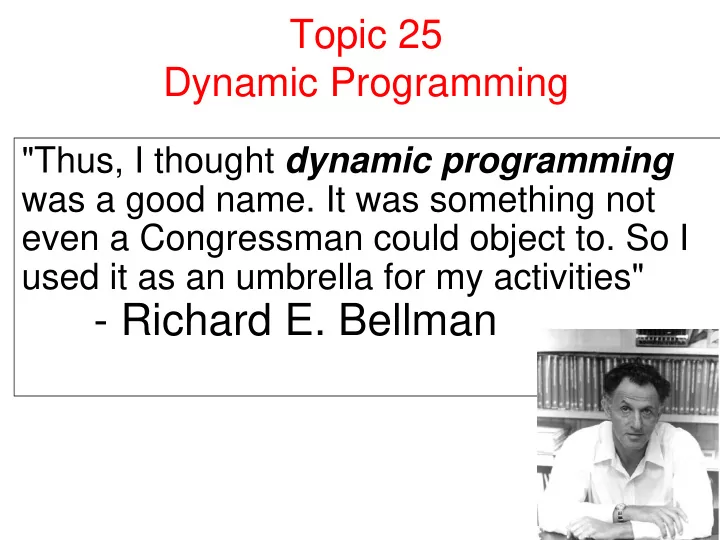
"Thus, I thought dynamic programming was a good name. It was something not even a Congressman could object to. So I used it as an umbrella for my activities"

  • Richard E. Bellman
slide-2
SLIDE 2

Origins

A method for solving complex problems by breaking them into smaller, easier, sub problems Term Dynamic Programming coined by mathematician Richard Bellman in early 1950s

– employed by Rand Corporation – Rand had many, large military contracts – Secretary of Defense, Charles Wilson “against research, especially mathematical research” – how could any one oppose "dynamic"?

CS314 Dynamic Programming

2

slide-3
SLIDE 3

Dynamic Programming

Break big problem up into smaller problems ... Sound familiar? Recursion? N! = 1 for N == 0 N! = N * (N - 1)! for N > 0

CS314 Dynamic Programming

3

slide-4
SLIDE 4

Fibonacci Numbers

1, 1, 2, 3, 5, 8, 13, 21, 34, 55, 89, 114, … F1 = 1 F2 = 1 FN = FN - 1 + FN - 2 Recursive Solution?

CS314 Dynamic Programming

4

slide-5
SLIDE 5

Failing Spectacularly

Naïve recursive method Clicker 1 - Order of this method?

  • A. O(1) B. O(log N) C. O(N) D. O(N2) E. O(2N)

CS314 Dynamic Programming

5

slide-6
SLIDE 6

Failing Spectacularly

CS314 Dynamic Programming

6

slide-7
SLIDE 7

Failing Spectacularly

CS314 Dynamic Programming

7

slide-8
SLIDE 8

Clicker 2 - Failing Spectacularly

How long to calculate the 70th Fibonacci Number with this method?

  • A. 37 seconds
  • B. 74 seconds
  • C. 740 seconds
  • D. 14,800 seconds
  • E. None of these

CS314 Dynamic Programming

8

slide-9
SLIDE 9

Aside - Overflow

at 47th Fibonacci number overflows int Could use BigInteger class instead

CS314 Dynamic Programming

9

slide-10
SLIDE 10

Aside - BigInteger

Answers correct beyond 46th Fibonacci number Even slower due to creation of so many objects

CS314 Dynamic Programming

10

slide-11
SLIDE 11

Slow Fibonacci

Why so slow? Algorithm keeps calculating the same value over and over When calculating the 40th Fibonacci number the algorithm calculates the 4th Fibonacci number 24,157,817 times!!!

CS314 Dynamic Programming

11

slide-12
SLIDE 12

Fast Fibonacci

Instead of starting with the big problem and working down to the small problems ... start with the small problem and work up to the big problem

CS314 Dynamic Programming

12

slide-13
SLIDE 13

Fast Fibonacci

CS314 Dynamic Programming

13

slide-14
SLIDE 14

Fast Fibonacci

CS314 Dynamic Programming

14

slide-15
SLIDE 15

Memoization

Store (cache) results from functions for later lookup Memoization of Fibonacci Numbers

CS314 Dynamic Programming

15

slide-16
SLIDE 16

Fibonacci Memoization

CS314 Dynamic Programming

16

slide-17
SLIDE 17

Dynamic Programming

When to use? When a big problem can be broken up into sub problems. Solution to original problem can be calculated from results of smaller problems. Sub problems have a natural ordering from smallest to largest OR simplest to hardest.

– larger problems depend on previous solutions

Multiple techniques within DP

CS314 Dynamic Programming

17

slide-18
SLIDE 18

DP Algorithms

Step 1: Define the *meaning* of the subproblems (in English for sure, Mathematically as well if you find it helpful). Step 2: Show where the solution will be found. Step 3: Show how to set the first subproblem. Step 4: Define the order in which the subproblems are solved. Step 5: Show how to compute the answer to each subproblem using the previously computed

  • subproblems. (This step is typically polynomial,
  • nce the other subproblems are solved.)

CS314 Dynamic Programming

18

slide-19
SLIDE 19

Dynamic Programing Example

Another simple example Finding the best solution involves finding the best answer to simpler problems Given a set of coins with values (V1, V2, … VN) and a target sum S, find the fewest coins required to equal S

What is Greedy Algorithm approach? Does it always work?

{1, 5, 12} and target sum = 15 Could use recursive backtracking …

CS314 Dynamic Programming

19

slide-20
SLIDE 20

Minimum Number of Coins

To find minimum number of coins to sum to 15 with values {1, 5, 12} start with sum 0

– recursive backtracking would likely start with 15

Let M(S) = minimum number of coins to sum to S At each step look at target sum, coins available, and previous sums

– pick the smallest option

CS314 Dynamic Programming

20

slide-21
SLIDE 21

Minimum Number of Coins

M(0) = 0 coins M(1) = 1 coin (1 coin) M(2) = 2 coins (1 coin + M(1)) M(3) = 3 coins (1 coin + M(2)) M(4) = 4 coins (1 coin + M(3)) M(5) = interesting, 2 options available: 1 + others OR single 5 if 1 then 1 + M(4) = 5, if 5 then 1 + M(0) = 1 clearly better to pick the coin worth 5

CS314 Dynamic Programming

21

slide-22
SLIDE 22

Minimum Number of Coins

M(0) = 0 M(1) = 1 (1 coin) M(2) = 2 (1 coin + M(1)) M(3) = 3 (1 coin + M(2)) M(4) = 4 (1 coin + M(3)) M(5) = 1 (1 coin + M(0)) M(6) = 2 (1 coin + M(5)) M(7) = 3 (1 coin + M(6)) M(8) = 4 (1 coin + M(7)) M(9) = 5 (1 coin + M(8)) M(10) = 2 (1 coin + M(5))

  • ptions: 1, 5

M(11) = 2 (1 coin + M(10))

  • ptions: 1, 5

M(12) = 1 (1 coin + M(0))

  • ptions: 1, 5, 12

M(13) = 2 (1 coin + M(12))

  • ptions: 1, 12

M(14) = 3 (1 coin + M(13))

  • ptions: 1, 12

M(15) = 3 (1 coin + M(10))

  • ptions: 1, 5, 12

CS314 Dynamic Programming

22

slide-23
SLIDE 23

KNAPSACK PROBLEM - RECURSIVE BACKTRACKING AND DYNAMIC PROGRAMMING

CS314 Dynamic Programming

23

slide-24
SLIDE 24

Knapsack Problem

A bin packing problem Similar to fair teams problem from recursion assignment You have a set of items Each item has a weight and a value You have a knapsack with a weight limit Goal: Maximize the value of the items you put in the knapsack without exceeding the weight limit

CS314 Dynamic Programming

24

slide-25
SLIDE 25

Knapsack Example

25

Items: Weight Limit = 8 One greedy solution: Take the highest ratio item that will fit: (1, 6), (2, 11), and (4, 12) Total value = 6 + 11 + 12 = 29 Clicker 3 - Is this optimal?

  • A. No B. Yes

Item Number Weight

  • f Item

Value of Item Value per unit Weight 1 1 6 6.0 2 2 11 5.5 3 4 1 0.25 4 4 12 3.0 5 6 19 3.167 6 7 12 1.714

slide-26
SLIDE 26

Knapsack - Recursive Backtracking

CS314 Dynamic Programming

26

slide-27
SLIDE 27

Knapsack - Dynamic Programming

Recursive backtracking starts with max capacity and makes choice for items: choices are:

– take the item if it fits – don't take the item

Dynamic Programming, start with simpler problems Reduce number of items available AND Reduce weight limit on knapsack Creates a 2d array of possibilities

CS314 Dynamic Programming

27

slide-28
SLIDE 28

Knapsack - Optimal Function

OptimalSolution(items, weight) is best solution given a subset of items and a weight limit 2 options: OptimalSolution does not select ith item

– select best solution for items 1 to i - 1with weight limit of w

OptimalSolution selects ith item

– New weight limit = w - weight of ith item – select best solution for items 1 to i - 1with new weight limit

28

slide-29
SLIDE 29

Knapsack Optimal Function

OptimalSolution(items, weight limit) = 0 if 0 items OptimalSolution(items - 1, weight) if weight of ith item is greater than allowed weight wi > w (In others ith item doesn't fit) max of (OptimalSolution(items - 1, w), value of ith item + OptimalSolution(items - 1, w - wi)

CS314 Dynamic Programming

29

slide-30
SLIDE 30

Knapsack - Algorithm

Create a 2d array to store value of best option given subset of items and possible weights In our example 0 to 6 items and weight limits of of 0 to 8 Fill in table using OptimalSolution Function

CS314 Dynamic Programming

30 Item Number Weight

  • f Item

Value of Item 1 1 6 2 2 11 3 4 1 4 4 12 5 6 19 6 7 12

slide-31
SLIDE 31

Knapsack Algorithm

Given N items and WeightLimit Create Matrix M with N + 1 rows and WeightLimit + 1 columns For weight = 0 to WeightLimit M[0, w] = 0 For item = 1 to N for weight = 1 to WeightLimit if(weight of ith item > weight) M[item, weight] = M[item - 1, weight] else

M[item, weight] = max of M[item - 1, weight] AND value of item + M[item - 1, weight - weight of item]

slide-32
SLIDE 32

Knapsack - Table

CS314 Dynamic Programming

32

Item Weight Value 1 1 6 2 2 11 3 4 1 4 4 12 5 6 19 6 7 12

items / capacity 0 1 2 3 4 5 6 7 8 {} {1} {1,2} {1, 2, 3} {1, 2, 3, 4} {1, 2, 3, 4, 5} {1, 2, 3, 4, 5, 6}

slide-33
SLIDE 33

Knapsack - Completed Table

CS314 Dynamic Programming

33

items / weight 1 2 3 4 5 6 7 8 {} {1} [1, 6]

6 6 6 6 6 6 6 6

{1,2} [2, 11]

6 11 17 17 17 17 17 17

{1, 2, 3} [4, 1]

6 11 17 17 17 17 18 18

{1, 2, 3, 4} [4, 12]

6 11 17 17 18 23 29 29

{1, 2, 3, 4, 5} [6, 19]

6 11 17 17 18 23 29 30

{1, 2, 3, 4, 5, 6} [7, 12]

6 11 17 17 18 23 29 30

slide-34
SLIDE 34

Knapsack - Items to Take

CS314 Dynamic Programming

34

items / weight 1 2 3 4 5 6 7 8 {} {1} [1, 6]

6 6 6 6 6 6 6 6

{1,2} [2, 11]

6 11 17 17 17 17 17 17

{1, 2, 3} [4, 1]

6 11 17 17 17 17 17 17

{1, 2, 3, 4} [4, 12]

6 11 17 17 18 23 29 29

{1, 2, 3, 4, 5} [6, 19]

6 11 17 17 18 23 29 30

{1, 2, 3, 4, 5, 6} [7, 12]

6 11 17 17 18 23 29 30

slide-35
SLIDE 35

Dynamic Knapsack

CS314 Dynamic Programming

35

slide-36
SLIDE 36

Dynamic vs. Recursive Backtracking

CS314 Dynamic Programming

36

slide-37
SLIDE 37

Clicker 4

Which approach to the knapsack problem uses more memory?

  • A. the recursive backtracking approach
  • B. the dynamic programming approach
  • C. they use about the same amount of memory

CS314 Dynamic Programming

37