
SLIDE 1
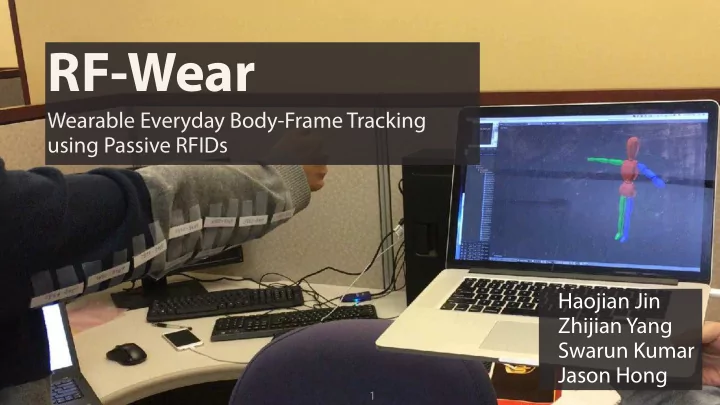
RF-Wear
Wearable Everyday Body-Frame Tracking using Passive RFIDs Haojian Jin Zhijian Yang Swarun Kumar Jason Hong
1
RF-Wear Wearable Everyday Body-Frame Tracking using Passive RFIDs - - PowerPoint PPT Presentation
RF-Wear Wearable Everyday Body-Frame Tracking using Passive RFIDs Haojian Jin Zhijian Yang Swarun Kumar Jason Hong 1 RF-Wear turns a regular clothing into a body-frame aware garment using low-cost , light weight , machine washable ,
Wearable Everyday Body-Frame Tracking using Passive RFIDs Haojian Jin Zhijian Yang Swarun Kumar Jason Hong
1
RF-Wear turns a regular clothing into a body-frame aware garment using low-cost, light weight, machine washable, battery-free RFID tags.
2
Commercial Tracking Wearables
3
Pulse Sensor Pedometer (Accelerometer)
How do these devices track?
4
many times, we want more than heart rate and steps….
5
Personal Trainer in Fitness
6
Gait Tracking in Rehabilitation
7
Gesture Input in VR/AR
8
how can we do body-frame today?
9
Optitrack
10
Kinect Leap Motion
Infrastructure-based sensing
Openpose (CMU)
11
inertial sensors
Neuron Wearable Electronics
12
Smart fabrics
Google jacquard [UIST 2016]
13
mobile, ad-hoc v.s. infrastructure solutions washable, durable, low cost v.s. wearable electronics continuous rich tracking v.s. smart fabrics
14
(limited gestures)
skeleton tracking for daily use. using low-cost, machine washable, lightweight, battery-free RFIDs
15
180° 96° 80° 105° 75° 135° 45°
average joint angle tracking accuracy of 8~21°, 20~60 Hz
16
17
A RFID sensing primitive for joint tracking A practical body-worn RFID tag placement solution
18
RFID sensing, phase measurement, triangulation
19
RFID Reader RFID Antenna RFID Tags
RFID Sensing Confjguration
20
RFID Antenna (Transmitter) RFID Tags (Refmector)
RFID Backscatter Communication
21
RFID Antenna (Transmitter) RFID Tags (Refmector)
22
RFID Backscatter Communication
θT θR θTag λ d θ1 θ2
Backscatter wave Direct wave
Phase in Backscatter Communication
LESS THAN 0.1 mm Phase Ranging resolution:
23
Tagoram [MOBICOM 2014]
24
d1 d2 d3 d4 A1 A2 A3 A4
Static multiple antennas at known positions Use triangulation to calculate the tag position
Stationary RFID Sensing
25
d1 d2 d3 d4 A1 A2 A3 A4
Static multiple antennas at known positions Use triangulation to calculate the tag position
Stationary RFID Sensing Mobile/Wearable
26
θ1 θ2
27
θ
reversing the tag-antenna relationship
28
θ1
past work RF-Wear
1 2 3 4 5
θ
6
measure the radio signal time-of-arrival delay
29
1 2 3 4 5
θ
6
the tag placement l is known
30
31
θ1
the antenna is in the pocket the position may change when the user moves
θ1 θ2
knee joint angle =
32
θ1 θ2
ideally…
33
multipath
in reality…
1 2 3 4 5
θ
6
Eigenspace method (MUSIC algorithm)
Broadside Angle (degrees)
10 30 50 70 90 110 130 150 170
p(α)
Incoming signal power distribution across 0° to 180°
θ = α α
34
35
θ1
Broadside Angle (degrees)
10 30 50 70 90 110 130 150 170
p(α)
α
Incoming signal power distribution across 0° to 180°
Real-world Spectrum
θ1 θ2
36
Broadside Angle (degrees)
10 30 50 70 90 110 130 150 170
p(α) p(α) 68°
α
Incoming signal power distribution across 0° to 180°
measure the offset of two spectrum to counter multipath signals
37
Two Degree of Freedom Joints Fabric fmexibility
38
θ
RFID tags, RFID readers, Software
39
5.2 x 1.2 x 0.1 (cm) fmexible, washable 25Hz on the body (1m)
RFID Tags
40
Software
implemented in Python computation time: 0.03s => live demo (15 Hz) raw signal rate at 20~60 Hz continuous skeleton tracking
Context: RapID [CHI’16] - 200 ms IDSense [CHI’15] - 2s discrete gesture recognition
41
1) Array geometry 2) Fabric fmexibility 3) Motion capture experiment
42
1m away on the fmoor facing the same direction 30 seconds/repetition
43
6 tag array dimensions [2x3; 2x4; 2x5; 3x3; 4x4; 5x5] X 3 aperture [3cm, 4cm, 5cm] X 6 relative angles [30°, 60°, 90°, 120°, 150°, 180°] X 3 repetitions = 324 experiments
example: 2x4 aperture: 5cm
44
45
azimuth elevation angle error (°) 3x2_5cm 4x2_5cm 4x2_4cm 5x2_4cm 3x3_5cm 3x3_4cm 3x3_3cm 4x4_5cm 4x4_4cm 5x5_5cm 5x5_4cm 5 10 15 20
best! worst!
46
1 tag array confjguration [2x4 with an aperture at 5 cm] X 3 fabrics [cotton, wool, polyester] X 6 relative angles [30°, 60°, 90°, 120°, 150°, 180°] X 3 repetitions = 54 experiments (30 sec each data collection)
47
A c c u r a c y E r r
( d e g r e e s ) Cotton pant Wool Sweater Jacket 6.56 5.24 8.69
48
context: cardboard: 4°
8 cameras on the ceiling sub-millimeter accuracy
49
knee shoulder elbow
50
walk in place (50s) walk around (50s)
+
51
52
Walk around Walk in-place time (sec) knee joint angle (°)
RF-Wear (Raw) RF-Wear (KF) GroundTruth
hand movement (160 sec)
53
54
RF-Wear (Raw) RF-Wear (KF) GroundTruth
54
time (sec) elbow joint angle (°)
shoulder rotation (3 x 20 sec)
55
56
time (sec) shoulder joint angle (°)
RF-Wear (Raw) RF-Wear (KF) GroundTruth
Horizontal DOF Vertical DOF
RF-Wear (Raw) RF-Wear (KF) GroundTruth
If we use a tag array for 4X2 with an 5cm aperture, Card board accuracy: 4° On fabric: 6°-9° On body: knee 9° (walk in place), 12° (walk around). elbow 12°, shoulder (21° and 8°) Context (Kinect): knee joint angle accuracy in a gait cycle: 28.5°
Accuracy of the Microsoft Kinect™ for measuring gait parameters during treadmill walking [Gait & Posture 2015] 57
58
64 on four limbs + 48 on the main body = 112 tags
59
in the fabric
in the body (implant)
60
61
WiSh: Towards a Wireless Shape-aware World using Passive RFIDs (MobiSys’18)
63
body-frame tracking for daily use turns a regular clothing into a body-frame aware garment using low-cost, light weight, machine washable, battery-free RFID tags tracks joint angle at 8~21°, 20~60 Hz
64
Wearable Everyday Body-Frame Tracking using Passive RFIDs
65
Haojian Jin http://haojianj.in/
66
θT θR θTag λ d θ1 θ2
Backscatter wave Direct wave
Phase in Backscatter Communication
67
Phase to Super Resolution Distance
The speed of radio in the air is 3x10^8 m/s. The 900 MHz radio will have 9x10^8 cycles in one second. The wavelength (the length of a cycle) would be 33 cm. The resolution of phase reading is 0.0015 radians. The distance resolution = = 0.0079 cm. LESS THAN 0.1 mm
68
70
Hardware limit reader: 1,100 tags/second. RFID tags backscatter frequency on body: 20 Hz. Software limit: MUSIC algorithm is computing expensive: 15 Hz.
https://www.atlasrfjdstore.com/impinj-speedway-revolution-r420-uhf-rfjd-reader-4-port/
71
Each angle computation was run independently based on one
we can do 30~60 Hz with commercial RFID readers given the reader moves at human speeds.
Accuracy of the Microsoft Kinect™ for measuring gait parameters during treadmill walking [Gait & Posture 2015]
knee in a gait cycle RMSD: 28.5° hip RMSD: 11.8° Context, accuracy of Microsoft Kinect
72
73
Traditional architecture: Stationary readers + Mobile Tags RFWear, WiSh Mobile readers + Mobile/Stationary Tags Users will have the control and awareness the reader status.
74
RF-Wear tracks the body-frame by tracking the way clothes move as the body moves. Limitation: RF-Wear can only track the joints covered by clothing. Advantage: We can also track stomach spasms, belly movement. :)