Review We can declare an array of any type, even other arrays A 2D - - PowerPoint PPT Presentation

review
SMART_READER_LITE
LIVE PREVIEW

Review We can declare an array of any type, even other arrays A 2D - - PowerPoint PPT Presentation

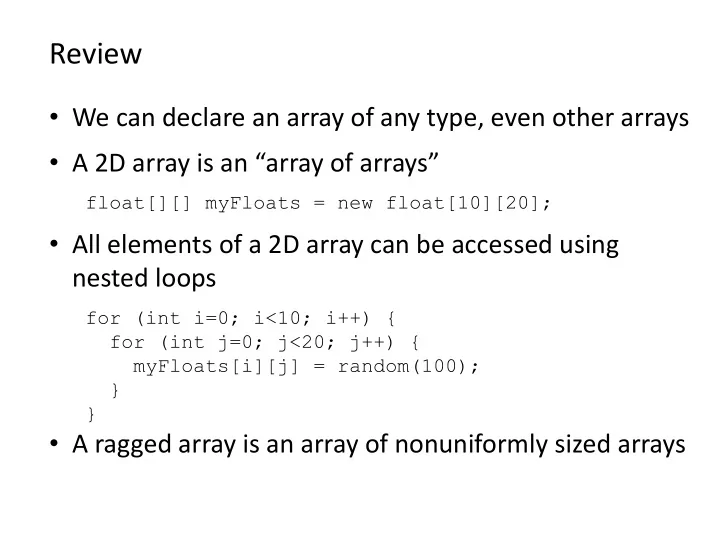
Review We can declare an array of any type, even other arrays A 2D array is an array of arrays float[][] myFloats = new float[10][20]; All elements of a 2D array can be accessed using nested loops for (int i=0; i<10; i++) {


slide-1
SLIDE 1

Review

  • We can declare an array of any type, even other arrays
  • A 2D array is an “array of arrays”

float[][] myFloats = new float[10][20];

  • All elements of a 2D array can be accessed using

nested loops

for (int i=0; i<10; i++) { for (int j=0; j<20; j++) { myFloats[i][j] = random(100); } }

  • A ragged array is an array of nonuniformly sized arrays
slide-2
SLIDE 2

Image Processing … computing with and about data, … where "data" includes the values and relative locations of the colors that make up an image.

slide-3
SLIDE 3

An image is an array of colors

1 2 3 98 99 100 101 102 103 198 199

… …

200 201 202 203 298 299

300 301 302 303 398 399

400 401 402 403 498 499

500 501 502 503 598 599

600 601 602 603 698 699

700 701 702 703 798 799

800 801 802 803 898 899

… … … … … … … …

mag.pde

Pixel : Picture Element

slide-4
SLIDE 4

Color

  • A triple of bytes [0, 255]

– RGB or HSB

  • Transparency (alpha)

– How to blend a new pixel color with an existing pixel color

rgba.pde

slide-5
SLIDE 5

Accessing the pixels of a sketch

  • loadPixels()

– Loads the color data out of the sketch window into a 1D array of colors named pixels[] – The pixels[] array can be modified

  • updatePixels()

– Copies the color data from the pixels[] array back to the sketch window

slide-6
SLIDE 6

A 100-pixel wide image

  • First pixel at index 0
  • Right-most pixel in first row at

index 99

  • First pixel of second row at

index 100 The pixels[] array is one-dimensional

1 2 3 98 99 100 101 102 103 198 199

… …

200 101 102 103

1 2 3 98 99 100 101 102 103 198 199

… …

200 201 202 203 298 299

300 301 302 303 398 399

400 401 402 403 498 499

500 501 502 503 598 599

600 601 602 603 698 699

700 701 702 703 798 799

800 801 802 803 898 899

… … … … … … … …

slide-7
SLIDE 7

// shade void setup() { size(100, 100); float b = 0.0; // Load colors into the pixels array loadPixels(); // Fill pixel array with a grayscale value // based on pixel array index for (int i=0; i<10000; i++) { b = map(i, 0, 10000, 0, 255); pixels[i] = color(b); } // Update the sketch with pixel data updatePixels(); }

slide-8
SLIDE 8

// whiteNoise int nPixels; void setup() { size(400, 300); nPixels = width*height; } void draw() { float b; // Load colors into pixels array loadPixels(); // Fill pixel array with a random // grayscale value for (int i=0; i<nPixels; i++) { b = random(0, 255); pixels[i] = color(b); } // Update the sketch with pixel data updatePixels(); }

See also colorNoise.pde

slide-9
SLIDE 9

Accessing Pixels as a 2D Array

  • Pixels can be accessed as a 2D array using the

following formula:

Index = (Col-1) + #Columns * (Row-1)

Check it …

  • Using 0-based indexes…

int i = c + width*r; pixels[i] = color(b);

slide-10
SLIDE 10

// cone void setup() { size(400, 400); float b = 0.0; // Load colors into the pixels array loadPixels(); // Access pixels as a 2D array for (int r=0; r<height; r++) { for (int c=0; c<width; c++) { // Compute distance to center b = dist(c, r, 200, 200); // Set pixel as distance to center int idx = c + width*r; pixels[idx] = color(b); } } // Update the sketch with pixel data updatePixels(); }

slide-11
SLIDE 11

// ripple void setup() { size(400, 400); float d; float b; // Load colors into the pixels array loadPixels(); // Access pixels as a 2D array for (int r=0; r<height; r++) { for (int c=0; c<width; c++) { // Compute distance to center point d = dist(c, r, 200, 200); // Compute ripple b = sin(d/5.0); b = ((200.0-d)/200.0)*map(b, -1.0, 1.0, 0, 255); // Set pixel as distance to center int idx = c + width*r; pixels[idx] = color(b); } } // Update the sketch with pixel data updatePixels(); }

slide-12
SLIDE 12

Rendering Images in a Sketch

  • Image data can be loaded from a file using

loadImage() method, and drawn on a sketch with the image() command

  • The PImage object also permits individual

pixel color data to be modified.

– like the sketch window

PImage img = loadImage("myImage.jpg"); image(img, 0, 0);

slide-13
SLIDE 13

Animating with Images

  • Animations can be created using

– Arrays of PImage objects, and – Transformations

slide-14
SLIDE 14

Image Sequence

http://commons.wikimedia.org/wiki/File:Muybridge_race_horse_animated_184px.gif

slide-15
SLIDE 15

// sequence PImage[] sequence = new PImage[15]; int seqNum = 0; void setup() { size(180, 138); // Load images into array for (int i=0; i<15; i++) { String fileName = "horse" + (i+1) + ".gif"; sequence[i] = loadImage(fileName); } // Set frame rate frameRate(16); } void draw() { // Draw a new image on each draw image(sequence[seqNum], 0, 0); seqNum = (seqNum + 1) % 15; }

slide-16
SLIDE 16

// sequence2 PImage[] sequence = new PImage[15]; int seqNum = 0; float xOffset = 0.0; void setup() { size(800, 138); // Load images into array for (int i=0; i<15; i++) { String fileName = "horse" + (i+1) + ".gif"; sequence[i] = loadImage(fileName); } // Set frame rate frameRate(16); } void draw() { // translate and draw a new image on each draw background(230); translate(xOffset, 0); image(sequence[seqNum], 0, 0); seqNum = (seqNum + 1) % 15; xOffset = (xOffset + 20.0) % width; }

slide-17
SLIDE 17

PImage

Fields

width

  • the width of the image

height

  • the height of the image

pixels[]

  • the image pixel colors

(after a call to loadPixels())

slide-18
SLIDE 18

PImage

Methods

loadPixels() Loads the color data out of the PImage object into a 1D array of colors named pixels[]. updatePixels() Copies the color data from the pixels[] array back to the PImage object.

Also

red(color) extract the red component of from color blue(color) extract the green component from a color green(color) extract the blue component from a color

slide-19
SLIDE 19

// warhol void setup() { size(750, 327); // Load the image three times PImage warhol_r = loadImage("andy-warhol2.jpg"); PImage warhol_g = loadImage("andy-warhol2.jpg"); PImage warhol_b = loadImage("andy-warhol2.jpg"); // Load pixels warhol_r.loadPixels(); warhol_g.loadPixels(); warhol_b.loadPixels(); // Remove color components color c; for (int i=0; i<warhol_r.pixels.length; i++) { c = warhol_r.pixels[i]; warhol_r.pixels[i] = color(red(c), 0, 0); c = warhol_g.pixels[i]; warhol_g.pixels[i] = color(0, green(c), 0); c = warhol_b.pixels[i]; warhol_b.pixels[i] = color(0, 0, blue(c)); } // Draw modified images image(warhol_r, 0, 0); image(warhol_g, 250, 0); image(warhol_b, 500, 0); }

slide-20
SLIDE 20

PImage

Methods (Cont'd)

get(…) Reads the color of any pixel or grabs a rectangle of pixels set(…) Writes a color to any pixel or writes an image into another copy(…) Copies pixels from one part of an image to another mask(…) Masks part of the image from displaying save(…) Saves the image to a TIFF, TARGA, PNG, or JPEG file resize(…) Changes the size of an image to a new width and height blend(…) Copies a pixel or rectangle of pixels using different blending modes filter(…) Processes the image using one of several algorithms

slide-21
SLIDE 21

get(…)

  • Get a single pixel (very slow)

Color c = img.get(x, y);

  • Get a rectangular range of pixels

PImage img2 = img.get(x, y, w, h);

slide-22
SLIDE 22

// crumble int nTiles = 12*9; Tile[] tiles = new Tile[nTiles]; void setup() { size(600, 450); // Load and display image imageMode(CENTER); PImage img = loadImage("bmc3.jpg"); int c = 0; // Init all image tiles for (int y=25; y<450; y=y+50) { for (int x=25; x<600; x=x+50) { tiles[c] = new Tile( img.get(x-25, y-25, 50, 50), x, y); c++; } } } void draw() { background(127); // Randomly start tiles falling int j = (int)random(nTiles); tiles[j].falling = true; for (int i=0; i<nTiles; i++) tiles[i].update(); // Draw tiles from the bottom to the top for (int i=nTiles-1; i>=0; i--) tiles[i].draw(); } class Tile { // Tile class float x; float y; PImage img; float angle = 0; boolean falling = false; Tile(PImage timg, float tx, float ty) { img = timg; x = tx; y = ty; } // Move and rotate tile to current location // and draw void draw() { resetMatrix(); translate(x, y); rotate(angle); image(img, 0, 0); } // Update tile location and angle of rotation void update() { if (!falling) return; if (y > height) return; angle = (angle + 0.1) % TWO_PI; y += 3.0; } }

slide-23
SLIDE 23
slide-24
SLIDE 24

tint(…) / noTint()

  • tint() modifies the fill value for images

tint( gray ); tint( gray, alpha ); tint( red, green, blue ); tint( red, green, blue, alpha );

  • Turn off applied tint() values with noTint()
slide-25
SLIDE 25

// warhol2 void setup() { size(750, 327); // Load the image three times PImage warhol = loadImage("andy-warhol2.jpg"); // Draw modified images tint(255, 0, 0); image(warhol, 0, 0); tint(0, 255, 0); image(warhol, 250, 0); tint(0, 0, 255); image(warhol, 500, 0); }

slide-26
SLIDE 26

// fade PImage[] img = new PImage[5]; int alpha = 255; int i1 = 0, i2 = 1; void setup() { size(600,400); imageMode(CENTER); for (int i=0; i<img.length; i++) { // Load images img[i] = loadImage("bmc"+i+".jpg"); } } void draw() { background(255); // Fade out current image tint(255, alpha); image(img[i1], 300, 200); // Fade in next image tint(255, 255-alpha); image(img[i2], 300, 200); // Swap images when fade complete alpha--; if (alpha < 0) { i1 = (i1 + 1) % img.length; i2 = (i2 + 1) % img.length; alpha = 255; } }

slide-27
SLIDE 27

// pointillism PImage img; void setup() { size(600, 450); // Load and display image img = loadImage("bmc3.jpg"); imageMode(CENTER); image(img, 300, 225); noStroke(); ellipseMode(CENTER); loadPixels(); // Cover with random circles for (int i=0; i<20000; i++) addPoint(); } void addPoint() { // Add a random filled circle to image int x = (int)random(width); int y = (int)random(height); int i = x + width*y; color c = pixels[i]; fill(c); ellipse(x, y, 7, 7); } void draw() { //addPoint(); }

slide-28
SLIDE 28
slide-29
SLIDE 29

Extending Processing with Libraries

  • New objects can be added to Processing by

"importing" libraries of prewritten code

  • An extensive set of libraries are available

– Video – Networking – Hardware Interfaces (Serial, Arduino) – Graphics (OpenGL) – Sound – Animation – User Interfaces – …

http://processing.org/reference/libraries/

slide-30
SLIDE 30

Video Library

  • Classes

– Capture : Grabs images/frames from a camera – Movie : Read movie frames and play movies – MovieMaker : Create movies from scratch

  • Importing …

– Add the following line to the top of your program

import processing.video.*;

slide-31
SLIDE 31

Creating a Video of Your Animation

  • MovieMaker object

– A class used to create QuickTime movies

MovieMaker mm = new MovieMaker( this, // Parent sketch width, height, // Sketch size "myMovie.mov", // Video file 30, // Frames per second MovieMaker.ANIMATION, // Codec MovieMaker.HIGH); // Quality

  • addFrame() method

– Adds a snapshot of the sketch to the move as a new frame.

  • finish() method

– Stops recording and closes the video file.

http://processing.org/reference/libraries/video/MovieMaker.html

slide-32
SLIDE 32

// Capture // Import Video library import processing.video.*; // Declare MovieMaker object MovieMaker mm; void setup() { size(300, 300); // Create new MovieMaker object with target movie file mm = new MovieMaker(this, width, height, "myMovie.mov", 30, MovieMaker.ANIMATION, MovieMaker.HIGH); println("Recording..."); // Put other setup here smooth(); } void draw() { // Do all drawing ... // ... // Add current sketch display to movie as new frame mm.addFrame(); } // Stop recording when space bar is pressed void keyPressed() { if (key == ' ') { mm.finish(); println("Finished"); } }

A generic framework for recording animated sketches as a movie

slide-33
SLIDE 33

// captureCrumble // Generating a video of the crumble import processing.video.*; MovieMaker mm; int nTiles = 12*9; Tile[] tiles = new Tile[nTiles]; void setup() { size(600, 450); // Load and display image imageMode(CENTER); PImage img = loadImage("bmc3.jpg"); int c = 0; // Init all image tiles for (int y=25; y<450; y=y+50) { for (int x=25; x<600; x=x+50) { tiles[c] = new Tile( img.get(x-25, y-25, 50, 50), x, y); c++; } } // Create new MovieMaker object mm = new MovieMaker(this, width, height, "myMovie.mov", 30, MovieMaker.ANIMATION, MovieMaker.LOSSLESS); println("Recording..."); } void draw() { background(127); // Randomly start tiles falling int j = (int)random(nTiles); tiles[j].falling = true; for (int i=0; i<nTiles; i++) tiles[i].update(); // Draw tiles from bottom to top for (int i=nTiles-1; i>=0; i--) tiles[i].draw(); // Add current sketch to movie mm.addFrame(); } // Stop recording on space bar void keyPressed() { if (key == ' ') { mm.finish(); println("Finished"); } }